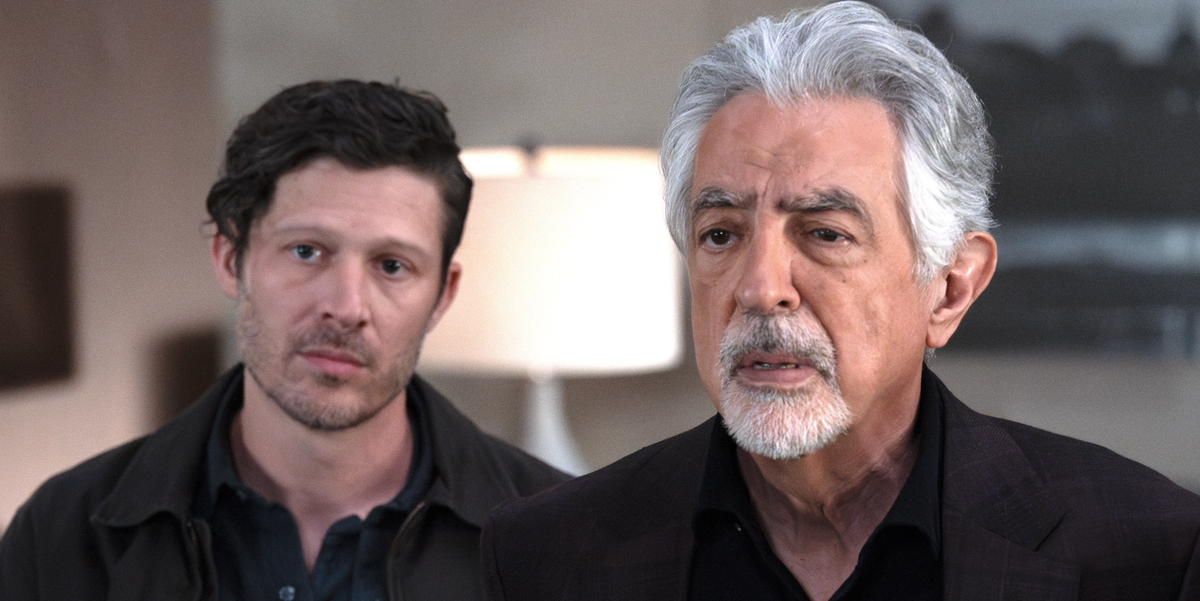
On Criminal Minds, Zach Gilford and Joe Mantegna play men who would never, ever be seated together at a peaceful brunch. Gilford’s Elias Voit is manipulative, unsettling, and always one sentence away from making everyone in the room question their life choices. Mantegna’s David Rossi is the veteran profiler who has seen everything, except perhaps one serial killer who manages to be both deeply monstrous and weirdly fascinating. Their on-screen connection is tense, layered, and occasionally feels like a psychological arm-wrestling match with no referee.
Off screen, though, the story is much warmer. Gilford has spoken openly about how much Mantegna meant to him when he first joined Criminal Minds: Evolution. Instead of describing a chilly “legend meets newcomer” dynamic, Gilford has painted a picture of a supportive, collaborative relationship built on trust, encouragement, and the kind of mutual respect that helps actors handle very dark material without turning the set into an emotional basement. In plain English: the characters may be chaos, but the working relationship sounds refreshingly healthy.
That contrast is the real hook here. Fans see Rossi and Voit circling each other like two men trying to solve the same nightmare from opposite ends. But Gilford’s comments suggest that what makes those scenes crackle is not real tension between the actors. It is the exact opposite. He has made it clear that Mantegna helped settle his nerves early, gave him confidence, and created an environment where the work could go deeper. For a franchise built on profiling, trauma, and long-running character histories, that kind of behind-the-scenes bond matters more than viewers may realize.
From Nervous Newcomer to Comfortable Scene Partner
When Zach Gilford joined the Paramount+ continuation of Criminal Minds in 2022, he was not just signing up for another TV role. He was entering a franchise with nearly two decades of fan investment, a cast with established chemistry, and one especially intimidating co-star: Joe Mantegna, the man who has played David Rossi since the original series’ third season. That is enough to make almost any actor sweat through a jacket.
Gilford has said he grew up admiring Mantegna, which makes his first major interaction with him feel almost too perfect for television. Mantegna directed one of Gilford’s early episodes, and Gilford has admitted he was nervous going in. Not mildly nervous. Not “I had an extra coffee” nervous. More like “please let me say my lines like a functioning adult” nervous. But that anxiety did not last. As the two talked and worked together, Gilford said the relationship became easy, and that shift removed the initial pressure when they later had to share more intense scenes.
That detail explains a lot. The Rossi-Voit material is not built on flashy action. It depends on eye contact, timing, restraint, and tiny shifts in power. When actors are playing scenes that live or die on emotional precision, comfort matters. Gilford’s comments suggest that Mantegna did not simply welcome him into the show; he made the working process feel stable enough for Gilford to stop thinking about surviving the moment and start shaping it.
And once that comfort clicked into place, the scenes benefited. Gilford has essentially described a situation every good ensemble hopes for: two actors who understand the assignment, trust each other, and know the scene is smarter than either one trying to “win” it alone. That is a major reason the Rossi-Voit exchanges feel so electric. The tension is in the writing and performance, not in off-screen ego. Which, frankly, is much better for everybody’s blood pressure.
Why the Rossi and Voit Dynamic Feels So Complicated
The Gilford-Mantegna relationship off camera helps explain the strange power of the Rossi-Voit story on camera. This is not a simple hero-versus-villain setup. Voit is dangerous, but he is also someone who has studied Rossi, read his work, and treated him as a benchmark. Gilford has described that connection as something closer to twisted admiration than straightforward hatred. Voit does not see Rossi as a mentor in any healthy sense, but he does see him as someone worth challenging, needling, and trying to outsmart.
That makes their dynamic more personal than procedural. Voit is not just another unsub Rossi has to catch. He is a killer who knows how to weaponize attention, psychology, and ego. He understands that getting under Rossi’s skin can be as useful as escaping a locked door. Gilford has spoken about Voit as someone who treats this battle as both strategy and self-validation. Outsmarting Rossi is not just practical for him. It feeds his ego. It confirms the image he has of himself as the smartest person in the room.
Mantegna, for his part, has emphasized that the relationship keeps evolving in ways that make the story richer. He has pointed out that the show has been able to reveal multiple sides of Voit, including his suburban family-man facade, which makes the character harder to flatten into a one-note monster. That complexity changes how Rossi reacts to him. It is not just disgust. It is frustration, anger, fascination, and, at times, the uncomfortable awareness that understanding Voit may require getting closer to him than Rossi would ever like.
This is where Criminal Minds: Evolution has really benefited from its streaming format. Instead of solving everything neatly in 42 minutes and sending the unsub off into TV jail oblivion, the series has had room to turn Rossi and Voit into an ongoing psychological duel. Their story has moved from captivity and revenge to hallucinations, interrogation, manipulation, and even bizarre shades of dependency. That gives Gilford and Mantegna more emotional terrain to cover, and both actors seem to enjoy that messiness in the best possible way.
Joe Mantegna Was More Than a Co-Star. He Was a Mentor.
One of the most revealing parts of Gilford’s comments about Mantegna has nothing to do with acting opposite him. It has to do with directing. According to Gilford, Mantegna saw something in him early and encouraged him to think seriously about stepping behind the camera. That was not a throwaway compliment tossed into the wind like confetti at a wrap party. Gilford has said that Mantegna’s encouragement gave him real confidence, and that confidence mattered later when he directed an episode himself in season 2.
The confidence boost that changed the relationship
There is a specific kind of validation that hits differently when it comes from someone you admire. If a veteran actor and director like Joe Mantegna tells you that you are capable of directing, that can stick. Gilford has described exactly that kind of moment. Mantegna’s belief in him did not just make him feel nice for a day. It helped reframe what Gilford thought was possible for his own career on the show.
That matters because directing an episode of a long-running franchise is not a cute extracurricular activity. It is serious work, especially when you are doing it for the first time and guiding scenes involving performers who know the series inside and out. Gilford later spoke about the pressures and excitement of making his directorial debut, but the backstory makes the achievement even more meaningful. Mantegna was not simply the respected co-star who shared scenes with him. He was part of the reason Gilford believed he could take on more responsibility in the first place.
In that light, the phrase “relationship with Joe Mantegna” becomes much bigger than friendly soundbite material. It points to mentorship. It points to artistic support. It points to the kind of set culture that keeps a veteran franchise alive instead of stale. Fans often focus on plot twists and killer reveals, but shows stick around because the people making them invest in one another. Gilford’s story suggests Mantegna has been doing exactly that.
Off-Screen Trust Makes the Darker Scenes Work
Gilford has also been refreshingly direct about something viewers do not always think about: scenes like Rossi and Voit’s can be hard to play if the actors do not genuinely trust each other. He has explained that if he and Mantegna did not get along, the material would be much more difficult. Instead, they come into scenes knowing they have each other’s backs and can figure the moment out together.
That may sound simple, but it is huge. These are not light, breezy scenes where two detectives discuss lunch plans and exchange mildly sarcastic banter. The Rossi-Voit material often asks both actors to move between contempt, curiosity, fear, manipulation, and fractured empathy in the span of a few minutes. Sometimes the show makes them play the relationship as a classic interrogation. Sometimes it turns it into a hallucination-fueled mind game. Sometimes it becomes something stranger, like a psychological dependency neither man would ever admit out loud.
In 2024, both actors talked about how season 2 asked them to play multiple versions of the same relationship. That was especially clear when Rossi was dealing with hallucinations and Voit existed in both literal and distorted forms within the story. By 2025, the material had shifted again, with Voit’s amnesia creating new and deeply uncomfortable emotional territory. The series kept reinventing their dynamic, but the engine underneath it stayed the same: trust between the performers.
That trust gives the show room to be bold. Mantegna can lean into Rossi’s bruised pride and exhaustion. Gilford can lean into Voit’s unnerving intelligence and emotional slipperiness. Neither actor has to protect himself from the other’s choices because the collaboration appears strong enough to handle risk. That is why the performances feel textured instead of mechanical. It is not just two good actors reading lines. It is two actors building a shared rhythm, then letting the characters try to destroy it.
Why Fans Keep Responding to This Pairing
It would be easy to say fans love the Gilford-Mantegna pairing because it is dramatic, but that would be underselling it. Viewers respond because the relationship contains contradictions that feel human, even when the circumstances are wildly not human. Rossi hates what Voit has done. He has every reason to. Voit has hurt him, humiliated him, and inserted himself into the BAU’s emotional bloodstream like a virus in a nice sweater. Yet the story refuses to leave the relationship at simple hatred.
Voit sees Rossi as an intellectual target. Rossi sees Voit as both a threat and a problem he cannot stop trying to solve. That creates tension with layers. Add in Gilford’s off-screen admiration for Mantegna and Mantegna’s support for Gilford, and the pairing gains another level of intrigue. Fans can sense when actors are engaged with each other’s work. They may not know the production details, but they can feel when scenes are being played with curiosity rather than autopilot.
There is also something appealing about seeing a franchise veteran and a newer addition challenge each other in ways that strengthen the series instead of splitting attention. Mantegna brings history, authority, and the gravitas of a character fans have followed for years. Gilford brings volatility, sharpness, and the willingness to make Voit both repellent and weirdly watchable. Put them together, and the show gets a villain-hero dynamic that feels less like a rerun and more like a real evolution.
And yes, there is a tiny bit of irony here that deserves a smile. Gilford has talked about how supportive Mantegna is, while the show keeps handing them scenes where Rossi would probably prefer to launch Voit into the sun. That dissonance is part of the fun. Behind the scenes: mentorship, respect, collaboration. On screen: absolute psychic warfare. Television loves contrast, and this pairing serves it by the truckload.
Extended Take: The Real Experience Behind a Great Co-Star Relationship
What makes Gilford’s experience with Joe Mantegna especially interesting is that it reflects something bigger than one actor praising another. It shows how long-running television survives. Viewers often assume a hit franchise is sustained by scripts, ratings, and recognizable characters. Those things matter, obviously. But a series like Criminal Minds also survives because experienced actors create room for newer or newer-to-the-franchise performers to do their best work. Mantegna appears to have done that for Gilford.
Think about the circumstances. Gilford entered a world that already had a built-in fan base, a beloved ensemble, and a character legacy heavy enough to make anyone overthink every eyebrow movement. He was not playing a one-episode guest villain who shows up, glowers, and disappears before the opening credits are cold. He was playing Elias Voit, a serial killer designed to stick around, evolve, and become central to the reboot’s identity. That is a lot to carry, especially when many fans arrive with protective feelings about older characters like Rossi.
In that kind of environment, the first few interactions on set matter. A veteran star can make a newcomer feel like an intruder, or he can make him feel like a collaborator. Based on Gilford’s own descriptions, Mantegna chose the second option. He directed him early. He talked with him enough to calm the nerves. He treated him like someone who belonged there. Later, he encouraged him in a way that helped Gilford imagine himself directing. None of that is flashy, but all of it matters.
There is also something revealing about the kind of support Gilford described. Mantegna was not presented as overbearing, performative, or eager to turn mentorship into a speech. The support sounded practical. Confidence-building. Quietly generous. That sort of guidance tends to be the most useful because it gives the other person ownership of the work. Gilford still had to perform. He still had to build Voit. He still had to direct an episode successfully. But Mantegna’s support seems to have made those steps feel possible rather than distant.
That experience also helps explain why their scenes have developed such unusual texture. Actors who trust each other can take sharper turns. They can play silence without panicking. They can go uglier, colder, stranger. They can let a scene breathe. In a show like Criminal Minds: Evolution, where the material can pivot from procedural logic to psychological damage in half a heartbeat, that flexibility is priceless. You need scene partners who can go there without making the work feel unsafe or sloppy.
For fans, the payoff is obvious. Rossi and Voit do not feel repetitive even after multiple seasons of conflict. Their dynamic keeps mutating because the actors can handle mutation. One season leans into revenge, another into manipulation, another into warped dependence, another into unsettling vulnerability. The relationship changes shape, but it still holds. That is usually a sign that the performers understand not only their own characters, but what they are building together.
So when people search for “Zach Gilford on his relationship with Joe Mantegna,” they are really looking for more than backstage niceness. They are looking for the secret ingredient behind one of the show’s strongest pairings. And the answer seems surprisingly grounded: admiration, trust, encouragement, and a veteran actor helping another actor find his footing, then helping him grow. In an industry full of dramatic headlines, that may be the most satisfying twist of all.
Conclusion
Zach Gilford’s relationship with Joe Mantegna sounds like the kind of behind-the-scenes partnership every smart drama hopes to create. Gilford has described the nerves of meeting a longtime hero, the relief of discovering a generous collaborator, and the confidence boost that came from Mantegna’s support. Meanwhile, the show has turned that off-screen trust into one of its richest on-screen dynamics, with Rossi and Voit shifting from pure hostility to something more layered, more personal, and far more compelling.
In other words, the secret behind some of Criminal Minds’ most intense scenes is not real-world friction. It is respect. Mantegna’s steadiness helped Gilford settle into the franchise, expand his role within it, and take creative risks. Gilford, in turn, has helped give the modern Criminal Minds era a villain dynamic with staying power. For viewers, that means better scenes, sharper emotional stakes, and a reminder that sometimes the strongest TV relationships are built when the actors trust each other enough to let the characters fall apart.