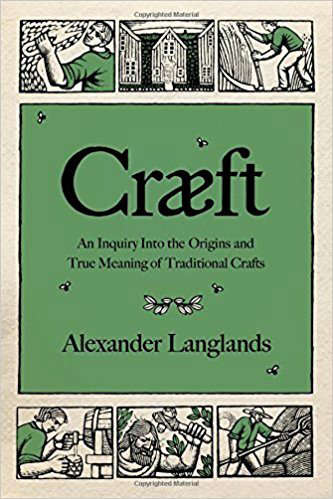
Once upon a time, “craft” did not mean glitter glue, weekend hobby bins, or a suspiciously wobbly birdhouse made during a corporate team-building retreat. The older word, cræft, carried more muscle. It meant skill, strength, knowledge, power, and the hard-earned ability to work with the world instead of merely ordering it around with a credit card.
Alexander Langlands’ Cræft: An Inquiry Into the Origins and True Meaning of Traditional Crafts invites readers to look past the polished object and pay attention to the intelligence inside the making. The book is not simply about baskets, thatched roofs, hand tools, haymaking, or sheep. It is about what happens when human beings learn deeply from materials, seasons, landscapes, and necessity. In other words, it is about the wisdom of handsand yes, your hands may be smarter than your phone, even if your phone currently knows where you parked.
Traditional crafts are often treated as charming leftovers from a slower world. But cræft argues that they are more than nostalgia. They are systems of knowledge. A hedgerow is not just a rustic fence. A scythe is not just a dramatic farm prop. A handmade object is not merely “cute.” Each one contains decisions, adaptations, failures, repairs, and local intelligence built over generations.
What Does “Cræft” Really Mean?
The Old English word cræft is the ancestor of the modern word “craft,” but its original meaning was broader and stronger. It referred to strength, skill, capacity, knowledge, and a kind of practical power. Modern English has narrowed the word until “craft” can sound like something done with pipe cleaners on a rainy afternoon. The older meaning had less to do with decoration and more to do with competence.
To be “cræfty” was not to be quaint. It was to know how to do something well in real conditions. It meant understanding wood by splitting it, not merely by browsing furniture catalogs. It meant reading weather in the body, soil through the boot, and wool through the fingers. Traditional craftsmanship depended on observation, patience, and judgment. No pop-up notification can replace that.
This is why Langlands’ inquiry feels surprisingly modern. In a world full of automation, disposable products, and frictionless convenience, cræft asks an uncomfortable question: what have we lost by making everything easier?
Traditional Craft Is Knowledge in Motion
One of the central insights of Cræft is that traditional crafts are not just objects. They are processes. The finished basket, wall, roof, rope, loaf, or tool is only the visible ending of a long conversation between maker and material.
A skilled thatcher does not simply put straw on a roof. They understand the angle of water, the behavior of reed, the direction of wind, the rhythm of decay, and the local climate. A dry stone waller does not merely stack rocks like a patient toddler with better balance. They read shape, gravity, pressure, and drainage. A beekeeper using traditional skeps understands bees as part of a seasonal and ecological pattern, not just as honey-producing interns.
This is the difference between craft as product and craft as intelligence. Industrial systems often separate thinking from making. One person designs, another manufactures, another markets, and another throws the thing away when it breaks. Traditional craft joins thinking and doing in the same body. The hand learns, the eye judges, the material answers back.
Why the Origins of Craft Still Matter
The origins of traditional crafts are tied to survival. People made what they needed from what was near: wood, clay, wool, stone, flax, straw, iron, leather, bark, bone, and plant fiber. This did not make the objects primitive. It made them responsive.
Before global supply chains, a craftsperson had to understand local resources. A chair made from green wood, a basket woven from willow, or a wall built from fieldstone reflected the environment that produced it. This connection gave traditional craft its regional character. A handmade object often carried the accent of its landscape.
That local quality is one reason heritage crafts remain culturally important. They preserve not only techniques but also memory. Quilting, basketry, pottery, weaving, blacksmithing, timber framing, boatbuilding, and carving can reveal histories of migration, labor, identity, faith, trade, and community. In the United States, craft traditions include Native American basketry and beadwork, African American quilting, Appalachian woodworking, Shaker furniture, Hispanic weaving, Hmong textile arts, and countless local practices that refuse to fit neatly into museum labels.
Craft is not frozen in the past. It evolves. That is the sneaky genius of tradition: it survives by changing just enough.
The Myth of “Simple” Handmade Work
Calling traditional craft “simple” is one of modern life’s favorite mistakes. A handwoven basket may look simple until you try to make one and end up with something that resembles a nervous octopus. A forged hook may appear basic until you understand the heat, timing, hammer control, and metal behavior required to make it strong, balanced, and useful.
Traditional craft often hides complexity inside usefulness. This is why it can be easy to underestimate. A well-made tool disappears into function. A good wooden spoon feels inevitable. A sturdy wool blanket quietly does its job for decades. Unlike many modern products, traditional crafts do not always shout for attention. They whisper, “I know what I am doing.”
Langlands’ work helps restore respect for that quiet competence. He shows that old tools and methods were not necessarily inferior to modern ones. They were adapted to different values: repairability, locality, durability, and embodied knowledge. A scythe, for example, is not simply an outdated lawn mower. In the right hands and landscape, it is efficient, quiet, low-energy, and precise. It also will not wake the neighbors or require a warranty registration form.
Craft, Sustainability, and the Problem of Too Much Stuff
Traditional craftsmanship has become newly relevant because modern society is drowning in cheap abundance. We own more things, replace them faster, and often understand them less. Many products are designed for convenience, not repair. When something breaks, we are encouraged to buy another. The landfill nods grimly in the distance.
Cræft offers a different philosophy. Traditional craft values the full life of materials. It asks where things come from, how they are made, how long they last, how they can be repaired, and what happens after use. This does not mean everyone must abandon modern life and begin hand-forging spoons in the backyard. Your homeowners association may object. But it does suggest that craft thinking can reshape how we consume.
Buying fewer, better-made objects is one practical lesson. Learning basic repair is another. Supporting artisans, local workshops, and heritage craft education helps keep skills alive. Even choosing natural, durable, repairable materials can move us closer to the spirit of cræft.
Craft as a Relationship With Materials
A major difference between industrial production and traditional craft lies in the maker’s relationship with materials. In mass production, materials are standardized so machines can process them predictably. In craft, variation is not always a problem. It is information.
Wood has grain, knots, tension, moisture, and mood swings. Clay changes with water and fire. Wool behaves differently depending on breed, preparation, and spinning. Stone resists, splits, or cooperates depending on its structure. A craftsperson learns to notice these differences and work with them.
This is not romantic fluff. It is practical intelligence. The maker who ignores material reality produces weak joints, cracked pots, warped boards, uneven cloth, or baskets with the structural confidence of overcooked noodles. Traditional crafts teach humility because materials do not care about your personal brand.
Apprenticeship: The Original Search Engine
Before online tutorials, knowledge moved from person to person through apprenticeship, family practice, community work, and repetition. A beginner learned by watching, copying, failing, correcting, and doing again. This method may sound slow, but it transmitted details that written instructions often miss.
Craft knowledge is full of things that are difficult to explain in words: the right pressure of a blade, the sound of a tool cutting cleanly, the smell of bread near the end of baking, the feel of properly spun yarn, the moment clay is ready, the way a stone “wants” to sit. These are not mystical secrets. They are sensory judgments developed through practice.
That is why preserving traditional craft requires more than saving old objects in glass cases. Museums matter, archives matter, and documentation matters, but living skills need living practitioners. A basket without a basket maker is evidence. A basket maker teaching another person is continuity.
The Art-Craft Divide: A Very Fancy Argument
Modern culture has often separated “art” from “craft,” as if painting belongs in a gallery while weaving must sit politely near the gift shop. This divide has never been neutral. Many practices labeled as craft have been associated with women, Indigenous communities, rural workers, immigrants, and domestic labor. The label sometimes carried less prestige because the makers themselves were undervalued.
Cræft helps challenge that hierarchy. It reminds us that skill, beauty, function, and intelligence can exist in the same object. A handmade quilt can be warm, useful, political, mathematical, emotional, and visually stunning. A pot can hold soup and history at the same time. A carved chair can support both a person and a philosophy of design.
In recent decades, American museums, craft councils, public television programs, and cultural institutions have done important work to broaden the understanding of craft. Contemporary craft is no longer confined to the category of “nice handmade things.” It is recognized as a field of artistic innovation, cultural storytelling, technical mastery, and social commentary.
Examples of Cræft in Everyday Life
Hedgelaying
Hedgelaying turns living shrubs into a durable boundary that shelters wildlife, controls livestock, and marks land. It is engineering, ecology, and patience braided together. A fence can be bought. A hedge must be grown, cut, bent, maintained, and understood.
Dry Stone Walling
Dry stone walls use no mortar. Their strength comes from careful selection, placement, weight, and drainage. Built well, they can last for generations. Built badly, they become a dramatic pile of regret.
Spinning and Weaving
Textile crafts transform fiber into thread and thread into cloth. This process requires knowledge of plants or animals, preparation, tension, pattern, and use. Clothing once carried far more visible evidence of labor than most people imagine today.
Blacksmithing
Blacksmithing joins fire, metal, timing, and force. It is not just hitting hot iron until something useful happens. The smith must understand temperature, color, hardness, shape, and purpose. The hammer is only the loudest part of the thinking.
Why Cræft Feels Urgent in the Digital Age
The digital age has given us extraordinary tools, but it has also made many experiences strangely weightless. We tap, swipe, scroll, and upload. Much of our work leaves no shavings on the floor, no clay under the nails, no smell of oil, straw, wool, or sawdust. That is not automatically bad. But it can make the physical world feel distant.
Traditional craft brings attention back to bodies, tools, and materials. It slows perception. It rewards patience. It teaches that not everything valuable can be optimized, automated, or delivered by Tuesday.
This may explain why craft revivals keep happening. People return to woodworking, ceramics, sewing, gardening, baking, leatherwork, weaving, and repair not only because handmade objects are attractive, but because making restores a sense of agency. In a world where many systems feel too large to touch, craft gives the hand a vote.
Experience Section: What Cræft Teaches Modern Makers
The most powerful lesson from Cræft: An Inquiry Into the Origins and True Meaning of Traditional Crafts is that making changes the maker. Anyone who has tried to learn a traditional craft knows the first stage is usually comic humiliation. The wood splits wrong. The dough refuses to behave. The thread tangles. The wall leans like it has heard bad news. The beginner discovers that watching a skilled person work is not the same as possessing skill. This is annoying, educational, and spiritually healthy.
One practical experience related to cræft is the act of repairing something instead of replacing it. Mending a shirt, tightening a chair joint, sharpening a kitchen knife, patching a garden tool handle, or re-seasoning a cast-iron pan can feel minor. Yet each act changes the relationship between person and object. The item stops being disposable background matter and becomes something with a history. Repair teaches attention. It says, “This is worth understanding.”
Another experience is learning from materials directly. For example, a person who works with wood quickly discovers that boards are not neutral rectangles. They cup, bow, crack, absorb moisture, and reveal grain direction at inconvenient times. A beginner may try to force the material into obedience. A better maker learns to cooperate. This is cræft in action: not domination, but informed partnership.
Gardening offers a similar lesson. A packet of seeds looks simple until weather, soil, pests, timing, and watering habits join the meeting. Traditional agricultural skills are full of local knowledge because land is never generic. A tomato plant in Arizona, Vermont, and coastal California does not live the same life. The craft lies in observation and adjustment. The garden is a classroom with bees.
Cooking from scratch also reveals the meaning of cræft. Bread baking, pickling, fermenting, smoking, and preserving connect the maker to time. The process cannot always be rushed. Dough rises when it rises. Fermentation has its own tiny civilization to manage. Heat must be judged. Texture must be felt. The cook becomes less of a button-pusher and more of a participant.
Many people who take up pottery, weaving, carving, or blacksmithing describe the same surprise: craft is calming, but not because it is easy. It calms because it demands attention. The mind cannot doomscroll effectively while guiding a chisel or centering clay. Traditional craft gives anxiety a job to do. It turns nervous energy into pressure, rhythm, and focus.
Cræft also teaches respect for experts. In a culture full of instant opinions, traditional craft reminds us that mastery takes time. A person who can lay a hedge, build a boat, weave a complex pattern, or restore a timber frame possesses knowledge that cannot be downloaded in one afternoon. Tutorials are useful, but apprenticeship, repetition, and correction remain irreplaceable.
Finally, cræft encourages better consumption. Once you understand the labor behind a handmade object, cheapness looks different. A $20 table that wobbles after a month may seem less like a bargain and more like a future errand. A well-made object, even a modest one, carries care forward. Traditional crafts invite us to ask better questions: Who made this? From what? How? Can it be repaired? Will it age well? Does it belong somewhere?
These questions are not old-fashioned. They may be exactly what modern life needs.
Conclusion: The True Meaning of Traditional Crafts
Cræft is not a plea to reject modern technology and live entirely by candlelight, although candle makers would probably appreciate the business. Its deeper message is more useful: human beings need skilled relationships with the material world. Traditional crafts preserve those relationships.
The true meaning of traditional craft is not merely hand production. It is knowledge embodied in action. It is memory shaped into usefulness. It is culture passed through fingers. It is the meeting point of strength, skill, patience, place, and imagination.
Alexander Langlands’ inquiry reminds us that craft is not a lesser form of art, nor a decorative hobby for people with excellent storage bins. At its best, cræft is a way of knowing. It teaches us to see materials clearly, value labor honestly, repair what can be repaired, and live with more attention. In a fast, disposable world, that may be one of the most radical skills left.
Note: This article is written as original SEO content based on verified public knowledge about traditional craftsmanship, craft history, cultural heritage, and Alexander Langlands’ book Cræft. It does not include embedded source links or citation placeholders.