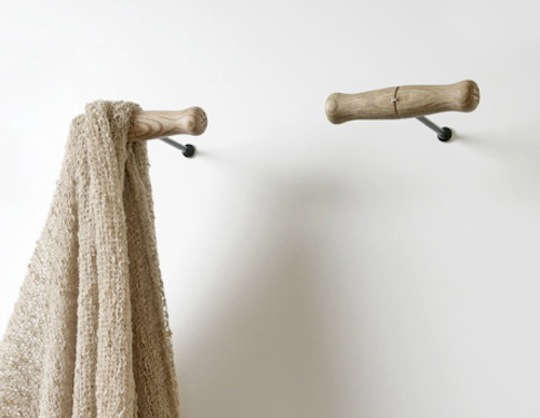
Some objects enter a room quietly. Others walk in, wink, and somehow make your wall look more intelligent. The Corkscrew Coat Hooks by Ernest Perera, better known by their product name Barrina, belong firmly in the second category. At first glance, they look like miniature hand tools that accidentally wandered out of a workshop and found themselves in a stylish Barcelona apartment. Look again, and the joke becomes the point: this is not a tool waiting to be used. It is a wall hanger pretending to be one.
Designed by Spanish industrial designer Ernest Perera for Amor de Madre, Barrina is a compact wall hook made from wood and painted steel. It measures roughly 12 x 1.5 x 12 centimeters and is made in Barcelona. That small footprint is part of its charm. It does not shout for attention, but it still turns a blank wall into a conversation starter. In the world of home organization, where many hooks look like they were designed during a very serious meeting about coats, Barrina brings a little mischief.
But this piece is more than a cute visual trick. It sits at the intersection of product design, practical storage, and everyday humor. It proves that even the most ordinary household hardware can carry personality. A hook can simply hold a jacket. Or, in Perera’s hands, it can hold a jacket while making your entryway feel like it has a secret.
What Are the Corkscrew Coat Hooks by Ernest Perera?
The Corkscrew Coat Hooks by Ernest Perera are wall-mounted hangers shaped like a traditional screw-style hand tool. The official product name, Barrina, refers to a boring tool or auger-like form, which explains the visual reference. The object appears to twist into the wall, as though the hook itself has drilled its way into place. That illusion is simple, clever, and oddly satisfying.
The design uses two familiar materials: wood and painted steel. The wooden handle provides warmth and tactility, while the steel portion gives the hook structure and function. The result is both rustic and modern, a rare combination that does not feel forced. It can sit comfortably in a bathroom, kitchen, hallway, mudroom, studio, or compact apartment entryway.
What makes Barrina special is not only what it does, but how it changes the mood of a space. Standard hooks disappear into the background. Barrina does the opposite. It asks to be noticed, but politely. It is the kind of object guests point at before asking, “Wait, is that a hook?” That moment of discovery is a small design victory.
Meet Ernest Perera: The Designer Behind Barrina
Ernest Perera is a Barcelona-based product designer whose work often moves between industrial production and craft sensibility. His background in fine arts and industrial design helps explain why Barrina feels both useful and sculptural. It is not merely shaped for function, and it is not merely decorative. It lives in the productive middle ground where good household objects tend to thrive.
Perera founded Ernest Perera Studio in 2003 and has worked across product design, space design, and objects for daily life. He is also associated with Amor de Madre, the Barcelona product editor behind Barrina. His design philosophy often favors useful, timeless, material-aware objects rather than trendy pieces that age faster than an avocado on a warm countertop.
That philosophy is visible in the Corkscrew Coat Hooks. The design is not overloaded with decoration. There are no unnecessary flourishes, no dramatic materials trying to win an award for “Most Expensive Way to Hang a Scarf.” Instead, Barrina takes a recognizable object and slightly changes its purpose. The surprise comes from reinterpretation, not excess.
Why the Corkscrew Shape Works So Well
Great design often begins with recognition. We understand Barrina before anyone explains it because the form feels familiar. The handle suggests grip. The spiral suggests turning. The wall placement suggests insertion. Our brains quickly connect the dots, and then the twist arrives: it is not a tool, it is a hook.
A Familiar Object with a New Job
By borrowing the language of a hand tool, Barrina gives the wall hook a tiny narrative. It looks as if it has performed the action required to install itself. That makes the object feel active, almost animated. Most coat hooks simply sit on the wall. This one looks like it arrived there with a plan.
A Little Humor Without Becoming a Gimmick
Novelty objects can easily become annoying. We have all seen home accessories that are funny for seven seconds and then visually exhausting forever. Barrina avoids that trap because its joke is quiet. It does not rely on loud color, oversized proportions, or cartoon styling. The humor is embedded in the object’s logic. It looks like one thing, functions as another, and keeps the joke tasteful.
A Compact Form for Real Homes
Small-space living rewards objects that do more than one job. Barrina works as storage, wall accent, and design detail. In a narrow hallway, it can hold a jacket without requiring a freestanding coat rack. In a bathroom, it can hold a towel while adding warmth to tile or plaster. In a kitchen, it can handle aprons, tote bags, or lightweight accessories. It is a small object with a surprisingly flexible resume.
Materials and Construction: Wood Meets Painted Steel
The pairing of wood and painted steel is a big part of Barrina’s appeal. Wood brings the handle back into the world of hand tools, craft, and touch. Painted steel provides the necessary strength and a clean visual line. Together, they create a balance between soft and hard, domestic and industrial, playful and practical.
This material contrast also makes the hook easy to style. Against white walls, the shape becomes graphic. Against wood paneling, it feels more workshop-inspired. On colored walls, especially deep green, navy, terracotta, or warm gray, the hook can read as a small sculptural accent. It does not need a dramatic backdrop, but it benefits from a little breathing room.
Because Barrina is compact, grouping several hooks can create a rhythm across a wall. A single hook feels like a clever detail. Three or five arranged in a row become a design feature. Staggered vertically, they can work for households with children, guests, or anyone who owns more tote bags than they are emotionally prepared to admit.
Where to Use Corkscrew Coat Hooks at Home
The best wall hooks solve daily problems without creating visual chaos. Barrina is especially useful in places where you need quick access but do not want the area to look like a lost-and-found bin after a thunderstorm.
Entryway
An entryway is the obvious place for Corkscrew Coat Hooks by Ernest Perera. Install a small row near the door for jackets, caps, dog leashes, umbrellas, or everyday bags. Because the design is visually interesting, it can help a plain entry wall feel intentional. Pair it with a narrow bench, a shoe tray, and a small bowl for keys, and suddenly the “drop zone” becomes less of a disaster zone.
Bathroom
Barrina’s compact size makes it a smart towel hook in a bathroom, especially one with a rustic-modern or Mediterranean mood. The wood handle softens harder bathroom finishes such as tile, stone, glass, and metal. Use one beside the sink for a hand towel or several near the shower for bath towels and robes.
Kitchen
In the kitchen, a corkscrew-shaped hook feels right at home because kitchens already celebrate tools. Use it for aprons, linen towels, market bags, or lightweight utensils with hanging loops. It works particularly well in kitchens that blend utility and display, where beautiful everyday objects are allowed to remain visible.
Bedroom or Closet
In a bedroom, Barrina can serve as a landing spot for tomorrow’s outfit, a favorite hat, a scarf, or a robe. In closets, it adds a little personality to areas that often become purely functional. The trick is restraint. One or two well-placed hooks feel charming. Fifteen overloaded hooks feel like your closet is trying to grow antlers.
How to Style Barrina Without Overdoing It
The Corkscrew Coat Hooks by Ernest Perera have enough personality to stand on their own, so styling them is mostly about not smothering the joke. Give the hook space. Avoid crowding it with too many other novelty items. If every object in the room is trying to be funny, the room starts to feel like a gift shop with commitment issues.
For a clean modern look, install three hooks in a straight horizontal line at equal spacing. Keep the wall color neutral and let the form do the work. For a warmer, handcrafted look, mount them on a wood backboard, especially in an entryway or mudroom. For a more artistic approach, place a single Barrina hook near a framed print or mirror so it reads like a functional sculpture.
Texture matters, too. These hooks look especially good with natural fabrics: canvas totes, linen towels, wool scarves, cotton aprons, and soft leather bags. The combination of wood, steel, and fabric makes the whole setup feel layered rather than cluttered.
Installation and Practical Considerations
Like any wall hook, Barrina is only as useful as its installation. Even the most charming hook becomes less charming when it exits the wall with your coat still attached. Always consider the wall type, the expected weight, and the proper mounting hardware before installation.
For heavier items, mounting into a wall stud is generally the strongest option. If a stud is not available, choose anchors appropriate for the wall material and load. Drywall, plaster, brick, concrete, and wood all behave differently. A hook used for a light towel does not require the same support as a hook expected to carry a heavy bag or winter coat. Practicality may not be glamorous, but neither is repairing a wall hole shaped like regret.
Placement is also important. In an entryway, hooks should be easy to reach but not positioned where hanging items block doors, switches, or walkways. In a bathroom, avoid placing wood elements where they will be constantly soaked. In a kitchen, keep hooks away from heat sources and cooking splatter. Good design lives longer when it is installed thoughtfully.
Why Small Design Objects Matter
It is easy to underestimate small objects. Sofas, dining tables, and light fixtures get all the attention, while hooks are treated like background staff. But small details often shape how a home feels day to day. A good hook can prevent clutter, save floor space, and make routines smoother. A great hook does all that while adding character.
Barrina reminds us that utility does not have to be boring. A wall hanger can carry humor. A compact object can tell a story. A practical detail can make a room feel more personal. That is why design enthusiasts respond to pieces like this: they prove that thoughtfulness can live at any scale.
The Corkscrew Coat Hooks by Ernest Perera also fit into a broader movement in home design: the desire for objects that feel both useful and human. In a world full of anonymous, mass-produced hardware, a hook with wit and material presence stands out. It does not need to be expensive-looking or overly polished. It simply needs to feel considered.
Who Will Love Corkscrew Coat Hooks by Ernest Perera?
Barrina is ideal for people who enjoy functional design with a sense of humor. It suits homeowners, renters, studio dwellers, designers, and anyone trying to make a small space feel more personal. It is especially appealing if you like industrial design, Barcelona design, tool-inspired decor, modern rustic interiors, or clever entryway storage.
It may not be the right choice for someone who wants invisible hardware or ultra-minimalist storage that disappears completely. Barrina wants to be seen. Not loudly, not obnoxiously, but definitely seen. It is a small design statement for people who believe everyday objects should earn their place in the room.
Experience Notes: Living with Corkscrew-Style Coat Hooks
Using sculptural hooks like Barrina changes the way you think about wall storage. At first, you install them for function. You need somewhere to hang a coat, towel, or bag. Very reasonable. Very adult. Then, after a few days, you realize the hook is doing something else: it is making the room feel finished. A blank stretch of wall now has rhythm, texture, and a tiny punchline.
In an entryway, corkscrew-style hooks work best when they are treated as part of a system. One hook alone is charming, but a small group can create a real landing zone. Imagine three Barrina hooks mounted near the door: one for a jacket, one for a daily bag, and one for a cap or scarf. Add a slim shoe tray below and a mirror nearby, and the area becomes practical without needing bulky furniture. This is especially helpful in apartments, where every square foot behaves like it pays rent.
The most satisfying experience comes from how guests interact with the hooks. People notice them. They lean closer. They ask whether the hook is actually screwed into the wall that way. That little pause creates a moment of delight, which is rare for household hardware. Most hooks are only discussed when they break. Barrina gets discussed because it is clever.
In bathrooms, the experience is quieter but still useful. A towel on a standard hook is just a towel. A towel on a Barrina hook feels more intentional, especially in a bathroom with simple finishes. The wood adds warmth, and the tool-like shape keeps the space from feeling too polished. It is the design equivalent of rolling up your sleeves: relaxed, useful, and slightly handsome.
There is also a lesson in restraint. Decorative hooks can become clutter magnets if every hook is always full. The best way to use Barrina is to let it breathe occasionally. When nothing is hanging from it, the hook still looks good. That is one of the advantages of choosing a sculptural hanger over a purely generic one. Empty, it becomes wall decor. Full, it becomes storage. Either way, it is earning its keep.
For families, the playful form can even make organization more appealing. A child may be more likely to hang a backpack on a hook that looks like a funny tool than on a plain metal peg. Adults are not immune to this either. We all respond to objects that make routines feel a little less dull. If a coat hook can reduce the number of jackets thrown over chairs, it deserves applause, possibly a tiny parade.
The only real caution is to match the hook’s use to its installation. Lightweight items are ideal. Heavier loads require stronger mounting and more careful planning. A beautiful object should not be asked to perform beyond its support. Treat Barrina as a design-forward wall hanger, not as a challenge to physics.
Overall, living with corkscrew-style coat hooks is a reminder that good design improves daily life in small increments. You walk in, hang your bag, smile at the form, and move on. That may sound minor, but homes are built from minor moments. The right hook in the right place can make the ordinary act of hanging up a coat feel just a bit more satisfying.
Conclusion
The Corkscrew Coat Hooks by Ernest Perera prove that even humble home hardware can be imaginative. Barrina is compact, practical, material-conscious, and quietly funny. It turns a familiar tool shape into a useful wall hanger, bringing a touch of Barcelona design wit into everyday rooms. Whether used in an entryway, bathroom, kitchen, or bedroom, it offers more than a place to hang things. It offers a small moment of surprise.
In a home filled with necessary objects, the best pieces are the ones that make necessity feel delightful. Barrina does exactly that. It holds your coat, yes. But it also holds attention, sparks conversation, and reminds us that practical design does not have to be plain. Sometimes, all a wall needs is one clever twist.