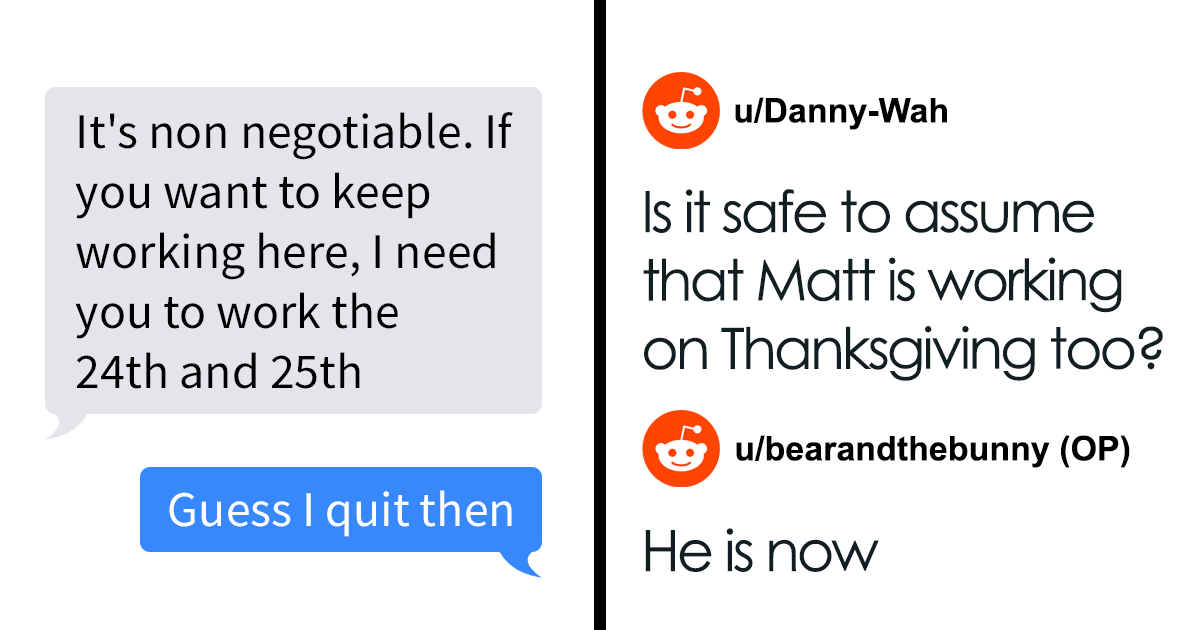
There are workplace requests, and then there are workplace “requests” wearing a fake mustache and pretending not to be demands. One viral story about a woman who refused to work on her time off hits a nerve because it captures a scene many employees know too well: the phone buzzes, the manager needs “just one favor,” and suddenly your day off has been kidnapped by a schedule you never agreed to.
In this case, the employee did not deliver a long speech, stage a dramatic hallway exit, or write a resignation letter with twelve footnotes and a weather report. Her boss issued an ultimatum after she declined to come in on her time off. She chose the third option: quit immediately. And the internet, naturally, pulled up a chair.
The story is entertaining because it is bold. But it is also serious because it raises bigger questions about time off, boundaries, unpaid labor, employee loyalty, burnout, and the strange corporate habit of treating workers like emergency equipment stored behind glass. The real issue is not simply whether one person should have worked an extra shift. It is whether employers can expect people to be available whenever management fails to plan properly.
Why This Workplace Story Went Viral
The reason this story spread so widely is simple: it feels familiar. Many workers have received messages during weekends, holidays, vacations, sick days, family events, and, somehow, during moments when they are clearly not available. The wording changes, but the emotional pressure is often the same: “We are short-staffed,” “The team needs you,” “You should be flexible,” or the classic workplace guilt sandwich, “I thought you were committed.”
What made this woman’s response stand out was the speed. The boss tried to turn her refusal into a loyalty test. Instead of negotiating with someone who did not respect her time, she quit. That decision may sound extreme to some readers, but to others it felt like the cleanest possible answer to a messy situation.
Online reactions often split into two camps. One side says employees should help out when the business is in trouble. The other side says poor staffing is not a personal emergency for workers who are off the clock. Both points can be discussed, but one truth sits in the middle like a very tired office chair: if a company depends on people constantly sacrificing personal time to survive, the schedule is broken.
The Hidden Problem Behind “Can You Come In?”
At first glance, asking an employee to cover a shift may seem harmless. Businesses have callouts, rushes, sick workers, weather problems, and last-minute chaos. A respectful manager can ask. An employee can accept or decline. That is normal.
The problem begins when “Can you?” becomes “You have to.” Time off is not a decorative phrase. It is the period when an employee is not scheduled to work. It may be used for rest, family care, errands, school, another job, religious observance, recovery, or the sacred American tradition of sitting in sweatpants and pretending laundry does not exist.
When a boss treats time off as optional, the employee receives a clear message: your life outside work matters only when the company is fully staffed. That is not leadership. That is panic management with a name badge.
Work-Life Boundaries Are Not Laziness
One of the most common myths in modern workplaces is that strong boundaries mean weak commitment. In reality, boundaries are what keep commitment sustainable. Employees who never disconnect may look productive for a while, but constant availability can drain energy, patience, creativity, and trust.
Healthy boundaries sound simple: “I am not available today,” “I am off the clock,” “I can discuss this during my next shift,” or “I need advance notice for schedule changes.” These statements are not rude. They are basic adult communication. The rudeness comes when a manager hears a boundary and responds with punishment, guilt, or an ultimatum.
Good managers understand that workers are people first and employees second. They know that respect is not a perk like free coffee or a pizza party with suspiciously small slices. Respect is the foundation that makes people want to stay, help, and perform well.
What U.S. Labor Rules Say About Off-the-Clock Work
In the United States, the legal details depend on state law, worker classification, job duties, pay structure, contracts, union agreements, and company policy. However, one broad principle is important: non-exempt employees generally must be paid for all hours worked. That includes work an employer allows or requires, even if it happens outside the usual schedule.
This matters because after-hours calls, texts, emails, unpaid preparation, post-shift cleanup, and “quick favors” can become compensable time in many situations. A manager may think a five-minute task is too small to matter, but those minutes can pile up like unread Slack messages on a Monday morning.
Employers should be especially careful with hourly or non-exempt workers. If the business benefits from the work, the time often needs to be tracked and paid. A company policy that says “do not work off the clock” is useful only if managers also stop asking people to do exactly that with a cheerful emoji attached.
Why Ultimatums Usually Backfire
An ultimatum can feel powerful in the moment. A boss may believe it forces clarity: work the shift or face consequences. But ultimatums also reveal something dangerous about workplace culture. They show that management is more interested in control than cooperation.
When an employee hears, “Do this or else,” the relationship changes. The issue is no longer only the shift. It becomes a question of respect, trust, and whether the employee wants to keep working for someone who treats personal time like a company-owned storage unit.
In the viral story, the ultimatum did not scare the employee into compliance. It gave her permission to stop investing in a job that had already stopped respecting her. That is the risk managers take when they confuse authority with leadership.
The Business Cost of Disrespecting Time Off
From a business perspective, pressuring employees during time off is often a bad trade. The company may fill one shift today but lose a trained worker tomorrow. Recruiting, hiring, onboarding, and training replacements are expensive. Even worse, remaining employees notice what happened.
Workplace morale is not built during all-hands meetings with stock photos and inspirational quotes. It is built in everyday moments: how schedules are handled, how managers speak under stress, whether employees can say no without fear, and whether time off is actually time off.
When workers see a colleague punished for refusing an unreasonable request, they learn a lesson. Not “we are a team,” but “we are disposable.” Once that lesson spreads, loyalty becomes thin, quiet quitting becomes tempting, and the best employees start browsing job postings with the focus of a detective in the final act of a crime drama.
When Saying No Is the Professional Response
There is a polite way to decline extra work, and it usually works best when the message is short and clear. For example: “I am not available today. I will be back for my scheduled shift tomorrow.” Another option is: “I cannot cover that shift, but I hope you find someone.” Notice what is missing: an essay, an apology parade, and a detailed map of your personal life.
Employees often feel pressured to justify every boundary. They explain childcare, appointments, travel, exhaustion, family obligations, second jobs, or mental health. Sometimes sharing context is useful, but it is not always required. “I am unavailable” is a complete sentence. It may not win a poetry prize, but it does the job.
Professionalism does not mean unlimited availability. It means communicating clearly, doing the work you agreed to do, and respecting mutual expectations. A worker who says no to an unscheduled shift is not automatically irresponsible. A manager who cannot accept no, however, may be showing a serious leadership problem.
How Managers Should Handle Last-Minute Staffing Problems
Staffing emergencies happen. People get sick. Cars fail. Childcare collapses. Weather interferes. Customers appear in swarms, as if summoned by a coupon-shaped moon. Good managers prepare for this reality instead of turning every gap into an employee loyalty test.
Ask, Do Not Command
A respectful request sounds like: “We had a callout. Are you available to cover today? No pressure if you cannot.” That sentence tells the employee the manager recognizes their time off as real.
Offer Proper Compensation
If a business needs extra help, it should be ready to pay for it. Depending on the situation, that might mean overtime, shift differentials, holiday pay if company policy provides it, bonuses, or future schedule flexibility. “Team spirit” is not a currency accepted by landlords.
Create Backup Plans
Managers should maintain a voluntary call-in list, cross-train employees, forecast busy periods, and avoid running the business with staffing levels so thin a sneeze can collapse the schedule.
Respect the Answer
If an employee declines, the response should not be punishment. It should be: “Thanks for letting me know.” That one sentence can save a working relationship.
Why Employees Are Reconsidering Workplace Loyalty
The modern workplace has changed. Many employees still care deeply about doing good work, but fewer are willing to confuse loyalty with self-erasure. They have watched companies restructure, reduce benefits, demand return-to-office schedules, freeze hiring, and praise “resilience” while quietly handing everyone more work.
For younger workers especially, work-life balance is not a cute bonus. It is part of how they evaluate whether a job is worth keeping. They are not necessarily anti-work. They are anti-being-treated-like-a-charging cable that belongs to the office.
This is why stories about employees quitting after unfair treatment receive so much attention. They offer a satisfying ending to a common frustration. The worker refuses the impossible choice, exits the drama, and leaves the manager holding the schedule like a sad little clipboard.
Was Quitting Immediately the Right Move?
Whether quitting on the spot is wise depends on the person’s finances, job market, health, family responsibilities, and risk tolerance. Not everyone can walk away instantly, and no one should feel ashamed if they need to stay while planning an exit. Rent has a rude habit of arriving whether or not your boss is emotionally mature.
Still, quitting can be the right move when a workplace becomes disrespectful, coercive, unsafe, or chronically unreasonable. If a job repeatedly invades personal time, ignores availability, threatens discipline for lawful boundaries, or relies on guilt instead of planning, leaving may be less dramatic than staying.
The smartest approach is to prepare when possible. Save documentation, review policies, understand pay rights, update your resume, build references, and avoid burning bridges unless the bridge is already on fire and management is handing you a marshmallow.
What Employees Can Learn From This Story
The biggest lesson is not “quit every time your boss annoys you.” That would be exciting, chaotic, and terrible financial advice. The better lesson is this: your time has value before, during, and after your shift.
If a manager contacts you outside working hours, pause before responding. Ask yourself: Am I required to be available? Am I being paid for this time? Is this truly urgent? Is this a one-time request or a pattern? Does saying yes help me, or does it teach them that my boundaries are decorative?
Workers should also understand their classification and company policies. Hourly and non-exempt employees should track work time carefully. Salaried employees should still clarify expectations around after-hours availability. Anyone facing threats, retaliation, or unpaid work concerns should consider documenting the situation and seeking guidance from a qualified professional or appropriate labor agency.
What Employers Should Learn Before Their Best People Leave
Employers should take this story as a warning wrapped in internet applause. Employees do not usually quit over one text. They quit after repeated signals that their time, effort, and dignity are negotiable.
A manager who wants loyalty should start by being predictable and fair. Publish schedules early. Honor approved time off. Avoid contacting workers after hours unless it is necessary. Pay people correctly. Train supervisors to ask instead of demand. Most importantly, do not issue ultimatums unless you are prepared for the employee to choose the door.
Respectful workplaces are not soft. They are stable. They keep people longer because employees do not have to spend half their energy defending the basic boundary between “working” and “not working.”
Real-World Experiences Related to Bosses, Time Off, and Quitting
Many workers describe similar experiences in retail, restaurants, healthcare, warehouses, call centers, offices, and small businesses. The details vary, but the pattern is familiar. A person requests or receives time off. A manager later realizes the schedule has a hole. Instead of solving the staffing problem professionally, the manager pushes the responsibility onto the employee who is already off.
One common experience involves holiday shifts. Employees may say they are unavailable for Thanksgiving, Christmas, New Year’s Eve, or a family event months in advance. Then, as the date approaches, management suddenly “needs everyone.” The worker who planned ahead is treated as difficult, while the scheduling failure is treated as unavoidable. This creates resentment because the employee did the responsible thing by communicating early, but the company still tried to override it later.
Another experience involves second jobs. Many people work part-time roles to earn extra money, build savings, or fill weekends. When a part-time employer acts as if it owns all seven days of the worker’s life, conflict becomes inevitable. A cashier, server, or warehouse worker may be happy to cover occasional shifts, but that does not mean they are permanently on call. The phrase “part-time” should not secretly mean “full-time availability with part-time pay.”
Remote and office workers face a different version of the same problem. Their boss may not ask them to physically come in, but the emails, calls, and messages still arrive after hours. A “quick question” becomes a task. A task becomes a meeting. A meeting becomes a new deadline. Suddenly, the employee’s evening has turned into a bonus work shift, except the bonus is stress.
Some employees try to be helpful at first. They answer once. Then twice. Then every weekend. Eventually, the favor becomes the expectation. When they finally say no, management acts shocked, as if the employee has broken a sacred ancient law carved into the break room microwave. This is why boundaries are easier to protect early than to rebuild later.
There are also positive examples. Good managers ask for volunteers, offer incentives, respect refusals, and thank employees who help. They remember that goodwill is a limited resource. When workers feel respected, they are often more willing to step up during genuine emergencies. When they feel exploited, even a simple request sounds like another withdrawal from an already empty bank account.
The woman in this story became relatable because she did what many people imagine doing when pushed too far. She refused to debate the value of her own time. She saw the ultimatum, made her decision, and left. For some, that is just a viral moment. For others, it is a reminder to build an exit plan, protect personal time, and stop treating unreasonable demands as proof of personal worth.
Conclusion: The Real Power Move Is Respect
The story of a boss issuing an ultimatum after a woman refused to work on her time off is more than workplace drama. It is a snapshot of a larger shift in how employees think about time, loyalty, and respect. People are increasingly unwilling to sacrifice their personal lives for managers who mistake pressure for leadership.
Time off should mean something. If a company needs extra labor, it should ask respectfully, compensate properly, and accept that employees have lives beyond the schedule. If a manager responds to a reasonable boundary with an ultimatum, they should not be shocked when the worker chooses freedom over frustration.
The best workplaces do not run on fear. They run on trust, planning, communication, and mutual respect. And sometimes, the most professional answer to an unreasonable demand is not a long argument. It is a calm goodbye.
Note: This article is written for general informational and editorial purposes. Workplace laws vary by state, job classification, contract, and individual circumstances, so workers with specific legal concerns should consult a qualified professional or the appropriate labor agency.