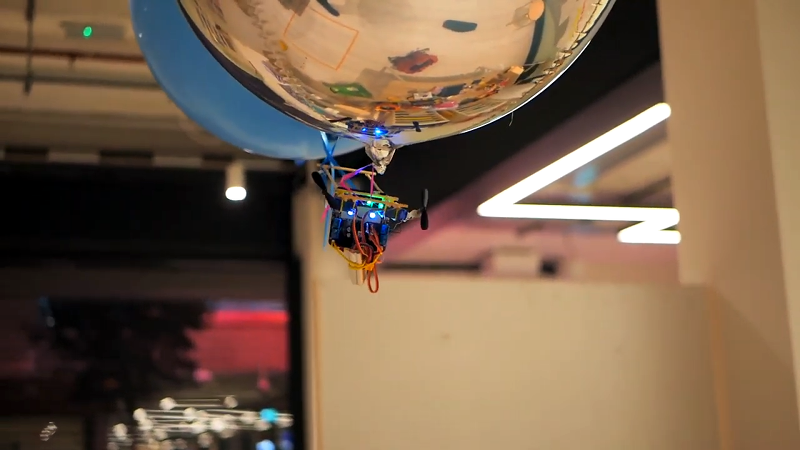
There are two kinds of people in this world: those who see bamboo skewers and think “grill night,” and those who see bamboo skewers and think, “Yes, this is obviously the beginning of an airship.” The second group is why the internet remains a glorious place.
The phrase “Bamboo Skewers Launch Airship” sounds like a headline smuggled out of a steampunk garage, but it describes a very real and wonderfully scrappy maker idea: using common craft materials, small motors, servos, helium balloons, and a lightweight frame to create a simple remote-controlled blimp. It is part science lesson, part engineering challenge, and part floating proof that invention does not always begin with a million-dollar lab. Sometimes it begins with party balloons and a packet of sticks from the kitchen drawer.
At its heart, a bamboo skewer airship is a small lighter-than-air vehicle. Instead of relying on wings like an airplane or high-speed rotors like a drone, it gets most of its lift from helium-filled balloons. The bamboo structure gives the craft a frame, the motors provide thrust, and servos or angled propellers help steer it. The result is slow, gentle, slightly ridiculous, and surprisingly educational. In other words, it is exactly the kind of project makers love.
What Is a Bamboo Skewer Airship?
A bamboo skewer airship is a small DIY blimp or model airship built with a lightweight frame made from bamboo skewers. The frame usually supports a controller board, small electric motors, propellers, a battery, and sometimes servo mechanisms that tilt the motors for directional control. Helium balloons act as the lift source, reducing the amount of power needed to stay airborne.
The beauty of this design is its accessibility. Bamboo skewers are cheap, light, easy to cut, and easy to glue. They are not space-age composites, but for an indoor micro airship, they are shockingly useful. They offer enough stiffness to hold the electronics in place while keeping the total weight low. In a project where every gram matters, bamboo earns its boarding pass.
This kind of airship is not meant to carry cargo, survey land, or intimidate the neighborhood pigeons. It is best understood as a maker project, classroom experiment, or weekend build for learning about buoyancy, balance, propulsion, and control systems. It floats slowly, turns with personality, and teaches physics without making anyone open a 600-page textbook.
Why Bamboo Skewers Work So Well
Bamboo has an excellent strength-to-weight ratio for small craft projects. A skewer is thin enough to remain light but rigid enough to form a triangular or rectangular frame. That matters because a helium airship has a strict weight budget. The balloons can only lift so much. Add too many decorations, heavy wires, oversized batteries, or a frame that looks like it was designed for a medieval bridge, and the airship becomes a very fancy floor ornament.
Bamboo skewers also encourage fast prototyping. Builders can cut them with basic tools, join them with hot glue, reinforce joints with thread or tape, and rebuild sections without mourning the loss of expensive material. If a design fails, the lesson is cheap. That is one of the greatest luxuries in DIY engineering.
Compared with plastic rods or metal wire, bamboo is easier to shape and repair. Compared with carbon fiber, it is far less intimidating for beginners. Carbon fiber may sound cooler at a robotics competition, but bamboo has a humble charm. It says, “I may have started life near a barbecue, but today I fly.”
The Science: How the Airship Gets Off the Ground
The flight principle is buoyancy. A helium-filled balloon rises because helium is less dense than the air around it. The balloon displaces a volume of air, and if the upward buoyant force is greater than the combined weight of the balloon, helium, frame, battery, motors, and electronics, the craft lifts.
This is why lightweight design is not optional. It is the whole game. A small airship does not have unlimited lift. Every wire, glue blob, motor mount, zip tie, and decorative pirate flag must justify itself. Builders quickly learn that “just one more thing” is the enemy of flight.
Most successful small blimp builds aim for neutral or slightly positive buoyancy. Neutral buoyancy means the airship neither drops quickly nor rockets to the ceiling like it has urgent business with the light fixtures. With neutral buoyancy, the motors can focus on moving and steering instead of constantly fighting gravity.
Parts That Usually Make the Magic Happen
Helium Balloons
The balloons supply lift. Party-store helium balloons can work for very small experiments, but larger balloons provide more lifting capacity and more stable flight. Foil balloons often hold helium longer than latex balloons, although they come with their own shape and attachment challenges.
Bamboo Skewer Frame
The frame holds everything together. A simple crossbeam or rectangular truss can carry the controller board and motor mounts. The strongest designs use triangles because triangular structures resist flexing better than floppy rectangle-only frames. This is true in bridges, towers, and tiny indoor blimps that look like they escaped from a science fair.
Motors and Propellers
Small drone-style motors provide thrust. Some builds use two motors for forward movement and turning. Others use more advanced arrangements with tilting motors, allowing the airship to climb, descend, rotate, or move forward with better control.
Servos
Servos are small motors designed for controlled movement over a limited range. In an airship, they can tilt propellers or adjust control surfaces. That makes the craft more maneuverable without adding too much complexity.
Controller Board
A microcontroller, RC receiver, or robotics board acts as the brain. It reads commands and sends signals to motors and servos. This is where a simple floating balloon becomes a controlled airship instead of a confused ceiling decoration.
Battery
The battery powers the electronics and motors. It must be light enough for the balloon lift available but strong enough to provide useful flight time. Battery choice is one of the trickiest parts of small airship design because power and weight are always arguing like siblings in the back seat.
Design Lessons from a Tiny Floating Machine
A bamboo skewer airship teaches the kind of engineering lessons that are hard to absorb from theory alone. The first lesson is that weight matters more than expected. A builder may begin with confidence, attach a controller, add a battery, glue on motor mounts, tape down wires, and then discover the craft is too heavy to rise. The airship has spoken, and it is not impressed.
The second lesson is balance. If the battery sits too far forward, the nose dips. If the motors are mounted unevenly, the craft yaws to one side. If the balloons are not centered, the frame hangs at a strange angle, like a tired shopping cart. Getting a small blimp to fly well requires careful positioning, not brute force.
The third lesson is that air is not empty. Indoor drafts from fans, air conditioners, open doors, and even people walking nearby can push a lightweight airship off course. What feels like a calm room to a human can feel like weather to a helium craft. A bamboo skewer airship reveals the invisible movement of air in a way that is both charming and mildly humbling.
Why This Project Is Great for STEM Learning
The bamboo skewer airship is an ideal STEM project because it combines several disciplines in one visible, testable machine. Physics explains buoyancy and thrust. Engineering shapes the frame. Electronics control motors and servos. Design thinking helps reduce weight and improve stability. Problem-solving appears every time the craft refuses to behave.
Unlike many robotics projects, a blimp moves slowly enough for learners to observe what is happening. If it turns poorly, dips, drifts, or climbs too fast, the problem is visible. That makes troubleshooting less mysterious. Students can ask clear questions: Is the craft too heavy? Is the center of mass too low or too far forward? Are the motors pushing evenly? Is the balloon losing helium?
It also rewards iteration. A builder can test one frame, change the motor angle, trim a skewer, reposition the battery, and try again. Each version teaches something. In the world of making, failure is not a dead end. It is data wearing a fake mustache.
Safety and Common-Sense Flying
A bamboo skewer airship should be treated as an indoor, lightweight educational project. It should not be released outdoors, flown near roads, power lines, airports, crowds, animals, or fragile objects. Even a tiny craft can become a problem if it drifts where it does not belong.
Builders should use low-voltage electronics, keep fingers clear of spinning propellers, avoid overloading batteries, and supervise younger makers. Helium balloons should be secured and disposed of properly. Releasing balloons outdoors can create litter and environmental hazards, so the responsible move is to keep the airship indoors and under control.
In the United States, outdoor unmanned aircraft operations can fall under aviation rules depending on size, location, and use. That is another reason this project is best kept inside a covered space where it remains a small educational craft rather than an accidental aviation paperwork generator.
Practical Build Strategy Without Overcomplicating It
The simplest approach is to start with the lift. Before building the frame, test how much weight the balloons can carry. Add small objects gradually until the balloons hover or sink slightly. That gives a rough weight budget. From there, the builder can choose motors, battery, controller, and frame size.
Next comes the frame. A minimal bamboo structure is usually better than an elaborate one. The goal is not to build a cathedral under a balloon. The goal is to support the electronics while adding as little mass as possible. Shorter sticks, triangular bracing, and tidy glue joints all help.
Then comes balance. The battery is often the heaviest component, so it becomes the main tuning weight. Moving it forward, backward, left, or right can dramatically change how the airship hangs. A good builder treats the battery like ballast and uses it to trim the craft.
Finally, control should be tested gently. Small motor inputs are better than dramatic throttle blasts. A helium airship responds slowly, and overcorrecting can make it wobble across the room like a nervous goldfish. Patience is part of the piloting skill.
Modern Airships and Why This Tiny One Still Matters
Large airships have been discussed for cargo transport, surveillance, research, advertising, tourism, and remote-area logistics. Modern designs often explore hybrid lift, advanced fabrics, efficient propulsion, and improved control systems. They are far more sophisticated than a bamboo skewer blimp, of course, but the basic question remains familiar: how do you lift useful weight safely and efficiently through the air?
The tiny DIY version makes that question approachable. It turns abstract aerospace ideas into something visible on a living-room floor. You can see lift, center of gravity, thrust vectoring, drag, and stability without needing a wind tunnel or a pilot license. That is the power of small projects. They shrink big ideas until you can hold them in one hand.
What Can Go Wrong?
Plenty, and that is half the fun. The frame can twist. The balloons can leak. The motors can be too weak. The battery can be too heavy. The propellers can push air in the wrong direction. The craft can rise beautifully and then rotate in slow circles like it is considering its life choices.
One common mistake is adding too much glue. Hot glue is convenient, but it is heavier than it looks. Another mistake is using wires that are longer than needed. Long wires add weight and create tangles. A third mistake is assuming more power fixes everything. In lighter-than-air craft, better balance often beats bigger motors.
A well-built bamboo skewer airship is not necessarily the one with the most parts. It is the one where every part has a reason to exist.
Experience Notes: What Building a Bamboo Skewer Airship Feels Like
The first experience is usually surprise. Bamboo skewers look too ordinary to become aircraft parts. They belong next to vegetables, not avionics. Yet once you start laying them into a frame, the logic appears. A skewer is straight, light, and stiff. Two skewers are a beam. Three skewers are a triangle. A few triangles become a structure. Suddenly the snack-table supply has entered aerospace.
The second experience is negotiation with gravity. You weigh the frame and feel proud. Then you add the controller and feel slightly less proud. Then the battery arrives, and gravity clears its throat. Every gram becomes personal. You start trimming tape ends, shortening wires, and applying glue as if it were imported perfume. The project teaches restraint better than any lecture could.
The third experience is the first float test. This is the emotional center of the build. You attach the balloons, hold your breath, and gently let go. If the airship rises, the room becomes a launch facility. If it sinks, the floor becomes a design review board. Either way, you learn immediately. No spreadsheet can match the honesty of a homemade blimp refusing to lift.
The fourth experience is trimming. The airship may float, but it will probably hang nose-down, tail-down, or sideways. This is where you discover that balance is not decoration; it is survival. Moving a battery one inch can change the entire personality of the craft. A small adjustment can turn “floating disaster” into “majestic indoor zeppelin,” although majestic may still be generous.
The fifth experience is powered movement. When the motors first spin and the airship slides forward, it feels absurdly satisfying. It is not fast. It will not win a race unless the opponent is a houseplant. But the motion is graceful. The craft glides, pauses, turns, and drifts with a softness that drones do not have. It feels less like piloting a machine and more like persuading a cloud.
The sixth experience is learning to fly slowly. Most remote-control vehicles reward quick reactions. A bamboo skewer airship rewards calm. Push too hard and it swings. Correct too late and it drifts. Oversteer and it rotates with theatrical disappointment. The best pilots learn to anticipate. They nudge rather than command. They guide rather than wrestle.
The seventh experience is public reaction. People smile at this project. They may not understand the circuitry, but they understand the comedy of a homemade airship drifting through a room on party balloons. It has personality. It invites questions. It turns engineering into a small event.
The final experience is appreciation. A bamboo skewer airship is simple, but not simplistic. It proves that good engineering is not always about expensive materials. It is about making thoughtful choices within limits. The constraints are the lesson: limited lift, limited power, limited stiffness, limited space. Work inside those limits, and the reward is a floating machine made from objects almost anyone can recognize.
Conclusion
Bamboo Skewers Launch Airship is more than a quirky maker headline. It is a reminder that invention often begins with everyday materials and a willingness to ask, “What happens if we try?” A few bamboo sticks, helium balloons, small motors, and a lightweight controller can open the door to real lessons in buoyancy, propulsion, balance, electronics, and design.
This project is charming because it is approachable. It does not pretend to be a commercial aircraft or a polished robotics kit. It is humble, visible, and wonderfully educational. It teaches that flight is not magic, but it can still feel magical when a handmade frame lifts off the table and drifts across the room like a tiny wooden zeppelin with big dreams.
Note: This article is written for web publication as original, reader-friendly content based on real DIY airship concepts, lightweight model-building principles, and safe indoor maker practices.