Decimal multiplication has a reputation problem. The moment a decimal point shows up, some people react like math just turned into a horror movie. Good news: it did not. Multiplying decimals is much less dramatic than it looks. In fact, the process is almost the same as multiplying whole numbers. The only extra job is placing the decimal point correctly at the end.
Once you understand place value, the whole thing starts to feel logical instead of mysterious. Whether you are helping with homework, brushing up for a test, or trying to calculate money, measurements, or discounts without breaking into a sweat, this guide will walk you through how to multiply decimals step by step with clear explanations and real examples.
What Does It Mean to Multiply Decimals?
Multiplying decimals means finding the product of numbers that include tenths, hundredths, thousandths, or more. The basic idea is the same as regular multiplication: you are combining equal groups. The only difference is that the numbers are not always whole.
For example:
- 0.5 × 4 means four groups of one-half.
- 2.3 × 1.2 means 2.3 multiplied by 1.2, which can also be understood through place value or fractions.
- 0.25 × 0.2 means one-quarter of two-tenths, which is a very small number.
This last point matters: when you multiply by a decimal less than 1, your answer can get smaller. That surprises a lot of people at first, because multiplication is often introduced as “making bigger numbers.” Decimal multiplication politely disagrees.
The Simple Rule for Multiplying Decimals
Here is the rule most students use:
- Ignore the decimal points for a moment.
- Multiply the numbers as if they were whole numbers.
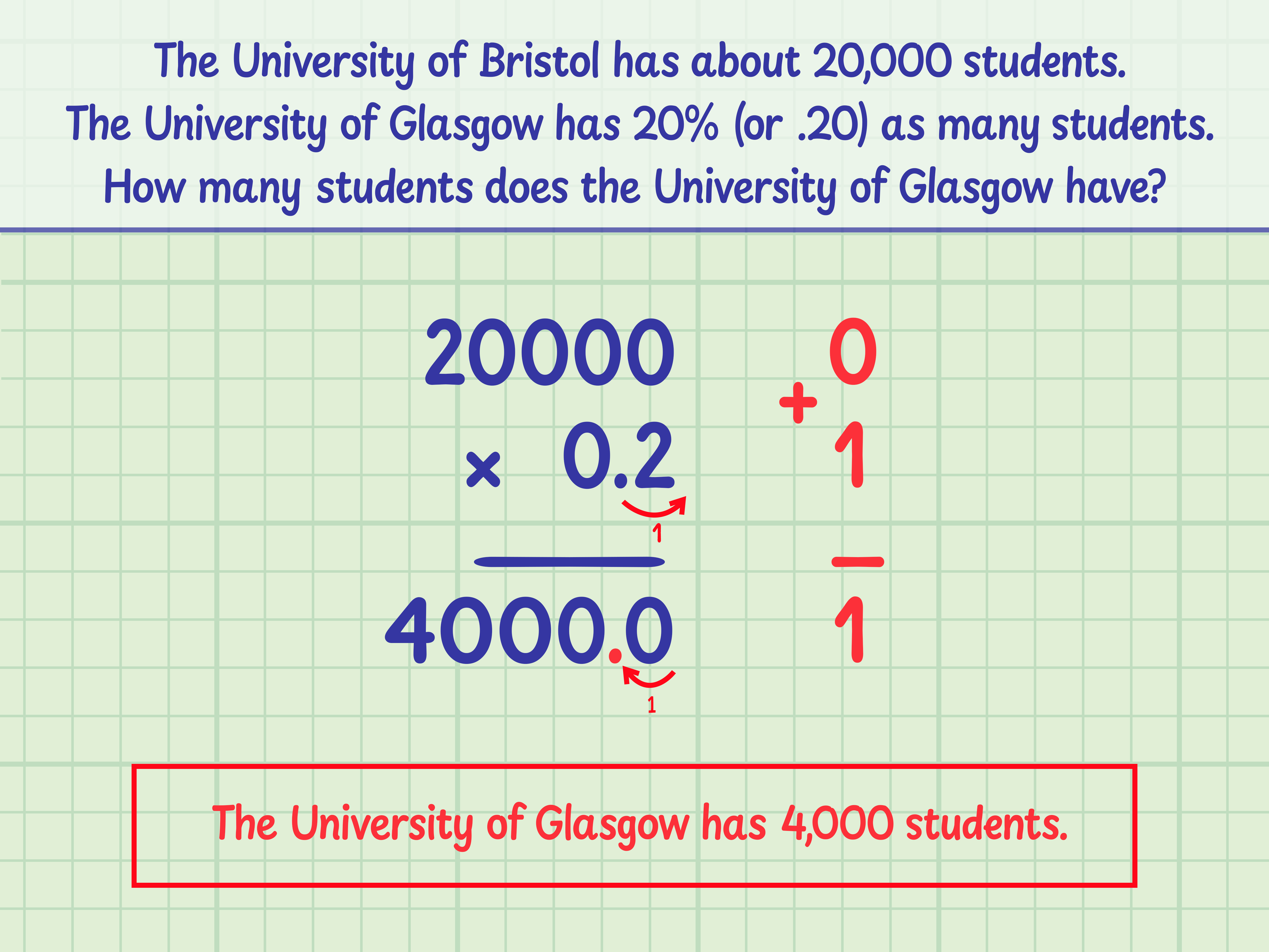
- Count the total number of digits to the right of the decimal point in both factors.
- Place the decimal point in the product so it has that same total number of decimal places.
That is the main method. It is reliable, fast, and perfect for paper-and-pencil work.
Step-by-Step Example 1: Multiply 3.4 × 2.1
Step 1: Ignore the decimal points
Treat the problem like this:
34 × 21
Step 2: Multiply as whole numbers
34 × 21 = 714
Step 3: Count decimal places
3.4 has 1 digit after the decimal point.
2.1 has 1 digit after the decimal point.
Total decimal places = 2
Step 4: Place the decimal in the product
714 becomes 7.14
Answer: 3.4 × 2.1 = 7.14
A quick estimate helps confirm it. Since 3.4 is close to 3 and 2.1 is close to 2, the answer should be around 6. A result of 7.14 makes sense. A result like 71.4 would be a giant red flag waving wildly in the wind.
Step-by-Step Example 2: Multiply 0.25 × 0.2
Step 1: Ignore the decimal points
25 × 2 = 50
Step 2: Count decimal places
0.25 has 2 decimal places.
0.2 has 1 decimal place.
Total decimal places = 3
Step 3: Place the decimal point
50 becomes 0.050, which is the same as 0.05
Answer: 0.25 × 0.2 = 0.05
This example shows why decimal multiplication can produce a smaller number. Since both factors are less than 1, the product is even smaller.
Step-by-Step Example 3: Multiply 12.5 × 0.04
Step 1: Ignore the decimal points
125 × 4 = 500
Step 2: Count decimal places
12.5 has 1 decimal place.
0.04 has 2 decimal places.
Total = 3
Step 3: Place the decimal point
500 becomes 0.500, or simply 0.5
Answer: 12.5 × 0.04 = 0.5
This is a great example of why estimating matters. Since 0.04 is very small, multiplying 12.5 by it should not produce something huge. An answer of 50 would be spectacularly wrong.
How to Multiply a Decimal by a Whole Number
This is usually the easiest version.
Example: 4.8 × 3
- Ignore the decimal: 48 × 3 = 144
- Count decimal places: 4.8 has 1 decimal place
- Place the decimal in the answer: 14.4
Answer: 4.8 × 3 = 14.4
Only the decimal number contributes decimal places here, because the whole number has none.
How to Multiply Decimals with Zeros
Zeros can make students nervous, but they are mostly harmless unless you forget how place value works.
Example: 2.40 × 0.30
- Ignore decimals: 240 × 30 = 7200
- Count decimal places: 2.40 has 2, and 0.30 has 2
- Total decimal places = 4
- Place the decimal: 0.7200
Answer: 2.40 × 0.30 = 0.72
Trailing zeros may be dropped unless the situation requires them, such as money or measurement precision. So 0.7200 and 0.72 are equal, but sometimes keeping the zeros shows the level of precision you started with.
Why the Decimal Rule Works
If you want the logic behind the rule, here it is in plain English. A decimal is really another way of writing a fraction based on powers of 10.
For example:
- 0.7 = 7/10
- 0.08 = 8/100
So when you multiply:
0.7 × 0.08 = (7/10) × (8/100) = 56/1000 = 0.056
That is why you count the total decimal places. The denominators multiply too, and powers of 10 stack up in the background doing all the heavy lifting.
Use Estimation Before and After You Multiply
Estimation is the math version of checking whether you left the house wearing two different shoes. It helps you catch mistakes before they become permanent.
Example: 5.6 × 1.2
Estimate first:
- 5.6 is about 6
- 1.2 is about 1
- 6 × 1 = 6
Now solve exactly:
- 56 × 12 = 672
- There are 2 decimal places total
- Answer = 6.72
Since 6.72 is close to 6, the answer is reasonable.
Estimation is especially helpful when:
- your decimal point seems suspicious,
- your answer is much larger or smaller than expected,
- you are solving word problems involving money or measurement.
Common Mistakes When Multiplying Decimals
1. Placing the decimal point too soon
Some learners try to line up decimal points before multiplying. That is useful in addition and subtraction, but not here. In multiplication, ignore the decimals first, then place the decimal at the end.
2. Forgetting to count all decimal places
In 1.25 × 0.4, you count 2 decimal places in 1.25 and 1 in 0.4, for a total of 3.
3. Assuming multiplication always makes numbers bigger
It does not. If you multiply by a number less than 1, the answer may shrink.
4. Dropping zeros carelessly
Zeros at the end of a decimal can sometimes be removed, but not zeros inside a number. For example, 0.05 is not the same as 0.5. One is five hundredths; the other is five tenths. Huge difference. Tiny dot. Big drama.
Real-World Examples of Decimal Multiplication
Money
A notebook costs $2.75. You buy 4 of them.
2.75 × 4 = 11.00
Total cost: $11.00
Weight
Apples cost $1.60 per pound, and you buy 2.75 pounds.
1.60 × 2.75 = 4.40
Total cost: $4.40
Distance
You walk 1.25 miles each day for 6 days.
1.25 × 6 = 7.50
Total distance: 7.5 miles
Recipes
A recipe needs 0.75 cup of milk, and you make it 3 times.
0.75 × 3 = 2.25
Total milk needed: 2.25 cups
Decimal multiplication is not just a school skill. It shows up in stores, kitchens, gyms, construction projects, science labs, and anywhere measurements matter.
An Alternate Way to Think About Decimal Multiplication
Some students understand decimals better through models instead of rules. An area model can help. For example, with 0.3 × 0.4, you can picture a rectangle that is 3 tenths wide and 4 tenths tall. The shaded area is 12 hundredths, or 0.12.
This approach helps explain why multiplying two decimals less than 1 can give a smaller answer. You are finding only a portion of a portion.
Practice Problems
Try these on your own:
- 2.4 × 1.5
- 0.6 × 0.7
- 3.25 × 4
- 0.08 × 2.5
- 1.2 × 0.03
Answers
- 3.6
- 0.42
- 13.0
- 0.20 or 0.2
- 0.036
Quick Step-by-Step Checklist
- Multiply like whole numbers.
- Count total digits after the decimal in both factors.
- Place the decimal in the product.
- Estimate to see whether the answer makes sense.
- Simplify trailing zeros if appropriate.
Final Thoughts
If you have ever stared at a decimal multiplication problem and felt personally attacked by the decimal point, you are not alone. The trick is to stop treating decimals like mysterious strangers. They follow patterns. They respect place value. They can be estimated. And once you practice the steps a few times, they become much more predictable.
The best way to get comfortable is to solve several examples, say the steps out loud, and check each answer with a quick estimate. That combination of procedure and number sense builds confidence fast. Soon enough, multiplying decimals will feel less like advanced wizardry and more like regular arithmetic wearing a tiny dot as a hat.
Experiences Related to Multiplying Decimals in Real Life and Learning
One of the most interesting experiences people have with decimal multiplication is realizing they have already used it in everyday life without calling it “decimal multiplication.” A student may struggle with 2.5 × 1.2 on paper, then go to a grocery store and easily understand the cost of 1.2 pounds of fruit at $2.50 per pound. Suddenly the skill feels less like a school exercise and more like a life tool. That moment matters. It changes math from a subject to survive into a skill to use.
Another common experience happens in the kitchen. Recipes are full of decimal multiplication, especially when doubling or tripling ingredients. If a pancake recipe uses 0.75 cup of milk and you make it twice, you are multiplying decimals whether you say it out loud or not. Many learners remember the idea better when they connect it to food, money, sports stats, or measurements for a project. Real life gives the decimal point a job, and once that happens, it stops looking so random.
In classrooms, students often have a funny pattern of confidence. At first, they feel fine multiplying 4.2 × 3 because one factor is a whole number. Then they see 0.4 × 0.6 and panic because both numbers are decimals. But after working through a few examples, many discover that the second kind is not harder, just different. The process is the same. What changes is the decimal placement and the size of the final answer. That “Oh, wait, I can do this” moment is one of the most satisfying parts of learning math.
Teachers and parents also notice that errors with decimals are often not multiplication errors at all. They are place-value errors. A student might correctly compute 56 × 12 = 672 and still write the wrong final answer because the decimal point was placed in the wrong spot. That is why strong learners do not just memorize steps. They build the habit of estimating first. If the problem is 5.6 × 1.2, an answer like 67.2 should feel suspicious immediately. Estimation acts like a built-in alarm system.
There is also a confidence experience that grows over time. At the beginning, decimal multiplication feels slow and mechanical. Students count digits, double-check everything, and sometimes erase holes straight through the paper. Later, with practice, they start to recognize patterns. Multiplying by 0.1, 0.01, or 10 becomes familiar. Money problems become easier. Measurement questions start to look less intimidating. That progress is not magic. It comes from repeated exposure and from seeing the same concept in different contexts.
In the end, the real experience of learning decimal multiplication is a shift from confusion to control. What starts as “Where does the decimal point go?” becomes “I know exactly what to do.” And that is one of the best feelings in math: not just getting the right answer, but understanding why it is right.