Note: This article is written as original editorial commentary based on real episode context, official episode information, and recent entertainment coverage. It avoids source-link clutter so it can be copied cleanly for web publishing.
Every great South Park finale needs at least one line that feels like it escaped from a writers’ room where the whiteboard was on fire, the coffee was nervous, and someone had just said, “Okay, but what if Jesus is the problem?” In the Season 28 finale, “The Crap Out,” that line arrives with the kind of casual precision the show has been sharpening since 1997.
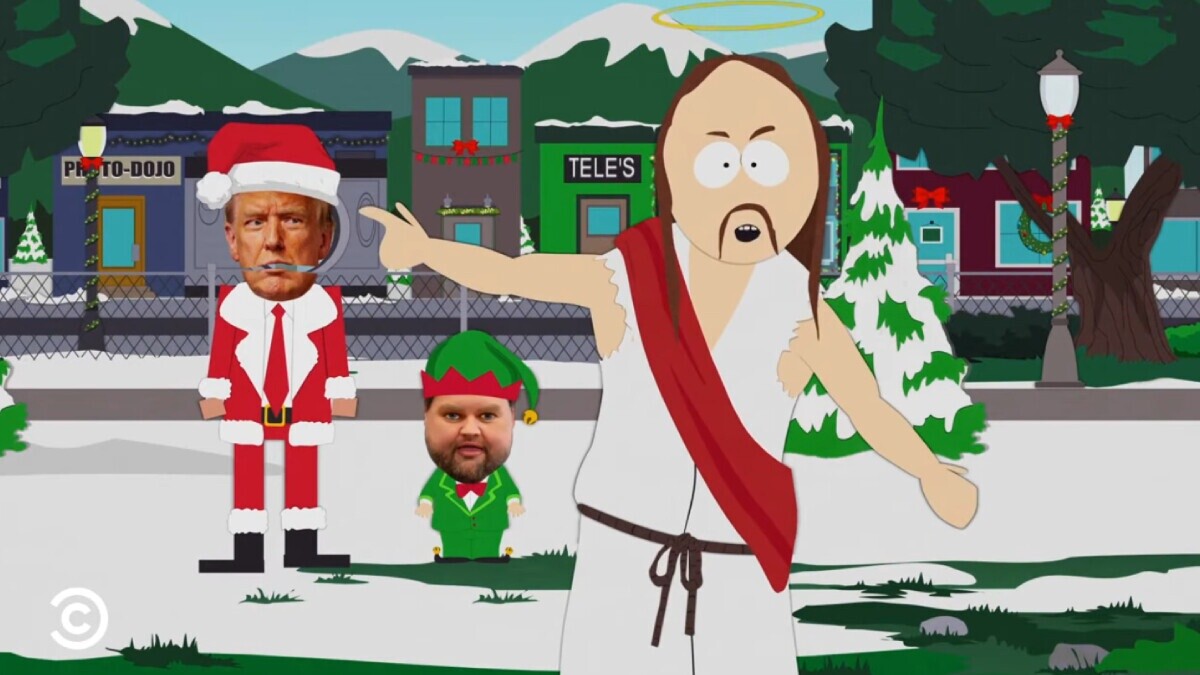
The best line in the South Park season finale is Stan’s dry response after Towelie asks what happened to Jesus: “He’s all Christian now.”
It is short. It is ridiculous. It is also sneakily brilliant. In five words, the joke manages to poke at organized religion, political branding, culture-war performance, and the weird way people can become walking advertisements for ideas they only half understand. That is classic South Park: a stupid joke with a tiny philosophy grenade taped underneath it.
The finale itself is a chaotic holiday-season pileup involving Satan, Donald Trump, JD Vance, Peter Thiel, Jesus, Stan, Towelie, and some returning nightmare fuel from the show’s past. On paper, that sounds like a sentence written by a refrigerator magnet after watching cable news for 48 hours. On screen, it becomes a sharp reminder of what South Park still does well: it takes the loudest parts of American culture and makes them sound even louder until the absurdity becomes impossible to ignore.
Why This One Line Wins the Finale
The genius of “He’s all Christian now” is that it sounds backward for half a second, then suddenly makes perfect sense inside the world of the episode. Jesus, historically and theologically, is already the central figure of Christianity. So saying he has become “Christian” is absurd on its face. But that absurdity is the joke. The line is not about faith in a sincere spiritual sense. It is about identity as performance.
In the finale, Jesus is not simply a sacred figure. He is a character caught inside the same noisy, image-obsessed, politically branded machine as everyone else. He has become less a moral compass and more a culture-war mascot. Stan’s line lands because it suggests that even Jesus can be swallowed by the version of Christianity that exists as a public label, a lifestyle costume, or a power move.
That is why the line feels bigger than a punchline. It is a whole thesis statement wearing a party hat.
The Finale’s Bigger Satirical Setup
“The Crap Out” serves as the Season 28 finale and continues threads that stretched across the unusually connected Seasons 27 and 28. The show has spent this run leaning hard into political parody, religious satire, media chaos, billionaire weirdness, and the exhaustion of watching public life turn into a never-ending sketch that refuses to end.
The story gives Stan a familiar emotional role: he is the kid who wants the world to make sense again. That has always been one of his best uses. While Cartman often represents appetite, Kyle represents outrage, and Randy represents the terrible consequences of letting adults touch anything, Stan is usually the one who looks around and says, “Is anyone else seeing this?”
In the finale, Stan’s longing for a Christmas miracle gives the episode a surprisingly old-school South Park spine. Around him, everything is ridiculous: Satan’s storyline, political scheming, fan-favorite character returns, supernatural stakes, and the kind of grim twist that reminds viewers this show has never been interested in staying polite. But Stan’s reaction keeps the satire grounded. He is not explaining the joke. He is exhausted by it.
That exhaustion is what makes the Jesus line so funny. Stan does not deliver it like a grand declaration. He says it like someone noticing that the milk has expired.
Why Stan Is the Perfect Character to Say It
The line would not work as well from Cartman. Cartman would make it bigger, meaner, and probably monetized by lunchtime. Randy would turn it into a business plan. But Stan can say something absurd with enough emotional flatness to make it feel like a normal observation.
That has been one of South Park’s secret weapons for decades. The show often surrounds its child characters with adults who are hysterical, hypocritical, or chasing some new social trend. The kids, despite being kids, become the closest thing to sane observers. Stan’s line follows that tradition perfectly.
He is not shocked that Jesus has changed. He is not even especially angry. He just recognizes the transformation and names it in the dumbest, cleanest way possible. That is why the joke has replay value. It does not scream for attention. It quietly steals the scene.
The Joke Works Because It Targets Performance, Not Faith
The strongest South Park religious jokes usually are not about theology homework. They are about people. Specifically, they are about how people use religion, morality, language, outrage, and public virtue to get what they want. “He’s all Christian now” fits into that tradition.
The joke is not simply “religion is silly.” That would be too easy, and frankly, too dusty. The sharper point is that any belief system can become strange when it turns into branding. The line points at the gap between what a belief claims to be and how people perform it in public. That is a much more durable joke because it applies beyond religion. It applies to politics, fandom, wellness culture, corporate activism, online outrage, and whatever LinkedIn is doing on any given Monday.
In that sense, the line is not just about Jesus. It is about the modern habit of turning every identity into a costume with a hashtag.
How the Finale Uses Old South Park Energy
The finale also works because it blends new political targets with old South Park mythology. Returning characters and references give longtime fans a sense of continuity, while the modern satire keeps the episode from feeling like a museum tour. It is nostalgia with teeth.
That matters because South Park has always been at its best when it treats its own history like a messy toy box. The show can bring back something deeply familiar, then drop it into a current cultural disaster and see what catches fire. In “The Crap Out,” that strategy helps the finale feel like both a culmination and a reset.
The line about Jesus benefits from that layered history. Viewers who know the show understand that Jesus has long been part of South Park’s strange moral universe. Seeing him reframed through the finale’s modern satire gives the joke extra weight. It is not just a random gag. It is a character shift expressed through one clean, brutal sentence.
Why This Line Beats the Louder Jokes
South Park finales often include jokes that are bigger, grosser, darker, or more headline-friendly. “The Crap Out” certainly has those. But the best line is not always the one that makes the most noise. Sometimes it is the line that best explains the episode without sounding like it is trying to explain anything.
“He’s all Christian now” does exactly that. It captures the finale’s central absurdity: institutions, identities, and public figures keep mutating into stranger versions of themselves. Nothing is safe from becoming a brand. Not politics. Not childhood. Not Christmas. Not even Jesus.
The line is funny because it is impossible, but it feels emotionally true. That is the sweet spot where South Park has always done its best work.
The Cultural Bite Behind the Punchline
American pop culture is crowded with people declaring what side they are on, what values they represent, and what enemies they oppose. The louder these declarations become, the less they sometimes seem connected to actual behavior. That is the cultural pressure the finale is squeezing.
Stan’s line turns that entire phenomenon into a joke about Jesus. It suggests that even the original symbol can become a follower of the symbol. The source can be replaced by the merchandise. The meaning can be replaced by the slogan. The person can be replaced by the posture.
That is a very South Park idea. The show has always been suspicious of crowds, trends, movements, and moral panics. It does not matter whether the crowd is conservative, liberal, corporate, religious, secular, online, offline, or wearing matching T-shirts at a school assembly. If people start chanting too confidently, South Park usually starts looking for the banana peel.
What the Finale Says About Modern South Park
Modern South Park is not the same show it was in the early seasons, and that is not necessarily a bad thing. The early show thrived on shock, speed, and the thrill of watching four badly behaved kids say things network television was not supposed to allow. The later show has become more serialized, more openly political, and more interested in turning real-world absurdity into multi-episode arcs.
That shift can be messy. Serialized South Park sometimes risks tying itself into knots. But when it works, it gives a line like “He’s all Christian now” more force. The joke lands not only because it is funny in the moment, but because it pays off a season-long atmosphere of religious branding, political opportunism, and institutional collapse.
The finale may be chaotic, but the best line is clean. That contrast is part of the appeal.
Why Fans Remember Lines Like This
Fans do not always remember plot mechanics first. They remember the line that made the room laugh. They remember the phrase that instantly became text-message material. They remember the sentence that felt ridiculous enough to quote but smart enough to argue about later.
That is how South Park has stayed culturally sticky for so long. The show produces phrases that sound silly in isolation but carry a surprising amount of context. A great South Park quote is rarely just a quote. It is a shortcut to an entire argument.
“He’s all Christian now” has that quality. You can laugh at it immediately. Then you can spend another ten minutes unpacking why it works. That combination is rare, and it is exactly why this is the best line in the finale.
Experience Section: Watching a South Park Finale in the Age of Endless Outrage
Watching a South Park season finale today is a different experience than watching one years ago. In the early days, the shock often came from hearing animated fourth-graders say things no cartoon kids were supposed to say. Now the shock comes from realizing the real world has become so strange that South Park sometimes looks less like parody and more like a documentary that got hit in the head with a snow shovel.
That is what makes a line like “He’s all Christian now” feel so satisfying. It gives viewers a small handle on a huge mess. The episode throws politics, religion, celebrity power, online weirdness, and old-school South Park chaos into one blender. Then Stan walks in with a five-word observation that somehow explains the smoothie.
For many viewers, the experience of watching the finale is probably not just laughter. It is laughter mixed with recognition. The joke works because people have seen versions of this behavior everywhere: public figures adopting moral language when convenient, brands dressing up as movements, influencers turning belief into content, and ordinary arguments becoming tribal identity tests. The finale exaggerates all of it, but exaggeration is the point. South Park has never whispered when a cartoon air horn would do.
There is also something comforting about Stan being the one to say the line. He reacts like a viewer who has had enough. In a world where everyone is yelling, selling, branding, spinning, and declaring victory before the conversation even starts, Stan’s flat delivery feels oddly calming. He does not need a speech. He just points at the absurdity and lets the audience catch up.
That is why the best South Park lines often travel beyond the episode. They become little tools for describing real life. You may not be talking about Jesus, Satan, or a bizarre animated finale at all. You might be talking about a politician, a company, a celebrity, or someone on social media who suddenly becomes a perfect spokesperson for whatever benefits them that week. “He’s all Christian now” becomes shorthand for that transformation: when a person, institution, or symbol gets swallowed by the performance of itself.
The best experience a finale can offer is not just a laugh before the credits. It is the feeling that the episode handed you a phrase you can use later. This one does exactly that. It is compact, quotable, and sharper than it first appears. Like the best South Park jokes, it looks dumb from a distance and gets smarter the closer you stand to it.
Final Verdict
The best line in the South Park Season 28 finale is not the darkest line, the loudest line, or the most outrageous line. It is Stan’s simple, devastating observation: “He’s all Christian now.”
That line wins because it does what great satire should do. It makes you laugh first and think second. It turns a ridiculous character beat into a critique of performance culture. It captures the finale’s entire worldview in one sentence: everything can become a brand, even the thing that supposedly came before the brand.
After nearly three decades, South Park can still land a joke that feels careless and precise at the same time. That is not easy. Then again, neither is making Jesus becoming “Christian” sound like a perfectly logical character arc.