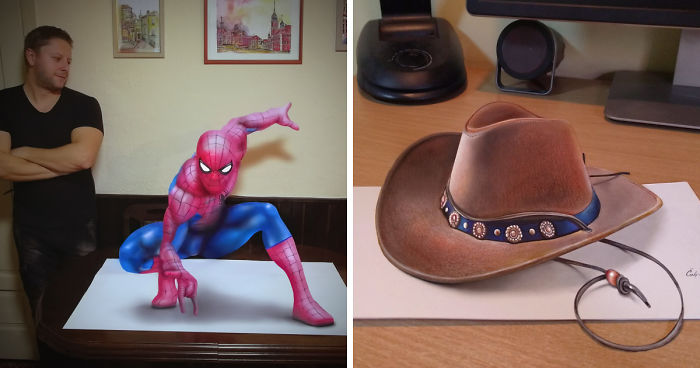
Some drawings politely sit on paper. Others leap out, steal your attention, and make your brain whisper, “Wait… is that thing real?” That delightful moment of confusion is exactly what makes 3D drawings so addictive. They are not sculptures, not digital renderings, and not magic tricks performed by a tiny wizard living inside a sketchbook. They are carefully built illusions created with perspective, shading, contrast, and a very sneaky understanding of how people see the world.
“3D Drawings That I Create To Confuse People (Part 4)” celebrates the kind of artwork that turns an ordinary sheet of paper into a visual trapdoor. At first glance, a bird appears to be flying off the page, a soda can seems ready to roll across the desk, or a creature looks as if it has been caught mid-step between the second and third dimension. Then you move your head slightly and the secret appears: it was flat all along. Your eyes have been pranked, and honestly, they probably deserved it.
The appeal of realistic 3D drawing is simple but powerful. It gives viewers two experiences at once: the shock of believing an object is real and the satisfaction of discovering how the illusion works. It is art, puzzle, performance, and practical joke wrapped into one beautifully shaded package.
What Makes a 3D Drawing Look Real?
A 3D drawing works because it borrows the visual language of the real world. When we look at objects around us, our brains rely on clues: shadows, highlights, overlapping forms, size changes, edge sharpness, and the direction of light. A skilled illusion artist studies those clues and rebuilds them on paper with pencils, markers, pastels, or paint.
The most important trick is anamorphic perspective. This is a drawing method where an image may look stretched, warped, or strange from most angles, but from one specific viewpoint it suddenly snaps into place. In other words, the drawing is not designed for the paper. It is designed for the camera, the viewer, and the exact angle where the illusion becomes believable.
That is why many 3D drawings look slightly bizarre when photographed from the side. A circle may become an oval. A short object may be drawn ridiculously long. A shadow may look misplaced until the viewer returns to the “sweet spot.” From that one angle, everything aligns, and the brain accepts the lie with embarrassing enthusiasm.
The Art of Confusing People Without Saying a Word
Great 3D art does not need a long explanation. It simply appears, points at your visual system, and says, “Gotcha.” The best pieces often use familiar objects because familiarity makes the illusion stronger. A viewer already knows what a shoe, phone, pencil, bird, cup, or fruit should look like. When the drawing matches those expectations, the brain fills in the rest.
That is the hidden comedy of 3D drawings: they use our own experience against us. We have spent our entire lives learning how shadows behave and how objects occupy space. The artist quietly copies those signals, places them on a flat surface, and lets the viewer do the final trick. The viewer becomes an unpaid assistant in the illusion show.
In this Part 4 style of 3D drawing, the fun often comes from variety. A single collection may include animals, everyday items, fantasy objects, food, vehicles, or pop-culture-inspired subjects. Each object demands a slightly different approach. A feather requires softness and layered texture. A metal can needs sharp highlights. A reptile or bird needs anatomical hints. A sneaker needs clean edges, depth, and believable fabric folds. Nothing can be treated casually, because one lazy shadow can ruin the entire illusion.
Why the Brain Falls for 3D Illusions
Human vision is fast, useful, and surprisingly gullible. Our eyes collect visual information, but the brain interprets it. To save time, the brain uses shortcuts. It assumes light usually comes from above. It assumes shadows belong to objects. It assumes familiar shapes are probably three-dimensional. Most of the time, those assumptions help us navigate the world without walking into furniture like confused penguins.
But illusion art takes advantage of those shortcuts. A carefully placed cast shadow can make a drawing appear lifted off the page. A dark edge can make a flat line look like a fold. A bright highlight can make colored pencil look like polished metal. A blurred boundary can suggest distance. The brain sees those clues and quickly builds a 3D object in the mind, even though the actual surface remains flat.
This is why 3D drawings are so satisfying online. The reveal is built into the viewing experience. First, you see the illusion from the perfect angle. Then you see the drawing from another angle and realize the object was never really there. The before-and-after effect gives the audience a tiny intellectual roller coaster: surprise, disbelief, laughter, and maybe a little personal betrayal from their own eyeballs.
From Trompe-l’Oeil to Viral Sketchbook Art
The idea of tricking the eye is not new. Artists have explored illusionistic depth for centuries. The French term trompe-l’oeil means “deceive the eye,” and it describes art that creates the appearance of real objects or spaces on a flat surface. Long before social media feeds and phone cameras, painters used walls, ceilings, panels, and still-life compositions to make viewers question what was painted and what was physically present.
Modern 3D drawing continues that tradition in a more portable, playful form. Instead of palace ceilings or large murals, today’s artists can create a mind-bending illusion on a desk, notebook page, sidewalk, or studio floor. The internet then turns that private trick into a shared experience. One clever drawing can travel across the world faster than someone can say, “No way, that’s flat.”
There is also a connection to Op Art, a movement known for using patterns, contrast, and visual perception to create the sensation of motion or depth. While Op Art often leans abstract, 3D drawing tends to be representational: animals, objects, tools, food, characters, and tiny fake disasters waiting to confuse your aunt on Facebook.
The Tools Behind the Illusion
One of the most charming things about 3D drawings is that the materials are often simple. Colored pencils, graphite, black markers, white pens, pastels, and blending tools can produce shockingly realistic results when handled with patience. The magic is not in expensive equipment. It is in observation, control, and the willingness to redo a shadow until it finally behaves.
Colored Pencils
Colored pencils are excellent for building texture and gradual tones. They allow an artist to layer colors slowly, creating smooth transitions from light to dark. For 3D drawings of fruit, animals, fabric, or skin-like surfaces, colored pencils can capture tiny details without making the image look too glossy.
Markers
Markers create bold contrast and clean edges. A black marker can deepen shadows, sharpen outlines, and give the object a strong graphic punch. Used carefully, it helps separate the “floating” object from the page. Used carelessly, it can make the drawing look like it got into a fight with a permanent marker and lost.
Pastels and White Pens
Pastels are helpful for soft shading and atmospheric effects, while white pens are perfect for highlights. A small white stroke on the rim of a glass, the eye of an animal, or the edge of metal can instantly increase realism. Highlights are tiny, but they carry big responsibility. They are the glittering little salespeople of the illusion.
Why Shadows Matter More Than People Think
If 3D drawing had a secret boss, it would be the shadow. The drawn object may be beautiful, but the cast shadow tells the viewer where the object supposedly sits in space. A shadow can make something appear raised, leaning, hanging, or touching the paper. It can also ruin everything if it points in the wrong direction.
For example, imagine a drawn pencil that appears to hover over the page. The pencil itself needs perspective, cylindrical shading, and a sharp tip. But the illusion becomes convincing only when the shadow falls beneath it in the correct place. The farther the shadow sits from the object, the higher the pencil appears to float. The softer the shadow’s edge, the more distance the brain may perceive between the object and the paper.
This is why many 3D artists spend as much time studying light as they do drawing the subject. The object says, “Look at me.” The shadow says, “Believe me.”
Specific Examples That Make 3D Drawings So Fun
The strongest 3D drawings often feature subjects with built-in drama. A flying eagle, for instance, already suggests movement. When drawn with spread wings and angled shadows, it can look as if it has just burst from the page. The illusion becomes more exciting because the subject is not merely sitting there. It appears to be doing something.
Food is another popular choice because it is familiar and textural. A slice of watermelon can show shine, moisture, seeds, and rough rind. An egg can use smooth gradients and a soft cast shadow. A soda can offers reflections, curves, typography-like details, and the kind of metallic highlights that make viewers lean closer to check whether it is real.
Animals are especially effective because people respond emotionally to living forms. A frog, rat, dinosaur, bird, or fish can feel playful, strange, or startling depending on its pose. When the anatomy is accurate enough and the perspective is stretched correctly, the creature seems to occupy the viewer’s space. It becomes less of a drawing and more of an uninvited guest.
The Role of Photography in 3D Drawing
A 3D drawing is often completed not when the last pencil stroke is placed, but when the final photograph is taken. Camera angle matters enormously. The artist must choose the viewpoint where the illusion reads clearly. A drawing that looks awkward in person may look spectacular through the camera because the camera freezes the exact perspective the artist designed.
This does not make the work fake. It makes it performative. Anamorphic art has always depended on viewpoint. The viewer must stand in the correct place, or the illusion collapses. Photography simply gives modern artists a way to guide everyone to that correct place at once.
Good lighting is equally important. If real light clashes with the drawn light source, the illusion weakens. If the paper is overexposed, subtle shading disappears. If the angle is too high, the drawing may flatten. The final image is therefore a collaboration between drawing skill, lighting, camera position, and timing.
Why People Love Being Confused by Art
Normally, confusion is annoying. Nobody enjoys being confused by tax forms, airport signs, or instructions that say “some assembly required” and then include 47 screws that look emotionally identical. But artistic confusion is different. It is safe, playful, and rewarding. It invites people to solve a mystery.
3D drawings create a quick emotional loop. First comes curiosity: “What am I looking at?” Then comes amazement: “How is that flat?” Then comes inspection: “Where is the trick?” Finally comes appreciation: “Okay, that is annoyingly good.” This loop keeps viewers engaged longer than a normal picture because the artwork gives them something to figure out.
That engagement is also why 3D drawing performs well online. People pause, zoom, comment, share, and argue with strangers about whether the image is real. In internet terms, that is basically a standing ovation with extra typing.
What Artists Can Learn from 3D Illusion Drawing
Even artists who do not specialize in illusion can learn a lot from 3D drawing. It trains the eye to notice subtle details: where shadows start, how edges soften, how highlights curve, and how perspective changes shape. It also forces discipline. In ordinary drawing, a small inaccuracy may still look fine. In 3D illusion drawing, a small inaccuracy can break the effect instantly.
The process encourages artists to think like both creators and viewers. The artist must ask: What does the audience expect to see? What visual clues will convince them? Where should the camera be? What part of the object must be exaggerated? Which details can be simplified without losing realism?
In that sense, 3D drawing is not only about technical skill. It is about communication. The artist creates a visual sentence, and the viewer’s brain finishes it.
Experiences Related to Creating and Viewing 3D Drawings
Anyone who has tried to create a 3D drawing quickly learns that the process is both exciting and mildly humbling. At the beginning, the idea seems simple: draw an object, add a shadow, become a legend. Then reality arrives with a ruler, a pencil, and a smirk. The first sketch often looks less like a floating object and more like a tired sticker lying on paper after a long day.
The first big lesson is that perspective must be planned before details begin. It is tempting to start shading immediately because shading feels productive. But if the proportions are wrong, beautiful shading only creates a beautifully wrong illusion. The drawing may still be attractive, but it will not confuse anyone except the artist, who will stare at it for twenty minutes wondering why the “3D” apple looks like a potato having an identity crisis.
The second lesson is that shadows are not decorative. They are structural. A cast shadow gives the object its location in imaginary space. When the shadow is too dark, the object looks glued down. When it is too pale, the object floats without reason. When it is placed incorrectly, the viewer may not know exactly what is wrong, but the brain will quietly reject the illusion like a bouncer outside a very exclusive nightclub.
Another experience many artists share is the strange moment when the drawing finally “clicks.” For a long time, it may look flat, awkward, and unconvincing. Then a highlight is added, an edge is sharpened, or the camera angle is adjusted, and suddenly the image pops. That moment is addictive. It feels like solving a visual lock. The paper has not changed shape, but the mind has changed its interpretation.
Viewing 3D drawings is its own experience. People often tilt their heads, squint, step closer, step back, and accuse the artist of cheating, which is usually a compliment wearing fake glasses and a trench coat. The best reactions come from viewers who discover the side angle. From the front, the object looks real. From the side, the distortion becomes obvious. That reveal does not weaken the art; it makes the art better because it shows the intelligence behind the illusion.
Creating 3D drawings also teaches patience. A convincing illusion may require repeated adjustments: a darker contact shadow, a softer background tone, a cleaner contour, a more accurate reflection. The process rewards careful looking more than speed. It also develops respect for ordinary objects. After drawing a spoon, a sneaker, or a paper clip in 3D, you never quite look at it the same way again. Suddenly, everything has architecture. Everything has light logic. Everything is suspiciously drawable.
Perhaps the most enjoyable experience is sharing the finished piece. A normal drawing may receive praise, but a successful 3D illusion receives investigation. People want proof. They want the behind-the-scenes angle. They want to know whether the paper was cut, whether the object was real, whether some digital trick was involved. That curiosity is part of the artwork. The drawing does not end at the edge of the page; it continues inside the viewer’s reaction.
That is why “3D Drawings That I Create To Confuse People (Part 4)” remains such a fun idea. It understands that art does not always have to be solemn, mysterious, or trapped in a museum whisper. Sometimes art can be clever, playful, and just a little mischievous. Sometimes the highest compliment a drawing can receive is a viewer leaning in and saying, “Hold on… what is happening here?”
Conclusion: The Joy of Being Fooled Beautifully
3D drawings remind us that seeing is not as simple as opening our eyes. Every image we understand is partly built by the brain, using clues, assumptions, memory, and context. Illusion artists know this and turn it into entertainment. They stretch perspective, sharpen highlights, deepen shadows, and invite us to believe in impossible objects sitting on ordinary paper.
What makes this art form special is not just realism. It is the playful battle between truth and perception. The paper is flat, but the object appears raised. The shadow is drawn, but it feels physical. The viewer knows it is a trick and still enjoys being fooled. In a world full of serious images competing for attention, 3D drawings offer something refreshingly human: surprise, curiosity, and the childish pleasure of saying, “No way!”
Whether you are an artist, an art lover, or simply someone who enjoys watching the brain trip over its own shoelaces, 3D illusion drawings are worth studying. They prove that creativity does not always require huge tools or expensive technology. Sometimes all it takes is paper, pencils, patience, and a very good plan for confusing people in the nicest possible way.