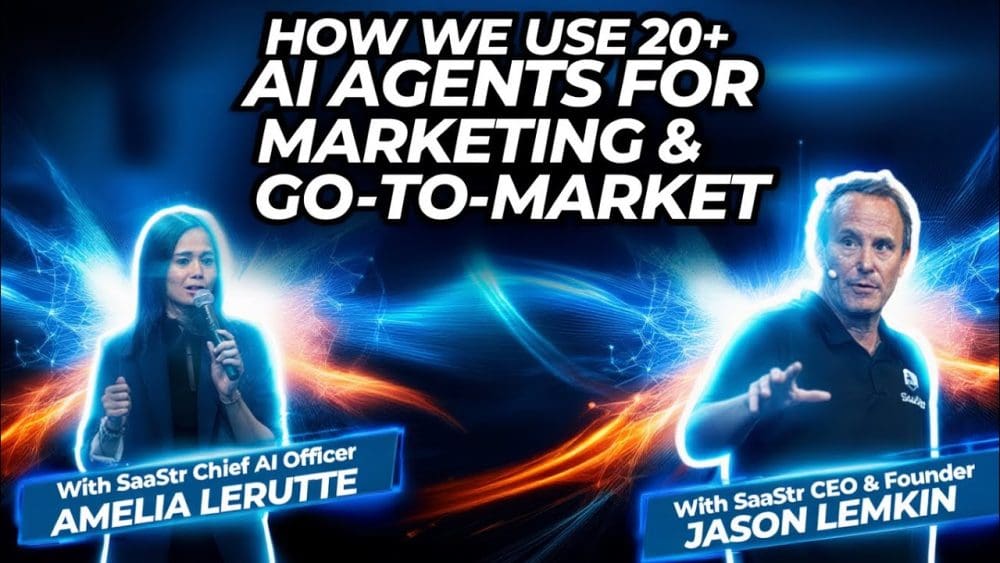
AI agents are no longer a shiny side project for SaaS teams. They are becoming the new operating layer for marketing, sales, support, content, and customer engagement. The big lesson from SaaStr’s public AI-agent experiment is not that robots are magically replacing everyone while drinking cold brew in the corner. The real lesson is more practical, more uncomfortable, and much more useful: AI agents work best when smart humans redesign the go-to-market machine around them.
SaaStr, led by founder and CEO Jason Lemkin, has openly discussed running more than 20 AI agents across its go-to-market stack, with Chief AI Officer Amelia Ibarra helping manage and train the system. That detail matters. The story is not “buy one AI tool and retire to a beach.” It is “build a living, measurable, supervised system where specialized agents do the repeatable work and humans focus on strategy, judgment, brand, and high-value relationships.” Less beach. More dashboard. Still exciting.
What “20+ AI Agents” Actually Means in a SaaS GTM Team
An AI agent is not just a chatbot with a nicer haircut. A true agent can take instructions, use tools, access data, perform multi-step workflows, and hand work back to a human when needed. In marketing and go-to-market, that might mean researching accounts, creating campaign assets, qualifying inbound leads, sending personalized follow-up, building decks, summarizing webinars, routing support questions, or updating a CRM.
The key phrase is specialized agents. One agent may help with event sponsor outreach. Another may convert a webinar into social clips. Another may build a customized sales deck. Another may greet visitors on the website and route them to the right resource. A support agent may answer common questions while also identifying buying intent. Suddenly, sales, marketing, and support are not separate islands. They become one connected revenue system, which is wonderful until someone asks, “Who owns this?” and everyone looks at the nearest marketer.
Why SaaStr’s example is important
SaaStr’s experience is interesting because it is not a lab demo. It is a real B2B media, events, and SaaS community business using agents for actual revenue workflows. The team has discussed using agents and AI-powered tools across sales outreach, event promotion, content repurposing, personalized email, support, lead capture, and internal operations. The point is not that every company should copy the exact same stack. The point is that AI agents become powerful when they are attached to real business processes, not random experiments floating around Slack like confused interns.
The Core Principle: AI Agents Don’t Fix Lazy Marketing
Here is the sentence every founder, CMO, and demand generation leader should tape to a monitor: AI agents multiply what already works. They do not rescue a broken message, a weak offer, a messy CRM, or a sales motion nobody understands.
If your best outbound email gets replies, an AI agent can help personalize and scale that motion. If your webinar creates strong buyer interest, an AI workflow can turn it into clips, summaries, blog posts, and follow-up campaigns. If your website visitors ask the same questions every day, a trained agent can respond instantly and capture leads. But if your positioning is mushy, your segmentation is random, and your product page reads like it was written by a committee trapped in a conference room since 2017, AI will simply help you distribute confusion faster.
The real job of the human team
Humans still need to decide the strategy: who the ideal customer is, what pain matters, what proof converts, what offer deserves attention, and where trust must be protected. AI agents can execute at scale, but they need direction, examples, guardrails, and feedback. In other words, the new marketing leader is part strategist, part editor, part systems designer, and part very patient coach for digital teammates who occasionally say something brilliant and occasionally try to put a conference booth on the moon.
How AI Agents Change Marketing Workflows
The most immediate impact of AI agents in SaaS marketing is workflow compression. Tasks that used to require five people, three meetings, and one mysterious spreadsheet can now move through an agent-assisted system in minutes or hours.
1. Content repurposing becomes a revenue engine
SaaS companies create mountains of valuable content: webinars, podcasts, customer interviews, demo recordings, event sessions, sales calls, and founder talks. The tragedy is that much of it gets uploaded once, lightly promoted, and then buried like treasure nobody bothered to map.
An AI-agent workflow can extract transcripts, identify the strongest themes, produce short-form video clips, draft LinkedIn posts, create blog outlines, summarize key takeaways, and recommend follow-up email angles. A single 60-minute webinar can become five articles, ten short clips, a newsletter segment, three sales enablement snippets, and a customer education sequence. That is not “more content for the sake of more content.” Done well, it is better distribution of the expertise you already paid to create.
2. Personalized sales collateral stops being a luxury
In the old world, a custom deck was reserved for whale accounts because humans had limited time. In the AI-agent world, teams can create more customized collateral for more segments. A sponsor pitch can include relevant mockups. A product deck can emphasize the buyer’s industry. A follow-up document can reference the exact content a prospect viewed.
This matters because B2B buying committees are allergic to generic materials. They want relevance. They want proof. They want to know that your team understands their context. AI-assisted presentation tools, image-generation tools, and research agents can help produce that context faster, while humans still review the final message and make sure the deck does not look like a robot discovered gradients for the first time.
3. Email marketing becomes behavior-based and conversational
Traditional marketing automation often sends the same drip sequence to hundreds or thousands of people. It works, but it can feel stiff. AI agents make it possible to trigger more personalized messages based on behavior: pages viewed, emails opened, events attended, product interest, company profile, and buying stage.
For example, if a prospect repeatedly opens emails about an AI event but never buys a ticket, an agent can draft a one-to-one style message referencing the content they engaged with, their company, and a relevant offer. This is not meant to replace newsletters or broader campaigns. It adds a personalized layer between mass marketing and human sales follow-up. Think of it as the polite digital assistant who notices interest before the human team has finished its second coffee.
How AI Agents Change Sales and Go-to-Market
Sales teams are one of the clearest places to deploy AI agents because many sales workflows are repetitive, data-heavy, and time-sensitive. Prospect research, lead scoring, inbound qualification, first-touch outreach, meeting routing, CRM updates, and follow-up reminders are all agent-friendly jobs.
AI SDRs and the end of “spray and pray” outreach
The classic SDR motion has relied heavily on templates, cadences, and manual prospecting. AI agents can improve this by researching accounts, identifying intent signals, personalizing messages, and following up at times humans simply cannot. A prospect who visits a pricing page at 11:30 p.m. does not care that your team is offline. They care whether someone helpful appears before their interest cools.
However, the best AI SDR is not a spam cannon. It must be trained on strong copy, connected to clean data, and monitored for quality. If a human SDR would not say it, the AI agent should not say it either. The goal is not to send more bad emails. The goal is to send more relevant messages to the right people at the right moment.
Humans still own complex deals
AI agents can handle a surprising amount of qualification and follow-up, but complex enterprise deals still need human judgment. Procurement questions, executive alignment, pricing strategy, legal concerns, and relationship building require nuance. The future sales professional may spend less time typing repetitive emails and more time managing agent workflows, coaching the system, interpreting signals, and stepping in when a deal becomes strategic.
That changes the career path. The best SDRs and AEs will not be the people who merely “use AI.” They will be the people who can train, supervise, and improve AI-assisted revenue systems. In plain English: the salesperson of the future may manage a small army of agents. Hopefully with fewer HR forms.
Support Is Becoming Lead Generation
One of the most overlooked lessons from AI-powered go-to-market is that support is no longer just a cost center. When a website visitor asks a support question, they may also be revealing buying intent. When a customer asks about integrations, pricing limits, event tickets, onboarding, or advanced features, that conversation can become a sales opportunity if handled respectfully.
An AI support agent can answer common questions instantly, route complex issues, recommend relevant content, and capture lead details. The line between marketing, sales, and support gets blurry because the customer does not experience your company in departments. They experience one brand. If the support experience is fast, helpful, and personalized, it can improve conversion. If it is clumsy, repetitive, and robotic, congratulations: you automated irritation.
The convergence of GTM tools
Modern AI agents often sit on top of CRM, website analytics, email engagement, chat history, and content libraries. That means a tool designed for sales can sometimes support marketing use cases, while a support agent can uncover revenue opportunities. The old martech map with neat boxes is starting to look like spaghetti. But it is useful spaghetti if the data flows are governed and the customer experience improves.
The 20+ Agent Operating Model: What to Build First
Most SaaS teams should not start by deploying 20 agents on Monday morning. That is how you create a beautiful disaster with dashboards. Start with a few high-value, low-risk workflows where success is measurable.
Start with these five agent roles
- Content repurposing agent: Turns webinars, podcasts, and videos into clips, summaries, articles, and social posts.
- Inbound qualification agent: Engages website visitors, answers basic questions, and routes high-intent leads.
- Personalized email agent: Sends behavior-based follow-up to segments that show interest but have not converted.
- Sales research agent: Summarizes accounts, recent activity, buyer roles, and possible pain points before outreach.
- Support deflection agent: Handles common questions while escalating sensitive or complex issues to humans.
Train agents like employees, not software switches
Agent training requires examples, feedback, and patience. Upload your best-performing emails, strongest call snippets, product messaging, FAQs, objection handling, customer stories, pricing rules, and brand voice guidelines. Then review outputs daily in the first month. Correct mistakes clearly. Track what improves. Kill what does not.
This is where many teams fail. They buy the tool, connect a data source, click “activate,” and expect a miniature revenue genius to appear. Instead, they get average output because they trained the system on average material. AI agents are mirrors with horsepower. Give them your best work.
Metrics That Matter for AI Agents in Marketing and GTM
Do not measure AI agents only by activity volume. More emails, more posts, more chats, and more decks do not automatically mean more growth. A hamster can also be very active. Measure business outcomes.
Useful AI-agent KPIs
- Lead response time: How quickly does the system engage qualified interest?
- Conversion rate: Do agent-assisted journeys convert better than standard journeys?
- Pipeline influenced: How much pipeline is sourced or accelerated by agent workflows?
- Reply quality: Are prospects responding with real conversations or unsubscribes?
- Content velocity: How many useful assets come from one original piece of content?
- Human time saved: Which tasks are removed from the team’s calendar?
- Escalation accuracy: Does the agent know when to involve a human?
The best teams combine quantitative metrics with qualitative review. Read the emails. Watch the chat transcripts. Inspect the decks. Look at the content. AI can scale excellence, but it can also scale tiny mistakes into very public confetti.
Risks, Guardrails, and the Chief AI Officer Role
As soon as agents touch customers, prospects, or revenue systems, governance matters. A Chief AI Officer does not need to be a ceremonial title with a cape. The role can be a dedicated operator, marketing technologist, revenue operations leader, or founder-level owner who manages agent performance, data access, prompts, workflows, approvals, and risk.
Where guardrails are essential
- Brand voice: Agents should sound helpful and specific, not like a motivational poster discovered SaaS.
- Pricing and legal claims: Agents should not invent discounts, contract terms, guarantees, or compliance promises.
- Data privacy: Agents should only access information they need and should follow internal security rules.
- Human escalation: Complex, sensitive, or high-value interactions should move to a human quickly.
- Quality review: Early-stage agent outputs should be checked frequently before broader automation.
The companies that win with AI agents will not be the ones with the longest tool list. They will be the ones with the best operating discipline: clean data, strong examples, measurable workflows, clear ownership, and humans who care about quality.
Field Notes: Experiences from Running AI Agents for Marketing and GTM
The first experience most teams have with AI agents is excitement. Someone builds a campaign in an afternoon that used to take a week. A webinar becomes five pieces of content before lunch. A lead gets a personalized response while the sales team is asleep. Everyone smiles. Someone says, “This changes everything.” They are right, but only halfway.
The second experience is friction. The agent needs better source material. The CRM fields are messy. The brand voice is inconsistent. The sales deck has three versions and nobody knows which one is current. The support FAQ is outdated. Suddenly, AI is not just a productivity tool; it is an x-ray machine exposing every sloppy process in the company. This is annoying, but it is also valuable. AI agents force teams to document what great work looks like.
A practical example: imagine a SaaS company promoting an annual customer conference. The old workflow might include one landing page, three newsletter sends, a generic sponsor deck, a few social posts, and manual follow-up from sales. With agent-assisted GTM, the workflow changes. A content agent turns last year’s best sessions into short clips. A research agent segments target sponsors by industry and past engagement. A deck agent creates sponsor-specific pitch materials. An email agent sends personalized follow-up to people who opened event emails but did not register. A chat agent answers agenda questions on the website and routes high-intent sponsor inquiries. A reporting agent summarizes which segments are converting and which messages are falling flat.
The team is not doing less thinking. It is doing less repetitive assembly. Humans still choose the event positioning, approve the offer, define the sponsor tiers, review sensitive outreach, and handle important negotiations. But the agents carry the heavy boxes. Nobody misses carrying heavy boxes.
Another experience is that small improvements compound. A slightly faster response time improves conversion. A better deck increases internal sharing. A personalized email gets replies that a generic campaign would miss. A support agent captures a lead that would have bounced. None of these wins may look dramatic alone. Together, they create a go-to-market system that is always listening, always learning, and always ready to act.
There is also a cultural shift. Teams must stop asking, “Can AI replace this person?” and start asking, “Which parts of this workflow should no human be forced to repeat?” That is a healthier question. Humans should not spend their best hours copying webinar transcripts, formatting basic decks, chasing low-intent leads, or rewriting the same follow-up email 47 times. Let agents do the repeatable work. Let people do the judgment work.
The biggest lesson from the SaaStr-style 20+ agent approach is that AI adoption is not a tool rollout. It is an operating model. The first agent teaches the team how to train. The fifth agent teaches the team how to govern. The tenth agent teaches the team how to coordinate. By the twentieth agent, the company is no longer just “using AI.” It is running a different kind of GTM machine.
Conclusion: AI Agents Are the New GTM Leverage
The future of SaaS marketing and go-to-market is not fully automated, and it is not fully human in the old sense either. It is hybrid, specialized, measurable, and fast. AI agents can help teams personalize outreach, repurpose content, qualify leads, improve support, build collateral, and uncover revenue opportunities that would otherwise be missed.
But the winning formula is not “replace humans with tools.” It is “give excellent humans a system that removes repetitive work and expands their reach.” SaaStr’s 20+ agent story is powerful because it shows that the next generation of GTM teams may be smaller, sharper, more technical, and more focused on orchestration than manual execution.
If your SaaS company wants to begin, do not start with 20 agents. Start with one painful workflow, one clear metric, one strong set of examples, and one human owner. Train the agent. Measure the output. Improve the process. Then add the next agent. That is how AI moves from toy to team member. And yes, the team member may occasionally need editing. So do most humans before their second cup of coffee.
Editorial note: This article is a fully rewritten, publish-ready analysis based on public industry information, current AI-agent research, and real SaaS go-to-market practices. It does not include source links inside the article body to keep the HTML clean for web publishing.