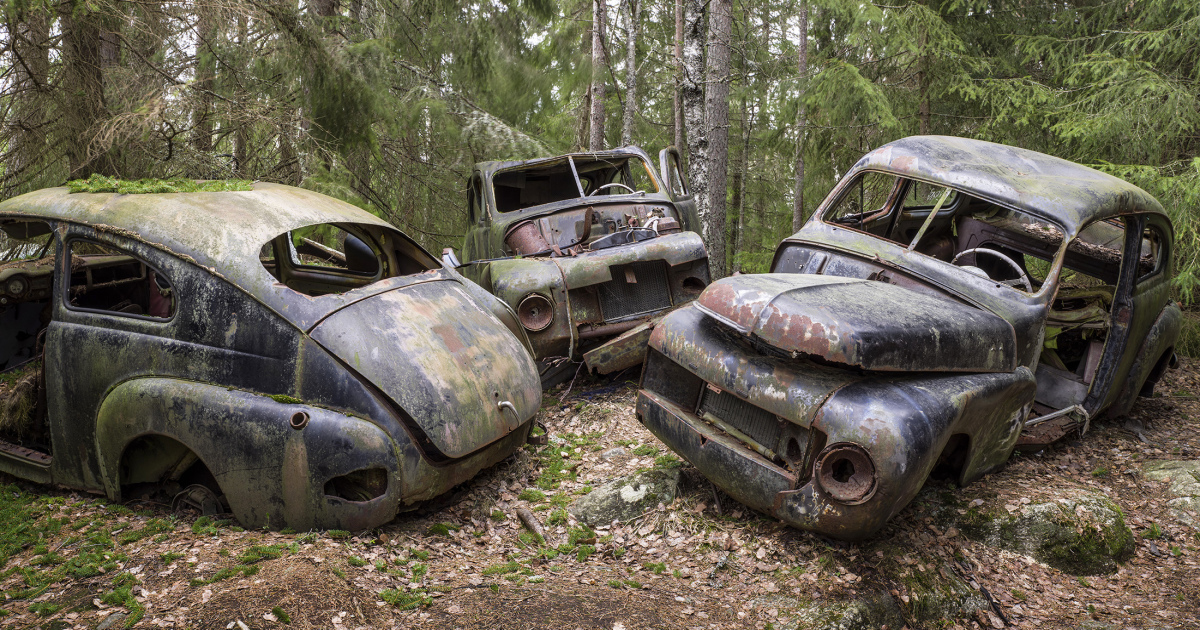
Some places whisper. Bastnäs, Sweden’s abandoned car graveyard, coughs politely, drops a little rust on your boots, and asks whether you brought a wide-angle lens. Hidden deep in the forested Värmland region near the Norwegian border, Båstnäsoften written as Bastnäs by English-language travelersis one of those rare abandoned places that feels less like a ruin and more like a slow-motion conversation between machines and moss.
At first glance, it looks like a post-apocalyptic movie set where the director yelled “cut” sometime in 1964 and nobody ever came back. Vintage cars from the 1940s, 1950s, and 1960s sit in rows, lean into trees, sink into mud, and wear fern crowns like tiny forest monarchs. Some are stacked. Some are split open. Some look as if they are waiting for a mechanic who has been late for several decades. And for photographers, urban explorers, car lovers, and anyone with a soft spot for beautiful decay, the place is unforgettable.
This photo essay-style article explores what makes Bastnäs car cemetery so visually powerful: its history, atmosphere, photography challenges, ethical rules, seasonal moods, and the odd emotional punch of seeing chrome, glass, rubber, and steel slowly surrender to the Swedish wilderness.
The Story Behind Bastnäs Car Graveyard
The Båstnäs car cemetery began as a practical business, not an art installation. In the mid-20th century, two brothers, often identified as the Ivansson brothers, operated a car scrap and spare-parts business in this remote patch of Sweden. The location was strategic. Norway was nearby, and after World War II, used car parts were valuable. Import restrictions and high costs made spare parts a serious business, especially for Norwegian customers trying to keep older vehicles alive.
The brothers collected and dismantled cars from many brands: Volvo, Saab, Ford, Opel, Volkswagen, Buick, Fiat, Sunbeam, and others. These were not museum queens parked under velvet ropes. They were working inventoryparts donors, mechanical patients, and metal puzzles waiting to be solved. Over time, however, demand changed. The business slowed, the cars stayed, and the forest began doing what forests do best: taking over without asking for a permit.
Today, Bastnäs is often described as one of the most unusual car graveyards in Europe. Hundreds of vintage vehicles remain scattered through the woods and around old structures. The site is privately owned, but it has become a cultural curiosity and a magnet for photographers from around the world. It is not polished. It is not sanitized. It is not the kind of attraction with a gift shop selling “I Brake for Rust” mugsalthough, honestly, that mug would sell.
Why Bastnäs Looks Like No Other Abandoned Place
Many abandoned places are defined by emptiness: empty hospitals, empty factories, empty schools. Bastnäs is different because it is fullalmost crowdedwith objects that still have personality. A car has a face. Headlights become eyes. Grilles look like grimaces. Broken windshields resemble expressions of surprise, as if the cars just realized they missed the last ferry to civilization.
The surrounding forest gives the scene its magic. Moss climbs over hoods. Birch trees grow through engine bays. Ferns spill out of interiors. Tree roots wrap around axles like patient fingers. Instead of a clean line between human industry and nature, Bastnäs offers a messy handshake between the two. The cars are not simply abandoned; they are being slowly edited by weather, fungi, leaves, insects, snow, and time.
A Living Landscape of Rust and Green
Rust photography can easily become repetitive: orange metal, broken glass, dramatic shadows, repeat until memory card cries for mercy. Bastnäs avoids that trap because the environment keeps adding new layers. One car might be framed by spring shoots, another nearly hidden by summer greenery, another half-buried in autumn leaves, and another softened by snow. The same vehicle can feel cheerful, spooky, nostalgic, or tragic depending on the season and light.
That is why photographers return. The subject is fixed, but the mood is never still. A cloudy day makes the colors richer. A foggy morning turns the rows of cars into ghosts. Winter strips the forest down to bones and reveals shapes that summer hides. Spring adds comic optimism, as if nature has decided every dashboard is a planter box.
Photographing 19 Pictures in a Place With 1,900 Possibilities
The biggest challenge at Bastnäs is not finding a photo. It is deciding which photo to ignore. Everywhere you turn, there is another composition: a chrome bumper catching soft light, a steering wheel wrapped in moss, a stacked trio of wrecks leaning at impossible angles, a door hanging open like a question mark.
For a 19-picture series, variety matters. You do not want nineteen identical close-ups of rusty headlights, no matter how poetic the headlights are trying to be. A strong Bastnäs photo set should move between wide establishing shots, medium environmental portraits, and intimate details. Think of the series as a small visual story rather than a scrapbook of “cool old stuff.”
Picture 1: The Arrival Shot
The first image should show the viewer where they are. A gravel road, dense trees, and the first car appearing through the forest creates instant curiosity. It says, “Welcome to the place where GPS confidence goes to die.”
Picture 2: The Row of Forgotten Cars
A line of vehicles beneath trees gives scale. It helps readers understand that Bastnäs is not one lonely wreck beside a barn. It is a full landscape of abandoned vehicles, each with its own stage of decay.
Picture 3: The Moss-Covered Hood
Close-ups are where Bastnäs becomes intimate. Moss on a hood shows time in a way numbers cannot. You can say “several decades,” but a green blanket growing over steel says it better.
Picture 4: The Tree Through the Engine Bay
This is one of the classic Bastnäs compositions. A tree growing through a car turns the machine into a planter, a sculpture, and a punchline all at once. Nature does not recycle on a schedule; it improvises.
Picture 5: The Interior Shot
Old dashboards, cracked seats, and steering wheels offer a different kind of nostalgia. These interiors once held cigarettes, maps, arguments, radio songs, grocery bags, and someone saying, “No, no, I know a shortcut.”
Picture 6: The Stacked Cars
Stacked wrecks add drama. They show the site’s scrapyard origins and create strong geometric lines. They also make you grateful your own parking situation is less vertical.
Picture 7: The Swedish Classic
Volvo and Saab models give the series local character. Their rounded forms and practical Scandinavian design look especially poignant when softened by moss and weather.
Picture 8: The American Shape
Among the European vehicles, old American cars stand out with bigger curves, heavier chrome, and a certain “I used to own the road” confidence. Even when rusted, they know how to pose.
Picture 9: The Broken Glass Detail
Cracked windshields catch light beautifully. They also create a metaphor without trying too hard: the view forward has fractured, but it has not disappeared.
Picture 10: The License Plate or Badge
Badges, emblems, and number plates are visual anchors. They remind viewers that every wreck once had a name, a model, a purpose, and paperwork. Glorious, boring paperwork.
Picture 11: The Fern-Filled Cabin
Few images summarize Bastnäs better than vegetation growing inside a car. It flips the normal relationship: instead of humans riding through nature, nature is riding shotgun.
Picture 12: The Wide Forest Composition
Step back. Let the trees dominate. A wide frame helps show that the cars are no longer the only subject. The forest is the main character now, and the cars are supporting actors with excellent patina.
Picture 13: The Rainy-Day Reflection
Water on metal makes rust glow. Puddles create reflections. Wet leaves add texture. Rain is not bad weather at Bastnäs; it is free production design.
Picture 14: The Door Left Ajar
A half-open car door gives a sense of interruption. It feels as if someone stepped out and meant to return. That tiny human suggestion makes the abandonment more powerful.
Picture 15: The Headlight Portrait
Headlights are expressive. Some look sleepy, some startled, some oddly judgmental. A close headlight shot can give personality to a car that has not moved since disco was a modern threat.
Picture 16: The Snow or Frost Frame
If photographed in colder months, frost transforms Bastnäs into a quiet monochrome world. Rust becomes warmer against snow, and the silence feels even deeper.
Picture 17: The Human-Scale Shot
Without touching or climbing on anything, include a path, boot prints, or a distant figure for scale. It helps viewers feel the size of the place without turning the photo into a selfie contest.
Picture 18: The Nature Wins Image
Choose one frame where the car is almost completely swallowed by plants. This image tells the larger story: metal is strong, but patience is stronger.
Picture 19: The Leaving Shot
End with a car fading into trees, a road bending away, or a final rear-view-like composition. A good last image should feel like walking out of a dream and checking your pockets for moss.
Photography Tips for Bastnäs Car Cemetery
Because Bastnäs is visually dense, the best photographs often come from patience rather than panic. It is easy to arrive excited and shoot everything in the first ten minutes. Resist that urge. Walk slowly. Notice how the cars relate to each other. Watch the background. Rust is photogenic, but a branch sticking through the frame like a confused antenna can ruin an otherwise strong image.
Use Soft Light
Overcast days are excellent for abandoned car photography because clouds act like a giant softbox. Harsh sun creates bright highlights on metal and deep shadows under trees. Soft light reveals texture: flaking paint, green moss, cracked rubber, and faded chrome.
Bring More Than One Lens
A wide-angle lens helps capture the forest setting and rows of vehicles. A standard zoom is practical for most compositions. A macro lens or close-focusing lens is perfect for details such as badges, knobs, gauges, lichen, and peeling paint. The place rewards photographers who can switch from epic to tiny in the same breath.
Mind Your Feet
Bastnäs is not a polished tourist walkway. Expect uneven ground, mud, roots, sharp metal, broken glass, and slippery leaves. Good boots matter. So does common sense, which is basically a safety feature with no firmware updates required.
Do Not Move Things Around
The golden rule of photographing abandoned places is simple: take pictures, leave everything else. Do not remove parts, open things unnecessarily, break branches, climb on cars, or rearrange objects for a “better” shot. The authenticity of Bastnäs depends on visitors not treating it like a prop warehouse.
Why Bastnäs Feels Emotional, Not Just Creepy
It would be easy to describe Bastnäs as creepy and stop there. It is creepy, yes. A remote forest full of dead cars does not exactly scream “casual picnic spot,” unless your picnic basket contains a flashlight and a backup flashlight. But the deeper feeling is more complicated.
Cars are personal machines. They carry families, workers, teenagers, groceries, pets, secrets, and bad singing. Seeing them abandoned in the woods makes the past feel strangely physical. A rusted door is not just metal; it is a boundary between public history and private memory. A steering wheel is not just a circle; it is the place where someone once chose a direction.
That is why the best photographs from Bastnäs are not only about decay. They are about transition. The vehicles are no longer useful in the human sense, but they have become useful to the imagination. They hold moss, frame trees, shelter insects, and invite questions. Who owned this car? How did it arrive here? What road did it last travel? Did anyone slam this door in frustration? Did someone love this car enough to name it? Please tell me someone named a rusty Volvo “Bert.”
The Environmental Question
Bastnäs also raises a fair question: is this cultural heritage, environmental neglect, or both? Old vehicles can contain materials that are not friendly to soil and water. Fluids, batteries, rubber, paint, and metals all complicate the romance of decay. The site’s unusual status is part of what makes it fascinating. It is not a traditional museum, yet it functions like one. It is not untouched nature, yet nature is the dominant force. It is not a normal scrapyard anymore, yet its scrapyard past is impossible to ignore.
That tension gives the place depth. A polished museum tells visitors what to think. Bastnäs leaves people with questions. It asks whether beauty can come from waste, whether memory can justify preservation, and whether letting nature reclaim human leftovers is poetic, problematic, or a little of both.
Practical Visitor Notes
Bastnäs is located in rural Värmland, not far from Töcksfors and the Norwegian border. Travelers typically need a car to reach the area, and the last stretch may involve narrow or gravel roads. Weather can change the experience quickly, especially in winter or after heavy rain. Visitors should plan ahead, bring proper footwear, respect private property, and avoid entering unsafe buildings.
There is no need to rush. A quick stop may give you a few dramatic images, but the real reward comes from wandering slowly and letting the details appear. The first impression is overwhelming; the second hour is where the best photographs usually happen.
My Extended Experience Photographing Bastnäs
Arriving at Bastnäs felt less like reaching a destination and more like crossing into a different rulebook. The road narrowed, the trees thickened, and the ordinary sounds of travel faded behind the tires. Then the first car appeared between the trunks. Not a sign, not a ticket booth, not a cheerful welcome bannerjust a rusted shape waiting in the forest like it had been expecting me and was slightly disappointed by my punctuality.
I started with the wide shots because the scale of the place needed to be established. The cars were not arranged like a neat classic-car show. They were layered into the landscape: some facing the road, some buried deeper in the trees, some pressed against one another like commuters in an extremely unfortunate parking garage. Every few steps changed the composition. A hood became a hill of moss. A windshield became a spiderweb of reflected branches. A roof became soil for leaves. It was hard not to personify the vehicles. One looked proud. One looked embarrassed. One looked as if it had been waiting since 1962 for someone to finally appreciate its good side.
The silence was one of the strongest parts of the experience. In a city, old cars are noisy by association: engines, horns, brakes, radios, arguments over directions. In Bastnäs, they are silent enough to make you notice your own jacket rustling. That quiet changed how I photographed. I stopped hunting for dramatic shots and began looking for patient ones. The best frames were not always the loudest. A small fern growing through a dashboard said more than a whole row of wrecks. A faded badge half-covered by moss felt like a signature on a letter nobody had mailed.
One of the most memorable moments came while photographing a car whose interior had become part greenhouse, part time capsule. The seats were torn, the steering wheel cracked, and the floor had collected leaves in every shade of brown. Yet a young plant had found enough space and moisture to grow inside. It was funny at firstnature using an old car like a rental apartment with questionable plumbingbut it also felt strangely hopeful. The machine was finished, but the space was not dead. Something else had moved in.
Lighting was tricky in the best possible way. The forest broke the sky into patches, and the cars reflected light unevenly. Bright chrome could flare while the interiors stayed dark. I found that underexposing slightly helped preserve highlights, especially on wet metal and glass. When clouds covered the sun, the entire place became easier to photograph. Colors deepened. Rust glowed. Moss became almost velvet. If photography has a flavor, Bastnäs on an overcast day tastes like strong coffee, cold air, and old pennies.
I also learned that restraint matters. It is tempting to shoot every steering wheel, every emblem, every spooky open door. But a strong series needs rhythm. After several tight detail shots, I stepped back for wider compositions. After a dramatic stacked-car image, I looked for something quiet. After photographing the most obvious subjects, I turned around and found better ones behind me. Bastnäs rewards the photographer who remembers that curiosity has peripheral vision.
The emotional weight of the place stayed with me after I left. At the time, I thought I was photographing abandoned cars. Later, while reviewing the images, I realized I had photographed time behaving physically. Paint did not simply fade; it became a calendar. Moss did not simply grow; it measured silence. The cars were not just objects in decay. They were evidence that human plans are temporary, forests are patient, and even a junkyard can become a strange kind of cathedral if enough years pass and the light hits it just right.
Conclusion: Why Bastnäs Belongs on Every Photographer’s Dream List
Bastnäs, Sweden’s abandoned car graveyard is more than a collection of rusty vehicles. It is a rare visual archive where automotive history, rural trade, postwar economics, environmental questions, and natural reclamation all overlap in one hauntingly beautiful forest. For photographers, the site offers endless compositions: wide landscapes, intimate details, surreal plant-and-metal juxtapositions, and emotional images that feel both nostalgic and slightly mischievous.
The magic of Bastnäs is that it refuses to be only one thing. It is a scrapyard, a memory bank, an accidental outdoor gallery, a warning, a playground for light, and a place where nature appears to be writing the final chapter with moss instead of ink. Photograph it respectfully, walk carefully, touch nothing, and give yourself time. The best pictures are not always the ones you chase. Sometimes they are the ones waiting quietly under a birch tree, wearing rust like a medal.
Note: Bastnäs is private property and an environmentally sensitive abandoned site. Visitors should photograph respectfully, avoid removing or moving parts, stay out of unsafe structures, and leave the place exactly as they found it.