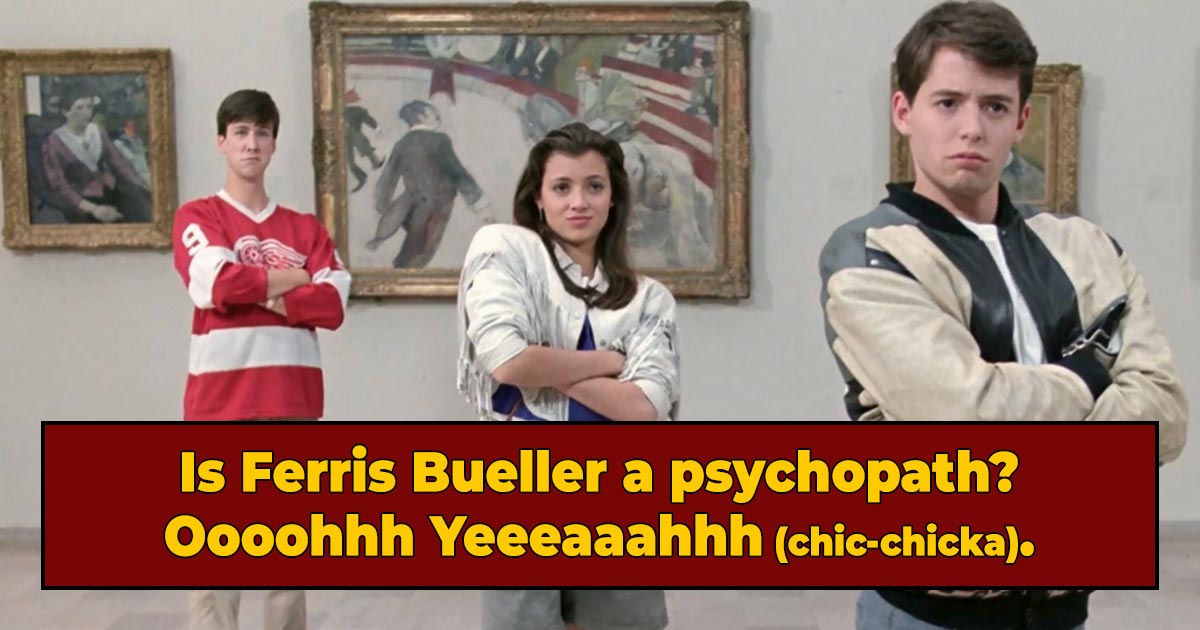
Some movies age like fine wine. Others age like the mysterious Tupperware in the back of your fridge. Ferris Bueller’s Day Off somehow does both at once. It is still breezy, funny, stylish, and weirdly charming, but the older you get, the more one question starts tapping you on the shoulder like an anxious hall monitor: is Ferris Bueller actually the villain?
That may sound dramatic. After all, Ferris is the poster child for youthful rebellion, a suburban folk hero who fakes sick, outsmarts adults, hijacks a parade, and treats Chicago like his personal playground. He breaks the fourth wall, smiles into the camera, and makes you feel like you are in on the joke. But once the laughter settles, another reading appears. Ferris lies constantly. He manipulates almost everyone in his orbit. He pressures his vulnerable best friend into doing things that could ruin his life. He rarely shows real regret. And somehow, he still gets framed as the coolest kid alive.
So yes, the headline is intentionally spicy. Calling Ferris a “textbook psychopath” is not a literal diagnosis. It is a pop-culture argument, a fun but serious way of asking whether John Hughes built one of the most charismatic antiheroes in teen-movie history and then wrapped him in sunshine, synth-pop, and perfect timing. The answer is more complicated than a simple yes or no, which is exactly why the theory has stuck around for decades.
First, Let’s Clear Up the Word “Psychopath”
Before we pin a fake psychiatric label on a fictional high school senior in a leopard-print vest, it helps to define the term. In everyday conversation, people use “psychopath” to describe anyone who is manipulative, cold, selfish, fearless, or wildly unconcerned with rules. Clinically, things are messier. “Psychopathy” is not a formal diagnosis in the same way many people think it is. It is more of a cluster of traits often associated with severe antisocial behavior, lack of remorse, shallow charm, impulsivity, and exploitation of others.
That matters because Ferris is still a teenager, and teenagers are chaos with car keys. They test limits. They chase thrills. They make dumb decisions with the confidence of a Fortune 500 CEO. Modern conversations about adolescent behavior also remind us that teen brains are still developing, especially in areas tied to judgment, impulse control, and long-term consequences. In other words, “reckless teen” and “clinical menace” are not the same category, even if they sometimes wear the same sunglasses.
Still, the theory survives because Ferris does not merely act impulsively. He acts strategically. He is not just rebellious; he is masterfully persuasive. He does not stumble into manipulation by accident. He weaponizes charm like it is one of his core extracurriculars. And that is where the “maybe this guy is kind of terrifying” interpretation starts to get interesting.
The Case Against Ferris: Charm, Control, and Zero Chill
He lies to everyone, constantly
Ferris does not simply fake a sick day. He stages a full production. He performs symptoms, rigs sound effects, manipulates his parents, and sells the illusion with the confidence of a seasoned con artist. Then he escalates. He hacks school records, engineers phone scams, and choreographs overlapping deceptions as if he were running a mini intelligence agency from his bedroom.
That is not normal teen slacking. That is logistical excellence in the service of nonsense. Most kids skip school by mumbling something about a stomachache. Ferris creates a multi-layered misinformation campaign that would make a crisis PR consultant nod in quiet respect.
He uses people, especially Cameron
The most damning evidence against Ferris is not how he treats authority figures. Honestly, most viewers enjoy watching him embarrass pompous adults. The real issue is Cameron. Cameron is anxious, fragile, fearful, and clearly carrying a mountain of family dysfunction. Ferris knows this. He also knows Cameron is the one person most likely to cave under pressure. So what does he do? He pushes him. Hard.
Ferris does not just invite Cameron out for a healing day in the city. He pressures him into stealing emotional oxygen from his own panic. He pushes him to take the Ferrari, a car Cameron’s father values more than his son. He steamrolls every objection with jokes, confidence, and relentless momentum. It is friendship with a sales funnel attached.
Yes, Cameron eventually experiences a breakthrough. Yes, the day helps him confront his father’s power over him. But that outcome does not erase the fact that Ferris drags him there like a motivational speaker who has confused growth with emotional kidnapping.
He shows a suspicious lack of remorse
Ferris lives as if consequences are for other people. He treats rules like decorative wallpaper. He rarely pauses to ask whether his plan might blow back on someone else. Cameron could be destroyed by the Ferrari disaster. Sloane could get caught in the middle of a school scandal. His parents could be humiliated. Rooney, ridiculous as he is, still becomes a human boomerang because Ferris keeps baiting the system.
And Ferris? Ferris keeps grinning. Not a guilt grin. Not a “wow, maybe I overdid it” grin. More of a “this is going great, actually” grin. That emotional smoothness is exactly what makes the theory so seductive. He does not read as merely reckless. He reads as strangely untroubled by collateral damage.
He is a social engineer in a varsity jacket
Everywhere Ferris goes, reality bends around him. Teachers, parents, restaurant staff, classmates, and random strangers respond to his confidence like they have all been hypnotized by cheekbones and timing. He knows how to mirror people, flatter them, distract them, and redirect attention. He is the human version of a beautifully designed pop-up ad: irresistible, polished, and slightly alarming once you realize what just happened.
There is a reason viewers who once idolized Ferris often grow up and start muttering, “Wait, this kid is basically running a charm-based regime.” He does not merely rebel against the world. He gets the world to participate in his rebellion.
Why the Theory Feels So Convincing
The genius of the movie is that it puts you under Ferris’s spell before you have time to resist. He talks straight to the audience. He lets you in on the tricks. He gives you the thrill of breaking rules without the usual movie punishment. That narrative design matters. Ferris is not only the protagonist. He is also the spin doctor of his own legend.
If another character described these same events, the movie would feel completely different. Imagine Ferris Bueller’s Day Off told from Cameron’s point of view. Suddenly it becomes the story of an anxious teen being dragged across Chicago by his unnervingly gifted friend, who lies for sport, commandeers a luxury car, and leaves destruction in his wake. That sounds less like a comedy and more like the opening act of a cautionary drama.
Even the movie’s visual joy adds to the argument. Ferris moves through museums, baseball games, restaurants, and parade floats like a prince who has mistaken the city for a sandbox. The style is so buoyant that it disguises how controlling he can be. It is a magic trick. The audience is laughing so hard that it does not notice the wallet disappearing from its back pocket.
The Counterargument: Ferris Is Not a Monster, He Is a Movie
Now for the fair defense. Ferris is not written as a clinical case study. He is written as a wish-fulfillment fantasy. He is the teenager who says what everyone wishes they could say, escapes what everyone wishes they could escape, and turns one stolen day into something huge, cinematic, and unforgettable. Calling him a psychopath in a literal sense misses the genre entirely.
John Hughes did not build Ferris as a horror figure. He built him as a pressure-release valve. The school is deadening. The adults are distracted or absurd. The routines are soul-flattening. Ferris is the interruption. He is the fantasy of refusing to let institutions define your best years. That helps explain why so many viewers still adore him. He represents freedom, not pathology.
There is also the Cameron factor. For all his selfishness, Ferris does seem genuinely invested in helping his friend. His methods are obnoxious, invasive, and occasionally worthy of legal review, but the movie frames his mission as emotional rescue. Roger Ebert famously called the film sweet and warm-hearted, in part because Ferris’s wild day is really tied to Cameron’s growth. That does not excuse Ferris’s manipulations, but it does complicate them.
In other words, Ferris may be controlling, but he is not empty. He may be irresponsible, but he is not depicted as cruel for cruelty’s sake. He does not seek suffering. He seeks motion, excitement, victory, and total domination of the narrative. Which, to be fair, is still a little exhausting.
The Real Twist: Cameron Is the Soul of the Movie
If Ferris is the engine, Cameron is the conscience. That is why the movie works. Ferris, for all his iconic swagger, is emotionally static. He begins the movie confident, adored, and slippery, and he ends it basically the same way. Cameron is the one who changes. He is the one who cracks open. He is the one who finally decides he cannot live in fear of his father forever.
This is the sneaky brilliance of the movie. Ferris thinks he is the main attraction, and on the surface he is. But the emotional center belongs to Cameron. Without Cameron, Ferris is just a hyper-competent prankster on a field trip. With Cameron, the story becomes something richer: a comedy about rebellion that quietly turns into a drama about paralysis, resentment, and growing up.
That is also why the “Ferris is a psychopath” reading will never completely win. The movie knows he is too much. It balances him with someone who feels deeply, suffers visibly, and forces the audience to reckon with the emotional cost of Ferris’s momentum. Cameron keeps the film human. He is the gravity that prevents Ferris from floating off into pure cartoon narcissism.
So, Is Ferris Bueller a Textbook Psychopath?
Not literally. Not clinically. Not in a way any responsible person should present as an actual diagnosis. But as a cultural reading? As a cheeky, provocative theory about one of cinema’s most charming manipulators? Absolutely, the argument has legs.
Ferris displays many traits people associate with psychopathy in pop culture: charisma, deceit, calculated manipulation, fearlessness, impulsivity, and a startling ability to treat rules like punchlines. He can be selfish, reckless, and emotionally slippery. If he showed up in real life, most sensible adults would not call him “a righteous dude.” They would call him “the reason we need stronger school verification procedures.”
And yet that tension is exactly what makes him iconic. Ferris is both a dream and a warning. He is the fantasy of total freedom wrapped around the unsettling possibility that some charming people are only charming because the world has not yet sent them an invoice. He is hilarious because he wins. He is fascinating because, morally speaking, he probably should not.
Why This Reading Resonates More With Age
When you watch Ferris Bueller’s Day Off as a kid, Ferris looks like liberation. He has nerve, style, timing, and zero interest in authority. It feels glorious. Watching as an adult is a different experience. You start noticing who cleans up the mess. You start recognizing the emotional labor happening around him. You start seeing that being the most entertaining person in the room is not the same thing as being the healthiest one.
That shift in perspective is one of the movie’s secret strengths. It plays differently at 15, 25, and 45. Teen viewers see an escape fantasy. Adults often see a polished chaos goblin. Parents may see a blood-pressure event with excellent soundtrack choices. The film survives every reading because it is smart enough to support all of them.
And maybe that is the best verdict. Ferris is not a textbook psychopath. He is something more interesting: a beloved cinematic trickster who becomes more ethically suspicious the more life experience you bring to him. He is fun until you imagine dealing with him in real life, at which point you immediately want Cameron to have a therapist, Sloane to have firmer boundaries, and the school to have better cybersecurity.
Experience Section: What It Feels Like to Rewatch Ferris Bueller Now
Rewatching this movie today is a strangely layered experience, almost like meeting a high school classmate at a reunion and realizing the guy everyone called “legendary” may actually have been running a low-grade social experiment on the entire student body. The first feeling is nostalgia. The music kicks in, the camera starts moving, and there is that old familiar rush. The movie still has bounce. It still has sparkle. It still feels like summer got dressed up and decided to skip homeroom.
Then the second feeling arrives: suspicion. Not huge suspicion at first. More like a tiny voice clearing its throat in the back of your mind. Ferris talks directly to the camera and suddenly he does not seem merely funny. He seems strategic. He is not sharing his thoughts with you because you are special. He is recruiting you. You become his accomplice before you have even had coffee.
That is what makes the rewatch experience so much fun. You are laughing, but you are also auditing the damage. You start noticing Cameron’s face more. You realize that Sloane spends a good portion of the day calmly tolerating a man who operates like a charisma-fueled weather system. You realize Jeanie, once dismissed as uptight, may actually be the only person in the movie responding to Ferris with appropriate levels of concern.
There is also a very adult kind of panic in watching the logistics unfold. The fake illness. The school calls. The restaurant scam. The Ferrari. The citywide detour. The sprint home. As a younger viewer, it all feels effortless. As an older one, it feels like watching someone juggle chainsaws over a hardwood floor while smiling at the camera and saying, “Relax, I’ve got this.”
But the oddest part of the experience is that the movie still works. Even after you have become deeply skeptical of Ferris’s moral operating system, the film keeps charming you. The museum sequence still lands. The Chicago imagery still glows. Cameron’s breakthrough still matters. The parade still feels like bottled joy. That is the real magic trick. The movie lets you become wiser without forcing you to become joyless.
So the modern experience of Ferris Bueller’s Day Off is not about canceling Ferris or pretending the movie was secretly dark all along. It is about realizing the film contains more friction than you noticed the first time. Ferris can be exhilarating and alarming. He can be a fantasy and a red flag. He can be the coolest kid in the room and the person you would absolutely not lend your car to. That duality is why people still talk about him. Plenty of movie characters are likable. Very few remain likable after you start building a case file on them.
And maybe that is why the psychopath theory endures. Not because viewers truly believe Ferris belongs in a psychiatric textbook, but because the movie becomes richer once you admit that his charm has a shadow. Rewatching it now feels like standing in front of a familiar painting and suddenly seeing a detail that was always there. The image has not changed. You have.