Greek mythology did not believe in keeping things simple. A normal lion? Too plain. A snake? Not dramatic enough. A woman who asks riddles, has wings, and eats people who fail the quiz? Now we are getting somewhere. The ancient Greeks created some of the strangest creatures in world mythology, and they were not just random nightmare fuel. These monsters explained danger, chaos, storms, disease, temptation, fear, and the very uncomfortable truth that heroes need something terrifying to fight before anyone writes songs about them.
The best Greek mythological creatures are unforgettable because they combine the familiar with the impossible. A goat becomes part of a fire-breathing lion. A serpent grows back twice as angry. A beautiful song turns into a death trap. These beings are bizarre, yes, but they are also deeply symbolic. They reveal how ancient people imagined the wild edges of the world: swamps, caves, mountains, oceans, grave markers, and the strange corners of human desire.
Below are six of the strangest creatures in Greek mythology, chosen not only because they look like they were assembled during a thunderstorm, but because their stories still influence books, movies, games, art, and everyday language today.
1. The Chimera: The Fire-Breathing Animal Mashup
If Greek mythology had a “design your own disaster” contest, the Chimera would win first prize and probably set the trophy on fire. The Chimera was usually described as a terrifying hybrid with the body and head of a lion, a goat’s head rising from its back, and a serpent for a tail. As if that were not enough, it breathed fire. One animal was apparently not enough trouble, so mythology glued three of them together and added a flamethrower.
The Chimera’s story is closely connected with Lycia in Anatolia, where it was said to ravage the countryside and destroy herds. In many traditions, it was the child of Typhon and Echidna, two of the most important monster-parents in Greek myth. That family tree is less “cute holiday reunion” and more “please alert the nearest hero.”
Why the Chimera is so strange
The Chimera is strange because it represents a perfect violation of natural order. It is not simply big or dangerous; it is biologically impossible. Lion, goat, and snake belong to different worlds, yet in this myth they become one living threat. That is why the word “chimera” still survives today as a way to describe something made of mismatched parts or an impossible fantasy.
The hero Bellerophon defeated the Chimera with help from Pegasus, the winged horse. In one famous version, Bellerophon attacked from above, using the sky as his battlefield. The image is wonderfully cinematic: a flying horse, a fire-breathing monster, and a hero trying very hard not to become barbecue.
2. The Lernaean Hydra: The Monster That Made Problems Multiply
The Lernaean Hydra is one of the most famous Greek mythology monsters because it turns a simple problem into a management crisis. The Hydra was a gigantic serpent-like creature that lived near the swamps of Lerna. It had multiple heads, and when one was cut off, more grew back. That is not a monster; that is an inbox after vacation.
Heracles faced the Hydra as one of his Twelve Labors. At first, the usual heroic strategyhit the monster until it stops being a monsterdid not work. Every blow made the danger worse. With help from Iolaus, Heracles solved the problem by cauterizing the neck stumps after cutting off the heads, preventing new ones from growing. In some versions, one head was immortal and had to be buried under a heavy rock.
What the Hydra symbolizes
The Hydra is strange because it is not just physically frightening; it behaves like a metaphor. Cut away one bad habit, and two excuses appear. End one argument, and three group chats explode. The Hydra is the ancient Greek version of a problem that multiplies when handled badly.
Its swampy home also matters. Lerna was associated with water, depth, and danger. A many-headed serpent emerging from that landscape made the Hydra feel like a living disease of the earth. The story suggests that brute strength alone cannot solve every crisis. Sometimes a hero needs strategy, teamwork, and possibly a very hot torch.
3. Typhon: The Storm Giant Who Challenged Zeus
Typhon was not merely a monster. He was the monster’s monster, the final boss of Greek mythology, the cosmic panic button. Descriptions vary, but he was often imagined as a gigantic storm-being with serpentine features, wings, fire flashing from his eyes, and a body so enormous that he threatened the heavens themselves. In some traditions, he had serpent legs or countless snake-like heads. Subtlety was not his brand.
Typhon’s most important myth is his battle with Zeus. After the Olympian gods defeated the Titans, Typhon rose as a terrifying challenger to divine rule. His conflict with Zeus was not just a monster fight; it was a struggle over cosmic order. If Zeus represented the storm as controlled power, Typhon represented the storm as chaos without a leash.
Why Typhon matters in Greek mythology
Typhon is strange because he is both creature and catastrophe. He is a body, a weather event, a rebellion, and a volcano-shaped nightmare all at once. Later traditions linked him with Mount Etna, imagining him trapped beneath the earth, where his rage explained volcanic fire and violent eruptions.
He also matters because he sits at the root of many monster genealogies. Typhon and Echidna were often credited as parents of famous creatures such as the Hydra, Chimera, Cerberus, and the Sphinx. In other words, when Greek mythology needed a terrifying family tree, Typhon was standing there with smoke coming out of his ears.
4. Echidna: The Mother of Monsters
Echidna may be less famous than Medusa or the Minotaur, but she deserves a top spot among the strangest creatures in Greek mythology. She was commonly imagined as half-woman and half-serpent: beautiful or human-like above, snake-like below. That dual form made her unsettling because she crossed boundaries between attraction and horror, civilization and wilderness, human and animal.
Known as the “mother of monsters,” Echidna was linked to some of the most dangerous beings in Greek myth. Depending on the source, her children included the Hydra, Chimera, Cerberus, Orthrus, the Sphinx, and other nightmare celebrities. If Greek monsters had a yearbook, Echidna would be listed under “Most Likely to Produce a Hero’s Career.”
The deeper meaning of Echidna
Echidna’s strangeness comes from her role as origin point. She is not just a single monster to be defeated in one adventure. She is a source of monstrous possibility. Her serpent body connects her to the earth, caves, poison, and hidden danger. Her human upper form makes her harder to dismiss as merely animal.
In mythological storytelling, creatures like Echidna often mark the border between the known world and the unknown. She belongs to the places where rules break down. Heroes may slay her children, but the idea she represents is harder to kill: the world always contains something older, stranger, and more dangerous than human order.
5. The Sphinx: The Riddle Monster With a Deadly Grading Policy
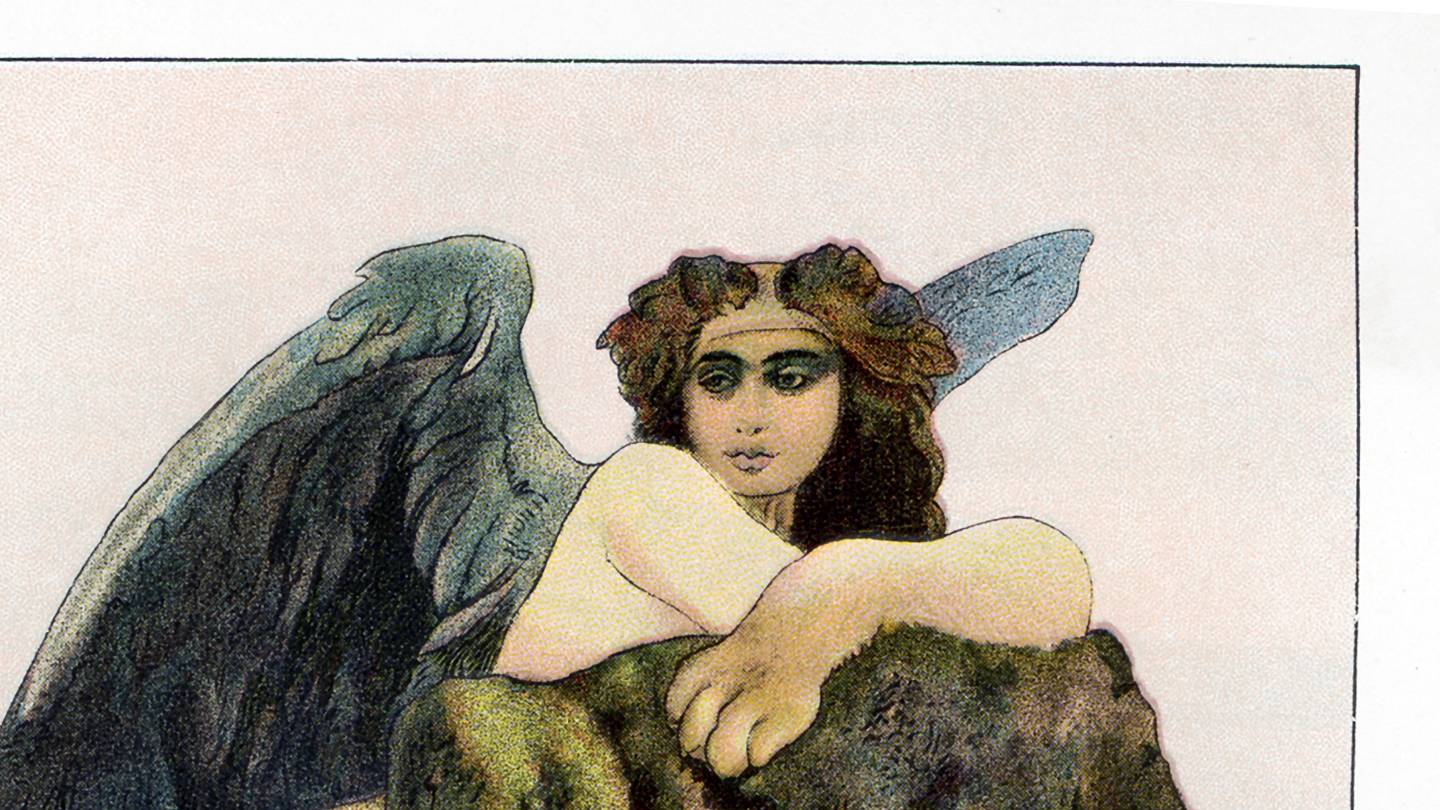
The Greek Sphinx was a creature with a woman’s head, a lion’s body, and often wings. Unlike the Egyptian sphinx, which was usually male and associated with royal power, the Greek Sphinx became a dangerous female monster connected with riddles, death, and the city of Thebes.
Her most famous story involves Oedipus. The Sphinx blocked the road to Thebes and asked travelers a riddle: what walks on four legs in the morning, two at noon, and three in the evening? Those who failed were killed. Oedipus answered correctly: a human being, who crawls as a baby, walks upright as an adult, and uses a cane in old age. After he solved the riddle, the Sphinx destroyed herself in many versions of the myth.
Why the Sphinx is unforgettable
The Sphinx is strange because she attacks with intelligence. She is not simply a clawed beast leaping from the bushes. She turns language into a weapon. Her body is hybrid, but her real danger is the mind game. She makes survival depend on interpretation.
That is why the Sphinx remains one of the most powerful Greek mythological creatures. She represents mystery, thresholds, and the fear of not understanding the question life is asking. Also, let us admit it: a monster that eats you for failing a riddle is basically the world’s harshest standardized test.
6. The Sirens: Beautiful Voices, Terrible Customer Reviews
Modern audiences often imagine Sirens as mermaids, but in ancient Greek tradition they were frequently depicted as bird-women: creatures with female heads or upper bodies and bird-like forms. Their power was not brute force. It was song. The Sirens lured sailors toward destruction with voices so irresistible that men forgot their homes, duties, and common sense.
The most famous Siren episode appears in the story of Odysseus. Warned about their deadly music, he ordered his sailors to plug their ears with wax while he had himself tied to the mast. That way, he could hear the song without steering the ship into disaster. This is either heroic curiosity or the most dramatic way in history to listen to live music responsibly.
Why the Sirens are stranger than they seem
The Sirens are strange because they blur beauty and death. They are not ugly monsters chasing victims with claws. They are attractive, musical, and persuasive. Their danger lies in desire. They know what sailors want to hear, and they use longing as bait.
In that sense, Sirens are among the most psychologically interesting creatures in Greek mythology. They represent temptation, distraction, and the sweet voice of self-destruction. The myth warns that not every beautiful invitation leads somewhere good. Sometimes the song is lovely because the trap is expensive.
Why Greek Mythology Created Such Strange Creatures
The strangest creatures in Greek mythology are rarely strange for no reason. Their bodies tell stories. Hybrids like the Chimera and Sphinx combine animals to show disorder, danger, or foreign mystery. Serpentine monsters like the Hydra and Echidna connect fear with the earth, poison, swamps, caves, and regeneration. Winged beings like Sirens and Harpies link the sky with sudden disappearance, speed, and the unseen forces that interrupt human plans.
Greek monsters also made heroes meaningful. Heracles is impressive because the Hydra is nearly impossible to defeat. Bellerophon becomes legendary because the Chimera is beyond ordinary human power. Oedipus gains entry to Thebes because he solves the Sphinx’s riddle. Monsters created tests, and tests created stories worth repeating.
There is also a cultural reason these creatures endured. Greek mythology traveled through poetry, drama, vase painting, sculpture, local cult, Roman adaptation, Renaissance art, and modern entertainment. Each generation reshaped the creatures slightly. The Sirens became more mermaid-like in later imagination. The Chimera became a scientific and literary word. The Hydra became a metaphor for problems that multiply. These monsters survived because they are flexible. Like the Hydra, cut them out of one era and they grow back in another.
What These Creatures Teach Us Today
Even though nobody is likely to meet a Chimera on the way to the grocery store, Greek mythological creatures still feel relevant. The Hydra teaches that some problems require smarter systems, not louder swords. The Sphinx reminds us that knowledge can be a matter of survival. The Sirens warn us about seductive distractions. Typhon represents chaos that challenges order. Echidna reminds us that fear often comes from hidden sources. The Chimera shows the terror of things that should not fit together but somehow do.
That is why these ancient monsters keep showing up in novels, films, video games, brand names, psychology, biology, and everyday conversation. We still talk about “hydra-headed” problems, “chimeric” combinations, and “siren songs” because the Greeks built creatures that were larger than their original myths.
Personal Experiences and Modern Encounters With Greek Mythology’s Strangest Creatures
One of the most enjoyable experiences related to Greek mythology is realizing that these creatures are not locked away in dusty books. They are everywhere once you learn to recognize them. Walk through a museum gallery, and suddenly a vase is not just a vase. It is a tiny ancient movie screen showing Bellerophon charging the Chimera, Heracles wrestling some impossible beast, or a Sphinx perched like she owns the entire room. Ancient artists loved these monsters because their bodies were visually exciting. A normal horse is elegant, but a winged horse facing a fire-breathing lion-goat-snake creature? That gets people to stop and look.
Reading Greek myths as an adult can also be surprisingly funny. As a child, you may think, “Wow, Heracles is strong.” As an adult, you think, “Who assigned this man twelve impossible tasks, and did he have dental insurance?” The Hydra story feels especially modern. Everyone has faced a Hydra: a household repair that creates three new repairs, a simple email that becomes a meeting, or a small problem that grows heads faster than you can cut them off. The myth works because it captures the emotional truth of being overwhelmed.
The Sirens feel even more familiar in the digital age. Ancient sailors had to worry about supernatural singers on a rocky island. Modern people have glowing screens singing, “Just one more video.” Odysseus tying himself to the mast suddenly seems less bizarre. He understood temptation management. He did not pretend he was immune; he built a system to survive the song. Honestly, that is excellent productivity advice from a man famous for taking ten years to get home.
The Sphinx also has a modern personality. She represents the pressure of being tested by a question that looks simple until your brain starts sweating. Her riddle about human life is brilliant because it turns age into a puzzle. The answer is not a monster, a god, or a magic object. The answer is us. That is the trick behind many Greek myths: the strangest creature in the story often reveals something ordinary and human underneath.
Typhon and Echidna, meanwhile, make Greek mythology feel huge. They remind readers that monsters were not just individual villains. They belonged to a cosmic ecosystem. Typhon is storm, rebellion, and volcanic violence. Echidna is hidden danger, fertility, and the dark imagination of the earth. Together, they make the monster world feel connected. It is like discovering that all the scariest creatures went to the same family reunion and nobody survived the potato salad.
Perhaps the best modern experience of these myths is seeing how flexible they are. A video game can turn the Hydra into a boss battle. A fantasy novel can reinvent the Sirens as tragic figures. A science article can use “chimera” to describe biological mixture. A business writer can call a difficult project “hydra-headed,” and everyone instantly understands the problem. These creatures remain alive because they are not just monsters. They are symbols with teeth.
For readers new to Greek mythology, the best way to enjoy these creatures is not to memorize every family tree first. Greek monster genealogy can get complicated quickly, and after a while everyone seems to be related to Typhon, Echidna, or a suspiciously dramatic river god. Start with the stories. Picture the scene. Ask what fear the creature represents. Then notice how often the same fear appears in modern life. That is when the myths stop feeling ancient and start feeling oddly current.
The strangest creatures in Greek mythology endure because they are entertaining, meaningful, and wonderfully weird. They let us laugh at impossible anatomy while thinking about real problems: temptation, chaos, intelligence, survival, and the courage to face what should not exist. The Greeks may not have had movie studios, but they absolutely understood special effects.
Conclusion
Greek mythology is packed with strange creatures, but the Chimera, Hydra, Typhon, Echidna, Sphinx, and Sirens stand out because they are more than monsters. They are ideas given bodies. Some breathe fire, some sing, some multiply, and some ask riddles with extremely serious consequences. Together, they show why Greek mythology remains one of the richest storytelling traditions in the world.
These creatures are strange because they combine fear with imagination. They turn storms into giants, temptation into music, disease-like persistence into a many-headed serpent, and mystery into a winged lion-woman waiting at the gate. That is the real magic of Greek myth: it makes invisible human anxieties visible, memorable, and just weird enough to last for thousands of years.