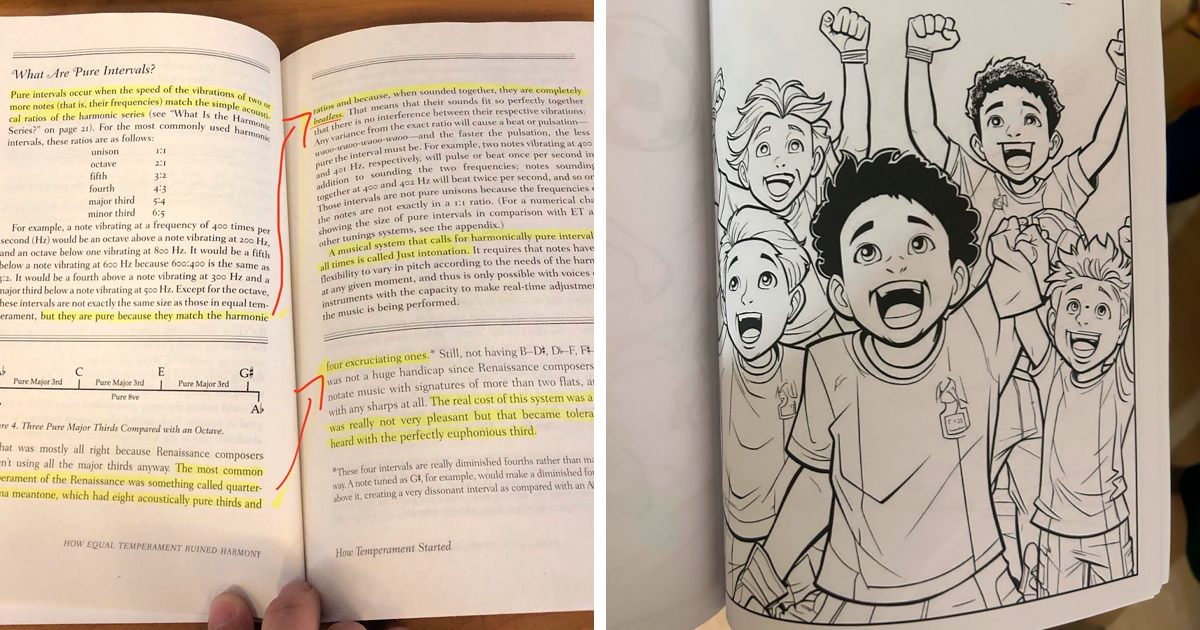
Book lovers are peaceful peopleuntil someone folds a dust jacket backward like it owes them money. Then the cardigan comes off, the reading glasses lower, and a quiet little storm forms somewhere between “excuse me” and “how dare you.” The internet has made these tiny literary tragedies impossible to ignore. From missing pages and upside-down chapters to coffee-soaked library books and decorative shelves arranged by “vibe” instead of sanity, readers everywhere have found one universal truth: books may be paper, but our feelings about them are hardcover.
The phrase “50 Times Book Lovers Were Horrified By What They Saw And Just Had To Share It” captures a very specific corner of online culture: the world of book crimes. These are not always dramatic crimes, of course. Nobody is calling the FBI because someone used a slice of pizza as a bookmarkalthough emotionally, yes, we are pressing charges. Book horror can be funny, painful, oddly relatable, and sometimes genuinely educational. It reminds us that books are objects with value, memory, design, craftsmanship, and, occasionally, pages 87 through 104 printed twice while pages 105 through 122 have gone on vacation.
Why Book Lovers Take “Book Crimes” So Personally
To non-readers, a damaged book may look like a small inconvenience. To a bibliophile, it can feel like watching a tiny cultural monument get drop-kicked. Books are not just containers for stories. They are gifts, collectibles, study tools, heirlooms, comfort objects, and evidence that someone once said, “I will finish this 700-page fantasy novel,” and then bravely carried it around for three months.
There is also a practical reason readers react so strongly. Books are surprisingly vulnerable. Paper expands when wet. Bindings weaken when forced flat. Corners crease permanently. Cheap tape can stain pages over time. A book can survive a century in a careful collection and then be defeated in five minutes by a leaky water bottle in a backpack. That is why librarians, archivists, collectors, and everyday readers all develop strong opinions about handling books with care.
The 50 Book Lover Horror Moments Readers Can’t Forget
Here are 50 types of book-related disasters that make readers gasp, laugh nervously, and immediately take photographic evidence for the group chat.
Physical Book Damage That Hurts the Soul
- The cracked spine: A paperback opened so violently that the spine looks like a sidewalk after an earthquake.
- The dog-eared page: A folded corner that says, “I own bookmarks but have chosen chaos.”
- The coffee ring: A perfect brown circle on a cream page, like a crime scene drawn by a barista.
- The bathtub casualty: A once-proud novel swollen into a paper accordion after “just one relaxing chapter.”
- The beach book full of sand: Every page turn sounds like a tiny gravel driveway.
- The cracked hardcover hinge: That horrifying moment when the cover starts separating from the text block.
- The bent cover corner: Especially tragic when the book arrived brand new in a box big enough for a microwave.
- The greasy fingerprint: A permanent souvenir from someone who read during fries.
- The torn dust jacket: The fancy coat of the book, now looking like it survived a raccoon disagreement.
- The loose page: One page drifting out like it has resigned from the story.
Printing Errors That Make Readers Question Reality
- Missing pages: The plot jumps from a confession to a funeral, and the reader is left blinking at the ceiling.
- Repeated pages: Page 142 appears again where page 143 should be, because apparently the book needed déjà vu.
- Upside-down chapters: The reader rotates the book like they are opening a secret vault.
- Blank pages in the middle: Not artistic silence. Just panic.
- Wrong cover on the book: A romance cover hiding a business manual is one way to ruin both date night and quarterly planning.
- Bad trimming: Text sliced too close to the edge, as if the printer had a grudge against margins.
- Ink smears: A paragraph that slowly becomes a weather forecast.
- Misbound sections: Chapter 9 arrives before Chapter 4 and refuses to explain itself.
- Color printing gone wrong: Illustrations that look sunburned, haunted, or both.
- Typo on the cover: The one place where spellcheck should have been wearing a cape.
Library and Shared Book Nightmares
- Underlined library books: Someone highlighted half the chapter and none of the useful parts.
- Personal notes in the margins: Occasionally charming, often just “lol” next to tragedy.
- Food crumbs in the gutter: The binding did not request trail mix.
- Sticky mystery pages: A phrase no reader ever wants to investigate.
- Library books returned wet: The book version of coming home from battle.
- Pages cut out: A villain origin story for librarians.
- Receipts used as bookmarks forever: Not horrifying, but strangely intimate. Why did you buy batteries, soup, and glitter in 2016?
- Flattened books on scanners: A common way to stress bindings until they give up.
- Books shoved too tightly on shelves: Removing one becomes an upper-body workout and a preservation risk.
- Children’s books with “improvements”: Crayon mustaches, dinosaur stickers, and one suspiciously green moon.
Bookstore, Shipping, and Collecting Disasters
- A rare book wrapped in plastic tape: Good intentions, terrible chemistry.
- A collectible first edition stored in a damp basement: Mold loves a plot twist.
- Books shipped with no padding: The box arrives fine; the book looks emotionally unavailable.
- Signed books with smeared signatures: Autograph meets thumbprint, everybody loses.
- Price stickers on delicate covers: Removing them becomes a high-stakes surgical procedure.
- Sun-faded spines: A rainbow shelf slowly becoming beige soup.
- Dust jackets discarded: Collectors everywhere just felt a cold breeze.
- Books stacked under heavy decor: Nothing says “I love literature” like crushing it with a ceramic pineapple.
- Incorrect author names on listings: A small error that can confuse buyers and make search engines sigh.
- Book boxes damaged in transit: The moment a reader opens a package and whispers, “Who hurt you?”
Social Media Book Crimes
- Books arranged backward: Pages facing out may look minimalist, but readers want titles, not a wall of beige secrets.
- Books sorted by color only: Beautiful until you need to find one specific novel before midnight.
- Fake books as decor: A room full of hollow spines is the literary equivalent of inflatable fruit.
- Books used as plant stands: Water plus paper equals heartbreak with leaves.
- Book pages folded into crafts: Pretty, yes. Still emotionally complicated.
- Readers spoiling endings in comments: Digital vandalism, now with emojis.
- Books placed face-down open: Also known as the spine-stretching yoga pose nobody asked for.
- Movie tie-in covers replacing classic art: Some readers accept it. Others need three business days to recover.
- AI-looking book covers with strange hands: The dragon has seven claws and the hero has seventeen fingers. Excellent.
- Book bans and removals: The most serious horror on the list, because losing access to books affects entire communities.
Some Book Horrors Are Funny. Others Are Serious.
It is easy to laugh at a paperback with a bite mark from a dog who apparently wanted literary fiber. But some book-related horror stories point to bigger issues. When books are banned, challenged, removed, or restricted, the damage is not cosmetic. It affects readers’ access to ideas, histories, identities, and perspectives. For many librarians and educators, the most frightening book crime is not a coffee stain; it is a shelf made quieter by pressure, fear, or censorship.
That is why the funniest book-lover posts often sit next to more serious conversations. A misprinted chapter is annoying. A damaged rare book is expensive. A removed book can be culturally harmful. The internet’s obsession with book crimes works because it combines comedy with genuine affection. Readers are not dramatic for caring. They know books carry more than words. They carry access.
Why Misprints and Production Errors Still Happen
Modern book production is impressive, but it is not magic. Traditional print runs and print-on-demand systems both involve files, machines, trimming, binding, shipping, and quality checks. Somewhere in that chain, things can go sideways. A file can be uploaded incorrectly. A printer can produce uneven color. A batch can be trimmed too close. A book can be bound with sections out of order. The result is the kind of copy that makes a reader stop mid-sentence and wonder whether the author has invented a new experimental structure called “Oops.”
Most printing defects are not collectible treasures. Usually, they are just defective copies that should be replaced. Still, they become internet-famous because they break the private reading spell. One second you are deep in a murder mystery; the next, the book has repeated the same four pages and turned you into a detective in real life.
How to Avoid Becoming the Villain in a Book Lover’s Story
Good book care does not require museum gloves, a velvet rope, or a dramatic soundtrack. It mostly requires common sense. Wash and dry your hands before handling special books. Keep food and drinks away from valuable copies. Use a real bookmark instead of folding corners. Do not force a book to lie flat if the binding resists. Store books away from damp basements, hot attics, direct sunlight, and overstuffed shelves. If a book is already damaged, avoid quick fixes like office tape, which can stain and stiffen over time.
For everyday paperbacks, a little wear is part of the charm. A cracked spine on a beloved beach read may be proof that the book did its job. But for rare books, signed editions, family heirlooms, library materials, or expensive hardcovers, careful handling matters. The goal is not to treat every book like a sacred artifact. The goal is to avoid turning a perfectly healthy novel into a cautionary tale with page numbers.
What These Viral Book Disasters Reveal About Readers
Book lovers share these horrifying finds because they are funny, but also because they create instant community. Every reader has a boundary. Some people can tolerate a highlighted page but not a broken spine. Others can survive a coffee stain but consider spoilers a federal offense. The debate is part of the fun.
These posts also reveal how physical books still matter in a digital world. Ebooks are convenient, audiobooks are powerful, and online reading is everywhere. Yet readers still feel fiercely protective of printed books. The texture of pages, the smell of paper, the cover design, the margin notes, the shelf presencethese details create attachment. A physical book can become part of a person’s life in a way that a file rarely does. That is why seeing one mistreated can trigger such theatrical despair.
Personal Experiences Every Book Lover Will Recognize
Ask any serious reader about their worst book-related experience, and they will usually pause like a veteran preparing to discuss a difficult campaign. Maybe it was the friend who borrowed a pristine hardcover and returned it with a cracked spine, bent corners, and the confidence of someone who saw no problem. Maybe it was the online order that arrived in a flimsy envelope, its corners smashed so badly the book looked like it had been mailed through a tornado. Or maybe it was the heartbreaking discovery of a favorite childhood book in a storage box, curled and spotted after years in a damp garage.
One of the most relatable experiences is lending a book and slowly realizing it may never come home. At first, you are generous. “Take your time,” you say, because you are a civilized person. Three months later, you ask politely. Six months later, you see the person post a photo of their bookshelf, and there it isyour book, standing there like a hostage in good lighting. At that moment, every book lover understands the need for a personal library checkout system, complete with due dates and emotional damages.
Another common experience is buying a used book and finding evidence of a previous life tucked inside. Sometimes it is sweet: a postcard, a grocery list, a pressed flower, a birthday note. Sometimes it is confusing: a dentist appointment card from 1998, a breakup letter, or a receipt for three cans of tuna and a single birthday candle. These discoveries can feel like tiny time capsules. They remind readers that books move through many hands, gathering private histories along the way.
Then there is the horror of reading in public and seeing someone commit a book crime in real time. A person bends a paperback completely backward. Another uses a pen as a bookmark and clips it deep into the pages. Someone puts a sweating iced coffee directly on top of a hardcover. You want to intervene, but society has rules, so you sit there silently, gripping your own book like it needs protection.
Book lovers also know the mixed emotion of loving a book to piecesliterally. A favorite paperback may eventually become soft, faded, and full of creases. The spine may lean. The cover may peel. The pages may carry fingerprints from years of rereading. This kind of wear is different from careless damage. It is affection made visible. A book destroyed by neglect is sad; a book softened by love is a trophy.
That is the funny contradiction at the heart of book collecting and reading culture. We want books to be used, read, shared, carried, opened, discussed, and loved. But we also want people to respect them. The best readers know the balance: enjoy the book, but do not drown it in soup. Share the story, but do not spoil the ending. Lend the copy, but return it before the lender starts making eye contact with your bookshelf. In the end, every horrifying book moment proves the same thing: readers care deeply, dramatically, and sometimes hilariously about the objects that carry the stories they love.
Conclusion
The world of book lover horror is full of tiny tragedies: torn pages, cracked spines, missing chapters, coffee stains, strange bookmarks, and design choices that make readers question civilization. But underneath the jokes is something sincere. People share these moments because books matter. They matter as stories, objects, memories, tools, and symbols of access to knowledge. Whether you are a collector, a casual reader, a librarian, a student, or someone who buys books faster than you can read them, the lesson is simple: treat books with care, share them generously, and neverunder any circumstancesuse barbecue sauce as a bookmark.
Note: This article is an original SEO-friendly synthesis based on real reader-community examples, library preservation guidance, book care practices, and publishing-quality issues. It does not reproduce or copy any existing list.