Some childhood games arrive in our memories wearing sneakers, sticky fingers, and the smell of pizza rolls. They seem simple: roll dice, draw cards, press buttons, shout “UNO,” blame your sibling, repeat. But behind many of the most beloved classic games are origin stories so odd they sound like urban legends invented during a sleepover after too much orange soda.
Monopoly began as a warning about greed. Candy Land came from a hospital ward. Twister was once considered scandalous. Pac-Man may owe his shape to a missing slice of pizza. And The Oregon Trail, that educational rite of passage where everyone somehow developed dysentery before lunch, started on a teletype machine before personal computers were common in classrooms.
This nostalgic game history roundup looks at 20 games we grew up on, from board games and card games to arcade classics and video games. The backstories are real, the memories are loud, and yes, someone is still mad about landing on Boardwalk with a hotel.
Classic Games With Surprisingly Weird Origins
1. Monopoly: The Anti-Monopoly Game That Became Monopoly
Monopoly is the game that teaches children financial strategy, property ownership, and how quickly a pleasant family evening can become a courtroom drama. The weird part? It began as The Landlord’s Game, created by Elizabeth Magie in the early 1900s to criticize monopolies and show how concentrated land ownership could hurt ordinary people.
Over time, the game evolved through different versions before Parker Brothers popularized the Monopoly we know today. In other words, one of capitalism’s most famous board games started as a critique of capitalism. That is not just irony; that is irony wearing a top hat and charging rent.
2. Candy Land: A Sweet Escape From a Difficult Place
Candy Land looks like pure sugar: gumdrops, lollipops, bright colors, zero strategy, and enough cheer to make a dentist nervous. But its backstory is surprisingly touching. Retired schoolteacher Eleanor Abbott created the game in the late 1940s while recovering from polio in a hospital, surrounded by children facing the same illness.
The game required no reading, counting, or complex decision-making, making it accessible to young children stuck in long recoveries. Candy Land’s rainbow path was not just decoration; it was a small act of comfort. That makes every trip through the Peppermint Forest feel a little more meaningful.
3. Scrabble: Born From Unemployment and Letter Math
Scrabble feels like a cozy word game until someone plays “qi” on a triple-word score and becomes unbearable for the rest of the evening. The game was created by Alfred Mosher Butts, an architect who found himself out of work during the Great Depression.
Butts did not simply toss letters into a bag and hope for vocabulary magic. He studied letter frequency in newspapers to decide how many of each tile should exist and how much each letter should be worth. So every Z, Q, and X in your rack carries a little Depression-era data science. Scrabble is basically spreadsheets with attitude.
4. Clue: A Mystery Game From Wartime Boredom
Clue, known as Cluedo outside North America, was invented by British musician Anthony Pratt and his wife, Elva, during World War II. Pratt had observed murder-mystery parlor games in hotels, then adapted that social guessing format into a board game during the long indoor nights of wartime blackouts.
The result was a deduction game where players solve a mansion mystery by eliminating suspects, rooms, and objects. It is elegant, theatrical, and slightly ridiculous in the best way. Only Clue can make a conservatory feel suspicious.
5. Twister: The Party Game That Made Adults Panic
Today, Twister is a harmless party classic: left foot blue, right hand red, dignity somewhere under the couch. But when it launched in the 1960s, some critics thought the game was too physically awkward and too close-contact for polite society.
The game’s fortunes changed after Johnny Carson and Eva Gabor played it on The Tonight Show in 1966. Suddenly, what had seemed scandalous became hilarious. Twister went from retail hesitation to pop-culture sensation almost overnight, proving that sometimes a game just needs national television and one very flexible celebrity.
6. Operation: The $500 Idea With a Buzzing Red Nose
Operation began as a student project by John Spinello, who created an early version called The Box That Sparked and Made Noise. He later sold the rights for $500 and the promise of a job, which reportedly did not become the life-changing deal one might hope for.
The game became a classic, famous for its tiny plastic ailments, stressful tweezers, and buzzer that could make even calm children jump like cartoon cats. Operation’s weird backstory is a reminder that a simple idea can become iconic, even when its creator does not get the jackpot ending.
7. UNO: A Barber’s Solution to Family Arguments
UNO was created by Merle Robbins, a barber from Ohio, after his family kept arguing about the rules of Crazy Eights. Instead of simply declaring “house rules” like a normal family dictator, Robbins made a special deck with instructions printed directly on the cards.
That practical fix became UNO, one of the most recognizable card games in the world. It is funny to think that a global friendship-testing machine began as a peace treaty at the family table. Of course, anyone who has received a Draw Four knows peace was temporary.
8. Jenga: A Childhood Block Game With a Swahili Name
Jenga looks almost too simple to have an origin story: stack blocks, pull blocks, regret decisions. Designer Leslie Scott developed it from a wood-block stacking game her family played while she was growing up in East Africa.
The name comes from a form of the Swahili word kujenga, meaning “to build.” That is perfect, because Jenga is a game about building something carefully and then destroying it through overconfidence. It is architecture for people who like suspense and tiny disasters.
9. The Game of Life: From Moral Lessons to Tiny Plastic Cars
The Game of Life began with Milton Bradley’s 19th-century Checkered Game of Life, a moral board game about choices, virtue, and consequences. The modern version, released in the 20th century, turned life into a colorful ride of jobs, money, houses, family, and retirement.
Its weirdness comes from the way it mirrors cultural values. Earlier versions focused on moral conduct; later versions leaned into consumer success. Basically, Life went from “be virtuous” to “fill the tiny plastic car and hope payday arrives before disaster.” Honestly, suspiciously accurate.
10. Ouija: A Parlor Game From the Spiritualism Craze
The Ouija board is now associated with spooky movies and nervous sleepovers, but it began as a commercial talking board during the 19th-century spiritualism craze. Businessmen saw a public fascination with mysterious messages and turned it into a parlor product.
What makes Ouija strange is not proof of anything supernatural; it is how well the game reflects psychology, suggestion, grief, and group behavior. Few games have traveled so far from living-room novelty to horror icon. It is basically the board game equivalent of dramatic lighting.
Video Games We Grew Up On, With Backstories That Still Sound Fake
11. The Oregon Trail: The Classroom Game That Made Dysentery Famous
The Oregon Trail began in 1971 as an educational computer game created by student teachers in Minnesota. Early versions ran on school computer systems long before many students had personal computers at home.
The game taught history through decision-making: supplies, river crossings, hunting, weather, and illness. But what generations remember most is the blunt little message that someone in the wagon party had died of dysentery. It was educational, yes, but also accidentally responsible for one of gaming’s most enduring dark jokes.
12. Dungeons & Dragons: Wargaming Meets Shared Storytelling
Dungeons & Dragons emerged in the 1970s from tabletop wargaming culture, with Gary Gygax and Dave Arneson helping transform miniature strategy into character-driven fantasy role-playing. Instead of merely moving armies, players became heroes, rogues, wizards, and problem-solvers in shared imaginary worlds.
The weird part is how radical that idea was. A game with no fixed board, no single ending, and no required winner sounded strange to many people. Then it helped shape modern role-playing games, video games, fantasy fandom, and the concept of collaborative storytelling. Not bad for dice, graph paper, and one friend doing too many voices.
13. Pac-Man: A Pizza-Shaped Answer to Arcade Violence
Pac-Man was created by Toru Iwatani at Namco and released in 1980. One famous origin story says the character’s shape was inspired by a pizza with a slice missing. Whether treated as literal spark or charming legend, the pizza image fits perfectly.
Pac-Man also stood apart because it was colorful, character-driven, and less focused on shooting than many earlier arcade hits. Its maze, ghosts, fruit, and waka-waka rhythm gave video games a personality boost. Pac-Man did not just eat dots; he ate the idea that arcade games had to be cold and mechanical.
14. Tetris: The Soviet Puzzle That Escaped Into the World
Tetris was created by Alexey Pajitnov, a Soviet computer scientist who loved puzzles. Inspired by geometric tiling shapes, he built a falling-block game so simple that anyone could understand it and so addictive that “just one more round” became a global condition.
The backstory gets weird because early licensing involved Soviet bureaucracy, international negotiations, and a tangled path to worldwide release. Tetris feels pure and abstract, but behind those falling blocks was a Cold War-era rights maze. Somehow, a game about fitting pieces neatly together had one of the messiest business stories in gaming.
15. Super Mario Bros.: From Jumpman to Plumber Royalty
Before Mario became Mario, he was Jumpman in Donkey Kong. Nintendo of America employees later named him after Mario Segale, the landlord connected to their warehouse space. That means one of gaming’s most famous heroes owes his name to rent.
Super Mario Bros. turned the character into a household name, helping define side-scrolling platform games and the Nintendo Entertainment System era. The backstory is delightfully ordinary: a global icon with mushrooms, pipes, and castles was partly shaped by a practical office situation.
16. Donkey Kong: The Failed Popeye Plan That Built Nintendo’s Future
Donkey Kong was not originally supposed to be Donkey Kong. Nintendo had considered a Popeye-related game concept, but when that path did not work out, Shigeru Miyamoto created original characters instead: a stubborn gorilla, a damsel in distress, and a jumping hero.
That pivot helped create Donkey Kong and introduced the world to the character who would become Mario. In business terms, it was a rescue mission. In game history terms, it was a lucky accident wearing overalls.
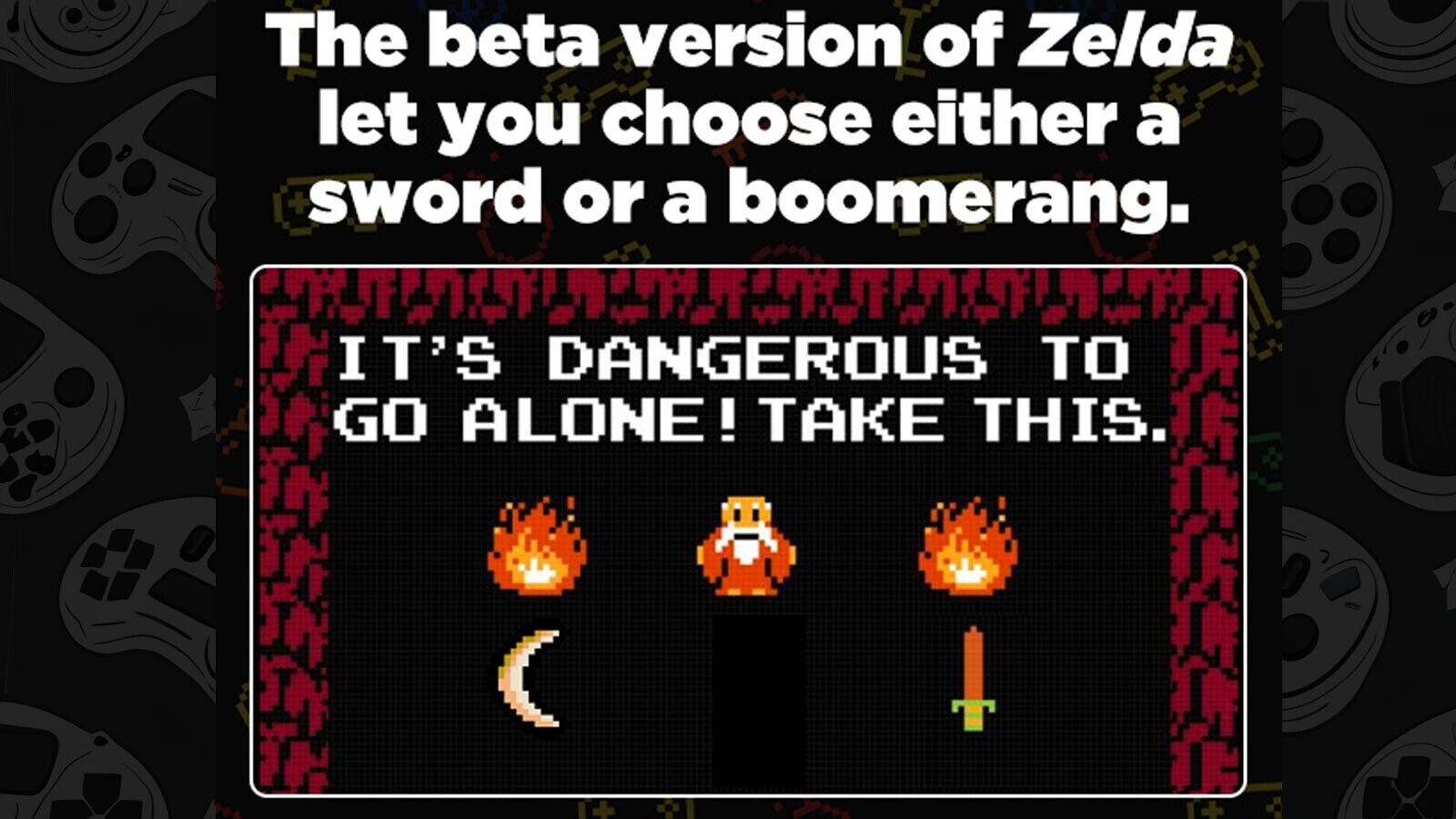
17. The Legend of Zelda: Childhood Exploration Turned Into Hyrule
The Legend of Zelda was inspired in part by Shigeru Miyamoto’s childhood experiences exploring woods and caves. That sense of curiosity became central to the game: hidden paths, secrets, dungeons, and the feeling that the world was bigger than the screen.
Its weird backstory is wonderfully human. Zelda did not begin as a spreadsheet of fantasy tropes; it began with the memory of wandering, wondering, and poking around places that felt mysterious. Every cracked wall in Hyrule owes something to childhood curiosity.
18. Sonic the Hedgehog: Sega’s Blue Mascot With Red Shoes
Sonic was created as Sega’s answer to Mario, and early design work reportedly used the codename “Mr. Needlemouse.” The final character became a cobalt-blue hedgehog with attitude, speed, and red shoes.
The oddest part is how calculated and chaotic the mascot formula was: make him fast, make him cool, make him visually distinct, and make sure he can stare down Nintendo’s mustachioed superstar. Sonic was not just a character; he was a marketing sprint with spikes.
19. Pokémon: Bug Collecting Through a Link Cable
Pokémon creator Satoshi Tajiri loved collecting insects as a child. When he saw the Game Boy’s link cable, he imagined creatures moving between handheld systems, inspiring the trading mechanic that became central to Pokémon.
That is the beautiful weirdness of Pokémon: a global media empire began with childhood bug hunting, portable hardware, and the idea that collecting should be social. Every trade, battle, and Pokédex entry carries a little echo of fields, jars, and tiny discoveries.
20. Minecraft: A Weekend Experiment That Became a Universe
Minecraft began as an independent project by Markus “Notch” Persson, who released an early public version in 2009 and continued shaping it with community feedback. Its blocky look, open-ended play, and survival-building loop turned simplicity into creative freedom.
The weird backstory is that Minecraft did not need glossy realism to become massive. It looked like digital bricks, asked players to make their own goals, and trusted imagination to do the heavy lifting. Then millions of players built castles, farms, cities, roller coasters, calculators, and occasionally dirt houses with questionable roofs.
Why These Weird Game Backstories Matter
The best games we grew up on often feel timeless because they are easy to enter. Roll the dice. Draw a card. Move a piece. Press start. But their histories show that games are never just games. They are shaped by illness, boredom, business problems, technological limits, family arguments, childhood hobbies, moral lessons, marketing wars, and moments of pure accident.
That is why classic game backstories are so fun to revisit. They remind us that creativity rarely arrives in a clean, heroic spotlight. Sometimes it appears in a hospital room. Sometimes it shows up during unemployment. Sometimes it comes from a family dispute about card rules. Sometimes it happens because a company cannot get the license it wanted and has to invent a gorilla instead.
500-Word Nostalgia Experience: What It Felt Like Growing Up With These Games
Growing up with these games was less about perfect rules and more about the tiny rituals around them. Monopoly meant clearing the biggest table in the house, choosing a token like it was a lifelong identity, and watching the banker slowly become the most suspicious person in the room. Nobody fully trusted the banker. Not then. Not now.
Candy Land was usually the first board game that made children feel like they were playing “for real,” even though the game was mostly colorful destiny. You drew a card and marched forward like a tiny sugar pilgrim. There was no strategy, which was perfect. At that age, strategy meant eating the red candy first because it tasted faster.
UNO was louder. UNO had drama. UNO created courtroom-level arguments over whether a Draw Four was legal, whether someone forgot to say “UNO,” and whether stacking cards was an official rule or something your cousin invented to avoid losing. Every family had its own constitution, and every constitution was written in chaos.
Then there were the video games. The Oregon Trail made school computers feel like portals. You were supposed to be learning history, but you were also naming wagon party members after classmates and making deeply questionable supply decisions. The game taught resource management, but mostly it taught that rivers were not to be trusted.
Pac-Man and Tetris had a different kind of magic. They did not need complicated stories. Pac-Man was rhythm, panic, and snack-based survival. Tetris was focus, geometry, and the emotional collapse that followed one badly placed long piece. These games worked because they were instantly understandable but endlessly replayable. They made failure feel like an invitation instead of a punishment.
Mario, Zelda, Sonic, Pokémon, and Minecraft expanded that feeling into worlds. Mario gave players motion and timing. Zelda gave them secrets. Sonic gave them speed and attitude. Pokémon gave them collecting, trading, and playground mythology. Minecraft gave them blank space and said, “Go ahead. Make something weird.” That freedom mattered.
What connects all 20 games is not genre, platform, or decade. It is memory. These games taught us how to compete, cooperate, improvise, argue, forgive, explore, and start over. They gave ordinary afternoons a structure: a board on the table, a cartridge in the console, a deck of cards between friends, a controller passed from hand to hand.
The weird backstories only make them better. Knowing that Candy Land came from compassion, Monopoly from protest, UNO from a family argument, and Pokémon from bug collecting adds another layer to the nostalgia. It turns every familiar game into a tiny historical artifact. We were not just playing; we were unknowingly holding pieces of culture, invention, and accidental genius.
Conclusion
The games we grew up on are more than dusty boxes, old cartridges, and half-missing card decks. They are time capsules with strange beginnings. Some were created to teach, some to comfort, some to compete, and some simply to solve a problem no one else had fixed yet.
That is the secret charm of classic games with weird backstories: they prove that play can come from almost anywhere. A schoolteacher, a barber, an architect, a student, a programmer, a designer remembering childhood woodsall of them left fingerprints on the way generations spent rainy days, recess breaks, family nights, and screen-lit weekends.
So the next time someone flips the UNO table emotionally, builds an unstable Jenga tower, hums the Zelda theme, or starts a new Minecraft world “just for a few minutes,” remember: behind the fun is a story. And behind that story is probably someone making things up, solving a problem, or trying very hard not to be bored.
Note: This article is original editorial content based on documented game histories and written without embedded source links for cleaner web publishing.