Some illustrations explain an idea. Others politely kick the door open, rearrange the furniture in your brain, and ask why you have been storing fear next to hope all these years. Surreal conceptual illustrations live in that strange, useful neighborhood. They borrow from dreams, poetry, philosophy, editorial design, and the occasional spoon that looks suspiciously like an existential crisis.
The title “12 Surreal Conceptual Illustrations That I Made To Think Deeply About The Text” sounds simple, but the idea behind it is rich: images can make words slower, heavier, funnier, and more memorable. A sentence may tell us that time is fragile. A surreal illustration can show time as a cracked clock balanced on a paper boat in a sink full of stars. Suddenly, the meaning is not just understoodit is felt.
Why Surreal Conceptual Illustration Still Feels So Powerful
Surrealism has always been fascinated with the gap between logic and dream. Instead of painting the world exactly as it appears, surrealist artists distort familiar objects until they reveal hidden emotional truths. That is why melting clocks, floating doors, faceless figures, oversized shadows, and impossible rooms still feel oddly accurate. They do not show reality as a camera sees it. They show reality as anxiety, memory, desire, and curiosity experience it at 2:37 a.m.
Conceptual illustration adds another layer. It does not merely decorate a page; it interprets an idea. In editorial illustration, book covers, posters, social campaigns, and digital storytelling, a strong visual metaphor can turn abstract themes into something instantly readable. Loneliness becomes a tiny island. Pressure becomes a person carrying a house on their back. Hope becomes a match protected from the rain by two careful hands.
When text and illustration work together, the result is more than “pretty art.” It becomes visual thinking. The viewer reads the words, studies the image, then returns to the words with new suspicion. That back-and-forth movement is where deep interpretation begins.
The 12 Surreal Conceptual Illustrations and What They Invite Us To See
1. Time: The Clock That Refuses To Behave
Time is one of the classic subjects of surreal conceptual art because everyone has it, no one controls it, and most of us treat it like a messy drawer full of unpaid bills. A surreal illustration about time might show a clock growing roots, a calendar dissolving into birds, or a human figure trying to sew together broken minutes.
The deeper message is simple: time is not only measured; it is experienced. A happy hour can feel like five minutes. A painful five minutes can feel like a full medieval dynasty. By making time visible as a flexible, living object, the illustration asks us to think about how memory, regret, ambition, and waiting reshape our days.
2. Chance: A Dice Roll With a Secret Agenda
Chance is often drawn as a dice, coin, roulette wheel, or open door. But surreal conceptual illustration can make chance stranger and more human. Imagine a person standing beneath a sky where clouds are shaped like question marks, while ladders rise to nowhere and keys unlock empty frames.
This kind of image reminds us that life is partly planned and partly improvised. We love to pretend we are conducting the orchestra, but sometimes the trumpet has wandered into the kitchen. Chance is not always chaos; it can also be the unexpected invitation, the missed train that saves the afternoon, or the wrong turn that becomes a story.
3. Hope: The Small Light That Has No Business Surviving
Hope is easy to make sentimental, which is why surrealism helps. Instead of drawing a smiling sun and calling it a day, a conceptual illustrator might show a tiny plant growing from a locked suitcase, or a candle burning underwater. The impossibility makes the emotion stronger.
Hope often survives in unreasonable places. It does not wait for ideal weather. It appears inside grief, uncertainty, and exhaustion wearing a tiny helmet and saying, “Well, this is inconvenient, but let’s continue.” A surreal image can capture that stubbornness without becoming preachy.
4. The Text: Words Becoming Physical Objects
Because the project is about thinking deeply about text, one of the most interesting approaches is to treat words as objects. A paragraph can become a staircase. A sentence can become a thread. A letter can turn into a window, a bridge, or a cage.
This type of conceptual illustration asks an important question: do we use language, or does language use us? The words we repeat shape how we see ourselves. A label can become a wall. A compliment can become a wing. A single sentence remembered from childhood can sit in the mind for years like furniture nobody knows how to remove.
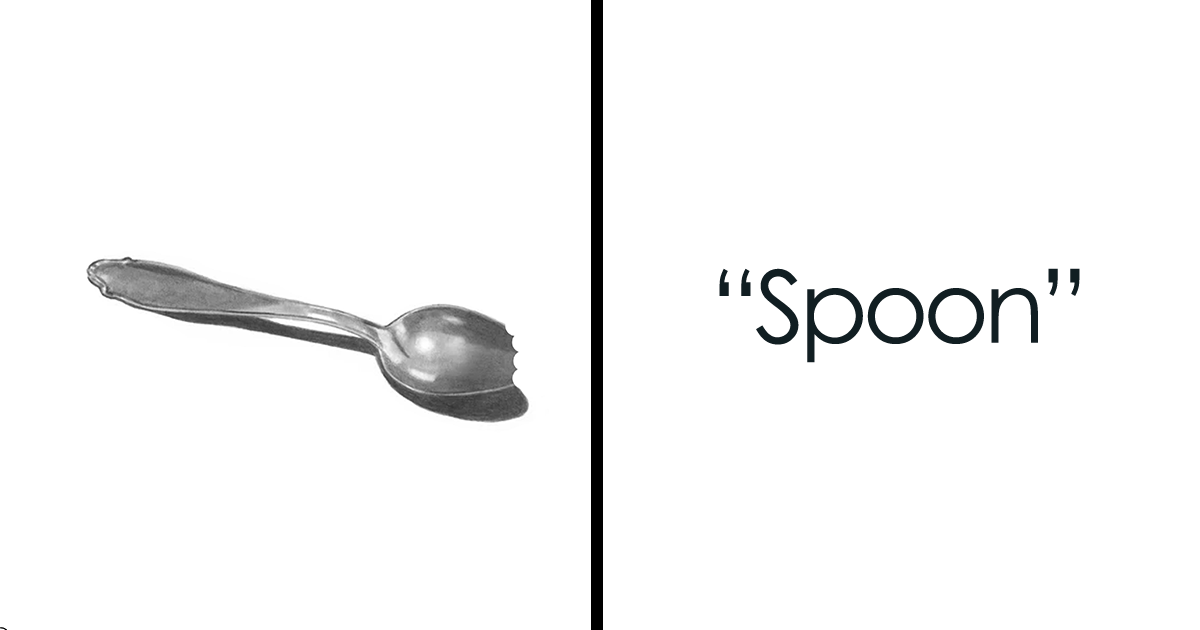
5. The Spoon: A Small Object With a Large Personality
A spoon may seem ordinary, but conceptual illustration loves ordinary objects because they are already familiar. Once the familiar turns strange, the viewer pays attention. A spoon might scoop stars from a bowl of night. It might reflect a face that is not there. It might hold an ocean, a city, or a memory too heavy for breakfast.
The spoon works as a symbol of appetite, care, routine, and dependence. It can suggest nourishment, poverty, childhood, medicine, domestic life, or the simple daily rituals that keep us from floating away. Yes, sometimes the deepest metaphor in the room is the cutlery. Art is rude like that.
6. You: The Viewer Inside the Illustration
One powerful conceptual strategy is to make the viewer feel personally addressed. An illustration titled “You” may show a faceless figure staring into a mirror that reflects a landscape, or a person opening their chest to reveal a room full of unread letters.
This is where surreal art becomes intimate. The viewer is no longer observing an idea from a safe distance. The image points gently and says, “This might be about you.” That directness can be uncomfortable, but it is also what makes the work memorable. Good conceptual illustration does not shout. It raises one eyebrow and lets your conscience do the rest.
7. Side: The Hidden Angle of Every Story
“Side” can refer to perspective, conflict, identity, or the parts of ourselves we keep turned away from the light. A surreal illustration might show a person split into two landscapes: one side crowded with buildings, the other side quiet as a desert. Or it might show two people arguing while standing on opposite sides of the same pencil line.
The visual message is that perspective changes meaning. What looks like a wall from one side may be shelter from another. What looks like silence may be survival. Conceptual illustration is especially good at showing that truth is often dimensional, not flat.
8. Memory: A Museum With Unreliable Lighting
Memory is not a perfect archive. It is more like a museum curated by emotion and staffed by sleepy ghosts. A surreal illustration of memory might show framed images melting, a child holding an elderly person’s shadow, or a staircase leading into a small drawer.
Such images help viewers understand that remembering is an act of reconstruction. We do not simply replay the past; we reshape it each time we return. That is why memory can comfort us, fool us, and occasionally embarrass us by replaying something awkward from 2009 while we are trying to buy apples.
9. Silence: The Loudest Empty Space
Silence is difficult to draw because it is an absence. Surreal conceptual illustration solves this by giving absence a body. A silent figure may have a birdcage for a head, a stitched mouth, or a speech bubble filled with snow.
The best illustrations about silence avoid one simple meaning. Silence can be peace, fear, respect, censorship, grief, or power. By making silence visible, the image allows viewers to ask what kind of quiet they are looking atand what might happen if someone finally speaks.
10. Identity: A Face Made of Rooms
Identity is never just one thing. We are made of roles, habits, histories, contradictions, private jokes, public masks, and the strange confidence required to choose a profile picture. A surreal illustration might show a face built from doors, windows, masks, maps, or handwritten notes.
This approach fits conceptual art beautifully because identity itself is conceptual. We are partly what we do, partly what we remember, partly what others call us, and partly what we are still becoming. A surreal portrait can show that complexity more honestly than a realistic one.
11. Fear: The Shadow That Learned Your Name
Fear is visually dramatic, but the most effective conceptual illustrations do not always make it monstrous. Sometimes fear is tiny: a small black dot following a person across a bright floor. Sometimes it is domestic: a chair that refuses to be sat on, a phone with teeth, a door with no handle.
Surrealism makes fear specific without explaining it too much. The viewer recognizes the emotional shape before naming the exact situation. That recognition is powerful because fear often works the same way in real life. It arrives before language, sits down without asking, and helps itself to your snacks.
12. Freedom: The Door That Opens Inward
Freedom is often represented by birds, open skies, and broken chains. Those symbols still work, but surreal conceptual illustration can complicate them. A person may unlock a door inside their own shadow. A bird may fly out of a book. A cage may be open, while the figure inside hesitates to leave.
This is the deeper truth: freedom is not only external. Sometimes the door is open, but the mind has not caught up. A strong illustration about freedom asks what keeps us contained after the lock is gone. Habit? Fear? Comfort? The terrifying responsibility of choosing? Freedom looks beautiful from far away, but up close it often comes with paperwork.
How Text Changes the Meaning of an Image
A surreal illustration without text invites interpretation. Add a title, phrase, or caption, and the meaning begins to tilt. The same image of a person holding a ladder under the moon can mean ambition, escape, grief, curiosity, or insomnia with excellent branding. Text guides the viewer, but it should not explain everything.
The best relationship between text and illustration is not a lecture; it is a dance. The words give direction, while the image adds tension, ambiguity, and emotional temperature. If the text says “hope,” the image should not merely show hope. It should challenge the viewer to feel how fragile, strange, or stubborn hope can be.
This is why conceptual illustrations are useful for essays, books, editorial pieces, posters, and online storytelling. They create a pause. In a digital world where people scroll faster than a caffeinated squirrel, a surprising visual metaphor can stop the thumb and invite thought.
What Makes a Surreal Conceptual Illustration Work?
It Starts With One Clear Idea
Even the strangest image needs a strong conceptual center. Before adding floating fish, oversized keys, or a chair growing antlers, the artist must know the idea: time passes, words wound, hope survives, identity shifts. Surrealism is not random decoration. It is controlled weirdness with a job.
It Uses Familiar Objects in Unfamiliar Ways
The magic often comes from ordinary things behaving badly. A spoon becomes a boat. A window appears in a forehead. A book leaks water. These combinations work because the viewer knows the objects already. The surprise is not in the object itself but in the new relationship between objects.
It Leaves Room for the Viewer
If an illustration explains everything, the viewer has nothing to do. Great conceptual art leaves a small gap where interpretation can enter. That gap is not a mistake; it is the doorway. The viewer completes the meaning by bringing personal memories, fears, questions, and hopes to the image.
It Balances Beauty and Unease
Surreal conceptual illustration often feels attractive and unsettling at the same time. That combination is important. Beauty invites the viewer closer. Unease keeps the viewer thinking. Too much beauty becomes wallpaper. Too much confusion becomes homework. The sweet spot is a visual question that looks good enough to stare at.
Why These Illustrations Matter in the Age of Fast Content
Modern audiences are surrounded by images. Social feeds, ads, thumbnails, memes, banners, icons, and videos compete for attention every second. In this noisy environment, conceptual illustration offers something rare: a reason to pause.
Surreal images are especially effective because they resist instant consumption. You cannot always understand them in one glance. That is not a flaw. It is the point. They slow the viewer down long enough for meaning to unfold. In a culture obsessed with quick answers, an image that asks a better question feels almost rebellious.
For artists, writers, designers, and publishers, this makes surreal conceptual illustration valuable. It can turn a simple article into a memorable visual experience. It can transform abstract themes into emotional scenes. It can help readers connect with difficult topics without feeling trapped in a textbook with fluorescent lighting and no snacks.
Personal Experience: Making Images That Argue With Text
Creating surreal conceptual illustrations around text feels less like drawing a picture and more like negotiating with a very poetic puzzle. The process usually begins with a word or phrase that seems simple at first. “Time.” “Hope.” “You.” “Chance.” These words look harmless on the page, but the moment I try to illustrate them, they begin opening secret doors.
The first challenge is avoiding the obvious. If the word is “time,” the easiest answer is a clock. If the word is “hope,” the easiest answer is a light. Those symbols are useful, but they can become predictable unless something unexpected happens to them. So I ask a second question: what is the emotional truth behind the word? Time is not only a clock; it is pressure, nostalgia, aging, waiting, healing, and the panic of realizing a deadline was yesterday. Hope is not only light; it is persistence, stubbornness, risk, and sometimes the tiny ridiculous belief that things may improve even when the evidence is being dramatic.
Once the emotional core appears, the visual ideas become more interesting. I might sketch a person carrying a clock like a backpack, or a candle burning inside a closed book, or a sentence turning into a bridge between two lonely figures. Many sketches fail. Some fail politely. Others fail with confidence and should probably apologize. But even the failed sketches teach me what the idea is not.
The most rewarding moment comes when the image begins to speak back to the text. At first, the words are in charge. They provide the theme. But after enough drawing, the image starts adding its own meaning. A small shadow changes the mood. A door placed slightly too high suggests frustration. A figure facing away from the viewer adds mystery. Suddenly, the illustration is no longer a servant of the text; it becomes a conversation partner.
I have also learned that surreal conceptual illustration requires restraint. It is tempting to add every clever symbol at once: clocks, birds, keys, ladders, clouds, mirrors, stairs, moons, hands, and maybe a fish wearing a tie because why not? But too many symbols can turn an image into a visual junk drawer. The stronger choice is often to keep one main metaphor and let the empty space breathe.
Another important experience is watching how different viewers interpret the same image. One person sees freedom. Another sees loss. Someone else sees childhood. At first, that can feel confusing, especially if the artist had a specific meaning in mind. But over time, I have come to see this as the beauty of conceptual art. A good illustration does not control the viewer like a remote. It invites them into a room and lets them notice what they notice.
Working with text also reminds me that language is never neutral. Words carry memory, culture, humor, fear, and personal history. When I illustrate a word, I am not illustrating a dictionary definition. I am illustrating the emotional weather around it. That is why surrealism fits so well. It allows an image to be symbolic without becoming stiff, thoughtful without becoming boring, and strange without losing its human center.
In the end, making these illustrations is a way of reading more slowly. The drawing process forces me to sit with a word until it stops being flat. It becomes an object, a place, a wound, a joke, a question, or a door. And when the image finally works, it does what good art should do: it makes the familiar unfamiliar again, so we can see it with fresh eyes.
Conclusion
Surreal conceptual illustrations are powerful because they transform abstract ideas into unforgettable visual experiences. They make text feel deeper, stranger, and more alive. Whether the subject is time, chance, hope, silence, fear, identity, or freedom, the goal is not simply to draw something beautiful. The goal is to create an image that makes the viewer pause, think, and maybe quietly whisper, “Okay, that hit harder than expected.”
The 12 illustrations explored here show how visual metaphors can turn ordinary words into emotional landscapes. They prove that illustration is not just decoration for a page; it is a language of its own. And when that language becomes surreal, it can say things that plain explanation often cannot.