Death may be universal, but humanity has never agreed on what to do with its visual evidence. Some societies bury remains and leave them undisturbed. Others place bones in chapels, paint names and flowers across skulls, dress skeletons in armor, or arrange thousands of bones into elaborate religious designs.
The resulting images can be unsettling, beautiful, sacred, and historically revealingsometimes all before breakfast. Yet these are not Halloween props or movie-set leftovers. Every skull belonged to a person, and every ossuary reflects a community’s response to overcrowded cemeteries, epidemics, warfare, religious devotion, or the simple reality that land was limited.
The following 10 incredible images of death lead through churches, crypts, charnel houses, and cemeteries across Europe. Rather than celebrating the macabre for its own sake, they show how earlier cultures transformed human remains into memorials, warnings, and symbols of eternal life.
Why Were Human Bones Displayed?
An ossuary is a place used to store skeletal remains after burial. In crowded European towns, cemeteries often could not expand because they were hemmed in by buildings, mountains, lakes, or defensive walls. Graves were therefore reopened after decomposition, and the bones were transferred to a chapel or charnel house.
Religion also shaped these displays. Bones could act as a memento moria reminder that wealth, beauty, and status eventually receive the same rather dramatic cancellation notice. In Catholic communities, relics associated with saints and martyrs were treated as sacred connections between earthly life and heaven.
Modern viewers may see something frightening. Earlier worshippers might instead have seen continuity, remembrance, and hope.
Ten Haunting Images and the Stories Behind Them
1. The Martyrs of Otranto, Italy
What the image shows: Rows of skulls and bones displayed in tall glass-fronted cabinets beside the altar of Otranto Cathedral.
The remains are traditionally associated with the inhabitants killed after Ottoman forces captured the southern Italian city in 1480. Hundreds of male prisoners were reportedly executed after refusing to abandon their Christian faith. Antonio Primaldo, a local tailor, became the best-known figure in the story.
The victims, commonly known as the Martyrs of Otranto, were canonized by Pope Francis in 2013. Their chapel does not hide death in a crypt. Instead, the remains stand openly beside marble, gold ornament, candles, and religious paintings.
The contrast creates the image’s power. The bones are neither randomly piled nor presented as archaeological specimens. They form a public memorial to collective violence, local identity, and religious conviction. It is less a chamber of horrors than a history book whose pages happen to have cheekbones.
2. The Soldiers of San Martino della Battaglia, Italy
What the image shows: Thousands of bones arranged with military precision inside an ossuary near Lake Garda.
The Battle of San Martino formed part of the wider Battle of Solferino in June 1859, one of the bloodiest encounters in the struggle for Italian unification. French and Piedmontese troops fought Austrian forces across fields that soon became overwhelmed by dead and wounded soldiers.
The ossuary preserves the remains of combatants from both sides. Skulls are placed in long, ordered rows, while larger bones are stacked beneath them. The arrangement looks almost like a library, except every “volume” once marched, worried, laughed, and probably complained about military food.
By mixing former enemies within one memorial, the site makes an important statement: political uniforms eventually disappear, leaving the same human structure underneath. The image turns an abstract battle statistic into a room filled with individuals.
3. The Skull Boxes of Marville, France
What the image shows: Human skulls placed inside individual wooden cases bearing names, dates, prayers, or social information.
The Saint-Hilaire Cemetery in Marville contains an ossuary organized in the late nineteenth century by its caretaker. Thousands of bones removed from older graves were stacked inside, while a smaller group of skulls received specially crafted boxes.
These containers are sometimes called “life clocks” because their fronts resemble clock faces. Through a central opening, the skull appears where the hands of a clock might normally be. Subtle? Absolutely not. Effective? Unquestionably.
Unlike anonymous walls of bones, the Marville skull boxes preserve individual identity. Names and death dates remind visitors that the occupants were not merely building materials for an unusual monument. They were neighbors, relatives, workers, and community members whose descendants wanted them remembered.
The image is eerie, but it is also intimate. Each box functions like a miniature tombstone with the person still physically present behind it.
4. The Chapel of Bones in Faro, Portugal
What the image shows: Walls and ceilings covered with carefully arranged skulls, femurs, and other bones.
Behind the ornate Igreja do Carmo in Faro stands a small nineteenth-century chapel constructed with the remains of more than a thousand Carmelite monks. Skulls form repeating patterns across the walls, while long bones create borders, columns, and decorative panels.
The visual shift from the church’s gilded Baroque interior to the pale geometry of the chapel is startling. One space displays earthly splendor; the other shows where every earthly owner of splendor eventually ends up.
The arrangement was intended to encourage contemplation, not panic. For religious visitors, the bones represented the temporary nature of the body and the hope of resurrection. For modern travelers, the chapel often produces a stranger mixture: curiosity, discomfort, admiration, and a sudden determination to make better use of the afternoon.
5. Hallstatt’s Painted Skulls, Austria
What the image shows: Hundreds of skulls decorated with flowers, ivy, crosses, names, and dates.
Hallstatt sits between steep mountains and a lake, leaving little space for burial. For generations, older graves were reopened so the cemetery could serve new families. The removed bones were cleaned and transferred to the ossuary in St. Michael’s Chapel.
Beginning around the eighteenth century, many skulls were painted. Floral designs often appeared on women’s skulls, while ivy or laurel motifs were frequently used for men. Names and dates turned each skull into a personal memorial rather than an anonymous object.
The ossuary holds more than a thousand skulls, hundreds of which are decorated. Some paintings are delicate and surprisingly cheerful, proving that even mortality occasionally receives excellent handwriting and a tasteful botanical border.
This image challenges the assumption that exposed remains automatically indicate disrespect. In Hallstatt, decoration restored the identity that exhumation might otherwise have erased.
6. The Bone Chandelier of Sedlec Ossuary, Czech Republic
What the image shows: A vast chandelier made from human bones hanging above garlands, pyramids, crosses, and a family coat of arms.
Sedlec Ossuary, beneath the Cemetery Church of All Saints in Kutná Hora, contains remains traditionally estimated to represent tens of thousands of people. The surrounding cemetery became highly desirable after soil reportedly brought from the Holy Land was scattered there. Later epidemics and warfare added many more burials.
In 1870, woodcarver František Rint was hired to organize the accumulated bones. He transformed them into one of the world’s most recognizable examples of funerary art. The central chandelier is said to contain examples of every type of bone in the human body.
The display can look theatrical, but its symbolism is serious. The chandelier hangs where light traditionally represents divine presence. Here, the light is surrounded by physical reminders of mortalitya visual argument that death and spiritual hope occupy the same room.
7. The Virgins of Palermo’s Capuchin Catacombs, Italy
What the image shows: Preserved bodies dressed in period clothing and arranged according to social or religious categories.
The Capuchin Catacombs of Palermo contain roughly 2,000 skeletons and mummified bodies dating primarily from the seventeenth through nineteenth centuries. Monks, professionals, children, women, and members of prominent families were placed in separate corridors or sections.
Among the most haunting figures are young women identified as virgins, sometimes displayed with palm fronds. In Christian art, the palm traditionally symbolizes martyrdom, purity, and spiritual victory. Clothing and bonnets preserved aspects of personality and social identity long after death.
The catacombs reveal that burial could also be a form of public portraiture. Families sometimes paid to have relatives preserved, dressed, and visited. Long before social media, Palermo had already discovered the enduring appeal of being seen in one’s best outfitalthough its version came with significantly less flattering lighting.
Today, the site is also important to researchers studying historical embalming, natural mummification, clothing, disease, and burial customs.
8. Vincenzo Piccini in Urbania’s Church of the Dead, Italy
What the image shows: A naturally preserved man wearing the ceremonial clothing of the Brotherhood of Good Death.
The small Chiesa dei Morti in Urbania houses 18 mummified bodies. They were discovered when graves were opened during cemetery reforms in the nineteenth century. Local environmental conditions had slowed decomposition, preserving skin and other tissues.
At the center stands Vincenzo Piccini, a prior connected with the Brotherhood of Good Death and a key figure in arranging the display. Unlike most of the other mummies, he remains clothed in the brotherhood’s ceremonial garments.
The organization’s name sounds like a particularly intense heavy-metal album, but its duties were compassionate. Such confraternities assisted with funerals, cared for the dying, and helped bury people who lacked money or family support.
Piccini’s image therefore represents more than unusual preservation. His clothing connects him to a community institution devoted to ensuring that no person faced death entirely alone.
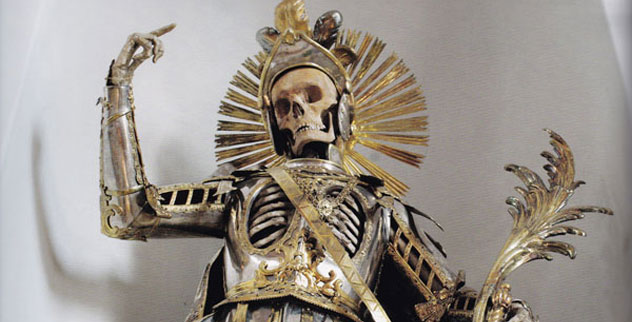
9. The Armored Skeleton of St. Pancratius, Switzerland
What the image shows: An articulated skeleton posed inside a glass shrine and dressed in an elaborate suit of armor.
The relic displayed in St. Nicholas Church in Wil is traditionally identified as St. Pancratius. It belongs to the broader tradition of “catacomb saints”skeletons removed from Roman catacombs and sent to Catholic communities north of the Alps during the Counter-Reformation.
The identity of many such remains cannot be proven by modern historical standards. At the time, however, recipients believed they were receiving the bones of early Christian martyrs. Nuns, goldsmiths, and craftspeople articulated the skeletons and dressed them in silk, jewels, armor, or embroidered robes.
Pancratius appears ready to defend the church from a dragon, an invading army, or perhaps someone attempting to shorten the Sunday service. Yet the armor was symbolic rather than practical. It represented the saint as a “soldier of Christ” who had conquered death through faith.
10. St. Gratianus at Waldsassen Basilica, Germany
What the image shows: A skeleton covered in jewels, embroidered fabric, golden ornament, and religious symbols.
Waldsassen Basilica contains ten richly decorated skeletons, making it one of Europe’s largest surviving collections of catacomb saints. The remains arrived from Rome and were adorned during the eighteenth century, notably through the work of Cistercian lay brother and goldsmith Adalbart Eder.
St. Gratianus is presented with the luxury of a royal courtier. Jewels cover the skull and hands, while richly worked textiles conceal much of the skeleton. A vessel once believed to contain a martyr’s blood helped authenticate such relics in the eyes of worshippers.
The display communicates a theological reversal. The exposed skeleton represents physical death, but the gems symbolize heavenly reward. What looks to a modern visitor like Gothic extravagance was intended as proof that martyrdom ended not in defeat but in glory.
It may be the only historical situation in which “you cannot take it with you” was answered with, “Perhaps, but we can certainly decorate the display case.”
What These Images Reveal About Human Attitudes Toward Death
These incredible images of death come from different countries and historical periods, yet they share several themes. First, they make mortality visible. Modern societies often separate everyday life from the dead through hospitals, funeral homes, sealed coffins, and distant cemeteries. Ossuaries placed death directly inside churches and community spaces.
Second, the displays preserved memory when ordinary graves could no longer remain. Painting a skull, labeling a wooden box, or dressing a mummy restored identity after the body had been moved from its original burial place.
Finally, these sites show that exposed human remains do not have one universal meaning. A wall of bones can represent necessity, mourning, faith, artistic expression, military remembrance, or several of those ideas at once. Understanding the cultural context prevents a sacred memorial from being reduced to a spooky background for vacation photographs.
Experiencing the 10 Incredible Images of Death
Seeing these sites in photographs is not the same as standing inside them. A screen keeps everything conveniently flat, silent, and several thousand miles away. Entering an ossuary removes that protective distance.
The First Reaction Is Usually Visual
At first, the mind focuses on patterns. Visitors notice the symmetry of skulls in Faro, the painted flowers in Hallstatt, or the sweep of Sedlec’s bone chandelier. From a distance, the arrangements can resemble architectural decoration. Then one detaila tooth, a fracture, a handwritten nameinterrupts the pattern. The visitor remembers that the material is human.
That mental shift is often the strongest part of the experience. Thousands become individuals again. A skull is no longer simply one piece in a wall; it belonged to someone who had routines, relationships, private jokes, unpaid bills, and opinions about the weather.
Silence Changes the Atmosphere
Most ossuaries are smaller and quieter than dramatic photographs suggest. Footsteps echo. Glass cases reflect dim light. Even visitors who arrived enthusiastically discussing camera settings tend to lower their voices without being asked.
This quiet does not always feel frightening. In Hallstatt or Marville, personalized inscriptions can create an unexpected sense of companionship. The dead are not presented as monsters. They remain members of a community whose names have stayed in the same landscape for centuries.
Respect Matters More Than the Perfect Photo
These locations may be tourist attractions, but many are also active churches, cemeteries, or sacred memorials. Visitors should follow photography rules, avoid touching remains or cases, and never pose in ways that mock the dead. Flash photography may be prohibited because light can damage preserved materials and disturb worshippers.
A useful approach is to spend a few moments looking before reaching for a phone. Observe how the remains are arranged, what symbols appear nearby, and whether names have been preserved. Reading the history transforms the display from a collection of “creepy bones” into evidence of real social practices.
Discomfort Can Be Valuable
It is normal to feel uneasy. These spaces challenge the comforting fiction that death is something unusual that happens mainly to historical figures and people in documentaries. Ossuaries make the ending visible and democratic.
Yet many visitors leave feeling more thoughtful than frightened. The sites can encourage gratitude for ordinary life, interest in family history, or a clearer awareness that time is limited. That does not require adopting the religious beliefs behind each display. The emotional lesson works surprisingly well without a membership card.
The Images Stay With You
The most memorable detail may not be the largest chandelier or the most ornate skeleton. It might be a painted rose on a forehead, a faded death date, or a wooden box built for one person almost two centuries ago.
Such details make the experience personal. They suggest that remembrance does not always require grand monuments. Sometimes a name, a flower, or a carefully prepared resting place is enough to carry a person forward in the minds of strangers.
Conclusion
The phrase 10 incredible images of death may sound like a promise of pure horror, but these places offer something more complicated. Their bones and mummies reveal how communities coped with war, limited cemetery space, religious upheaval, epidemics, and grief.
Some displays are austere; others are spectacularly decorated. Together, they show that humanity has rarely treated death as a simple biological event. We surround it with stories, symbols, clothing, flowers, architecture, and sometimes enough jewelry to make a royal treasury feel underdressed.
Viewed respectfully, these images are not celebrations of decay. They are portraits of remembranceand unusually honest reminders to do something meaningful while we still have the opportunity.