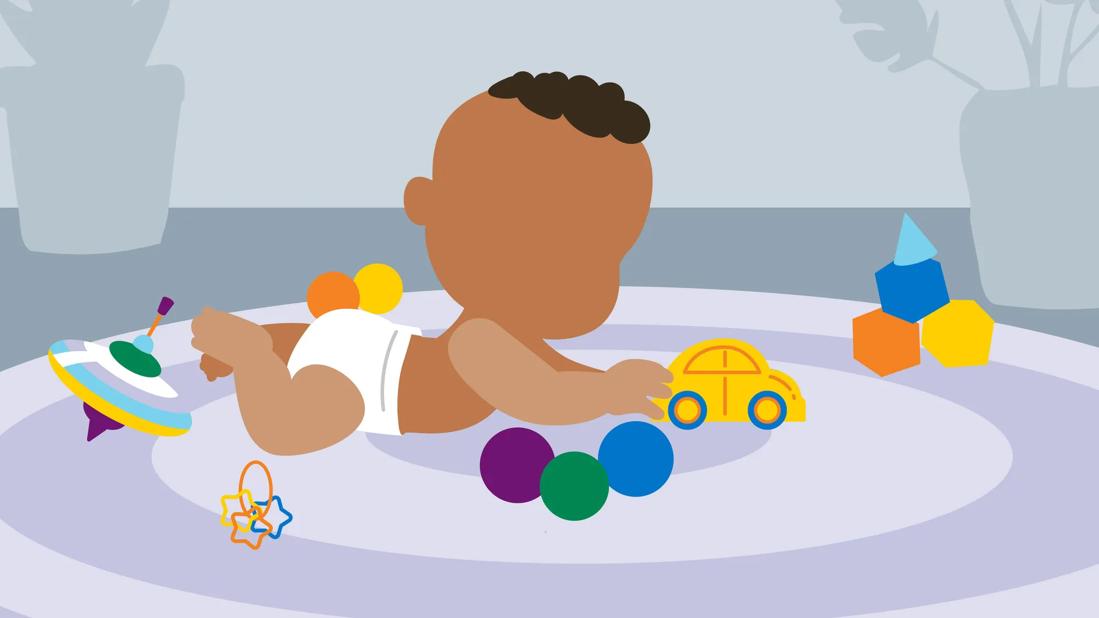
Tummy time sounds almost suspiciously simple: place a baby on their belly and let them wiggle. Yet this small daily activity supports some very big developmental jobs, including head control, upper-body strength, rolling, sitting and crawling.
For a newborn, lifting the head for two seconds can be the physical equivalent of an adult dragging a sofa upstairs. Grunting, wobbling and dramatic complaints are therefore fairly normal. The goal is not to create a tiny athlete overnight. It is to offer safe, supervised practice in manageable doses.
This guide explains when to start tummy time, how long it should last, which positions work best and how to help a baby who treats every session like a formal protest.
What Is Tummy Time?
Tummy time is any period when a baby is placed on their stomach while awake and closely supervised by an alert adult. It may happen on a firm play mat, across a caregiver’s lap or on an adult’s chest.
The phrase “awake and supervised” matters. Tummy time is an activity, not a sleep position. Babies should still be placed on their backs for every nap and nighttime sleep, on a firm, flat sleep surface free from pillows, loose blankets, toys and positioners. The easy phrase to remember is “back to sleep, tummy to play.”
When Should You Start Tummy Time?
Most healthy, full-term babies can begin tummy time within the first day or two after birth or soon after arriving home from the hospital. There is generally no need to wait until the baby is several weeks old or can already hold up their head. In fact, those early sessions are part of how head control begins developing.
The American Academy of Pediatrics recommends starting with short sessions soon after hospital discharge and gradually building toward at least 15 to 30 minutes of total tummy time per day by about 7 weeks of age. The National Institutes of Health similarly suggests beginning with two or three sessions lasting approximately three to five minutes each.
What About the Umbilical Cord Stump?
A baby can usually do gentle tummy time before the umbilical cord stump falls off. If the area appears sensitive, begin with the baby lying belly-down on your chest or across your lap. These positions reduce pressure on the abdomen while still encouraging the baby to turn and lift their head.
Stop and contact your pediatrician if the cord area is bleeding repeatedly, has spreading redness, produces pus or develops a foul odor.
When Should Parents Ask a Doctor First?
Ask your pediatrician or pediatric physical therapist for individualized instructions if your baby was born prematurely, recently had surgery, uses medical equipment or has significant reflux, breathing difficulties, low muscle tone, a diagnosed orthopedic condition or another medical concern. The activity may still be encouraged, but the position, timing and amount may need to be modified.
How Much Tummy Time Does a Baby Need?
Think in terms of total daily practice rather than one heroic workout. Several short sessions are often more comfortable and productive than one long session featuring 14 minutes of crying and one exhausted adult staring at a timer.
| Baby’s Age | Practical Starting Goal | What Tummy Time May Look Like |
|---|---|---|
| Newborn to 4 weeks | One to five minutes per session, two or three times daily | Brief head turns, small attempts to lift the head and lots of resting |
| 1 to 2 months | Gradually build toward 15 to 30 total minutes daily | More frequent head lifting and improved ability to turn both ways |
| 2 to 4 months | Around 30 minutes or more, divided across the day | Propping on forearms, holding the head higher and looking toward toys |
| 4 to 6 months | Several longer play sessions as tolerated | Pushing through the arms, reaching, pivoting and practicing rolling |
| 6 months and older | Continue floor play until independent movement takes over | Rolling, scooting, rocking on hands and knees or beginning to crawl |
These are flexible targets rather than pass-or-fail tests. Development varies, and active floor play in other positions also contributes to movement skills. As babies become stronger, tummy time naturally blends into reaching, rolling, sitting and crawling practice.
How To Do Tummy Time Safely
1. Choose the Right Moment
Try tummy time when your baby is awake, calm and reasonably alert. After a nap or diaper change often works well. Avoid beginning when the baby is already hungry, overtired or staging a household-wide meltdown.
Do not place a baby flat on their stomach immediately after a full feeding. Pressure on a full stomach can increase spit-up, especially in babies with reflux. Allow some upright time after feeding and follow your pediatrician’s advice if reflux is frequent or uncomfortable.
2. Use a Firm, Low Surface
A clean floor with a thin play mat or blanket is usually the safest and most effective location. Avoid beds, couches, changing tables and other elevated surfaces because babies can move unexpectedly. A soft mattress also makes it harder for a baby to push against the surface.
3. Place the Baby Gently
Lay your baby on their stomach with the arms positioned near the shoulders rather than trapped underneath the body. Turn the head to one side if necessary so the nose and mouth remain clear.
Newborns may initially keep their elbows behind their shoulders, making head lifting difficult. Gently bring the elbows forward. A small rolled receiving blanket placed under the upper chest and armpits can provide support, but it must not cover the face or press against the throat.
4. Get Down at Eye Level
Your face may be more interesting than every expensive toy in the nursery. Lie in front of the baby, smile, talk, sing or make gentle sounds. Newborns see faces best at relatively close range, so there is no need to supervise from the opposite side of the room like a distant sports coach.
5. End Before Exhaustion Takes Over
Some effort and mild fussing are normal, but a session does not have to continue through intense crying. Pick the baby up, offer comfort and try again later. Frequent positive attempts usually build tolerance more effectively than turning tummy time into a daily battle.
6. Stay Within Arm’s Reach
Supervision means actively watching the baby throughout the session. Do not walk away, become absorbed in a phone call or assume that a newborn who cannot roll is incapable of shifting into an unsafe position. If the baby becomes sleepy or falls asleep, move them to an approved sleep space and place them on their back.
Easy Tummy Time Positions
Chest-to-Chest Tummy Time
Recline at a comfortable angle and place the baby belly-down on your chest. Support the baby as needed and keep the face uncovered. The baby may try to lift their head to see you, while your warmth and voice make the position feel less unfamiliar.
Lap Tummy Time
Place the baby across your thighs with their head turned to one side. Keep one hand on the baby and make sure the head is supported appropriately. This position can work well for very young newborns or babies who dislike the floor.
Floor Tummy Time
Place the baby on a firm mat and sit or lie directly in front of them. Once the baby is interested in objects, position a high-contrast card, baby-safe mirror or lightweight toy within view.
Towel-Supported Tummy Time
Roll a thin towel and place it under the upper chest, with the arms reaching forward over the roll. This slight lift makes it easier to raise the head. The towel should remain below the armpits and well away from the baby’s mouth and nose.
Football Hold
Carry the baby face-down along your forearm, with the chest and abdomen supported and the head stabilized. Although this is not a replacement for floor practice, it provides another way to experience a belly-down position.
Benefits of Tummy Time
Builds Neck and Shoulder Strength
When a baby attempts to lift or turn their head, muscles in the neck, shoulders and upper back begin working against gravity. These muscles later contribute to steady head control and safer movement in supported sitting.
Develops Core and Upper-Body Control
Tummy time asks the abdomen, back, hips and arms to cooperate. As strength improves, the baby may press onto the forearms, straighten the elbows, reach with one hand or rotate the trunk.
Supports Motor Skill Development
The position provides opportunities to practice weight shifting, reaching, turning and pushing. These movement patterns contribute to later skills such as rolling, sitting, scooting and crawling. Tummy time does not guarantee that a baby will reach milestones on an exact schedule, but it creates useful opportunities to practice the required movements.
Helps Reduce Positional Flat Spots
Back sleeping remains essential for infant safety, but babies also need varied positions while awake. Supervised tummy time reduces the amount of awake pressure placed on the back of the skull and may help prevent or improve positional flattening.
Parents can also alternate the direction the baby faces in the crib, switch arms during bottle-feeding, provide upright cuddle time and avoid leaving the baby unnecessarily in car seats, swings or bouncers.
Encourages Visual and Sensory Exploration
A belly-down position gives a baby a new view of the room. Looking toward a caregiver, tracking a toy and feeling the floor against the hands introduce visual, tactile and body-position information.
Creates Opportunities for Interaction
Tummy time is also social time. Talking, singing and making eye contact can turn a physical activity into a bonding routine. The baby is not simply exercising; they are learning that movement can lead to faces, voices and interesting objects.
What If Your Baby Hates Tummy Time?
Many babies dislike tummy time at first because the position requires work. Their head feels heavy, their muscles fatigue quickly and the floor offers considerably worse customer service than a caregiver’s arms.
Try these adjustments:
- Start with 30 seconds to one minute and repeat the session more frequently.
- Use chest-to-chest or lap tummy time before moving to the floor.
- Place a rolled towel under the upper chest for support.
- Get face-to-face and use your voice as encouragement.
- Try after a nap or diaper change rather than near feeding or sleep time.
- Change locations or introduce a baby-safe mirror.
- Stop when crying becomes intense and try again after the baby has recovered.
Consistency matters more than perfection. A collection of one-minute sessions still counts. As strength and familiarity improve, many babies tolerate the position for longer periods.
Common Tummy Time Mistakes
- Using tummy time for sleep: Belly-down positioning is for supervised, awake play only.
- Practicing on a couch or bed: Elevated surfaces create fall risks, and soft surfaces make movement harder.
- Starting immediately after feeding: This can increase discomfort and spit-up.
- Expecting a long newborn session: Several brief attempts are developmentally appropriate.
- Leaving the arms trapped behind the body: Bring the elbows forward so the baby can begin bearing weight through the forearms.
- Comparing babies too closely: Milestones occur across ranges, not according to a single social-media schedule.
- Relying on infant equipment all day: Car seats are essential for travel, but routine awake time should include opportunities to move freely on a safe floor.
When To Contact Your Pediatrician
Bring up tummy time at routine well-child visits, especially if your baby consistently:
- Turns the head almost exclusively to one side
- Develops a noticeable flat area on the head
- Appears unusually stiff or unusually floppy
- Moves one arm or leg much less than the other
- Cannot lift the head at all by around 2 months
- Has persistent distress, breathing changes or significant vomiting in the position
- Loses a movement ability they previously demonstrated
These signs do not automatically indicate a serious condition. However, an early evaluation can identify torticollis, muscle weakness, head-shape concerns or another issue that may benefit from positioning guidance or pediatric physical therapy.
Conclusion
For most healthy babies, tummy time can begin shortly after birth. Start with tiny sessions, remain close enough to intervene immediately and build the total gradually as the baby grows stronger.
The routine does not require complicated equipment. A safe floor, an alert caregiver and a familiar face are usually enough. Over time, the baby who initially protested for 45 seconds may begin lifting their head, studying the room, reaching for toys and attempting to roll away before you have even finished arranging the play mat.
Keep the central safety rule clear: tummy time is for awake, supervised play, while the back remains the safest starting position for every sleep.
Real-Life Tummy Time Experiences: What Caregivers Often Learn
The following are composite examples based on common caregiver experiences rather than stories about specific families.
Experience One: The Newborn Who Lasts 20 Seconds
A caregiver places a 10-day-old baby on a beautiful play mat, expecting a calm developmental activity suitable for a parenting brochure. The baby immediately plants their cheek on the mat, kicks twice and begins complaining.
The caregiver initially assumes that something is wrong. In reality, the baby is being asked to lift a comparatively heavy head using muscles that have barely begun practicing against gravity. The family changes its approach: 20 seconds on the mat after one diaper change, 30 seconds on the caregiver’s chest after another and a brief lap session later in the day.
Within two weeks, the baby can remain on the mat for several minutes and briefly lift the head. The major lesson is that short attempts are not failures. They are repetitions.
Experience Two: The Baby Who Spits Up Every Time
Another family tries tummy time immediately after feeding because the baby is awake and appears cheerful. The result is predictable: milk returns, the mat needs washing and everyone begins questioning the entire concept.
They move the session to a calmer period after the baby has been held upright and has had time to digest. They also begin with an inclined chest-to-chest position instead of placing the baby flat on the floor. Spit-up decreases, and the baby becomes less frustrated.
The practical lesson is that timing can matter as much as technique. A baby who resists tummy time after a full meal may tolerate the same position much better after a nap or diaper change.
Experience Three: The Baby Who Always Looks Right
A caregiver notices that their 2-month-old almost always turns the head to the right. During tummy time, toys placed on the left receive no attention. Instead of repeatedly forcing the head, the family mentions the pattern to the pediatrician.
The pediatrician evaluates the baby and recommends positioning changes and a physical therapy assessment. At home, the caregivers approach from the less-preferred side, alternate feeding positions and use short supervised tummy time sessions to encourage balanced head turning.
Gradually, the baby becomes more comfortable looking both ways. The experience shows why tummy time is useful as an observation opportunity. It lets caregivers see how a baby uses both sides of the body rather than merely counting minutes.
Experience Four: Turning the Routine Into a Habit
Many caregivers struggle because tummy time feels like one more item on a very long newborn checklist. A simpler approach is to attach it to routines that already happen.
One family tries a short session after the first morning diaper change, another before the afternoon feeding and chest-to-chest practice during evening cuddle time. No elaborate schedule is required. The daily total grows naturally as the baby tolerates longer sessions.
The family also learns to stop chasing perfect numbers. One day includes 25 minutes; the next includes eight because the baby is tired and the household is chaotic. Progress is measured across weeks rather than judged by one imperfect Tuesday.
Experience Five: When Tummy Time Becomes Play
At around 4 months, a baby who once cried immediately begins pushing onto their forearms and looking around. A mirror encourages longer head lifting. A toy placed slightly to one side prompts reaching and weight shifting. Soon the baby rolls from the stomach to the back, looking mildly surprised by their own achievement.
At this stage, caregivers often realize that tummy time is no longer a separate exercise. It has become ordinary floor play. The baby uses the position to explore, rotate, reach and eventually prepare for independent movement.
The overall experience is rarely a smooth progression. Babies may tolerate five minutes one day and reject 30 seconds the next. The useful strategy is to remain patient, keep sessions safe and continue offering manageable opportunities without turning them into a contest.