UFO videos live in a strange little penthouse apartment where science, mystery, pop culture, national security, and internet chaos all pay rent. One grainy clip can launch a thousand comments, five conspiracy threads, and at least one person declaring, with the confidence of a man seasoning steak, “Yep, definitely aliens.” But the truth is usually messier, more interesting, and a lot more human.
Today, many officials and scientists prefer the term UAP, or unidentified anomalous phenomena, instead of UFO. The new phrase sounds less like a late-night cable special and more like something a government office would put in a spreadsheet, which is exactly the point. It widens the lens beyond “flying objects” and nudges the conversation away from assumptions. A video can be real without showing extraterrestrials. An event can be unexplained without being magical. And a blurry object can be dramatic without breaking the laws of physics.
That is what makes UFO videos so fascinating. They are not just clips of lights in the sky. They are tests of how people think, how cameras fail, how sensors mislead, how stories grow, and how badly the internet wants a mystery to stay mysterious. If you want to understand UFO videos, you have to do more than stare at the glowing dot. You have to study the machine that recorded it, the person who interpreted it, and the culture that turned it into a legend.
Why UFO Videos Never Go Out of Style
UFO videos survive every era because they thrive on uncertainty. In the 1950s, it was film reels, newspaper clippings, and Project Blue Book files. In the smartphone era, it is TikTok, Reddit, YouTube breakdowns, and frame-by-frame threads posted by people who have somehow convinced themselves that circling one pixel in red is forensic science.
The appeal is simple. A good UFO video gives viewers three irresistible ingredients:
1. It looks like evidence
Video feels objective. If the camera saw it, surely it must be true. But video has never been a perfect witness. A camera crops context, compresses detail, distorts light, and often flattens depth. Infrared footage can look eerie even when it is showing something ordinary. Digital zoom can make a common object look like a cosmic problem.
2. It leaves room for imagination
The less information a clip contains, the more imagination rushes in to fill the gap. That is why vague footage often travels faster than clear footage. A crystal-clear video of a balloon has the social media lifespan of a soggy cracker. A fuzzy glowing object zigzagging across a shaky frame? That thing is going places.
3. It arrives with emotional momentum
People do not watch UFO videos in a vacuum. They bring decades of movies, folklore, military secrecy, Roswell mythology, and personal belief with them. In America, UFOs are not just a subject. They are a cultural genre.
The Government Videos That Changed the Conversation
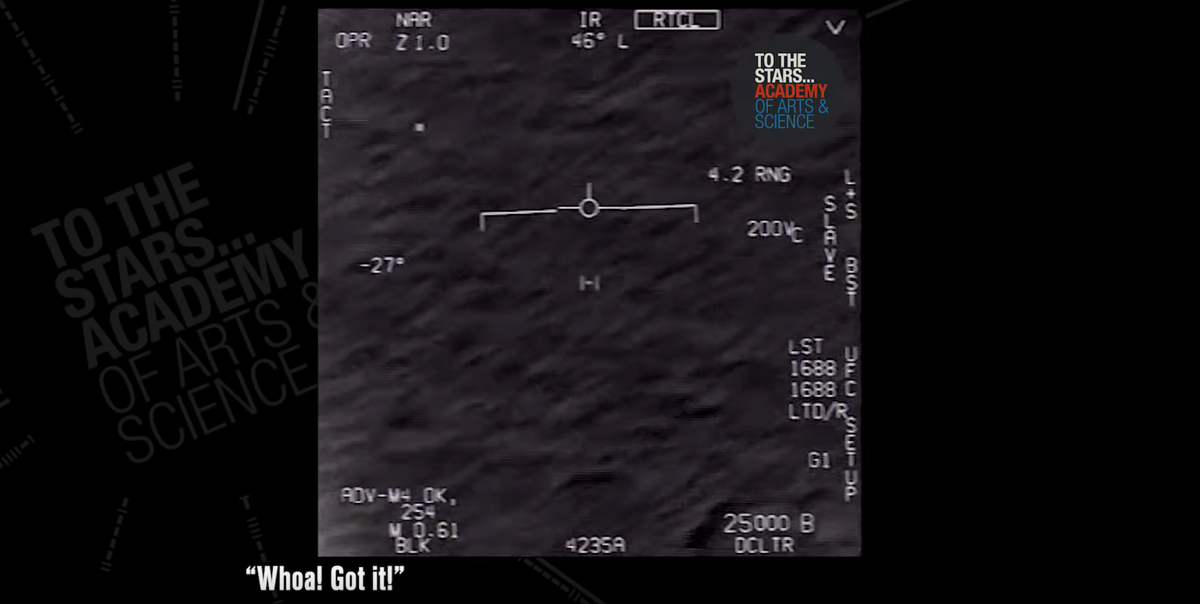
If UFO videos had a modern turning point, it came from a handful of military clips that pushed the topic out of the tabloid corner and into mainstream debate. The Pentagon officially released three historical Navy videos in 2020 to clear up public confusion about whether the footage circulating online was authentic. That release mattered because it confirmed the videos were real military recordings. It did not confirm that they showed alien craft.
That distinction is where many conversations go gloriously off the rails. A real video of an unidentified object is still just that: unidentified. It is not a signed autograph from another civilization.
The best-known cases include the so-called FLIR1, Gimbal, and GoFast videos. These clips became famous because they seemed to show objects behaving in unusual ways. Pilots sounded stunned. The footage looked strange. The internet did what the internet does and immediately rolled up its sleeves.
But later analysis has shown why visual impressions alone are not enough. The object in a video may appear to dart, rotate, hover, or outrun aircraft when what you are really seeing is a mix of viewing angle, sensor behavior, relative motion, missing metadata, and old-fashioned perspective tricks. In other words, the camera may be telling the truth, but viewers may still be reading the truth wrong.
What NASA and AARO Say About UFO Videos
NASA’s independent study on UAP made an important point: the biggest obstacle is not a lack of excitement. It is a lack of high-quality, calibrated, shareable data. That may sound less thrilling than “mothership over Nevada,” but it is exactly the grown-up answer this topic needs.
NASA argued for a rigorous, evidence-based approach and called for better data collection methods. In plain English, that means scientists do not want mystery clips passed around like urban legends. They want multiple sensors, timestamps, known locations, environmental data, and instruments designed for analysis instead of vibes.
The Department of Defense’s All-domain Anomaly Resolution Office, or AARO, has taken a similar line. Its reports repeatedly emphasize that many cases remain unresolved because the available data is incomplete, delayed, or too poor to support confident analysis. “Unresolved” does not mean “unearthly.” Quite often it means “the footage is not good enough to prove much of anything.”
That may disappoint people hoping every odd video ends with a grand reveal. But it is also what makes the current era more credible than earlier UFO panics. The official posture is less “believe” or “debunk” and more “measure first, talk later.” Frankly, that is refreshing.
Why So Many UFO Videos Turn Out to Be Ordinary Objects
Here is the part believers dislike and skeptics sometimes oversimplify: a lot of UFO videos do show real objects, but real objects are not always extraordinary ones.
AARO’s public case material includes footage assessed as birds, balloons, unmanned aerial systems, satellites, and conventional aircraft. Some clips are unresolved, but even there the language is often careful: the object may be physically present, yet its behavior is not especially remarkable, or the data is too limited to make a firm call.
The now-famous GoFast case is especially useful because it illustrates how dramatic footage can mislead. The object looked like it was screaming over the ocean at wild speed, but official analysis later argued that its apparent motion could be explained without invoking impossible technology. When geometry, wind, altitude, and perspective are considered together, the scene looks much less like a physics rebellion and much more like a reminder that cameras can be sneaky little goblins.
Some of the most common reasons UFO videos fool people include:
- Parallax: When the observer or camera is moving, a distant object can appear to move rapidly against the background.
- Infrared ambiguity: Heat signatures can be hard to interpret, especially when the source, distance, or reflection pattern is unclear.
- Autofocus and exposure shifts: Cameras can turn ordinary points of light into weird shapes.
- Compression artifacts: Digital video can invent ugly little distortions that viewers mistake for structure or motion.
- Missing metadata: Without precise location, speed, angle, altitude, and timing, analysts are working with one hand tied behind their backs.
UFO Videos as a National Security Issue
One reason UFO videos are treated more seriously now is that officials do not frame them mainly as an alien question. They frame them as a flight safety and national security issue.
That is an important shift. An unidentified object near military training ranges or civilian air corridors is worth investigating even if it turns out to be a balloon, a drone, or a data problem. Pilots are not filing reports because they want to audition for a science-fiction reboot. They are reporting because something entered airspace, behaved unexpectedly, or could not be immediately identified.
FAA guidance also reflects this practical mindset. Reports of UAP activity are handled as operational matters, not campfire stories. Meanwhile, government annual reports have described UAP as possible hazards to flight safety and potential collection threats, even while also stating that no evidence has emerged proving extraterrestrial origin.
That balance matters. The smart position is neither mockery nor blind belief. It is disciplined curiosity.
The Historical Baggage Behind Every New Clip
No UFO video arrives alone. It drags a giant suitcase of American history behind it.
Project Blue Book, the U.S. Air Force investigation that ran until 1969, still hangs over the subject like a ghost with paperwork. The National Archives holds those records, and they remind us that government interest in strange aerial sightings is not new. The FBI’s Roswell material also remains part of the public record, helping explain why almost every modern video gets funneled through old storylines about cover-ups, crash retrievals, and hidden truth.
That history matters because it shapes interpretation. People do not just watch a new clip. They watch it through decades of suspicion. A light in the sky becomes a referendum on trust: trust in government, trust in science, trust in eyewitnesses, trust in institutions that have not always been transparent. That is one reason the topic never dies. It is not only about what is in the video. It is about who gets to explain it.
How to Watch UFO Videos Without Losing Your Mind
If you want to evaluate a UFO video like a rational adult instead of a sleep-deprived comment-section shaman, ask a few simple questions:
What exactly recorded it?
A phone, a dashboard camera, a military infrared sensor, and a telescope all have different limits. You cannot judge them the same way.
Is the full clip available?
A ten-second viral cut is often the least useful version. Context before and after the event can change everything.
Do we have metadata?
Time, location, heading, altitude, weather, and sensor details are the difference between analysis and educated shrugging.
Is there corroboration?
Multiple witnesses are good. Multiple sensors are better. Radar, infrared, visual observation, and environmental data together create a stronger case than any single clip.
Does the explanation require magic?
If a video can be explained by parallax, a balloon, birds, drones, glare, or sensor behavior, those options deserve serious attention before anyone starts polishing the welcome banner for visitors from another star system.
What UFO Videos Really Reveal
The most honest conclusion is also the least dramatic: UFO videos reveal that humans are excellent at noticing anomalies and terrible at sitting comfortably with ambiguity. We want an answer. Any answer. Alien spaceship, classified drone, atmospheric oddity, software artifact, secret government plot, smug balloon with main-character energy, whatever it takes.
But the strongest body of current evidence points somewhere less cinematic. Official studies and recent case work suggest that many UFO videos are explainable, some are still unresolved because of poor data, and none publicly establish extraterrestrial visitation. That does not make the topic boring. It makes it real.
Because in the end, the story of UFO videos is not only about what is out there. It is about how we see, how we missee, and how a blurry image can become a national obsession before breakfast.
And maybe that is the most human thing in the sky.
Experiences Related to UFO Videos: What People Actually Go Through
The experience surrounding UFO videos is often far more intense than the video itself. Someone sees an odd light, a shape moving strangely, or an object that does not fit their mental filing cabinet of “normal sky stuff.” Their first reaction is rarely, “I have discovered extraterrestrial intelligence.” It is usually something much simpler: confusion. Then comes urgency. They grab a phone, start recording, and instantly discover one of modern life’s cruelest truths: the moon, airplanes, and mysterious lights all look much worse on camera than they do in person.
That gap between what people saw and what the video shows is one of the most common experiences in this whole topic. Witnesses often say the object felt brighter, larger, faster, lower, or more dramatic than the final clip suggests. By the time the video gets posted online, viewers are judging a flattened digital shadow of the event, not the event itself. The original witness may feel validated, embarrassed, or frustrated, sometimes all at once.
Pilots and trained observers describe a different kind of experience. For them, the emotional charge often comes from context. They know what belongs in a flight path and what does not. Even when a later explanation points to a balloon, drone, or sensor effect, the moment of uncertainty can still feel deeply strange. When something appears where it should not be, or moves in a way that seems wrong in real time, the experience is memorable whether the explanation turns out ordinary or not.
Then comes the internet phase, which is practically a genre of experience on its own. A person uploads a clip hoping for help, and within hours the comments split into familiar tribes: the true believers, the instant debunkers, the joke-makers, the “this is definitely Starlink” squad, and the amateur analysts drawing arrows like they are coaching a football game in low Earth orbit. For witnesses, this can be bizarre. They may feel like they have submitted a sincere question and accidentally wandered into a digital carnival.
There is also a quieter experience many people have after watching a wave of UFO videos: heightened attention. Suddenly they notice more objects in the sky. They look up longer. They question what they are seeing. Sometimes that leads to better observation. Sometimes it leads to every bright planet getting accused of suspicious behavior. Either way, UFO videos change how people look.
That may be why the subject persists. Even when a case is solved, the experience remains meaningful. A person had a moment where the ordinary world briefly stopped feeling ordinary. For a few seconds, the sky became a puzzle instead of a backdrop. That sensation, more than any single clip, is what keeps UFO videos alive in public imagination. The footage may be blurry, but the feeling is not.
Conclusion
UFO videos are compelling because they sit at the crossroads of evidence and emotion. They can capture genuine anomalies, expose the limits of cameras and sensors, raise valid safety concerns, and spark public curiosity in a way few subjects can. But the strongest modern lesson is not that every mystery hides an alien answer. It is that extraordinary claims need extraordinary data. Until better data arrives, the smartest response to UFO videos is open-minded skepticism: curious, careful, and allergic to both ridicule and fantasy.