Beauty has traditionally lived in the eye of the beholder, where it can relax without anyone arriving with a calculator. The Golden Ratio ranking takes a different approach. It uses facial measurements, digital mapping, and the mathematical value known as Phi to compare celebrity faces with a predetermined model of proportional balance.
In the 2025 ranking produced by London facial cosmetic surgeon Dr. Julian De Silva, Emma Stone finished first with a Golden Ratio score of 94.72%. Zendaya followed closely at 94.37%, while Freida Pinto and Vanessa Kirby were separated by only three-hundredths of a percentage point.
The results are fascinating, but they are not a universal declaration of who is beautiful. They represent one facial-mapping method applied to a selected group of celebrities. In other words, mathematics has entered the beauty conversation, but it has not confiscated everyone else’s opinion.
What Is the Golden Ratio of Beauty?
The Golden Ratio is an irrational mathematical number commonly written as 1.618 and represented by the Greek letter Phi. Two quantities follow the Golden Ratio when the relationship between the larger and smaller quantity matches the relationship between the whole and the larger quantity.
The proportion appears naturally in certain geometric structures and is closely related to the Fibonacci sequence. It has also been associated with design, architecture, painting, and the study of human proportions. However, many popular claims about its use in famous historical artworks are debated or exaggerated.
When applied to a face, Golden Ratio analysis compares distances and proportions among landmarks such as the eyes, eyebrows, nose, lips, chin, jawline, and forehead. A computerized system can calculate how closely those relationships match its chosen ideal measurements.
A higher score means that a face fits that mathematical template more closely. It does not measure personality, expression, charisma, style, cultural significance, or the mysterious ability to look fantastic while carrying airport luggage.
How the Celebrity Ranking Was Calculated
De Silva’s method uses computerized facial mapping to examine multiple parts of a celebrity’s face. Individual categories are scored according to their proximity to selected proportional targets, and the results are combined into an overall percentage.
The highest-ranked celebrity does not necessarily win every category. Consistency matters. A face that performs strongly across the entire set of measurements can finish above someone with one nearly perfect feature and several lower-scoring proportions. That distinction explains why Emma Stone topped the list even though other celebrities recorded higher scores in individual categories.
The candidate pool also matters. This was not a measurement of every person on Earthor even every celebrity. It was an analysis of selected famous women whose photographs could be digitally mapped. Calling it a ranking of the world’s most beautiful celebrities makes a terrific headline, but it should not be mistaken for a global census conducted door to door.
Golden Ratio Beauty Ranking at a Glance
| Rank | Celebrity | Golden Ratio Score | Standout Measurement |
|---|---|---|---|
| 1 | Emma Stone | 94.72% | Jawline: 97% |
| 2 | Zendaya | 94.37% | Lips: 99.5% |
| 3 | Freida Pinto | 94.34% | Nose proportions: 99.6% |
| 4 | Vanessa Kirby | 94.31% | Face shape: 99.8% |
| 5 | Jenna Ortega | 93.91% | Forehead: 99.6% |
| 6 | Olivia Rodrigo | 93.71% | Chin: 98.6% |
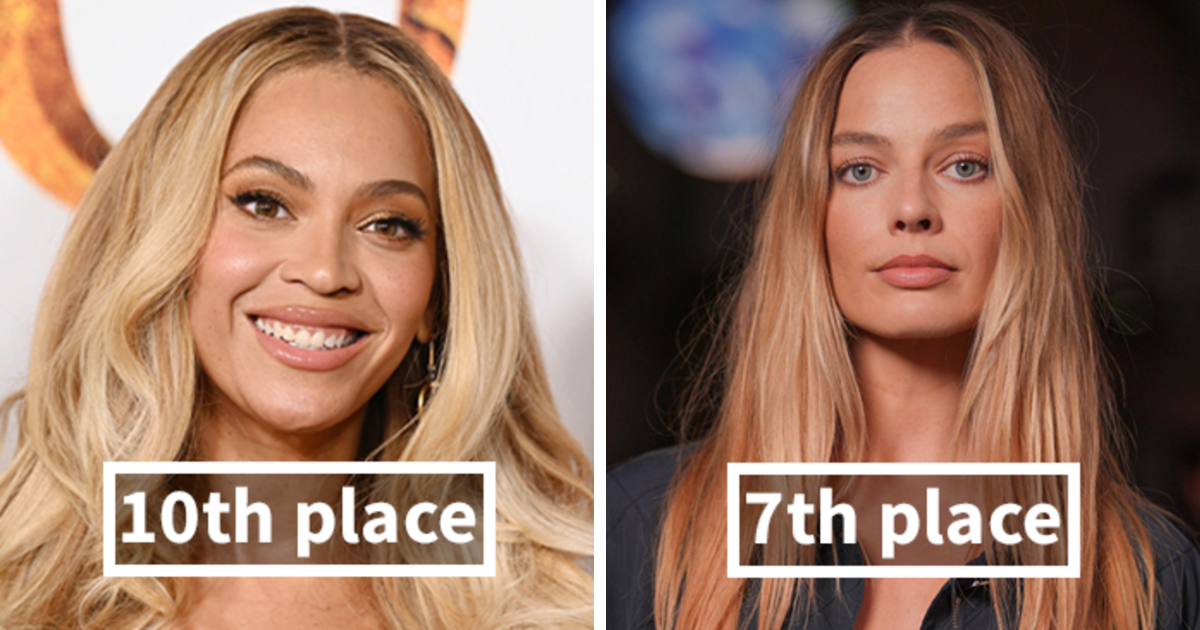
| 7 | Margot Robbie | 93.43% | Nose proportions: 97.4% |
| 8 | Aishwarya Rai Bachchan | 93.41% | Nose-to-lip spacing: 99.7% |
| 9 | Tang Wei | 93.08% | Chin: 99.8% |
| 10 | Beyoncé | 92.40% | Face shape: 99.6% |
The Top 10 Most Beautiful Celebrities According to the Golden Ratio
1. Emma Stone 94.72%
Emma Stone claimed first place because her facial proportions remained consistently strong across the measured categories. Her jawline received 97%, her lips scored 95.6%, and her eyebrows reached 94.2%. No single measurement dominated the entire competition, but her overall balance carried her to the top.
That feels appropriate for a performer celebrated for versatility. The two-time Academy Award winner has moved easily between musical romance in La La Land, dark comedy in The Favourite, and the wonderfully strange world of Poor Things. The formula may celebrate structural harmony, but Stone’s expressive range is what makes her face memorable on screen.
2. Zendaya 94.37%
Zendaya missed first place by only 0.35 percentage points. Her lips earned a remarkable 99.5%, while her forehead scored 98% and her eye position reached 97.3%. Lower results for eyebrow shape and the space between her nose and upper lip slightly reduced her total.
Whether she is navigating emotional chaos in Euphoria, crossing deserts in the Dune films, or commanding the tennis court in Challengers, Zendaya continually transforms her appearance. That adaptability demonstrates something the Golden Ratio cannot calculate: styling, movement, and confidence can change how the same facial structure is perceived.
3. Freida Pinto 94.34%
Freida Pinto finished only 0.03 points behind Zendaya. Her standout measurement was her nose, which received 99.6%the highest score in that category. Her forehead registered a comparatively lower 89%, but her other proportions kept her firmly in third place.
Pinto became internationally recognized through Slumdog Millionaire and later built a career spanning American, British, and Indian productions. Her placement adds global variety to the ranking and illustrates how balanced proportions can appear across different facial structures and ethnic backgrounds.
4. Vanessa Kirby 94.31%
Vanessa Kirby followed Pinto by another tiny margin. Her overall face shape earned 99.8%, one of the highest individual results in the entire analysis. Her nose dimensions were also especially strong, while her chin received a lower score of 87.6%.
Audiences may recognize Kirby from The Crown, Pieces of a Woman, the Mission: Impossible franchise, and The Fantastic Four: First Steps. Her sculpted facial structure photographs beautifully, although her performances prove that a face becomes far more compelling when emotion starts rearranging it.
5. Jenna Ortega 93.91%
Jenna Ortega’s forehead scored 99.6%, placing her first in that individual category. Her overall face-shape measurement was 88%, the lowest such result among the top 10, yet strong scores elsewhere produced an impressive 93.91% total.
Ortega’s expressive eyes and deadpan control helped make Wednesday a cultural phenomenon. Her success is a useful reminder that visual identity frequently depends on distinctive features rather than mathematical uniformity. Sometimes the memorable detail is precisely the one a formula would try to “correct.”
6. Olivia Rodrigo 93.71%
Olivia Rodrigo placed sixth, led by a 98.6% chin score and a 97.2% forehead measurement. Her eyebrows received 83.5%, demonstrating again that a lower category score does not prevent a highly balanced overall result.
The singer-songwriter built her reputation on emotionally direct albums such as SOUR and GUTS. Rodrigo’s stage presence depends heavily on expression, movement, lighting, and attitudenone of which can be captured by measuring a still photograph. Phi may like her chin, but concert audiences are generally paying more attention to the chorus.
7. Margot Robbie 93.43%
Margot Robbie recorded strong results throughout the analysis, including 97.4% for her nose proportions. Her eyebrow score of 82% brought down the average, although “bringing it down” to 93.43% is hardly an aesthetic emergency.
Robbie has played characters ranging from Harley Quinn to Tonya Harding and Barbie, changing hair, makeup, posture, and expression for each role. Her transformations reveal how much perceived beauty depends on presentation. Bone structure provides the stage; styling and personality decide what production is playing.
8. Aishwarya Rai Bachchan 93.41%
Aishwarya Rai Bachchan finished just 0.02 points behind Robbie. The former Miss World achieved 99.7% for the spacing between her nose and lips, along with 98% for her forehead and 96% for her lips. Her eyebrows received a lowerbut still strong87%.
Rai Bachchan has long been associated with classical beauty through Indian cinema, international film festivals, and global fashion campaigns. Her inclusion is unsurprising, but no mathematical score fully explains the poise and screen presence that have sustained her image for decades.
9. Tang Wei 93.08%
Chinese actress Tang Wei received an extraordinary 99.8% for her chin, tying one of the highest category scores in the ranking. Her face shape reached 97.7%, while the position between her nose and lips received a lower 86.7%.
Known internationally for films including Lust, Caution and Decision to Leave, Tang often projects a restrained, enigmatic quality. That impression emerges through gaze and expression rather than static measurements, showing why cinematic beauty remains more complex than geometry.
10. Beyoncé 92.40%
Beyoncé completes the top 10 with a face-shape score of 99.6%. Her eyes, brows, and lips also performed strongly, while the position between her nose and lips reduced her overall percentage.
Ranking Beyoncé tenth demonstrates the limits of treating numerical order as a final verdict. Her cultural impact, stage command, fashion influence, and ability to dominate a stadium cannot be squeezed into the space between two facial landmarks. Mathematics can measure proportions; it cannot measure star power without immediately overheating.
Does the Golden Ratio Really Determine Facial Beauty?
The short answer is nonot by itself. Research into facial attractiveness has found possible roles for symmetry, average proportions, skin appearance, emotional expression, age cues, familiarity, and culturally influenced preferences. No single measurement consistently explains what every population considers beautiful.
Some experiments have identified attractive facial proportions that do not equal the classic 1.618 ratio. Studies using three-dimensional faces have also found that many supposedly ideal measurements differ from Golden Ratio targets and may not correlate reliably with attractiveness ratings.
There are practical problems as well. Camera angle, focal length, head position, expression, makeup, lighting, image editing, and the placement of digital landmarks can all change a result. Even a small turn of the head may alter the apparent width of the nose or distance between the eyes.
Beauty is also dynamic. A smile changes cheek position, eye shape, and facial width. Conversation introduces movement and personality. Culture influences which traits receive attention, while personal memory can make a familiar face feel more appealing. A static formula captures only one quiet frame from a much longer movie.
What the Ranking Canand CannotTell Us
The Golden Ratio celebrity ranking works best as a conversation about facial harmony. It highlights how multiple features relate to one another and explains why a face can appear balanced without every individual feature matching the same ideal.
It cannot prove that Emma Stone is more beautiful than Zendaya, or that the tenth-ranked celebrity is less attractive in ordinary human experience. The differences are tiny, and the original candidate pool was selective. More importantly, beauty does not operate like a sports scoreboard. There is no trophy ceremony where Beyoncé graciously accepts tenth place while a referee reviews her jawline on instant replay.
The healthiest interpretation is simple: these are 10 famous faces that performed well under one mathematical model. Every person on the list also possesses distinctive traits that cannot be explained by perfect proportions alone.
An Experience-Based Way to Explore the Golden Ratio
Trying a Golden Ratio face analysis can be an entertaining visual experiment, provided it is approached with curiosity rather than self-criticism. The first surprise usually comes before any calculation: selecting a suitable photograph is remarkably difficult.
A casual selfie may introduce wide-angle distortion, making the center of the face look larger and the ears appear farther away. A professional portrait may use a longer lens, carefully controlled lighting, makeup, and retouching. Compare the two photographs and the software may produce different measurements for the same person. Your face has not changed; the camera has simply decided to become an unreliable witness.
Start With Consistent Photographs
For a fair comparison, use front-facing images taken at eye level with a neutral expression and even lighting. Keep the head upright and avoid beauty filters. If several people are being compared, use the same camera, focal distance, and lighting conditions.
Once facial landmarks are placed around the eyes, nose, mouth, chin, and outer face, the measurements reveal relationships that are difficult to notice casually. One person may have nearly ideal eye spacing but a longer lower face. Another may have balanced vertical proportions but a wider mouth. These differences are not defects; they are the architecture of recognizable faces.
Change One Variable at a Time
Repeat the analysis with a smile, a slight head turn, or a photograph taken from closer range. The resulting score may shift even though the subject is obviously the same person. This exercise offers a valuable lesson: numerical precision does not always equal real-world certainty.
It is also revealing to compare the score with ordinary human reactions. A technically balanced neutral portrait may feel less engaging than a candid photograph filled with warmth and humor. The less “perfect” image often becomes the favorite because people respond to emotion before reaching for imaginary calipers.
Notice What the Formula Ignores
A Golden Ratio tool does not understand expressive eyes, a contagious smile, personal style, kindness, or the confidence created by feeling comfortable in one’s own skin. It cannot account for how a face changes during conversation or how affection influences perception.
This is why the most useful experience is not chasing a higher score. It is discovering how photography, proportion, and perception interact. The experiment can teach visual literacy: images are shaped by lenses, poses, lighting, editing, and expectations long before an audience sees them.
The 2025 ranking offers an enjoyable intersection of celebrity culture and mathematics. Emma Stone may lead this particular table, but the more interesting conclusion is that every featured celebrity succeeds through a different combination of proportion, expression, talent, and presence. Phi can start the discussion. Thankfully, it does not get the final word.
Conclusion
According to Dr. Julian De Silva’s 2025 Golden Ratio analysis, Emma Stone is the world’s most mathematically beautiful celebrity, followed by Zendaya, Freida Pinto, Vanessa Kirby, and Jenna Ortega. The close scores show how balanced the selected faces were under the model, while their contrasting standout features demonstrate that there is no single blueprint for an attractive face.
The Golden Ratio is an intriguing tool for discussing symmetry and facial proportions, but beauty remains shaped by culture, individuality, expression, and experience. A percentage can describe distances between landmarks. It cannot explain why a face becomes unforgettable.