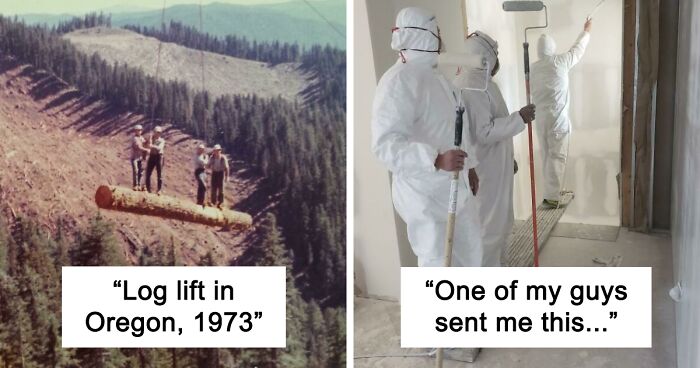
Some people look both ways before crossing the street. Others climb a ladder balanced on a forklift, near a live wire, while holding a power tool and the confidence of a cartoon coyote. The internet, naturally, has built a museum for the second group.
The online community at the center of this strangely educational chaos is Reddit’s r/OSHA, a place where users share photos and videos of workplace safety fails, questionable shortcuts, and moments so risky they make your spine file a complaint. The name borrows from the Occupational Safety and Health Administration, but the community itself is unofficial. Its mission is simple: post funny, shocking, and sometimes terrifying scenes from workplaces where safety seems to have gone on lunch break and never returned.
At first glance, it looks like pure internet comedy: unstable ladders, blocked exits, mystery wiring, forklifts doing things forklifts were never emotionally prepared to do. But beneath the jokes is a serious point. These images are funny because they are absurd. They are scary because they are familiar. And according to real safety data, the hazards people laugh at online are often the same ones that injure or kill workers in real life.
What Is This Online Safety-Fail Community?
r/OSHA is a Reddit community where people post workplace scenes that appear unsafe, poorly planned, or wildly improvised. Think of it as a digital “spot the hazard” game, except the hazards are usually so obvious they wave at you with both hands.
The posts often show people standing on buckets instead of ladders, using forklifts as elevators, ignoring eye protection, stacking materials like a Jenga tower with anger issues, or turning emergency exits into storage closets. The humor comes from the disbelief: “Surely nobody thought this was fine.” Then the comment section arrives, and someone who works in construction, maintenance, warehousing, or safety explains exactly why it is not fine.
That is what makes the community more than a gallery of bad decisions. It functions like accidental safety training. Users often identify the hazard, explain the rule, describe what could go wrong, and recommend what should have happened instead. One person laughs. Another person learns. Somewhere, a ladder breathes a sigh of relief.
Why Safety Fails Go Viral
Safety-fail photos work online because they combine comedy, suspense, and a little bit of moral panic. You do not need a degree in industrial hygiene to understand that a person standing on the top step of a ladder while reaching sideways over a spinning saw is not making a life-enhancing choice.
These images also trigger a universal reaction: “I have seen something like that.” Maybe it was a coworker using a chair as a ladder. Maybe it was a tangled extension cord situation that looked like spaghetti auditioning for a lawsuit. Maybe it was a contractor cutting concrete without dust control while everyone nearby suddenly developed a cough and a new respect for lungs.
The viral appeal comes from the gap between obvious danger and human confidence. People know better, but they rush, improvise, underestimate risk, or assume nothing bad will happen because nothing bad happened last time. That last part is the dangerous one. “It worked yesterday” is not a safety plan. It is a coin toss with better branding.
The Real Dangers Behind the Funny Pictures
Falls: The Classic Internet Safety Horror Show
If r/OSHA had a mascot, it might be a ladder looking deeply concerned. Falls are one of the most common themes in online safety-fail content, and real-world data explains why. OSHA reports that falls remain the leading cause of death in construction. In 2024, fatal falls to a lower level accounted for 389 of 1,034 construction fatalities. That is not a small category. That is a blinking red warning sign.
Online, fall hazards show up as workers balancing on railings, climbing shelves, standing on unstable pallets, or using ladders in ways that make physics clear its throat. The fix is rarely glamorous: use the right ladder, inspect it, place it on stable ground, maintain three points of contact, and use proper fall protection when required. Basic? Yes. Boring? Also yes. But boring is excellent when the alternative is gravity winning an argument.
Ladders: Simple Tools, Complicated Consequences
CDC/NIOSH ladder guidance shows that ladder-related injuries are a serious workplace issue. In 2020, ladder incidents were linked to 161 workplace fatalities and more than 22,000 workplace injuries. That makes every “quick ladder trick” a little less funny after the first nervous laugh.
The common mistakes are painfully ordinary: using the wrong ladder, overreaching, setting it on uneven ground, carrying heavy items while climbing, or standing on the top cap as if it were a VIP balcony. The safest ladder is not the one closest to you. It is the one designed for the job, set up correctly, and used by someone who has not decided to freestyle against gravity.
Electrical Hazards: The Invisible Villain
Electrical safety fails are especially unsettling because the danger is not always visible. A photo may show a worker near overhead power lines, cords running through wet areas, overloaded outlets, or improvised wiring that looks like it was assembled during a thunderstorm by a raccoon.
OSHA warns that common electrical hazards include contact with power lines, missing ground-fault protection, improper extension cord use, and equipment used in unsafe ways. Around power lines, OSHA guidance emphasizes keeping a safe distance, assuming lines are energized unless confirmed otherwise, and using nonconductive ladders where needed.
In other words, electricity is not impressed by confidence. It does not care that someone is “only going to be there for a second.” It is the ultimate no-nonsense coworker.
Forklifts: Not Elevators, Not Toys, Not Vibes
Forklift-related posts are a whole genre of internet safety comedy. Someone stands on the forks. Someone rides on a pallet. Someone uses a forklift to lift another forklift, because apparently the workplace needed a sequel.
But powered industrial trucks are serious equipment. OSHA guidance tells operators to yield to pedestrians, stop when people cross the route, use caution in congested areas, and walk the route first when visibility or clutter creates problems. The reason is simple: forklifts are heavy, have blind spots, and can turn a “shortcut” into an incident report very quickly.
Good forklift safety is not mysterious. Separate pedestrians from traffic where possible. Mark walkways. Use spotters when needed. Keep loads stable and low. Train operators. And please, for the love of every warehouse manager’s blood pressure, do not use forks as a people-lifting platform unless the correct approved equipment and procedures are in place.
PPE: The Gear People Skip Until They Need It
Personal protective equipment often gets treated like an optional accessory. Safety glasses fog up. Gloves feel annoying. Respirators are uncomfortable. Hard hats mess with hair. Then a flying chip, chemical splash, falling object, or dust cloud enters the chat.
OSHA describes PPE as equipment that helps minimize exposure to hazards that can cause serious injuries and illnesses. That includes safety glasses, gloves, hard hats, hearing protection, respirators, protective footwear, vests, and more. Eye and face protection is especially important because thousands of work-related eye injuries each year could be prevented with the right protection.
The mistake is thinking PPE is the whole safety plan. It is not. Hazards should be eliminated or controlled first when possible. But when PPE is needed, wearing it properly matters. Safety glasses on top of the head protect only the hairstyle.
Why People Ignore Safety Even When the Risk Is Obvious
Most people do not wake up thinking, “Today I will become a cautionary slideshow.” Unsafe behavior usually comes from pressure, habit, poor planning, weak training, or a workplace culture where speed is rewarded more than safe work.
One major factor is normalization of risk. If a shortcut works once, people repeat it. If it works ten times, it becomes “how we do it here.” Eventually, the hazard becomes invisible because everyone has learned to look around it.
Another factor is production pressure. Workers may feel pushed to finish quickly, avoid downtime, or “just get it done.” That is how lockout/tagout gets skipped, ladders get misused, dust controls get ignored, and near misses get shrugged off. The job gets finished, until one day it does not.
There is also overconfidence. Humans are very good at believing they are the exception. Other people fall. Other people get shocked. Other people lose fingers. The online safety community is basically a collection of photos taken moments before that theory gets peer-reviewed by reality.
The Best Thing About These Communities: They Make Hazards Visible
The value of r/OSHA and similar online spaces is not just mockery. It is pattern recognition. After scrolling through enough posts, you start spotting the same categories again and again: falls, blocked exits, missing guards, unstable loads, bad electrical setups, poor housekeeping, unsafe lifting, no dust control, no PPE, and creative equipment use that belongs in a circus with better insurance.
This matters because safety often begins with noticing. A blocked emergency exit may look like “temporary storage” until someone points out what happens during a fire. A missing machine guard may look like a productivity boost until someone explains how quickly moving parts can pull in clothing, fingers, or tools. A dry concrete-cutting job may look dusty and annoying until someone mentions respirable crystalline silica and lung disease.
When people learn to identify hazards in photos, they may become better at identifying hazards at work, in garages, on job sites, and in public spaces. That is the strange gift of these communities: they turn “Can you believe this?” into “I know what is wrong with this.”
Near Misses Deserve More Attention Than They Get
One theme that comes up repeatedly in safety discussions is the near miss. A near miss is an incident that could have caused injury, damage, or death but did not. No one got hurt, so everyone moves on. That is a mistake.
The National Safety Council emphasizes that near-miss reporting works best when leadership supports a non-punitive culture, reporting is easy, and investigations focus on root causes rather than blame. In plain English: people need to feel safe speaking up before someone gets hurt.
Many viral safety-fail photos are near misses frozen in time. The person did not fall. The forklift did not tip. The tool did not kick back. The load did not collapse. The wire did not arc. Yet. Treating those moments as warnings instead of entertainment-only content is where the real benefit begins.
How Workplaces Can Avoid Becoming the Next Viral Safety Fail
1. Build Safety Into the Plan, Not the Apology
Work should be planned with hazards in mind before the job starts. That means choosing the right equipment, assigning trained people, checking conditions, and making sure the schedule allows safe work. Safety added at the last minute usually looks like duct tape with a clipboard.
2. Train People for the Work They Actually Do
Generic training has limits. Workers need practical instruction for real tasks: ladder setup, fall protection, forklift traffic, power tools, machine guarding, electrical work, silica dust control, lifting, PPE selection, and emergency procedures. Training should not be a dusty binder that only appears during audits.
3. Make Reporting Normal
If workers are afraid to report hazards, the hazards stay hidden. A good safety culture rewards early reporting, fixes problems quickly, and treats near misses as valuable information. The goal is not to catch people doing something wrong. The goal is to stop bad conditions from becoming injuries.
4. Stop Rewarding Dangerous Speed
When supervisors praise fast work but ignore unsafe shortcuts, employees learn the real rule. If speed matters more than safety, safety becomes theater. Good leaders make it clear that the job is not done well unless it is done safely.
5. Use the Internet as a Training Tool
Safety-fail photos can be useful in toolbox talks, training sessions, and informal discussions. Ask: What is wrong here? What could happen? What control would fix it? What would you do if you saw this on our site? It is much better to learn from someone else’s bad ladder setup than to create your own starring role.
Experiences Related to Safety Fails: What These Photos Teach Us in Real Life
Anyone who has worked around tools, warehouses, kitchens, construction sites, repair shops, farms, or even chaotic home projects has probably seen a small-scale version of the “people ignoring safety as if they’re immortal” phenomenon. It rarely begins dramatically. It begins with a sentence like, “This will only take a second.” Those six words should come with flashing lights.
One common experience is the chair-ladder situation. Someone needs to reach a high shelf, the ladder is in another room, and suddenly an office chair with wheels becomes “good enough.” It is not good enough. It is a rolling betrayal device. The person may get the box down safely nine times, but on the tenth attempt the chair moves, balance disappears, and the floor becomes very committed to teaching physics.
Another familiar scene is the extension cord jungle. One cord becomes two. Two become five. Someone adds a power strip, then another power strip, then a heater, then a tool charger, and before long the setup looks less like electricity and more like a trap designed by a bored octopus. People step over it for weeks until someone trips, a cord overheats, or equipment fails at the worst possible moment.
Home improvement creates its own special category of optimism. A person watches a ten-minute video and decides they are ready to remove a wall, cut tile, climb onto the roof, or rent equipment with more horsepower than their first car. Confidence is useful, but preparation is better. The safe version includes reading instructions, using eye and hearing protection, checking dust hazards, keeping children and pets away, and knowing when a licensed professional is not an upsell but a survival strategy.
Workplaces add another layer: social pressure. People may copy unsafe habits because “the experienced guys do it that way.” New workers may stay quiet because they do not want to seem difficult. Temporary workers may not know who to ask. That is why leadership matters so much. When the most respected person on a crew uses fall protection, wears safety glasses, reports hazards, and refuses sketchy shortcuts, everyone else gets permission to do the same.
The best personal safety lesson from communities like r/OSHA is humility. Every person is capable of a bad judgment call when tired, rushed, distracted, or too comfortable with routine. The goal is not to mock people as foolish and move on. The goal is to recognize the little voice that says, “Maybe this is fine,” and answer it with, “Maybe we should do this correctly instead.”
That shift saves people from injuries that never needed to happen. It saves coworkers from trauma, families from phone calls, businesses from shutdowns, and supervisors from explaining why a preventable hazard was allowed to sit there wearing a neon sign. Safety is not about being scared of everything. It is about respecting reality before reality becomes aggressively educational.
Conclusion: Laugh, Learn, and Please Put the Ladder Down
The online community devoted to pictures of people ignoring safety works because it is funny, uncomfortable, and weirdly useful. It shows the comedy of human overconfidence, but it also highlights hazards that safety professionals have been warning about for decades: falls, ladders, forklifts, electricity, missing PPE, blocked exits, dust exposure, unstable loads, and shortcuts dressed up as efficiency.
The best way to enjoy these posts is not just to laugh at them. Use them as reminders. Look around your own workplace, garage, kitchen, warehouse, office, or job site. Are exits clear? Are ladders used correctly? Are cords managed? Is PPE available and actually worn? Are people comfortable reporting near misses? Is someone about to do something that begins with “hold my coffee”?
Immortality is a terrible safety policy. Good planning, proper equipment, real training, and a culture where people speak up are much better. They may not go viral, but they do have one major advantage: everyone gets to go home in one piece.