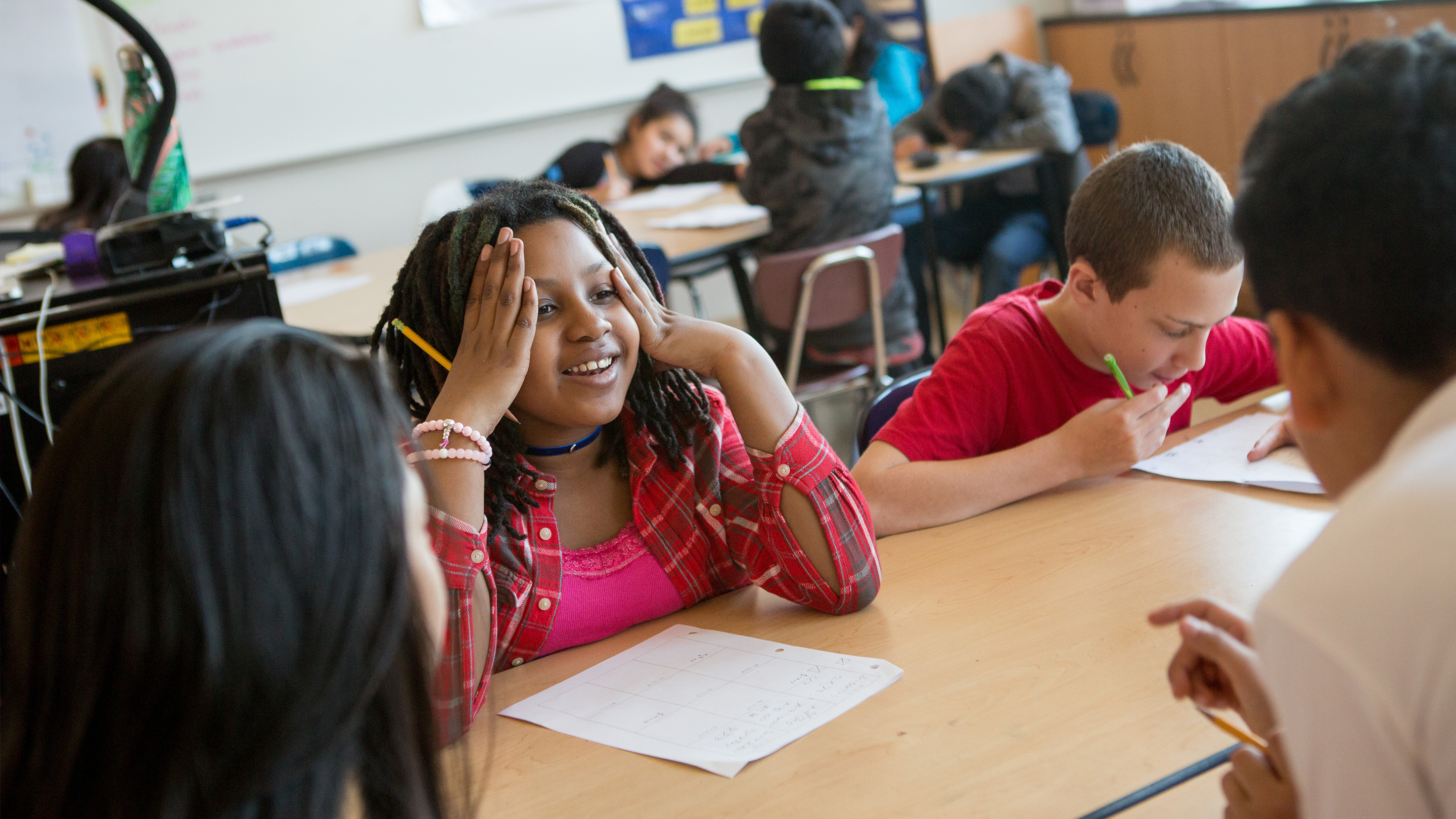
Walk into a middle or high school math classroom and you may see the classic scene: one student finishes the problem before the teacher has capped the marker, another is still staring at the first line like it just insulted their family, and three students are quietly debating whether the slope is positive, negative, or “emotionally complicated.” This is exactly why heterogeneous student groups in math classes matter.
Heterogeneous grouping means placing students with different performance levels, learning speeds, strengths, backgrounds, communication styles, and problem-solving habits in the same learning group. Instead of sorting students into “fast,” “average,” and “struggling” lanes, teachers create mixed-ability math groups where students learn with and from one another. In middle and high school math, this approach can support deeper understanding, stronger academic confidence, better classroom culture, and more equitable access to challenging mathematics.
Of course, heterogeneous grouping is not magic. It is not a seating chart with a cape. A mixed group can become awkward, passive, or dominated by one student if the teacher simply says, “Work together,” and then hopes for the best. But when it is supported by strong tasks, clear roles, high expectations, scaffolding, and purposeful teacher facilitation, heterogeneous grouping can turn math class from a race for the quickest answer into a shared investigation of ideas.
What Are Heterogeneous Student Groups in Math?
Heterogeneous student groups are learning teams made up of students with varied mathematical readiness, experiences, and strengths. One student may be quick with symbolic manipulation, another may be excellent at explaining patterns, another may notice visual relationships, and another may ask the question everyone else was too proud to ask. Together, they form something far more useful than a row of identical calculators with sneakers.
In math education, this model is often discussed alongside detracking, flexible grouping, collaborative learning, and differentiated instruction. The central idea is simple: students should not be permanently labeled by test scores, speed, or prior grades. Instead, they should have regular access to rigorous math tasks and opportunities to contribute meaningfully to mathematical discussion.
Why Mixed-Ability Math Groups Are Especially Powerful in Grades 6–12
Middle and high school are critical years for mathematical identity. Students begin to decide whether they are “math people,” “not math people,” or “please do not call on me while I am blinking.” Unfortunately, traditional tracking can reinforce these identities early. Students placed in lower tracks may receive less challenging content, while students in advanced tracks may develop speed without necessarily building flexible reasoning.
Heterogeneous grouping challenges that pattern. It tells students, through classroom design, that mathematical ability is not fixed. It also communicates that good math thinking includes explaining, questioning, representing, revising, listening, connecting, and making mistakes productively. In other words, math is not only about who can sprint to the answer first. Sometimes the best mathematician in the room is the student who says, “Wait, why does that work?”
Academic Advantages of Heterogeneous Student Groups
1. Students Develop Deeper Conceptual Understanding
When students with different approaches work together, they are exposed to multiple ways of solving the same problem. One student may use a graph, another may build a table, another may write an equation, and another may explain the situation in words. This variety helps students move beyond memorized procedures and toward conceptual understanding.
For example, in an Algebra I class solving a system of equations, a quick procedural student may immediately use substitution. Another student may sketch the two lines and notice where they intersect. A third may connect the solution to a real-world situation, such as comparing two phone plans. The group discussion helps everyone see that the “answer” is not just a pair of numbers; it represents a relationship.
2. Higher-Performing Students Benefit Too
A common fear about heterogeneous grouping is that advanced students will be “held back.” In reality, strong students often deepen their own understanding when they explain, justify, and defend their reasoning. Teaching a procedure is easy when the other person already understands it. Explaining why a procedure works to someone who sees it differently is where the intellectual workout begins.
Students who usually finish quickly may learn to slow down, analyze assumptions, use precise mathematical language, and consider alternate strategies. These are not consolation prizes. They are advanced mathematical habits. In higher-level math, from geometry proofs to calculus, the ability to explain reasoning clearly matters just as much as getting an answer.
3. Students Who Struggle Gain Access to Richer Math
Students who have struggled in math are often given more repetition, more worksheets, and fewer opportunities for rich problem-solving. That is like trying to make someone love music by assigning them twenty pages of scales and never letting them hear a song. Heterogeneous grouping can help struggling students participate in meaningful tasks while still receiving support.
In a mixed group, a student who needs more processing time can hear different explanations, ask questions in a smaller setting, and use peer models to build understanding. The goal is not to make peers replace teachers. The goal is to create more mathematical voices in the room so that support comes from multiple directions.
4. Heterogeneous Groups Encourage Productive Struggle
Productive struggle is the healthy kind of confusion that leads to learning. It is not panic. It is not abandonment. It is the moment when students wrestle with a problem long enough to build new understanding. Heterogeneous student groups make productive struggle more visible and more social.
When students see peers making mistakes, revising ideas, and trying again, they learn that confusion is part of the process. This can reduce math anxiety and help students become more resilient. The classroom message changes from “smart students get it instantly” to “mathematicians keep thinking.” That small shift can be enormous.
Equity Advantages of Heterogeneous Math Groups
Reducing the Harm of Fixed Ability Labels
Labels such as “high,” “medium,” and “low” may look tidy in a spreadsheet, but students are not canned soup. Once students are labeled, adults may unconsciously adjust expectations, curriculum, and opportunities. Students may also internalize those labels, especially during adolescence.
Heterogeneous grouping helps disrupt this pattern. It gives all students access to complex tasks and meaningful discussion. It also allows students to show strengths that traditional tests may not capture: visual reasoning, persistence, creativity, leadership, precision, and the courage to ask clarifying questions.
Expanding Access to Challenging Curriculum
In many schools, tracking determines who gets early access to Algebra I, honors pathways, advanced math, and eventually STEM opportunities. Because placement decisions can reflect prior opportunity as much as current ability, tracking can widen existing gaps. Heterogeneous grouping does not solve every equity problem, but it helps keep doors open longer.
When schools combine mixed-ability grouping with high-quality curriculum, intervention, acceleration opportunities, and strong teacher collaboration, more students can experience rigorous math. The goal is not to lower the ceiling. The goal is to raise the floor while keeping the ceiling high enough that nobody bumps their head.
Social and Emotional Benefits in Math Class
Students Learn to Communicate Mathematically
Mathematical communication is a skill, not a decorative classroom poster. Students must learn how to explain steps, ask for evidence, disagree respectfully, and connect one idea to another. Heterogeneous groups create authentic reasons for students to communicate. They cannot simply nod at identical thinking; they must negotiate meaning.
Useful sentence stems can help: “I agree because…,” “Can you explain why…?,” “Another way to represent this is…,” and “I think the error happened when….” Over time, students become more comfortable discussing math in precise, respectful language.
Mixed Groups Build Belonging
Math classrooms can feel socially risky. Nobody wants to be wrong in front of twenty-nine witnesses and a whiteboard. Heterogeneous groups can reduce that pressure by creating smaller learning communities where students build trust. When groups are well structured, students learn that everyone contributes something valuable.
This matters because belonging affects participation. Students who feel invisible rarely volunteer their thinking. Students who feel respected are more likely to take intellectual risks. And math, despite its reputation for cold logic, depends heavily on risk-taking.
What Makes Heterogeneous Grouping Work?
Use Rich Tasks With Multiple Entry Points
Mixed-ability grouping works best when the task is worth discussing. If the assignment is twenty identical computation problems, students may simply divide the work or wait for the fastest person to finish. A rich task has multiple entry points, multiple strategies, and enough complexity to invite conversation.
For example, instead of asking students to complete ten slope calculations, a teacher might ask them to compare three climbing routes on a mountain and decide which is steepest, safest, or most efficient using graphs, tables, and equations. Now students can enter the task visually, numerically, verbally, or symbolically.
Assign Roles That Support Thinking, Not Just Compliance
Roles should do more than keep students busy. Good roles support mathematical thinking. A facilitator ensures everyone speaks. A skeptic asks for justification. A recorder tracks strategies. A connector links the group’s method to previous learning. A reporter shares the group’s reasoning with the class.
Roles should rotate so that no student becomes the permanent “explainer” or the permanent “quiet note-taker.” Otherwise, the group can accidentally recreate the same hierarchy it was meant to disrupt. Nobody should be mathematically typecast before sophomore year.
Teach Collaboration Directly
Students are not born knowing how to collaborate. Adults attend entire professional development sessions on teamwork and still reply-all to emails by accident. Students need explicit instruction on listening, turn-taking, questioning, and resolving disagreement.
Teachers can model a short discussion, show examples of helpful and unhelpful group talk, and pause during class to highlight effective collaboration. Over time, students learn that group work is not “one person thinks while everyone else decorates the paper.” It is shared reasoning.
Use Flexible Grouping, Not Permanent Sorting
Heterogeneous grouping should not mean students are locked into the same group forever. Teachers should use assessment data, observations, student interests, and task demands to adjust groups regularly. Sometimes students need mixed groups. Sometimes they need a temporary skill workshop. Sometimes advanced learners need time together for extension. Flexibility is the key.
The most effective math classrooms avoid both extremes: permanent tracking on one side and random grouping without support on the other. The sweet spot is purposeful, responsive grouping that changes as students grow.
Examples of Heterogeneous Grouping in Middle and High School Math
Middle School Example: Proportional Reasoning
A seventh-grade teacher gives students a task about comparing recipes for sports drinks. One recipe uses 3 scoops of powder for 8 cups of water. Another uses 5 scoops for 12 cups. Students must decide which tastes stronger and justify their answer.
In a heterogeneous group, one student creates a ratio table, another uses unit rates, another draws a bar model, and another explains the comparison verbally. The group discovers that proportional reasoning is not just a formula; it is a way of comparing relationships. The student who is slow with division may still make a powerful visual argument. The fast calculator may learn a clearer explanation from the student who drew the model.
High School Example: Geometry Proofs
In geometry, students often freeze when they see the word “prove.” A teacher can use heterogeneous groups to analyze a diagram and generate possible reasons before writing a formal proof. One student notices congruent angles, another recalls a theorem, another tests the logic, and another organizes the final argument.
This collaborative process helps students understand proof as reasoning rather than as a mysterious ritual performed by people who enjoy abbreviations. Students learn that formal math writing grows from discussion, observation, and revision.
Common Challenges and Smart Solutions
Challenge: One Student Does All the Work
This happens when the task is too simple, roles are unclear, or speed is overvalued. The solution is to use tasks that require explanation and assign roles that distribute intellectual responsibility. Teachers can also require every student to be prepared to explain the group’s reasoning.
Challenge: Students Resist Mixed Groups
Some high-performing students may feel frustrated. Some struggling students may feel embarrassed. Teachers should explain the purpose of heterogeneous grouping clearly: everyone benefits from multiple perspectives, and speed is not the same as mathematical depth.
Challenge: Parents Worry About Rigor
Families may worry that mixed-ability classes mean less challenge. Schools should communicate that heterogeneous grouping works best with rigorous curriculum, strong differentiation, and opportunities for extension. The message should be: we are not removing challenge; we are expanding access to it.
Teacher Practices That Strengthen Heterogeneous Math Groups
Successful heterogeneous grouping depends on expert teaching. Teachers need to circulate, listen carefully, ask probing questions, and decide when to intervene. A well-timed question such as “Can you represent that another way?” or “Where do you see that in the graph?” can move a group forward without stealing the thinking.
Teachers should also use formative assessment frequently. Exit tickets, mini-whiteboards, group check-ins, and student reflections help teachers know who needs support and who is ready for extension. Heterogeneous grouping is not a replacement for assessment; it gives assessment more places to show up.
Why Heterogeneous Groups Prepare Students for Real Life
Outside school, people rarely work only with others who have identical skill levels. Engineers, nurses, designers, electricians, data analysts, and business owners all collaborate with people who think differently. Heterogeneous math groups help students practice this reality. They learn to explain ideas, listen to alternate strategies, manage disagreement, and combine strengths to solve problems.
These are not soft skills in the fluffy sense. They are durable academic and career skills. A student who can explain a quadratic model to a peer, critique a flawed graph, and revise a solution after feedback is building habits that matter far beyond the math classroom.
Experience-Based Reflections: What Heterogeneous Math Groups Look Like in Practice
In real classrooms, the advantages of heterogeneous student groups often appear gradually. At first, students may be suspicious. The fastest students wonder why they cannot just work alone. The quieter students hope nobody notices them. The teacher may wonder whether the room is full of mathematicians or a committee planning a very confusing pizza order.
But after a few weeks of consistent routines, something changes. Students begin to recognize one another’s strengths. The student who rarely speaks may become the best diagram maker in the group. The student who calculates quickly may learn that explaining a solution requires more than saying, “You just do it.” The student who has struggled for years may discover that asking a thoughtful question can unlock the entire problem for everyone.
One powerful classroom experience involves assigning groups a nonroutine problem with no obvious first step. For instance, students might be asked to design a small school garden using a fixed amount of fencing and then determine which dimensions maximize the area. In a tracked or speed-focused environment, some students may rush to formulas while others shut down. In a heterogeneous group, the task opens up. One student sketches rectangles. Another makes a table. Another notices a pattern. Someone else asks whether decimals are allowed. Suddenly, the group is doing real mathematics: testing, revising, arguing, and making sense.
The teacher’s role in that moment is crucial. Instead of rescuing the group too quickly, the teacher can ask, “What have you tried?” or “How do these two representations connect?” These questions keep ownership with students. When groups later present their strategies, the class sees that there is not one royal road to the answer. There are several roads, some scenic, some bumpy, and one that probably needs a warning sign.
Another experience often seen in mixed-ability math groups is the growth of student confidence. A student who once believed “I am bad at math” may begin to say, “I understand it when I draw it,” or “I can explain the pattern.” That shift is not small. It changes how students approach homework, tests, and future courses. Confidence does not come from empty praise. It comes from repeated experiences of contributing something real.
Heterogeneous grouping also changes high-performing students. Some students who are used to being praised for speed initially struggle when peers ask them to slow down. This can be uncomfortable, but it is productive. Over time, they learn that mathematical maturity includes patience, precision, and flexibility. They begin to value elegant explanations, not just quick answers. That is a major step toward advanced mathematical thinking.
Teachers who use heterogeneous grouping successfully often report that classroom conversations become richer. Instead of one student answering every question, more students participate. Instead of treating mistakes as disasters, groups use them as evidence. Instead of math class feeling like a talent show for the fastest processors, it becomes a workshop where ideas are built, tested, and improved.
The experience is not perfect every day. Some groups will need restructuring. Some students will need coaching. Some lessons will flop with the dramatic grace of a dropped calculator. But the long-term payoff is worth it. Heterogeneous student groups help create math classrooms where more students see themselves as capable thinkers and where mathematical success is measured by reasoning, persistence, communication, and growth.
Conclusion
The advantages of heterogeneous student groups in middle and high school math classes are academic, social, and deeply practical. Mixed-ability math groups can promote conceptual understanding, reduce the harm of fixed ability labels, increase access to rigorous curriculum, and help students develop the communication skills needed for advanced learning and real-world problem-solving.
Still, the success of heterogeneous grouping depends on thoughtful implementation. Teachers need rich tasks, clear roles, flexible grouping, strong scaffolds, and a classroom culture that values mistakes as part of learning. Schools need to support teachers with collaboration, professional learning, and honest communication with families.
When done well, heterogeneous grouping does not water down math. It makes math more visible, more discussable, and more human. It reminds students that mathematics is not a private race to the finish line. It is a shared journey of reasoning, questioning, explaining, and occasionally realizing that the negative sign was the villain all along.
Note: This article is an original synthesis written for web publication and informed by current U.S. education research, math leadership guidance, and classroom-based professional practice on heterogeneous grouping, detracking, flexible grouping, and equitable math instruction.