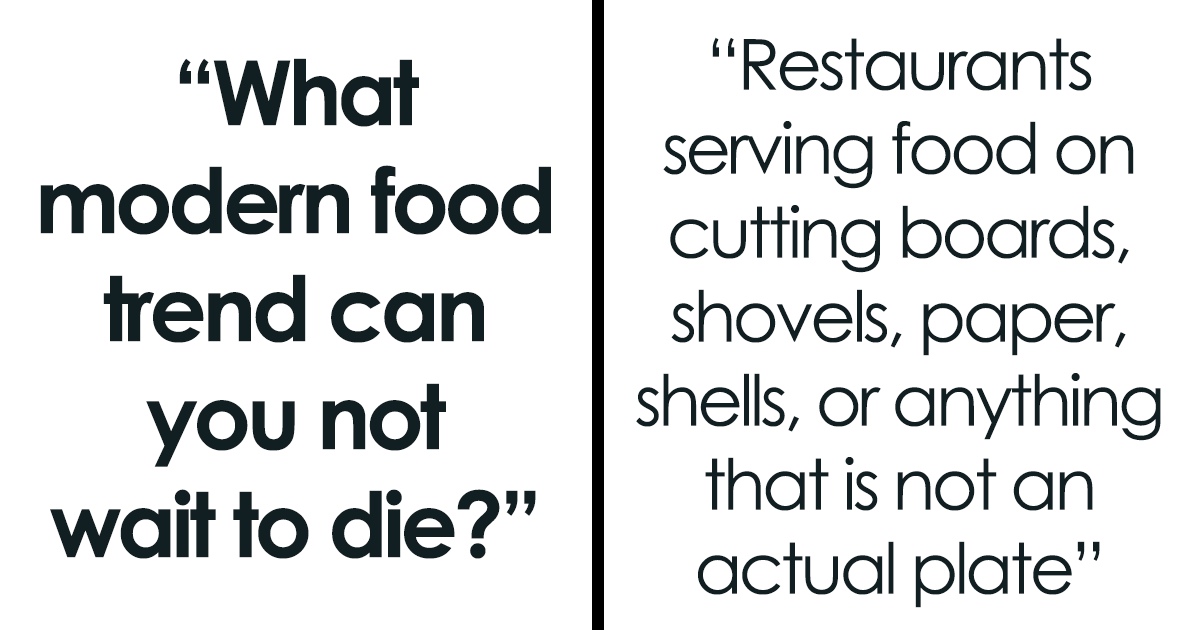
Food trends are like houseguests: some arrive with charm, bring wine, and make the evening better. Others show up wearing sunglasses indoors, ask where the ring light is, and dump nacho cheese on a perfectly innocent dessert. That is probably why a simple online question “What modern food trend can you not wait to die?” hit such a nerve. People did not merely answer. They unloaded. Politely? Not always. Accurately? Often.
The funniest part is that most people were not complaining about creativity itself. Nobody wants chefs to stop experimenting, home cooks to stop learning, or restaurants to serve only beige casseroles under fluorescent lighting. The frustration is more specific: food that is engineered for cameras instead of mouths, restaurant systems that make ordering feel like filing taxes, and “innovations” that somehow leave customers hungrier, poorer, and holding a tiny burger on a wooden plank that looks suspiciously like it came from a garage.
Modern food culture moves fast. Social media turns a sauce, sandwich, or dessert into a national obsession overnight. Delivery apps reshape how people discover restaurants. Wellness marketing makes every snack promise emotional rebirth. Restaurant prices rise, menus shrink, and suddenly the humble act of eating a meal comes with QR codes, service fees, tip screens, ai recommendations, and a milkshake wearing a donut as a hat. No wonder diners have thoughts.
Why Modern Food Trends Burn Out So Quickly
A good food trend solves a real problem or introduces people to something genuinely delicious. Think better nonalcoholic drinks, regional cuisines getting deserved attention, or fast-casual restaurants finally learning that vegetables do not have to taste like a printer manual. A bad trend, on the other hand, is usually a shortcut. It replaces flavor with spectacle, service with friction, or authenticity with a buzzword.
The rise of social media has changed the food economy. A dish no longer has to taste great to become famous; it has to look dramatic in the first three seconds of a video. Melted cheese must stretch like an action-movie bridge collapse. A cookie must be thick enough to qualify as construction material. A sandwich must be cut open slowly while someone whispers “listen to that crunch” into a microphone like the bread is testifying in court.
Restaurants and brands chase these moments because attention is money. If a dish goes viral, customers order it, photograph it, review it, and drag their friends to try it. But once the novelty fades, the weaknesses become obvious. Was it actually tasty? Was it worth $18? Could a normal human eat it without needing a poncho? These are the questions that separate a real food movement from a temporary internet fever.
The 35 Complaints Boil Down To One Big Message: Feed People, Don’t Perform At Them
The online responses covered everything from tipping fatigue to truffle oil overload, but the deeper theme was surprisingly consistent. People are tired of food experiences that feel designed around everyone except the person eating. They want menus they can read, portions that make sense, prices that do not require emotional support, and dishes that put flavor ahead of theatrics.
1. The “Instagrammable” Meal That Forgot To Be Edible
One of the biggest targets was food designed primarily for photos. These are the dishes that look amazing from one angle and become a structural disaster once a fork gets involved. Towering burgers, rainbow desserts, smoking cocktails, neon sauces, gold leaf, overloaded fries, and desserts stacked with other desserts all belong to this category.
The problem is not beauty. Beautiful food is wonderful. A thoughtful plate can make a meal feel special before the first bite. The problem begins when visual shock value replaces taste, texture, temperature, and basic dignity. A burger should not require a hydraulic press. A milkshake should not arrive with an entire bakery glued to the rim. A taco should not look like it is trying to win a costume contest.
People are not rejecting fun. They are rejecting the meal equivalent of a loud person at a party who keeps saying, “Are you filming this?” Food can be attractive without being exhausting.
2. Tipping Screens For Everything
The modern tip screen has become a tiny emotional trap at the register. You buy a muffin. You tap your card. Suddenly a glowing screen asks whether you would like to tip 20%, 25%, or 30%, while the cashier stands three feet away and your soul leaves your body.
Many diners understand tipping in full-service restaurants where servers take orders, refill drinks, answer questions, and manage the experience. The frustration comes from tip prompts appearing everywhere: counter pickup, self-service kiosks, food trucks, bakeries, coffee shops, and even places where the “service” is handing over an item that was already sitting in a case.
This complaint also points to a bigger issue. Customers are increasingly aware that tipping is being used to patch a broken wage model. They do not want workers underpaid. They also do not want every purchase to feel like a moral exam. The cleanest solution is not more guilt at checkout. It is transparent pricing and fair pay built into the business model.
3. QR Code Menus That Make Dinner Feel Like Tech Support
QR code menus made sense during the pandemic. They reduced contact, helped restaurants update prices quickly, and solved supply-chain chaos when dishes disappeared without warning. But many diners are ready for the paper menu comeback tour, complete with dramatic lighting and applause.
The complaint is simple: people go out to eat partly to escape their phones. Instead, they sit down and immediately have to scan a code, wait for a slow website, pinch-zoom through a tiny menu, dodge pop-ups, and sometimes enter a location or start an order before even seeing what is available. At that point, the appetizer is frustration with a side of low battery.
QR menus can work in fast-casual settings, food halls, bars, or places with changing inventory. But in a sit-down restaurant, especially one charging sit-down prices, hospitality matters. A printed menu is not old-fashioned. It is readable, shareable, and blessedly free of loading wheels.
4. Restaurant Websites That Hide The Menu Like It’s Classified Information
Few things irritate diners faster than visiting a restaurant website and being forced to start an online order before seeing the menu. People want the basics: food, prices, hours, location, photos, and allergy information. They do not want to enter a zip code, create an account, download an app, or choose pickup time just to discover whether the place serves soup.
This is not merely a design complaint. It affects trust. If a restaurant makes prices difficult to find, customers assume the prices are hiding for a reason. If hours are outdated, customers lose confidence. If the menu is trapped inside a third-party ordering system, the restaurant feels less like a neighborhood place and more like a puzzle with mozzarella sticks.
The best restaurant websites are boring in the most beautiful way. They show the menu. They show prices. They show when the kitchen is open. Nobody needs a cinematic homepage video of basil falling in slow motion before they can find the lunch special.
5. Food Trucks Charging Fine-Dining Prices Without Fine-Dining Comfort
Food trucks used to represent convenience, creativity, and affordability. Many still do. A great food truck can serve some of the best food in a city from a window the size of a microwave door. But the complaint is about trucks that charge premium restaurant prices while offering no seating, no shade, no water, tiny portions, and a tip prompt that appears after you have already stood in line for 22 minutes beside a generator.
Customers are willing to pay for excellent food. They are less thrilled when the value equation disappears. If a sandwich costs restaurant money, people expect either exceptional ingredients, generous portions, memorable flavor, or at least somewhere to sit that does not involve a curb and a questionable breeze.
6. Calling Every Small Idea A “Hack”
Adding parmesan to grilled cheese is not a “hack.” It is adding parmesan to grilled cheese. Putting chili crisp on eggs is not a “breakfast hack.” It is seasoning breakfast. Freezing grapes is not “disrupting dessert.” It is cold fruit.
People are tired of the language inflation around cooking. The word “hack” once implied a clever shortcut or unexpected workaround. Now it often means “we changed one ingredient and made a vertical video.” That does not make the food bad, but it makes the presentation annoying. A recipe can simply be a recipe. A tip can simply be a tip. Not every sandwich needs to think it escaped from a cybersecurity conference.
7. Viral Food Waste For Views
Food-wasting videos may be the least defensible trend on the list. Whether it is giant table dumps, sink recipes, absurd quantities of melted candy, or intentionally chaotic cooking stunts, the whole thing feels wasteful, sticky, and faintly cursed.
The United States already wastes a shocking portion of its food supply, and the environmental cost is not abstract. Food waste means wasted water, energy, labor, transportation, packaging, and landfill space. Turning waste into entertainment adds insult to indigestion.
There is room online for playful cooking. There is room for giant party recipes when people actually eat them. But dumping food across a counter for a camera and calling it content? That trend can be escorted out by security.
8. The “Sweets On Sweets On Sweets” Dessert Arms Race
At some point, dessert culture entered an escalation phase. A milkshake was no longer enough. It needed whipped cream, candy, a brownie, a slice of cake, two cookies, a sparkler, and possibly a small legal waiver. Pancakes became towers. Donuts became cereal bowls. Cookies became personal furniture.
These desserts photograph well, but they often eat poorly. Too sweet, too heavy, too messy, and too expensive, they create a first bite of excitement followed by 12 minutes of regret. Sugar can be wonderful. A great pie, brownie, scoop of ice cream, or slice of cake does not need to arrive dressed as a parade float.
9. Truffle Oil, Bacon, And Other Ingredients That Got Too Popular
Some ingredients are victims of their own success. Real truffles can be extraordinary in moderation. Bacon can be delicious. Cauliflower is a useful vegetable. But food culture has a habit of discovering one ingredient and then putting it in places it was never meant to go.
Truffle fries, truffle mac and cheese, truffle popcorn, truffle burgers, truffle chips eventually the flavor stops feeling luxurious and starts feeling like a scented candle fell into dinner. Bacon had a similar moment, appearing in sweets, cocktails, salads, sundaes, and every burger that wanted to look rebellious in 2011. Cauliflower has been asked to become rice, pizza crust, wings, steak, mashed potatoes, and probably a mortgage broker by now.
The lesson is moderation. A good ingredient should enhance a dish, not colonize the entire menu.
10. Deconstructed Food That Makes Customers Do The Work
Deconstructed dishes can be clever when they reveal something new about a familiar recipe. But too often, “deconstructed” means the kitchen stopped assembling the meal and called it art. A deconstructed cheesecake can be elegant. A deconstructed sandwich is just ingredients with commitment issues.
Diners are not opposed to creativity. They are opposed to paying extra for homework. If the customer has to rebuild the dish before eating it, the restaurant should at least provide instructions, tools, and maybe a tiny hard hat.
What These Complaints Say About American Dining Right Now
The backlash against annoying food trends is not anti-restaurant. It is actually pro-restaurant. People still want to eat out. They still want discovery, flavor, comfort, and community. They just want the experience to feel worth it.
Rising food costs have made diners more selective. When restaurant meals cost more, every weak spot becomes harder to forgive: the soggy bun, the tiny portion, the hidden fee, the slow app, the $18 “street tacos,” the burger so tall it becomes a physics problem. Customers may laugh about these things online, but underneath the jokes is a practical question: am I getting value?
At the same time, restaurants are under pressure too. Ingredients, rent, labor, insurance, delivery commissions, and utilities all cost more. Many operators are not adding fees, shrinking portions, or leaning into automation because they enjoy annoying customers. They are trying to survive. The tension comes when restaurants solve their problems by creating new problems for diners.
The best path forward is not to kill every trend. It is to keep the trends that improve the meal and retire the ones that make people feel manipulated. A good trend invites customers in. A bad trend turns dinner into a transaction with garnish.
Modern Food Trends That Deserve To Stay
For balance, not everything new deserves mockery. Many current food movements are genuinely positive. More regional cuisines are receiving national attention. Nonalcoholic drinks have become more interesting than sad club soda with lime. Fermented foods, spicy condiments, global comfort dishes, and better fast-casual bowls have expanded what everyday dining can look like.
Plant-forward cooking is also evolving. Diners may be cooling on some ultra-processed meat substitutes, but interest in vegetables, legumes, mushrooms, grains, and flavorful whole-food meals remains strong. The issue was never “plants are bad.” The issue was pretending every plant-based product needed to impersonate a bleeding burger while costing more than the original.
Likewise, social media can be useful. Many people discover small restaurants, family-owned bakeries, street vendors, and regional dishes through short videos. The problem is not the camera. The problem is when the camera becomes more important than the cook, the customer, and the food.
Experiences Related To This Topic: The Meal Should Be Better Than The Marketing
Anyone who eats out regularly has had a moment when the promise of a food trend collapses under the weight of reality. You see the photo online: a glossy burger, perfectly stacked, cheese melting like a sunset, sauce dripping in a way that suggests abundance rather than laundry. Then the real thing arrives. The bun is cold, the patty is tired, the toppings slide out the back, and the whole structure gives up halfway through bite two. Suddenly, you are not eating a burger. You are managing an incident.
I once ordered a “loaded” appetizer that looked spectacular in the menu photo. It arrived in a small skillet with so many sauces, garnishes, crumbs, and decorative sprinkles that no single ingredient knew who was in charge. The first bite was exciting. The second was confusing. By the fourth, it tasted like the kitchen had emptied six squeeze bottles and hoped confidence would handle the rest. That is the danger of trend-first cooking: it can create flavor noise instead of flavor harmony.
Another familiar experience is the restaurant technology obstacle course. You sit down hungry, ready to relax, and the server points to a QR code. The website loads slowly. The menu opens as a PDF. The PDF requires zooming. The cocktail list is in a separate tab. The prices are hidden until checkout. Then the Wi-Fi fails. By the time you find the burger section, you have aged spiritually. Technology should reduce friction, not turn dinner into a group project.
Tip screens create a different kind of awkwardness. The moment is small, but everyone recognizes it. You are buying coffee or picking up takeout. The screen swivels toward you with suggested percentages. You know workers deserve fair pay. You also know you have not received table service. You tap something while feeling either guilty or annoyed, and neither emotion pairs well with a cinnamon roll. A better system would be honest: charge what the food costs, pay people properly, and let tipping be a reward for service rather than a social ambush.
Then there are the viral desserts. These are fun once, especially with friends. There is joy in ordering something ridiculous and laughing at its architectural ambition. But the charm fades when every dessert becomes a stunt. The best sweets usually understand restraint. A warm chocolate chip cookie, a good slice of pie, or ice cream with one excellent topping can beat a towering sugar monument because it is designed to be eaten, not merely documented.
The most satisfying food experiences tend to be the least desperate for attention. A taco with a warm tortilla, balanced salsa, and well-seasoned filling. A burger that fits in your hands. A soup that tastes like someone cared. A printed menu with prices. A server who knows the special. A food truck that gives you big flavor without acting like a luxury handbag. These things do not need tricks. They work because they respect the diner.
That is why the online answers resonated. They were funny, but they were also a consumer manifesto in disguise. People are not asking for food culture to become boring. They are asking it to become less annoying. Keep the creativity. Keep the spice. Keep the regional flavors, the smart substitutions, the beautiful plating, and the joyful experiments. But retire the gimmicks that make eating feel like content production, financial negotiation, or unpaid assembly labor.
In the end, the modern food trend most people want to die is not one ingredient or one platform. It is the idea that novelty is automatically better than quality. A meal does not have to go viral to matter. It has to taste good, feel fair, and leave people happier than when they arrived. That may not sound trendy, but it has worked for thousands of years and unlike truffle foam on a bacon donut, it has staying power.
Conclusion: Let Food Be Food Again
The responses to “What modern food trend can you not wait to die?” are hilarious because they are familiar. We have all met the QR code that would not load, the burger too tall to bite, the tip screen that judged us silently, or the dessert that looked like a county fair exploded. These trends spread because they promise excitement, efficiency, or identity. They fade when diners realize the experience is not better just louder.
The future of food does not need to be anti-trend. Trends can introduce new flavors, support small businesses, and make dining more fun. But the best trends should serve the meal, not hijack it. Give people honest menus, thoughtful service, reasonable portions, clear prices, and food that tastes as good as it looks. That is not old-fashioned. That is hospitality with a backbone.
Note: This article is an original, web-ready synthesis based on real U.S. food, restaurant, consumer dining, nutrition, delivery, and social media trend reporting. Source links are intentionally omitted from the article body as requested.