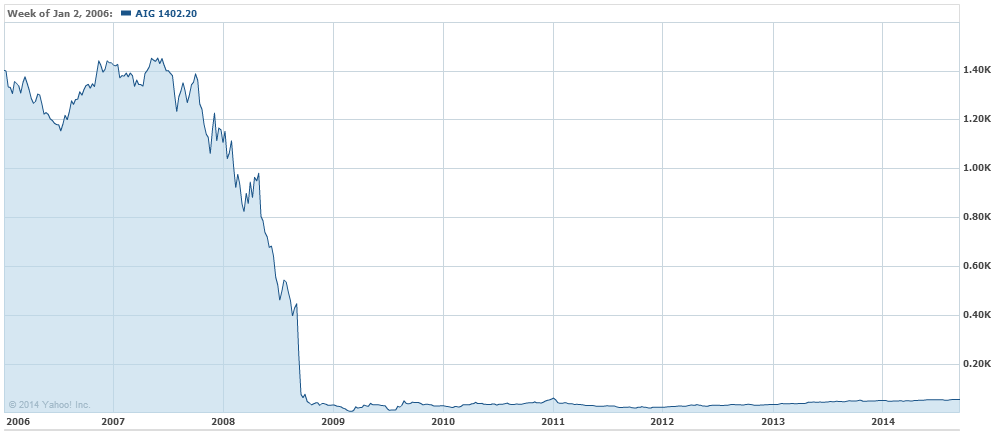
A falling stock can look like a coiled spring, a clearance sale, or a personal invitation from the investing gods. Sometimes it is. Other times, it is a trapdoor wearing a discount sticker.
Broad stock markets have historically recovered from recessions, financial crises, wars, and assorted economic headaches. Individual companies receive no such guarantee. A stock can decline 70%, lose another 70% from there, and eventually disappear altogether. The market is resilient partly because unsuccessful companies are replaced while exceptional businesses grow into larger positions.
Understanding that distinction is essential. “Buy and hold” can be an effective strategy for a diversified portfolio, but blindly holding a deteriorating company is not patience. It may simply be procrastination with a brokerage account.
The Stock Market Recovers, but Every Stock Does Not
Investors often treat the historical performance of the entire U.S. stock market as proof that any sufficiently battered stock will eventually recover. That conclusion confuses a changing collection of businesses with one permanent company.
Research covering 29,754 U.S. common stocks from 1926 through 2025 found that the median lifetime buy-and-hold return was negative 6.9%. Nearly 60% of stocks reduced shareholder wealth relative to one-month Treasury bills. Meanwhile, only 46 companies produced approximately half of the market’s $91 trillion in net wealth creation.1
That is the wonderfully strange mathematics of equities. A stock can lose no more than 100%, but a great business can gain many thousands of percent. A small group of extraordinary winners can therefore offset a very large collection of disappointing investments.
A broad market index also changes its membership. S&P Dow Jones Indices may remove companies because of bankruptcy, delisting, acquisition, or failure to meet eligibility requirements. Replacements are then added from the pool of qualifying businesses.2 The index heals by changing its ingredients. Your portfolio does not automatically replace a collapsing stock unless you or a fund manager does something about it.
Why Some Stocks Never Recover
Bankruptcy Can Cancel the Old Shares
In a corporate liquidation, common shareholders stand behind secured lenders, employees with eligible claims, tax authorities, bondholders, and other creditors. They receive whatever remains after everyone ahead of them has been paid. Frequently, the remainder is a professionally formatted zero.
Chapter 11 can allow a business to reorganize and continue operating, but that does not mean its original stock survives. Reorganization plans commonly cancel existing shares and issue new securities to creditors or new investors. FINRA warns that old common stock often has little or no value even when a familiar company emerges from bankruptcy.3
The business may come back. The old stock may not. Those are two separate events.
The Business Model Can Become Obsolete
Some companies fail more slowly. Technology changes, customer preferences move elsewhere, and once-powerful distribution networks become expensive museums. A company can keep operating for years while its competitive position steadily erodes.
Consider the path from physical media to streaming, department stores to e-commerce, or printed directories to online search. A familiar brand does not automatically possess a valuable future. Nostalgia may sell T-shirts; it does not reliably produce free cash flow.
A cyclical downturn is usually temporary: demand weakens, inventories adjust, and healthier industry economics return. Structural decline is different. Customers have found a better solution, and the old company is fighting gravity with a quarterly earnings presentation.
Debt Can Turn a Manageable Problem Into a Terminal One
A company with modest debt may survive several weak years. A heavily indebted business has less time. Interest expense consumes cash, lenders impose restrictions, and refinancing becomes more expensive precisely when the company is least attractive to creditors.
Investors should examine debt maturities, interest coverage, operating cash flow, available credit, and contractual obligations. The income statement alone is not enough. The SEC notes that cash-flow information helps investors evaluate whether a company can meet financial obligations and why reported earnings differ from actual cash receipts.4
A company can report adjusted profits while its bank account performs an unadjusted vanishing act.
Dilution Can Weaken the Recovery for Each Share
A struggling company may survive by selling additional stock. That financing can be necessary, but it divides the business among more shares. Revenue or market capitalization might eventually return to an earlier level while the value attributable to each original share remains far lower.
Reverse stock splits can make a quoted share price appear respectable without creating economic value. If ten shares priced at $1 become one share priced at $10, the arithmetic has changed outfits, not substance.
Fraud and Governance Failures Can Destroy Trust
Accounting scandals are especially damaging because investors may discover that the financial foundation of their original thesis never existed. Enron illustrates the danger. The company concealed losses and filed for bankruptcy in December 2001; its stock closed at $0.40 the following day after trading above $50 during insider sales earlier that year.5
Warning signs can include repeated restatements, unexplained auditor changes, heavy related-party transactions, complicated structures, aggressive non-GAAP adjustments, or executive compensation disconnected from long-term shareholder results. One unusual item may have an innocent explanation. A whole parade of them deserves more than a shrug.
The Cruel Mathematics of Stock Recovery
Percentage losses and gains are not symmetrical. The deeper a stock falls, the more spectacular its required recovery becomes:
| Decline | Gain Needed to Break Even |
|---|---|
| 20% | 25% |
| 50% | 100% |
| 70% | 233% |
| 80% | 400% |
| 90% | 900% |
After a 90% decline, a stock must rise tenfold merely to restore the original investment. That can happen, but “possible” is not a synonym for “probable.” The previous high is also irrelevant to the current value of the business. A stock chart remembers where the price has been; the market does not owe it a return ticket.
Temporary Setback or Permanent Impairment?
A large decline alone does not prove that a stock is doomed. Strong businesses can suffer brutal drawdowns when valuations become excessive, recessions interrupt demand, or temporary problems frighten investors. The important question is whether the company’s long-term earning power remains intact.
Signs of a Potentially Recoverable Setback
- The company’s core product remains relevant and competitively strong.
- Demand is delayed rather than permanently lost.
- The balance sheet provides enough liquidity to survive the downturn.
- Management is addressing the problem without hiding it behind creative vocabulary.
- Operating cash flow and margins have a credible path toward normalization.
- The valuation is attractive under conservative assumptions, not only heroic ones.
Signs of a Possible Value Trap
- Revenue declines repeatedly while the broader industry continues growing.
- Debt rises as operating cash flow weakens.
- The company repeatedly issues shares to fund ordinary operations.
- Management changes performance metrics whenever the old metrics become embarrassing.
- Customers are moving to a structurally better product or service.
- The investment case depends primarily on the stock returning to its previous high.
A cheap valuation cannot rescue a business that is heading toward insolvency. Price-to-earnings ratios are not very helpful when the “E” is preparing to leave the building.
A Practical Framework for Reviewing a Fallen Stock
1. Rewrite the Investment Thesis
Describe in plain English why the company should create value over the next three to five years. Do not mention your purchase price. If the thesis sounds like “it has already fallen so much,” you have described a chart, not a business.
Identify the company’s competitive advantage, target customer, growth opportunity, major risks, and measurable signs of progress. A useful thesis can be tested. Hope is considerably harder to audit.
2. Inspect Financial Survival
Review cash, operating cash flow, free cash flow, debt, interest expense, upcoming maturities, and access to financing. Estimate how long the company could continue under conservative conditions. A turnaround needs both a sound plan and enough time to execute it.
Read the footnotes and risk disclosures in SEC filings. Compare management’s earlier promises with actual results. One missed target happens. A five-year collection of “temporary headwinds” may be the company’s unofficial business model.
3. Focus on Per-Share Economics
Track revenue, earnings, cash flow, and book value on a per-share basis. Total corporate results may improve while dilution leaves existing shareholders with little benefit. Also account for stock-based compensation, convertible debt, warrants, and preferred securities.
4. Separate Price From Value
A stock priced at $3 is not automatically cheaper than one priced at $300. Share count, debt, profitability, cash generation, and future growth determine value. Market capitalization and enterprise value provide far more context than the price of one share.
5. Evaluate Opportunity Cost
Ask a clean-slate question: “If I had cash instead of this stock today, would I buy it at the current price?” Holding is economically similar to choosing the stock again each day. Refusing to sell simply because a loss feels painful allows the original purchase price to control a new decision.
6. Define Exit Conditions Before the Next Crisis
Write down the developments that would disprove the thesis: loss of a major customer, unacceptable leverage, persistent cash burn, dilution above a chosen threshold, or failure to achieve an operational milestone. Predefined rules reduce the temptation to move the goalposts whenever reality becomes inconvenient.
Diversification Is Protection Against Being Wrong
Diversification cannot prevent market declines, but it can limit the damage caused by one failed company. FINRA describes concentration risk as the possibility of amplified losses when too much of a portfolio depends on one investment, industry, or correlated group of assets.6
This protection matters because stock-market returns are highly concentrated among a relatively small number of winners. Owning a broad portfolio increases the chance of capturing those exceptional companies without requiring an investor to identify every future champion in advance.
Position size should reflect uncertainty. A speculative turnaround might deserve a small allocation that can fail without damaging important financial goals. Retirement money, emergency savings, and next year’s tuition generally should not be asked to audition for a financial thriller.
Employees should be particularly careful with employer stock. When salary, benefits, and investments depend on the same company, one corporate failure can attack several parts of a household’s finances simultaneously. Fidelity and Charles Schwab both caution that large single-stock positions can create substantial unwanted risk.78
Real Examples: The Company Name May Survive While the Shares Do Not
General Motors provides a useful lesson. The old General Motors Corporation entered bankruptcy in 2009. Its common stock became Motors Liquidation Company stock and continued trading over the counter for a period. The confirmed bankruptcy plan canceled those shares on March 31, 2011, and shareholders received no consideration. Today’s publicly traded General Motors represents new shares, not a recovery of the canceled old stock.9
This distinction is frequently misunderstood during reorganizations. A recognizable brand, website, or physical store can remain in operation even when the old equity has been erased. Investors must read the actual reorganization plan instead of assuming that corporate survival guarantees shareholder survival.
Experience Notes: Lessons Investors Commonly Learn the Expensive Way
The following are composite scenarios based on recurring investor behavior, not personal investment claims.
The Investor Who Waited to “Get Back to Even”
An investor buys a retailer at $40 after several years of strong growth. The stock falls to $25 following a disappointing quarter. He refuses to sell because $40 feels like the stock’s natural home. At $15, he points to the brand’s long history. At $7, he insists the shares are too cheap to sell. Meanwhile, online competitors gain customers, store traffic declines, debt rises, and suppliers tighten payment terms.
The mistake was not necessarily buying at $40. Every investor will make imperfect purchases. The larger error was allowing the purchase price to replace ongoing analysis. The business deteriorated, but the investor kept negotiating with an old number on a chart. Markets are many things, but they are terrible therapists.
The Investor Who Averaged Down Automatically
Another investor buys a young technology company and promises to add whenever it falls 20%. The strategy feels disciplined. Unfortunately, the company has negative gross margins, rapidly rising customer-acquisition costs, and a habit of funding losses through new shares.
She buys at $20, $16, $12, and $8. Her average cost falls, but so does the value of the underlying business. Averaging down amplified the original analytical mistake. A lower average purchase price offers no protection when intrinsic value is falling even faster.
A better process would require fresh evidence before every additional purchase. Has the competitive position improved? Is cash burn declining? Are unit economics becoming attractive? If the only new information is a lower stock price, the investor has learned almost nothing about the business.
The Investor Who Confused a Reorganized Company With the Old Stock
A third investor buys shares after a bankruptcy filing because news reports suggest the company will continue operating. He assumes that a successful restructuring will lift his stock. What he overlooks is the capital structure: creditors are owed more than the assets are worth, and the proposed plan gives new equity to those creditors while canceling the existing common shares.
The stores, factories, or brand may survive. His security does not. This experience teaches why reading court-approved documents, SEC filings, and official investor communications matters. A catchy ticker symbol is not a legal claim on the reorganized business.
The Investor Who Used Position Sizing
A fourth investor also likes turnaround situations, but limits each speculative stock to a small percentage of her diversified portfolio. She writes down the thesis, identifies failure conditions, and reviews each position after earnings reports. One company recovers, two disappoint, and another goes bankrupt.
The bankruptcy is annoying rather than life-changing. More importantly, her diversified holdings include successful companies whose gains more than offset the failed position. She did not predict every winner or avoid every loser. She designed the portfolio so that being wrong was survivable.
That may be the most practical investing lesson of all. Successful long-term investing is not a competition to avoid every mistake. It is a process of preventing ordinary mistakes from becoming extraordinary disasters.
Conclusion
Some stocks recover spectacularly, but others remain impaired, enter bankruptcy, or vanish from public markets. A previous high is not a promise, and a low share price is not proof of value.
Investors should focus on business relevance, cash generation, debt, dilution, governance, and per-share economics. When the facts weaken, reassess the thesis without consulting the emotional importance of the purchase price. Diversification and sensible position sizing provide an additional defense when analysis inevitably proves imperfect.
The goal is not to sell every stock that falls. It is to recognize when patience still has a business caseand when patience has quietly become denial.
Research sources
- Hendrik Bessembinder, One Hundred Years in the U.S. Stock Markets
- S&P Dow Jones Indices, Methodology Matters
- FINRA, What Corporate Bankruptcy Means for Shareholders
- SEC, Beginner’s Guide to Financial Statements
- SEC, Enron Enforcement Release
- FINRA, Concentration Risk
- Fidelity, Do You Hold Too Much in One Investment?
- Charles Schwab, Investing Mistakes
- General Motors, Stock Information
- IRS Publication 550
- Investor.gov, Stocks FAQ
- Arizona State University, Do Stocks Outperform Treasury Bills?
- Vanguard, ETFs Versus Individual Stocks
- NYSE Regulation, Delistings