Editor’s note: Amazon Prime Day 2025 ran from July 8 through July 11, 2025, so the sale prices discussed below are historical snapshots rather than current offers. They remain useful benchmarks for judging future discounts on portable power stations, solar generators, and fuel-powered generators.
Research basis: Amazon event information, 2025 deal archives, independent product testing, government safety guidance, and official manufacturer specifications.
A dead phone is annoying. A silent refrigerator full of rapidly warming groceries is a considerably more expensive personality test. That is why the best Prime Day generator deals of 2025 attracted attention from campers, homeowners, RV travelers, contractors, and anyone who had ever watched a thunderstorm knock out the neighborhood transformer.
The 2025 event included substantial discounts on battery-powered stations from Jackery, EcoFlow, Anker, and Bluetti, along with sale prices on traditional generators from DuroMax, Generac, and other established manufacturers. Some models reached or matched their lowest recorded Amazon prices, while others bundled solar panels or expansion batteries at prices far below buying each component separately.
However, the biggest percentage discount was not automatically the best deal. The smartest purchase depended on what needed power, how long it needed to run, where the equipment would be used, and whether lifting a 100-pound battery into a vehicle sounded like a reasonable Saturday activity.
Best Prime Day Generator Deals From 2025 at a Glance
The following prices were recorded during the July 2025 sale period. Prime Day pricing changed frequently, so certain models briefly appeared at slightly higher or lower prices as coupons and limited-time offers rotated.
| Model | 2025 Deal Snapshot | Key Specifications | Best For |
|---|---|---|---|
| Jackery Explorer 1000 v2 | Approximately $399–$429 | 1,070Wh capacity, 1,500W output | Refrigerators, camping, electronics, short outages |
| Anker 521 PowerHouse | About $160 | 256Wh capacity, 300W output | Phones, lights, routers, small camping equipment |
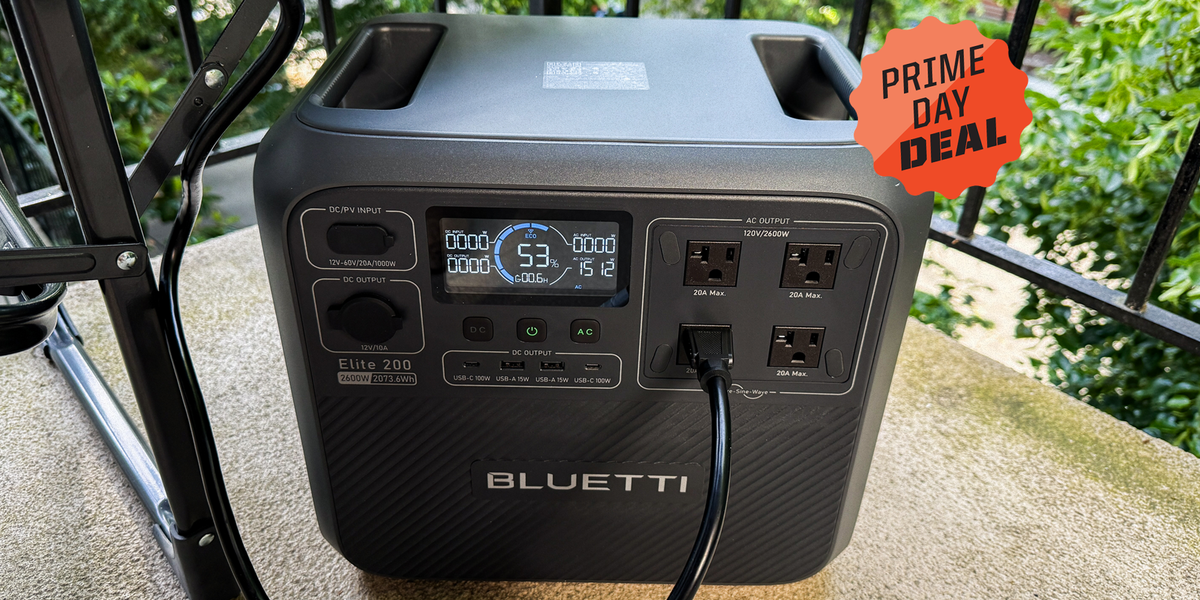
| Bluetti Elite 200 V2 | About $799 | 2,073.6Wh capacity, 2,600W output | RV use, larger appliances, extended backup |
| EcoFlow Delta Pro | About $1,599 | 3,600Wh capacity, 3,600W output | High-capacity home and workshop backup |
| Anker Solix F3800 | Limited offers near $1,800 | 3,840Wh capacity, 6,000W dual-voltage output | Home circuits, RVs, 240V equipment, expandable systems |
| DuroMax XP13000EH | About $1,299 | 13,000 starting watts on gasoline, dual-fuel operation | Long outages and multiple large household loads |
| Generac iQ3500 | About $1,067 | 3,000 running watts, 3,500 starting watts | Jobsites, recreation, air conditioners, sensitive electronics |
Historical prices and independent deal assessments: Product specifications:
Battery Station, Solar Generator, or Fuel Generator?
Online retailers frequently place all three products in the “generator” category, but they operate very differently. Choosing the correct type is more important than chasing an enormous red discount badge that appears to be yelling at you.
Portable Power Stations
A portable power station stores electricity in a rechargeable battery. It produces no combustion exhaust during operation, runs quietly, and can generally be used indoors when operated according to the manufacturer’s instructions. Most models include household AC outlets, USB ports, a 12-volt vehicle outlet, and a display showing remaining charge.
Battery stations are ideal for apartments, bedrooms, home offices, campsites with noise restrictions, and short outages. Their limitation is finite stored energy. Once the battery is empty, it must be recharged from a wall outlet, vehicle, solar array, or compatible generator.
Solar Generators
A solar generator is normally a portable power station packaged with one or more solar panels. The panels generate electricity, while the battery stores it. A panel by itself cannot keep the refrigerator running after sunset unless electricity has been stored somewhere.
Prime Day solar generator deals can provide excellent value because panels are expensive when purchased separately. During the 2025 event, notable packages included Jackery and EcoFlow systems with approximately 2,000Wh of storage and portable panel arrays. Before buying, shoppers needed to confirm the panel wattage, connector compatibility, and maximum solar input accepted by the power station.
Fuel-Powered Portable Generators
Gasoline, propane, and dual-fuel generators are better suited to long outages because they can continue operating as long as fuel is available. They also offer more power per dollar than most battery systems. A model such as the DuroMax XP13000EH can support several large household loads, while an inverter generator such as the Generac iQ3500 provides cleaner electrical output for computers, televisions, and variable-speed appliances.
The trade-offs are noise, maintenance, fuel storage, exhaust, and strict outdoor-placement requirements. A fuel generator is not an indoor appliance, no matter how confidently someone opens the garage door “just a little.”
The Standout Prime Day Generator Deals of 2025
Jackery Explorer 1000 v2: The Practical Sweet Spot
The Jackery Explorer 1000 v2 became one of the most attractive portable power station deals of the event. Its 1,070Wh lithium iron phosphate battery, 1,500W rated output, three AC outlets, and manageable 23.8-pound weight created a useful balance between capacity and portability.
At approximately $399 to $429 during its strongest promotions, it cost considerably less than its usual $799 list price. It was powerful enough for many refrigerators, televisions, CPAP machines, fans, laptops, and cooking appliances, although not necessarily all at once. Its 3,000W surge rating also helped with appliances that briefly draw extra power when their motors start.
Bluetti Elite 200 V2: More Energy Without a Giant Footprint
The Bluetti Elite 200 V2 offered roughly twice the storage of a typical 1,000Wh station. It combined a 2,073.6Wh battery with 2,600W of output and enough ports to run multiple devices simultaneously. At around $799 during Prime Day, it reached a price normally associated with smaller systems.
This was a strong option for an RV, cabin, mobile workstation, or household that wanted to preserve refrigeration while also powering lights, communications equipment, and selected kitchen devices. Its greater capacity added weight, of course. Big batteries obey physics, even during online shopping festivals.
EcoFlow Delta Pro and Anker Solix F3800: Serious Backup Power
The original EcoFlow Delta Pro fell to approximately $1,599 in 2025. Although it was no longer EcoFlow’s newest large battery, its 3,600Wh capacity, 3,600W inverter, expandable design, wheels, and broad charging support made it highly competitive at that price.
The Anker Solix F3800 moved further into home-backup territory. It offered 3,840Wh of initial storage, 6,000W of output, 120V and 240V service, expansion-battery support, and compatibility with optional home-integration equipment. It was considerably heavier and more expensive than a camping station, but it could support loads that smaller products could not approach.
DuroMax XP13000EH: High Output for Extended Outages
The dual-fuel DuroMax XP13000EH appeared near $1,299 during the sale. On gasoline, it is rated for 13,000 starting watts and 10,500 running watts. Propane output is slightly lower, but propane stores longer and avoids some of the carburetor problems associated with aging gasoline.
This was the type of machine shoppers considered for well pumps, refrigerators, freezers, window air conditioners, and other substantial loads. Connecting a generator to household circuits requires appropriate transfer equipment, not a homemade cable and an adventurous interpretation of electrical safety.
How to Tell Whether a Generator Deal Is Actually Good
Calculate Capacity Before Comparing Discounts
Battery capacity is measured in watt-hours, while output is measured in watts. Capacity estimates how much energy is stored; output determines which appliances can run.
A simple runtime estimate is:
Usable battery watt-hours ÷ appliance watts = approximate runtime
A 1,070Wh station operating at an assumed 85% usable efficiency provides about 910Wh. A continuous 100W load might therefore run for roughly nine hours. Real results vary because of inverter losses, temperature, appliance cycling, battery condition, and the power station’s own standby consumption.
Check Running and Starting Watts
Compressors, pumps, and power tools may briefly require much more electricity when starting. A refrigerator that averages modest power can still create a substantial startup surge. Compare both the appliance’s running requirement and its starting requirement with the generator’s continuous and surge ratings.
Compare the Complete Package
A cheap solar bundle may include a small panel that takes all day to recover a fraction of the battery. Another deal may appear expensive but include two 200W panels, charging cables, a rolling cart, or an expansion battery. Compare identical configurations before declaring one price the champion.
Look Beyond the Crossed-Out List Price
Retail list prices can be theatrical. Check previous selling prices, manufacturer promotions, coupon requirements, shipping charges, warranty coverage, and whether the item is new or refurbished. A 45% discount from a price nobody regularly paid is mostly decorative mathematics.
Generator Safety Is Not Optional
Fuel-burning generators produce carbon monoxide, an odorless and colorless gas that can kill without warning. The CDC and U.S. Consumer Product Safety Commission advise operating portable generators outdoors, more than 20 feet from doors, windows, and vents, with the exhaust directed away from buildings. A porch, attached garage, carport, basement, or open shed is not a safe substitute.
Homes using fuel generators should have working battery-powered or battery-backup carbon monoxide alarms. Use outdoor-rated, heavy-duty extension cords in good condition. Never connect a generator directly to household wiring without an approved transfer switch or interlock arrangement installed according to applicable codes.
Battery power stations avoid combustion exhaust, but they still require sensible treatment. Keep them dry, do not block cooling vents, avoid damaged batteries or cables, and follow the specified charging and operating temperature ranges.
Safety guidance:
Practical Ownership Experience: What a Backup-Power Test Reveals
Buying backup power is only the first step. A realistic household drill often reveals more useful information than an hour of admiring specifications on the box.
Consider a common setup built around a 1,000Wh-class portable power station. The planned emergency loads are a refrigerator, internet modem and router, two phones, a laptop, several LED lights, and a fan. On paper, the station appears generously sized. During the test, however, the refrigerator’s compressor starts, the fan changes speed, someone plugs in a coffee maker, and the display suddenly predicts a much shorter runtime. The lesson arrives before the coffee: high-wattage heating appliances can consume a small battery surprisingly quickly.
The next discovery is that refrigerators do not draw their rated power continuously. They cycle on and off, so an overnight test gives a more useful result than multiplying one number from the label. Room temperature, door openings, refrigerator age, and the amount of cold food inside all affect consumption. Recording the battery percentage before and after several hours creates a realistic household estimate.
Portability also looks different outside the product photographs. A 24-pound unit is easy for many adults to carry between rooms or place in a vehicle. A 50-pound station requires more planning. Large home-backup batteries with wheels move nicely across a smooth garage floor but become considerably less charming when stairs, gravel, or a muddy campsite enter the story.
Solar charging creates another useful reality check. A “400W” panel array does not continuously produce 400W. Clouds, heat, panel angle, shade, cable losses, and the movement of the sun reduce actual input. Portable panels need clear space and occasional repositioning. Solar remains valuable, especially during a multi-day outage, but it works best when expectations are based on real conditions rather than perfect laboratory sunshine.
A fuel-generator drill exposes a different set of issues. The owner must identify a safe operating location at least 20 feet from the home, confirm that extension cords reach the intended appliances, test the starting procedure, and learn how quickly fuel is consumed at different loads. The generator should be run before storm season, not introduced to the family for the first time during horizontal rain at 2 a.m.
The most successful backup plan often uses layers. A small battery station keeps phones, lights, networking equipment, and medical electronics operating silently overnight. A larger battery supports refrigeration and selected appliances. A properly operated fuel generator handles extended outages and recharges batteries when solar production is poor. This arrangement reduces unnecessary generator runtime, saves fuel, and provides quiet power when neighbors would prefer not to hear an engine auditioning for a monster-truck rally.
Finally, label the cables, store manuals where they can be found without internet access, recharge batteries periodically, test carbon monoxide alarms, and write down the order in which essential loads should be connected. Preparedness becomes much easier when nobody has to perform emergency electrical arithmetic by flashlight.
Final Verdict on the Prime Day Generator Deals of 2025
Prime Day 2025 produced meaningful savings across nearly every backup-power category. The Jackery Explorer 1000 v2 offered exceptional everyday value, the Bluetti Elite 200 V2 delivered unusually high capacity for its sale price, and the EcoFlow Delta Pro and Anker Solix F3800 brought expandable home backup within reach of more buyers. For long outages, discounted fuel models from DuroMax and Generac remained hard to beat.
The best deal was ultimately the system matched to a real power plan. Start with essential appliances, calculate their loads, choose enough capacity and output, confirm the warranty, and treat safety equipment as part of the purchase rather than an optional accessory.