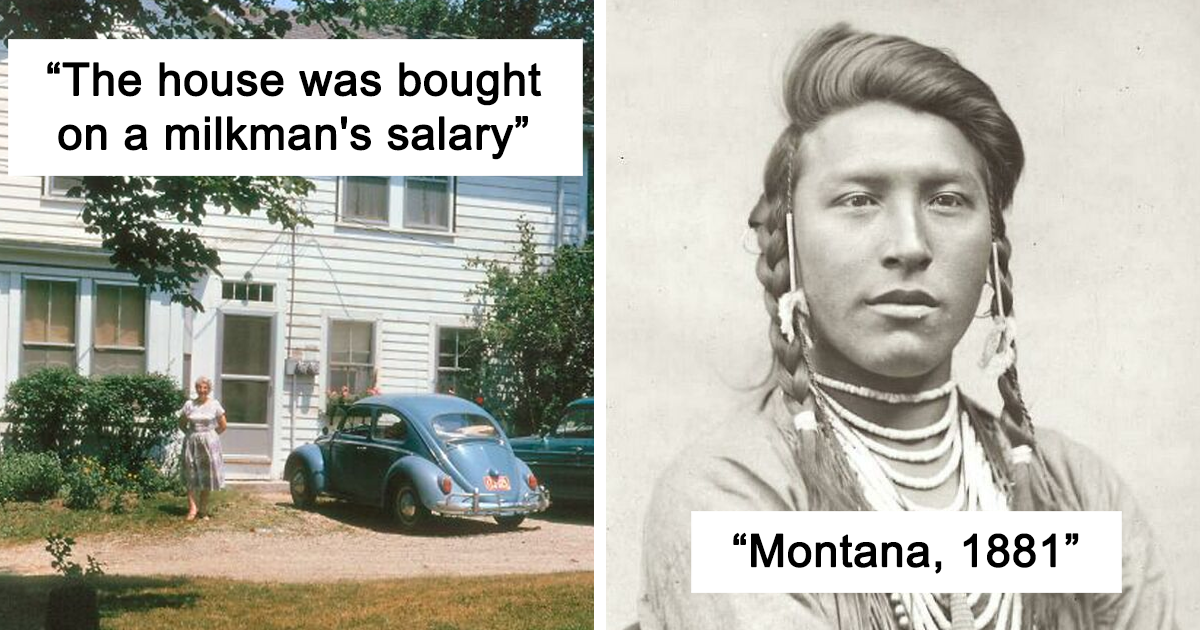
There is something strangely powerful about an old photograph. A black-and-white image of a grandmother standing beside a shiny 1950s refrigerator. A faded picture of kids playing in the street without helmets, phones, or a single adult yelling, “Don’t touch that!” A family portrait where everyone looks serious because smiling for the camera still felt like wasting expensive film. These snapshots from 50 to 100 years ago do more than make us nostalgic. They quietly grab our modern assumptions by the collar and say, “Hey, maybe life has changed more than you think.”
Across social media, online archives, museum collections, and community forums, people are sharing vintage photos of everyday life from the 1920s through the 1970s. The pictures are not always dramatic. In fact, that is the magic. They show school lunches, factory floors, grocery stores, family kitchens, Sunday best outfits, crowded city sidewalks, farm work, diners, beauty salons, streetcars, office desks, and living rooms where the television was treated like a visiting celebrity. These images put history in human size. Instead of memorizing dates, we meet people.
Looking at life 50-100 years ago can feel like stepping into a time machine with slightly squeaky brakes. Some images make the past seem simpler. Others remind us that “the good old days” came with hard labor, limited rights, fewer conveniences, and plenty of problems people today would not want to download, install, or update. The best old photos do not tell us that the past was better. They tell us it was real, complicated, funny, beautiful, unfair, creative, and surprisingly familiar.
Why Old Photos Feel So Addictive
Vintage photos are not just pictures. They are tiny evidence boxes. A single image can reveal what people wore, how they traveled, what they valued, what they owned, and what they had to do without. When someone posts a photo of a 1930s kitchen, viewers may notice the stove, the table, the aprons, the lack of plastic packaging, and the fact that dinner did not arrive through an app. When someone shares a 1960s street scene, we see cars, storefront signs, haircuts, advertising, and public life before smartphones turned sidewalks into obstacle courses for people staring at screens.
Photography also makes history feel personal. A textbook might say the Great Depression reshaped American family life. A photograph of a mother repairing clothes at a kitchen table while children sit nearby says the same thing with a lump in the throat. A museum label might explain the postwar boom. A picture of a family proudly standing in front of a small suburban home shows what prosperity looked like to people who had lived through rationing, war, and uncertainty.
The internet has made this visual memory more democratic. Instead of only professional historians choosing which images matter, families and everyday users now upload shoebox discoveries, scanned albums, neighborhood snapshots, and personal stories. The result is a living archive that mixes official history with ordinary life. And honestly, ordinary life is often the best part. Presidents shake hands. Celebrities pose. But a kid wearing too-large overalls while holding a sandwich the size of a brick? That is the kind of historical document the soul remembers.
Life 100 Years Ago: The 1920s Were Not Just Flappers And Jazz
When people imagine the 1920s, they often picture flappers, jazz clubs, Model T cars, silent movies, and glamorous parties. Those images are part of the story, but only part. Photos from the era show a country moving fast, sometimes faster than its people could comfortably manage. The United States was becoming more urban, consumer culture was growing, radios and automobiles were changing daily routines, and young people were testing new ideas about fashion, freedom, and entertainment.
But old photos also reveal the other side of the decade. Not everyone lived like a character from a champagne advertisement. Rural families still worked long days. Immigrants crowded into cities and built new lives under tough conditions. Racial segregation shaped schools, neighborhoods, jobs, and public spaces. Women gained more public visibility, but equality was still limited and uneven. A 1920s photo album can show a dance hall on one page and a child laborer, tenant farmer, or crowded tenement on the next.
What 1920s Photos Teach Us
The most striking lesson is that modern life did not arrive all at once. It appeared in pieces. A family might own a car but still heat the house with coal. A city office might have telephones and typewriters but no air conditioning. A young woman might wear a fashionable bob haircut while still facing strict limits at work and home. Old photographs capture these in-between moments, when the future had one foot in the door and the past refused to leave the sofa.
For today’s viewers, the 1920s can feel both distant and familiar. People worried about money, status, technology, changing morals, and the behavior of “kids these days.” In other words, humans have been dramatically sighing about the younger generation for a very long time.
The 1930s And 1940s: Hardship, Work, And Resilience In Plain View
Photos from the 1930s and 1940s often carry a heavier emotional weight. The Great Depression, Dust Bowl migration, New Deal programs, industrial labor, and World War II changed American life at every level. Government photographers and photojournalists documented farms, factories, roads, schools, migrant camps, small towns, and city streets. Their work created some of the most important visual records of everyday American life.
These pictures can be hard to look at because they do not decorate struggle. They show worn shoes, tired faces, patched clothing, crowded homes, and families trying to hold themselves together. Yet they also show humor, pride, and determination. People still posed for portraits. Children still played. Families still cooked, worshiped, celebrated, repaired, borrowed, saved, and hoped. The camera did not only capture poverty; it captured endurance.
Images from wartime America add another layer. Women working in factories, families planting victory gardens, ration books, military send-offs, neighborhood scrap drives, and busy train stations all show how global events entered the home. The war was not just fought overseas; it rearranged kitchens, workplaces, budgets, and expectations.
The Power Of Everyday Details
One reason these old photos remain so moving is the detail. A child’s hand-me-down coat. A lunch pail on a factory bench. A family gathered around a radio. A line outside a relief office. A homemade sign in a store window. These tiny clues tell us what people needed, what they lacked, and how they adapted. Modern viewers may look at a crowded 1930s kitchen and realize that “minimalism” is much easier when it is a lifestyle choice, not an economic condition.
The 1930s and 1940s also challenge a common myth: that people in the past were simply tougher. They were tough, yes, but toughness was often required because options were fewer. Old photos should inspire respect, not romanticize hardship. There is nothing cute about hunger, unsafe labor, or discrimination. Perspective means seeing both the courage and the cost.
The 1950s: A Decade Of Shiny Appliances And Quiet Pressure
Photos from the 1950s often appear cheerful at first glance. Chrome diners, tailfin cars, tidy suburban lawns, television sets, school dances, soda fountains, matching dresses, and kitchen appliances all suggest a world polished to a high shine. After the instability of the Depression and World War II, many American families wanted comfort, order, and normalcy. Photographs from the decade often reflect that desire.
But the 1950s were not one big smiling advertisement for dishwashers. The images also reveal social expectations that could be narrow and suffocating. Many women were pushed toward domestic roles even after proving their skills in wartime industries. Racial segregation remained deeply embedded in American life. The Cold War shaped schools, entertainment, politics, and family anxieties. Beneath the polished surface were tensions that would erupt more visibly in the civil rights movement, women’s rights activism, youth culture, and political protests of later decades.
Why 1950s Photos Are So Fascinating
The 1950s are visually rich because the decade sits at the crossroads of old and modern. Televisions entered living rooms. Cars reshaped suburbs. Teen culture became more visible. Consumer advertising grew louder. Fast food, shopping centers, and household gadgets changed daily habits. Yet many homes still had strict rules, formal manners, and clear expectations about age, gender, class, and race.
A picture of a family watching television in 1955 looks familiar because people still gather around screens. It also looks strange because there is one screen, not seven. Nobody is watching a show while scrolling another show while ordering snacks while arguing with a stranger in a comment section. The room itself seems calmer, though we should be careful: a quiet photograph does not always mean a quiet life.
The 1960s And 1970s: Change Gets Loud
By the 1960s and 1970s, photos of everyday life begin to look closer to the world many people recognize today. Color photography becomes more common. Clothing gets bolder. Youth culture becomes more visually distinct. Cars, music, protest signs, television news, classrooms, shopping malls, and family vacations all tell a story of rapid social change.
Images from these decades show civil rights marches, antiwar demonstrations, changing gender roles, new music scenes, environmental awareness, and shifting family dynamics. But they also show ordinary scenes: backyard barbecues, school portraits, grandparents in lawn chairs, kids on banana-seat bikes, teenagers at record stores, and living rooms decorated with colors that can only be described as “aggressively confident.” The 1970s did not fear orange. That much is clear.
The photos remind us that big cultural changes happen through daily life. A protest sign is history. So is a young woman wearing pants to school, a Black family moving into a neighborhood previously closed to them, a father cooking dinner, a teenager buying an album, or a classroom using new teaching methods. Social change is not always a lightning bolt. Sometimes it is a haircut, a bus ride, a lunch counter, a family decision, or a photo someone almost forgot in a drawer.
What Vintage Photos Reveal About Work
One of the clearest differences between past and present appears in photographs of work. Factory floors, farms, offices, mines, construction sites, laundries, classrooms, hospitals, and stores looked very different 50-100 years ago. Many jobs required more physical labor. Safety standards were often weaker. Workplaces were more sharply divided by gender and race. Offices had typewriters, paper files, switchboards, and rows of desks arranged like a human spreadsheet.
At the same time, work photos reveal pride. People posed beside machines, delivery trucks, storefronts, crops, tools, and uniforms. A job was not just income; it was identity, community, and survival. Looking at these images can make modern complaints about slow Wi-Fi feel slightly embarrassing. Not invalid, exactlyslow Wi-Fi is still a tiny villainbut perspective matters.
What Old Family Photos Tell Us About Home
Home life may be the most emotionally powerful category of vintage photography. Kitchens, bedrooms, porches, dining tables, holiday gatherings, birthday cakes, laundry lines, and family cars all reveal how people built comfort with what they had. Homes from the past often look less cluttered in some ways and more crowded in others. Fewer gadgets, more shared space. Fewer convenience products, more manual chores. Fewer screens, more waiting.
Old home photos also expose how much invisible labor shaped daily life. Cooking from scratch, washing clothes, ironing, canning, sewing, cleaning, hauling fuel, tending gardens, managing children, and stretching budgets took enormous time. Much of this work was done by women and rarely praised as “productivity.” Today, a vintage kitchen may look charming, but the person who had to scrub, cook, preserve, and clean in it might have preferred a microwave and five quiet minutes.
Fashion: The Past Had Style, But Also Rules
Vintage fashion photos are endlessly shareable because people looked so put together. Hats, gloves, polished shoes, tailored coats, full skirts, pressed shirts, and careful hairstyles make many modern outfits look like we are all one bad laundry day away from surrender. But old photos also remind us that fashion was often tied to rules: class rules, gender rules, workplace rules, church rules, school rules, and respectability rules.
People dressed formally more often because society expected it. Clothing also lasted longer because wardrobes were smaller, garments were repaired, and fast fashion did not dominate shopping habits. A photo of a 1940s family in their best clothes may show elegance, but it may also show scarcity. Those “best clothes” might have been the only formal set they owned.
Childhood Looked Freer, But Not Always Easier
Old photos of children are some of the most charming: kids building forts, riding bikes, walking to school, playing stickball, climbing trees, selling lemonade, or sitting in classrooms with desks bolted down like tiny academic prisons. Many viewers notice how independent children seemed. They played outside more. They walked places alone. They entertained themselves with fewer toys and no digital devices.
But childhood in the past also came with risks and responsibilities that modern families might find alarming. Children often did more chores. Some worked in family businesses or farms. Medical care was less advanced. Safety equipment was limited. Schools could be strict, unequal, or underfunded, especially for children facing segregation, poverty, disability, or discrimination.
The right takeaway is not “children today are spoiled” or “the past was terrible.” The better lesson is that childhood changes with technology, law, economics, and culture. Kids have always needed play, protection, guidance, and room to grow. The packaging changes. The need does not.
Technology: The Things We Take For Granted Were Once Miracles
Perhaps the funniest part of looking at photos from 50-100 years ago is noticing how people posed proudly with technology that now seems ancient. A radio the size of a cabinet. A washing machine that looks like it might demand a union contract. A television with a screen smaller than a laptop but a wooden body large enough to qualify as furniture. A camera that required patience, skill, and possibly upper-body strength.
These images remind us that convenience is historical. Running water, electricity, refrigeration, washing machines, cars, telephones, and televisions did not simply exist for everyone at the same time. They spread unevenly, shaped by income, geography, race, infrastructure, and public policy. What one household considered normal, another still considered luxury.
Modern technology moves so quickly that we rarely stop to appreciate the basics. Old photos help us notice. A refrigerator meant safer food storage. A washing machine saved hours of labor. A telephone changed emergencies, business, and family communication. A car expanded mobility but also reshaped cities and suburbs. Every object in a vintage photo is part of a larger story.
Why These Photos Put Things In A New Perspective
Old photos are powerful because they make comparison unavoidable. We compare their clothes to ours, their homes to ours, their tools to ours, their worries to ours. Sometimes we feel grateful. Sometimes we feel humbled. Sometimes we wonder whether progress has made us happier or just better equipped to complain in high definition.
The truth is that life today is easier in many measurable ways, especially when it comes to medicine, communication, transportation, education access, and household convenience. But old pictures also show things worth recovering: face-to-face community, repair skills, patience, intergenerational closeness, public spaces full of people, and the ability to be bored without treating it like a medical emergency.
Perspective does not mean choosing past or present. It means seeing both clearly. The past had beauty, but also barriers. The present has freedom, but also distraction. The past had community, but also exclusion. The present has convenience, but also loneliness. A good vintage photo does not ask us to move backward. It asks us to move forward with better memory.
How To Read Old Photos Like A Historian
When you see a picture of life 50-100 years ago, do not just look at the main subject. Look at the background. Street signs, wallpaper, shoes, grocery labels, power lines, classroom walls, store windows, transportation, and body language can reveal just as much as the people in the center. Ask what is visible and what is missing. Who had the power to take the photo? Who was expected to pose? Who was left out?
Also remember that photographs are not neutral. A family portrait may hide conflict. A government photograph may frame poverty in a particular way. An advertisement may sell an ideal that most families never lived. A social media caption may be funny but inaccurate. Old photos are evidence, not the entire truth. They start the conversation; they do not finish it.
Experiences Related To Seeing Life 50-100 Years Ago In Photos
One of the most meaningful experiences people have with vintage photos begins at home. Someone opens a closet, finds a dusty album, and suddenly the family becomes a museum. There is a grandfather as a young man leaning against a car with the confidence of a movie star. There is an aunt in a school uniform, looking like she already knows every family secret. There is a great-grandmother standing in front of a house that no longer exists, wearing a dress someone probably made by hand. These discoveries can make history feel less like a subject and more like a living room conversation.
Looking through old family pictures often changes how we think about our relatives. People we only knew as elderly once had wild hair, sharp suits, nervous smiles, and dreams they had not yet explained to anyone. A grandmother who seemed traditional may have been the first woman in her family to work outside the home. A quiet grandfather may have lived through war, migration, poverty, or cultural change without turning every dinner into a documentary. Photos give younger generations a chance to meet the earlier versions of people they thought they already knew.
Another common experience is realizing how much daily life required cooperation. In older photos, neighbors appear on porches, children gather in streets, families sit together at tables, and communities show up for parades, church events, school programs, weddings, and local celebrations. Today, people are connected in countless digital ways, but old pictures remind us that physical presence mattered. You borrowed tools, shared rides, watched each other’s kids, helped with harvests, brought food, fixed fences, and knew who lived three doors down. Community was not always perfect, but it was often practical.
Vintage photos also create gratitude for modern comfort. After seeing pictures of laundry being washed by hand, cramped kitchens without modern appliances, workers standing for long hours, or families traveling rough roads in uncomfortable vehicles, it becomes harder to take convenience for granted. A dishwasher begins to look less like an appliance and more like a tiny household angel. Online grocery delivery starts to feel like science fiction wearing sneakers. Even basic climate control seems miraculous when you study old summer photos of people dressed formally in rooms with no air conditioning.
At the same time, these photos can inspire people to slow down. The past was not simpler for everyone, but many images show a different rhythm. People repaired items instead of replacing them immediately. They dressed carefully for events. They wrote letters. They printed photographs and saved them. They sat on steps, waited at stations, and spent time in public spaces without documenting every second. Looking at those scenes can make modern life feel noisy. It may encourage us to keep fewer things, pay more attention, ask older relatives better questions, and print at least a few photos before they disappear into a cloud account with a password nobody remembers.
Perhaps the strongest experience is emotional humility. Every person in an old photo had a full life beyond the frame. They worried about money, love, health, work, children, weather, politics, and the future. They made jokes. They made mistakes. They had favorite meals, bad habits, private hopes, and unfinished plans. Seeing them reminds us that we are also living in someone’s future vintage photo. One day, people may look at our kitchens, phones, shoes, cars, and hairstyles and say, “Can you believe they lived like that?” Fair enough. We probably deserve it.
Conclusion: The Past Is Not A Filter, It Is A Mirror
People sharing pics of life 50-100 years ago are doing more than feeding nostalgia. They are helping us see how ordinary life becomes history. A lunch counter, a bus stop, a classroom, a kitchen, a factory, a porch, or a family car may look simple at first. But inside those scenes are stories about technology, inequality, creativity, work, childhood, community, and change.
The best vintage photos do not ask us to worship the past. They ask us to notice it. They remind us that progress is uneven, comfort is precious, memory is fragile, and everyday people deserve to be remembered. They also remind us that our own lives, messy and modern as they are, will someday look strange, charming, and maybe hilarious to someone else. So take the picture. Label it. Save it. Future generations will want proof that we really did carry tiny glowing rectangles everywhere and called it normal.
Note: This article is written for web publication in original standard American English and is based on synthesized historical information from reputable U.S. archival, museum, educational, and media sources.