Most dust is not famous. It gathers on bookshelves, hides under couches, and waits patiently for someone to sneeze. But lunar dust is different. Lunar dust has traveled through human history on the boots of astronauts, inside carefully sealed bags, and now, in one of the stranger turns in space-collecting history, through an auction room where a few microscopic particles sold for more than many homes.
NASA lunar dust samples connected to the Apollo 11 mission sold at auction for $504,375, proving once again that space history does not need to be large to be priceless. These were not fist-sized Moon rocks glowing like Hollywood props. They were tiny particles, measured in microns, mounted on sample stubs used for scanning electron microscope analysis. In plain English: a few specks of Moon dust became a half-million-dollar collector’s item.
The sale was fascinating not only because of the price, but because of the backstory. These particles were tied to Neil Armstrong’s first lunar sample from Apollo 11, the mission that placed humans on the Moon in July 1969. Their path from the Sea of Tranquility to a Bonhams auction in New York included NASA, lawsuits, a misplaced sample-return bag, scientific testing, and enough legal drama to make even a lunar module pilot ask, “Can we just go back to orbit now?”
Why These NASA Lunar Dust Samples Matter
The samples that sold were connected to the Apollo 11 contingency sample, the first material collected by Neil Armstrong shortly after he stepped onto the lunar surface. The contingency sample had a very practical purpose. If the astronauts had to leave the Moon in a hurry, NASA still wanted them to bring back at least a small amount of lunar material. That small act turned into one of the most important scientific collections in human history.
Apollo 11 was not just a flag-and-footprint moment. It was a geology mission, a chemistry mission, a physics lesson, and a global cultural event packed into one very risky flight. When Armstrong scooped lunar soil and rocks near the Lunar Module Eagle, he was collecting evidence from a world no human had touched before. Those grains helped scientists study the Moon’s origin, volcanic history, impact record, and relationship to Earth.
Across the Apollo program, astronauts brought back 842 pounds, or 382 kilograms, of lunar material. Most of it remains under NASA’s control and is carefully curated for scientific research and education. That is why this auction was so unusual. Apollo material is normally treated as government property, not something that appears in a collector’s cabinet next to vintage mission patches and signed astronaut photos.
The $504,375 Sale: Small Dust, Huge Price
The lunar dust samples sold for $504,375 as part of a space history auction. The final price included the buyer’s premium and came in below the pre-sale estimate, which had reportedly been much higher. Still, half a million dollars for particles too small to weigh in any satisfying way is not exactly a clearance-rack situation.
The lot included five scanning electron microscope aluminum sample stubs. These stubs held carbon tape containing microscopic lunar particles removed from an Apollo 11 sample-return bag. Independent analysis found that four of the five stubs contained lunar dust consistent with the Apollo 11 contingency sample. The fifth contained lunar traces that were described differently, possibly because of testing variation.
That technical detail is part of what made the sale so compelling. Buyers were not simply paying for “space dust” as a vague idea. They were paying for particles that had been examined, documented, and linked to one of the most famous missions in history. In the world of collectibles, provenance is everything. In the world of space collectibles, provenance is the rocket fuel.
The Strange Journey from the Moon to the Auction Block
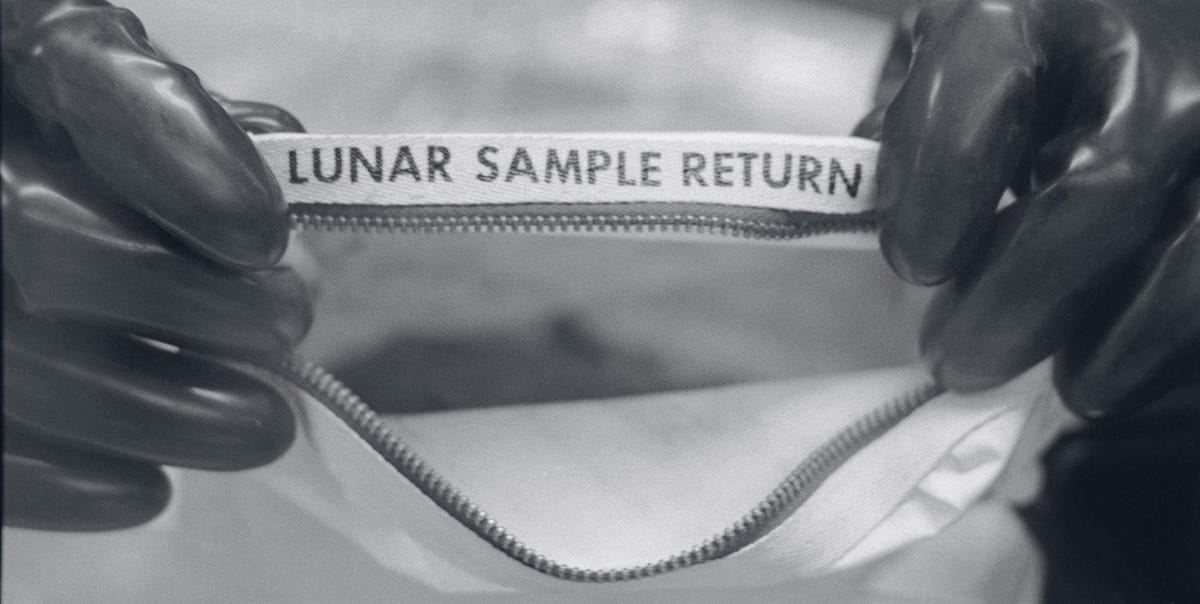
The lunar particles did not travel directly from NASA storage to the auction house. Their story is tangled, and that is part of their appeal. The particles were associated with the Apollo 11 contingency sample return container decontamination bag, a protective bag connected to the first lunar sample Armstrong collected.
That bag eventually left NASA’s possession through a complicated chain of events. It was later purchased at a government auction by Nancy Lee Carlson for just $995. At the time, the bag’s true identity was not fully understood in the way it later would be. Carlson sent it to NASA for authentication, and NASA confirmed its connection to Apollo 11. Then came the problem: NASA wanted to keep it.
A legal battle followed. Carlson argued that she had purchased the bag legally. NASA maintained that the artifact was a national treasure and should not have been sold. A court ultimately ruled in Carlson’s favor, and the bag was returned to her. In 2017, the bag sold at Sotheby’s for $1.8 million. That sale alone would have been enough to earn a place in space memorabilia legend, but the story was not finished.
During testing, NASA had removed lunar particles from the bag using sample stubs. After further dispute and settlement, some of those test samples were turned over. Those are the particles that later reached the auction market. So, yes, this is a story in which a $995 government-auction purchase led to a multimillion-dollar bag and microscopic Moon dust worth more than a luxury sports car. Space history is weird. Gloriously weird.
Is It Legal to Own Moon Dust?
This is where the story becomes especially important. In general, Apollo lunar samples collected by NASA astronauts are not legal private property. They belong to the United States government and are preserved for research, education, and public benefit. If someone casually offers you “Apollo Moon dust” in a parking lot, the correct response is not “Do you take Venmo?” It is “Absolutely not, and also why are we in a parking lot?”
The Bonhams sale was exceptional because of the unusual legal history of the sample-return bag and the related court rulings and settlements. That makes these particles different from ordinary claims of privately owned Apollo material. The sale stood out because the samples had NASA-authenticated history, documented testing, and a rare legal pathway into private ownership.
There are other legal categories of lunar material. Lunar meteorites, for example, are rocks from the Moon that were blasted into space by impacts and later fell naturally to Earth. Those can be bought and sold legally. Soviet Luna mission samples have also appeared in private sale under specific circumstances. But NASA Apollo lunar samples are normally off-limits. That is why the Apollo 11 dust sale made headlines: it was not just expensive; it was nearly one of a kind.
Why Lunar Dust Is Scientifically Valuable
Lunar dust is not ordinary dirt. On Earth, soil is shaped by water, wind, microbes, roots, worms, and time. Moon dust, or lunar regolith, forms in a much harsher neighborhood. It is created by constant micrometeorite impacts, solar radiation, and the slow grinding of rock on an airless world. There is no rain to smooth it. No breeze to soften it. No friendly backyard earthworm doing quality control.
That is why lunar dust can be sharp, abrasive, clingy, and scientifically rich. Apollo astronauts quickly learned that it stuck to suits, tools, and equipment. It got into seals and surfaces. It smelled strange inside the spacecraft after being brought back on suits and gear. Astronauts also reported irritation from exposure to the dust. NASA still studies lunar dust carefully because future Artemis missions will need to manage it during longer stays on the Moon.
For scientists, these tiny grains are time capsules. Lunar dust can preserve clues about meteorite impacts, solar wind, volcanic processes, and the Moon’s surface environment. It helps researchers understand not only what the Moon is made of, but how it has changed over billions of years. That is the scientific irony of this auction: collectors value lunar dust because it is rare and historic, while scientists value it because it is full of information.
Why Collectors Pay So Much for Space Memorabilia
Space memorabilia sits at the intersection of science, history, adventure, and emotion. A flown checklist is not just paper. A mission patch is not just cloth. A sample bag is not just a bag. These objects were present when human beings attempted something outrageous and succeeded.
The Apollo program remains one of the strongest brands in human achievement. It has drama, danger, engineering brilliance, national competition, and a clean narrative that nearly everyone understands: people looked at the Moon, built machines, crossed space, landed, explored, and came home. Objects connected to that story carry enormous symbolic weight.
That is why tiny lunar dust samples can command an enormous price. The buyer is not purchasing “dust” in the ordinary sense. The buyer is purchasing a physical connection to Apollo 11, Neil Armstrong, Tranquility Base, and the first human exploration of another world. In collector language, that combination is rocket-grade provenance.
The Apollo 11 Connection: Why Neil Armstrong Still Matters
Neil Armstrong’s role gives the samples a special gravity. Armstrong was the first human to walk on the Moon, and his first collection of lunar material was a moment of scientific insurance. NASA did not know exactly how much time the astronauts would have on the surface, or whether something might force an early departure. The contingency sample ensured that, whatever happened, humanity would bring home part of the Moon.
That practical scoop became iconic. Armstrong was not simply picking up rocks; he was collecting the first direct evidence from another world gathered by human hands. The Apollo 11 dust samples sold at auction were tied to that moment. That is why the story continues to attract attention more than 50 years later.
The sale also shows how Apollo history keeps moving. We often think of the Moon landing as frozen in grainy black-and-white footage. But the artifacts, samples, legal debates, scientific studies, and auctions continue to create new chapters. Apollo 11 is history, but it is not quiet history. It keeps knocking dust off the shelf.
What This Sale Says About the Future of Moon Collecting
The $504,375 sale suggests that interest in space artifacts remains strong, especially when an item combines rarity, documentation, and a direct connection to a major mission. As NASA and private companies return attention to the Moon, public fascination with lunar material may only grow.
Future lunar missions could also change the collecting conversation. If private companies collect lunar material under future legal frameworks, the market may eventually include new categories of Moon-related items. That does not mean Apollo samples will become ordinary. Quite the opposite: Apollo material may become even more valuable because it represents the first era of human lunar exploration.
Collectors love “firsts.” The first Moon landing. The first sample. The first bag. The first dust. Apollo 11 has all of them. That is why the Bonhams sale matters beyond its headline price. It revealed how a few particles can carry the weight of an entire age of exploration.
Experiences and Takeaways: What a Half-Million-Dollar Pinch of Moon Dust Teaches Us
The most interesting experience related to this story is not standing in an auction room with a paddle in hand, although that would certainly raise the heart rate. The deeper experience is realizing how physical history changes the way we feel about events we already know. Everyone has heard of Apollo 11. Many people have seen the footage of Armstrong stepping down the ladder. But a microscopic grain of lunar dust makes the story feel less like a textbook chapter and more like something you could almost hold.
Imagine looking at one of those scanning electron microscope stubs. At first glance, it might not look impressive. No glowing crystal. No dramatic Moon rock shaped like a meteor. Just tiny particles on dark tape. But then the context lands. Those particles came from the surface where Armstrong walked. They were part of the first lunar material collected by a human being. They crossed space in a spacecraft built with 1960s technology, survived splashdown, passed through NASA testing, got caught in legal history, and finally entered the collector market. That is a lot of mileage for dust.
For writers, educators, and space fans, the sale is a reminder that storytelling depends on details. “Moon dust sold for $500,000” is a good headline. “Microscopic particles tied to Neil Armstrong’s first lunar sample survived a strange journey involving NASA, a government auction, a lawsuit, a $1.8 million sample bag, and scientific authentication” is a story. The difference is context.
For collectors, the lesson is even sharper: documentation matters. In space memorabilia, a dramatic claim is not enough. The value comes from traceable history, mission connection, testing, records, and legal clarity. A random gray powder is worthless at best and legally dangerous at worst. A verified Apollo 11-related sample with a documented chain of custody is a different universe.
For the public, the sale invites a healthy debate. Should pieces of humanity’s greatest scientific achievements be privately owned? Should rare artifacts stay in museums and national collections? Or can private collectors help preserve history when the legal path is clear? There is no simple answer. NASA’s desire to protect lunar samples makes sense. So does the fascination of collectors who want a tangible connection to exploration.
Personally, the most charming part of the story is its scale. Humans built the Saturn V, crossed 240,000 miles of space, landed on another world, and brought back samples that transformed planetary science. Decades later, a few grains from that effort became valuable enough to make international headlines. It is absurd, poetic, and very human. We go to the Moon for knowledge, glory, curiosity, and maybe a little bragging rights. Then we come back and discover that even the dust has stories to tell.
Conclusion
The sale of NASA lunar dust samples for over $500,000 is more than a quirky auction headline. It is a compact version of the Apollo story itself: daring exploration, scientific discovery, government stewardship, legal complexity, and public fascination all packed into particles smaller than a breadcrumb. These grains were tied to Apollo 11, Neil Armstrong, and the first human-collected sample from the Moon. That makes them historically powerful, scientifically meaningful, and commercially extraordinary.
The Moon may look quiet from Earth, but its dust continues to stir up big questions. Who owns space history? What is the value of a national treasure? Why do tiny objects connected to great moments move us so deeply? In this case, the answer came with a gavel strike: $504,375 for a few specks of the Moon, and a story that still refuses to settle.