Some museum cafes are places where you buy a coffee because your feet have staged a small rebellion. Kafeteria, the Copenhagen cafe created at SMK, the National Gallery of Denmark, was conceived as something far more ambitious: a room where lunch, furniture, sculpture, lighting, and conversation could all belong to the same cultural experience.
When Kafeteria debuted in 2018, chef and restaurateur Frederik Bille Brahe brought his instinct for deceptively simple food into one of Denmark’s most important art institutions. Artist Danh Vo helped shape the interior, turning the cafe into a layered environment filled with design history, museum objects, natural materials, plants, and sculptural lighting. The result was neither a conventional restaurant decorated with art nor a gallery that happened to sell pastries. It occupied the much more interesting space between the two.
That distinction explains why Kafeteria became such a memorable chapter in Copenhagen’s already impressive relationship with food and design. It treated eating as part of cultural life rather than the activity visitors hurried through before returning to the “serious” business of looking at paintings.
Editorial note: This article looks back at Kafeteria as it emerged in 2018 and developed during its seven-year run at SMK. The original Kafeteria concept ended in 2025; the museum now lists Magnolia as its cafe.
Research grounding:
More Than a Museum Cafe
The ordinary museum cafeteria has a difficult job. It must feed families, tourists, students, art lovers, exhausted grandparents, and the occasional person who entered primarily because it was raining. Efficiency often wins. Design becomes neutral. Menus become predictable. Nobody writes home about the stackable chairs.
Kafeteria challenged that formula.
Located inside the grand architectural setting of SMK in Copenhagen, the cafe occupied a high-ceilinged, light-filled environment where the existing museum architecture already carried a certain formality. Rather than fighting that character with a glossy restaurant makeover, the project embraced a more collected, almost improvised visual language.
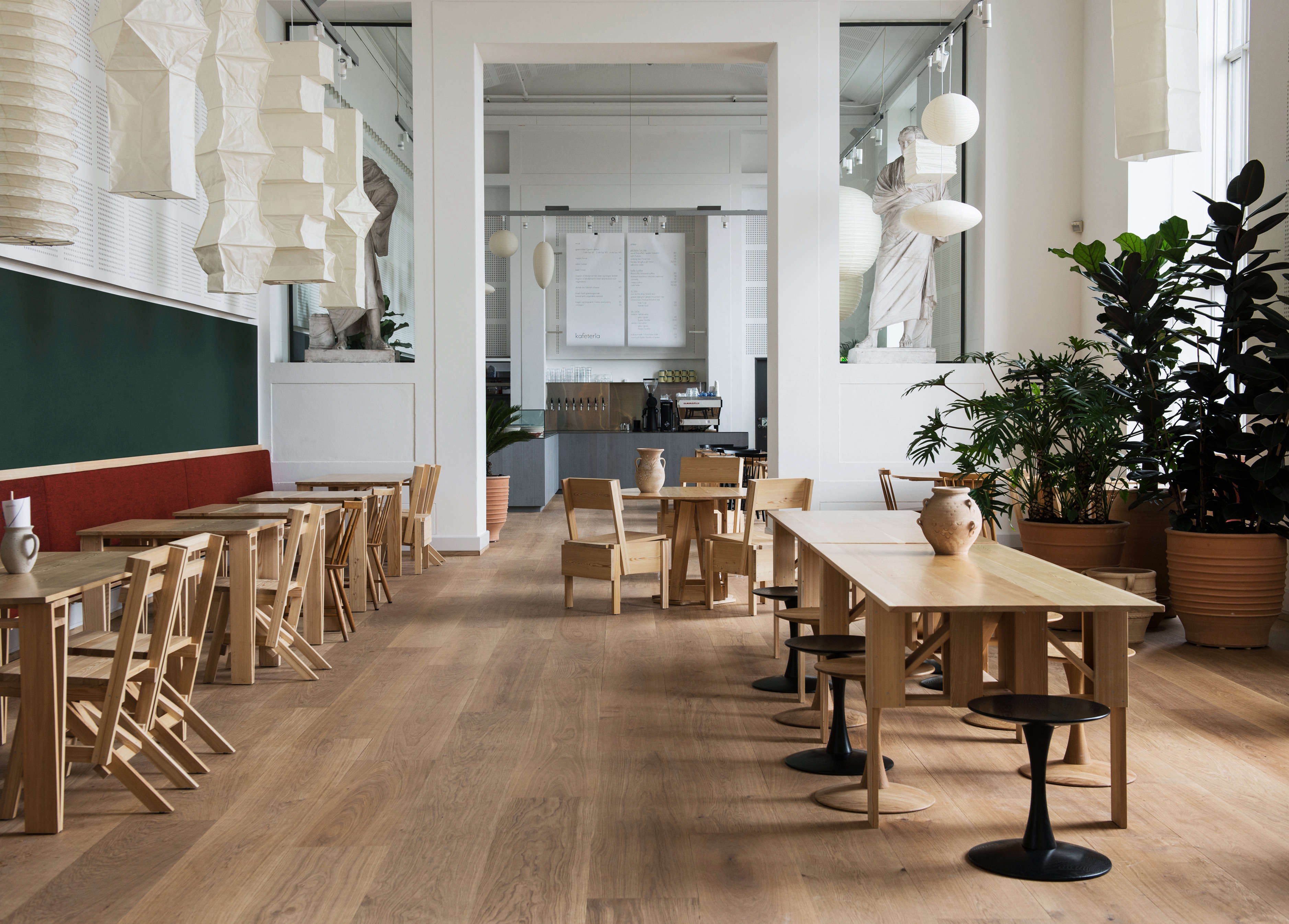
The room felt assembled through relationships among objects. Classical figures from the museum’s Royal Cast Collection appeared alongside modern furniture. Warm wooden floors softened the institutional scale. Large paper light sculptures floated overhead. Plants introduced irregular shapes and living texture. Long tables encouraged visitors to sit near strangers rather than disappearing into private restaurant booths.
It was a clever approach because museums are already full of objects asking to be examined. Kafeteria extended that habit of looking into everyday life. A chair was still a chair, but it also had a history. A lamp provided illumination, yet it also occupied the room like sculpture. A plate of bread could be lunch and, without becoming annoyingly precious about it, part of the overall composition.
Frederik Bille Brahe and the Art of Making Simplicity Difficult
Frederik Bille Brahe had already established a recognizable presence in Copenhagen through places including Atelier September and Apollo Bar & Kantine. His restaurants became associated with an unusually effective combination: relaxed hospitality, strong visual identity, and food that often looked simple enough to reproduce at home until you actually tried.
That last part is important. Simplicity in cooking can be a bit of a con artist. A dish with five visible components may require better ingredients, sharper judgment, and more restraint than one hiding behind seventeen sauces and a smoke machine.
Atelier September became internationally known for elegant breakfasts and lunches built around such ideas as carefully prepared toast, seasonal produce, dairy, grains, and beautifully composed everyday food. Apollo Bar extended Bille Brahe’s relationship with art-world settings. Kafeteria gave him a larger institutional stage.
The goal was not to transform a museum cafe into a white-tablecloth temple requiring a reservation, a vocabulary test, and emotional preparation for the bill. The ambition was more democratic: prove that cafeteria food could be genuinely good.
A Menu Built Around Clarity
Early descriptions of Kafeteria emphasized seasonal ingredients, organic produce, freshly baked bread, pastries, cakes, soups, and straightforward dishes influenced by both Danish and Japanese sensibilities. The menu changed over time, but its recognizable strength remained the elevation of familiar food through attention rather than excess.
That philosophy fits a museum setting remarkably well. After spending an hour looking at paintings, installations, or sculpture, a visitor does not necessarily need a twelve-course conceptual investigation of fermented turnips. Sometimes excellent bread with butter is the correct answer to civilization.
Later accounts of the cafe highlighted brunch dishes, pastries, homemade cakes, and sourdough served with accompaniments such as whipped butter, jam, and cheese. These examples reveal the broader Kafeteria method: begin with recognizable forms, remove the clutter, and concentrate on texture, proportion, seasonality, and ingredient quality.
Culinary context:
Danh Vo Turns the Interior Into an Everyday Artwork
Danh Vo was an especially intriguing collaborator for a project intended to blur the boundary between an artwork and an ordinary public room. Born in Vietnam and raised in Denmark, Vo has built an internationally recognized practice around objects, personal histories, cultural systems, migration, power, authorship, and the meanings that accumulate when things move from one context into another.
That sensitivity to context matters enormously at Kafeteria.
Instead of creating a single decorative theme and repeating it until the room surrendered, the interior brought together objects from different periods and design traditions. The cafe became a conversation among Danish modernism, Italian design thinking, Japanese-American lighting, institutional architecture, classical sculpture, and contemporary hospitality.
On paper, that list sounds like the beginning of a very expensive argument. In the room, the contrasts gave Kafeteria its character.
Noguchi Lights That Float Rather Than Shout
Among the interior’s most recognizable features were Isamu Noguchi’s Akari light sculptures. Their paper forms brought softness to the scale of the museum architecture. Suspended overhead in varied shapes, they functioned as lighting while retaining the presence of individual sculptural objects.
The effect was especially important because large institutional rooms can easily feel cold. Paper, warm light, oak, and irregular forms helped reduce the psychological distance between the building and the person sitting down with a cup of coffee.
There was also something pleasantly unshowy about the choice. The lamps were visually distinctive, but their material delicacy prevented them from overpowering the room. They floated. They glowed. They did not behave like a chandelier desperately waiting for compliments.
A Furniture Collection Instead of a Matching Set
Kafeteria’s furnishings further developed the feeling of a room assembled through curiosity rather than purchased from a single catalog page. The mix included pieces associated with designers such as Poul M. Volther and Nanna Ditzel, alongside furniture connected to Enzo Mari’s influential Autoprogettazione project.
Mari’s approach is particularly relevant to the atmosphere of the cafe. Autoprogettazione, first developed in the 1970s, explored direct, accessible furniture construction using simple materials and straightforward methods. Within Kafeteria, that spirit reinforced the productive tension between cultural prestige and ordinary use.
You could be sitting in Denmark’s national gallery under an iconic light sculpture near a classical cast, yet the room still communicated: Sit down. Eat something. Talk to your friend. This is not a throne room.
Oak Floors, Green Surfaces, Red Seating, and Living Plants
Wide oak flooring gave the interior a warm visual foundation. Dark green surfaces and red upholstered elements introduced concentrated blocks of color, while large plants prevented the carefully selected furniture from making the space feel too composed.
The plants were more than decorative punctuation. In a room filled with historical references and designed objects, leaves provided something uncontrolled. They grew, bent toward light, and changed shape. That small element of unpredictability helped the cafe feel inhabited rather than installed.
Design and art context:
Why the Collaboration Worked
The most successful collaborations between chefs and artists do not involve one profession decorating the other. Kafeteria worked because food and art were treated as parallel ways of shaping attention.
A chef thinks about sequence, temperature, texture, color, memory, and how a guest moves through a meal. An artist may think about context, objects, history, material, perception, and how a viewer moves through a space. Those disciplines are not identical, but they have enough overlap to create sparks.
Bille Brahe’s food did not need to imitate artworks. Vo’s interior did not need to resemble a restaurant-themed installation. Instead, both contributed to a shared environment in which everyday actions became more noticeable.
You noticed the bread. You noticed the chair. You noticed the light. You noticed the enormous room around you. Ideally, you also noticed the person sitting across the table, which remains one of hospitality’s more underrated design achievements.
Kafeteria and the Copenhagen Approach to Cultural Hospitality
Kafeteria also belonged to a wider Copenhagen phenomenon: the increasing expectation that cultural institutions should offer meaningful experiences beyond their exhibition galleries.
A museum cafe can influence how long visitors stay, how they remember the building, and whether the institution feels welcoming to people who might not consider themselves serious museumgoers. Food creates a lower-pressure point of entry. You can meet someone for coffee, become curious about the building, and end up looking at art almost by accident.
Copenhagen has been particularly fertile ground for this approach because the city’s international reputation for gastronomy overlaps with an equally powerful design culture. Restaurants are often discussed in architectural terms. Furniture appears in conversations about hospitality. Bakeries become destinations. Cafes are treated as social infrastructure rather than simply caffeine distribution centers.
Kafeteria distilled those tendencies into a museum environment. It suggested that culture does not begin when you enter a gallery and pause when you pick up a fork.
Lessons for Cafe and Restaurant Design
Although Kafeteria was highly specific to SMK, several of its ideas remain useful for designers, restaurateurs, and anyone trying to create a public interior with a genuine sense of identity.
Let the Building Participate
A strong interior does not always require erasing the architecture and starting again. Kafeteria benefited from the scale, history, and existing character of its museum setting. New elements worked with that backdrop rather than pretending it did not exist.
Mix Design Histories Carefully
Matching every chair, lamp, and table can produce order, but order is not automatically atmosphere. Kafeteria showed how objects from different periods can coexist when they share compatible proportions, materials, or attitudes.
Use Iconic Objects Without Turning the Room Into a Showroom
Design classics are most convincing when people actually use them. At Kafeteria, furniture and lighting were not displayed behind ropes. Their meaning came partly from becoming part of lunch, conversation, spilled coffee, waiting, and daily life.
Keep Food and Space in the Same Conversation
A restrained room paired with an incoherent menu feels disconnected. So does beautiful food served in a space that actively encourages escape. Kafeteria’s visual simplicity and culinary directness reinforced one another.
The Legacy of an “Everyday Art Piece”
Kafeteria’s importance was not that it invented the art museum restaurant or discovered that attractive lighting makes lunch nicer. Its achievement was the unusually complete way it brought different creative practices together.
Danh Vo’s contribution gave the room conceptual and visual depth without making it inhospitable. Frederik Bille Brahe’s food gave the project everyday usefulness without reducing it to a conventional cafeteria. SMK provided the institutional and architectural context that allowed those ideas to collide.
The cafe’s original run eventually ended, as restaurants and cultural institutions inevitably change. Yet its influence is easier to understand as an idea than as a permanent menu or set of opening hours. Kafeteria demonstrated that a museum cafe could become a destination in its own right while still serving the social life of the museum around it.
That may be the most persuasive definition of good cultural hospitality: not a sideshow, not a gift-shop afterthought, and not an ego-driven restaurant awkwardly attached to a museum. Instead, it becomes another way to experience the institution.
A Visitor’s-Eye Experience of Kafeteria
The following experiential reflection reconstructs what a visit to Kafeteria could feel like from its documented architecture, interior, food, and atmosphere; it is not presented as a claim of personal attendance.
Imagine arriving at SMK after walking through Copenhagen on one of those bright northern days when the sky seems to have been professionally cleaned. You enter a building associated with national culture, important collections, and the mild anxiety that perhaps everyone else knows more about art than you do.
Then you encounter Kafeteria.
The first impression is space. The ceiling rises above you, the pale architecture catches the daylight, and the room refuses the low, dark intimacy commonly associated with restaurants. You are still unmistakably inside a museum. Nobody has tried to make you forget where you are.
Then the details begin to interrupt the grandeur.
Paper lights hang overhead in different shapes, their forms soft and almost weightless against the architecture. Oak runs underfoot. Plants gather near windows and furniture. Classical figures occupy the same visual field as diners checking phones, children negotiating pastries, and friends leaning over coffee cups.
This mixture is the point. Nothing asks you to choose between high culture and ordinary life.
You find a table and begin noticing that the furniture does not have the anonymous uniformity of a chain restaurant. Chairs vary. Tables have distinct construction and proportions. Some pieces look refined; others communicate a more direct, almost workshop-like logic. The room feels curated, but not frozen.
Then food arrives, and the experience becomes smaller in the best possible way.
A piece of good bread can pull attention away from an enormous room. Butter, cheese, a pastry, a bowl of something seasonal, or a carefully made coffee shifts the scale from architecture to appetite. The museum has spent hours asking you to look closely; lunch quietly asks you to do the same thing.
Perhaps that is why the concept made so much sense. After viewing art, the senses are already awake. Colors seem slightly more important. Materials become easier to notice. A rough wooden edge, a ceramic cup, the translucency of a paper lamp, or the crumb of fresh bread receives more attention than it might on a hurried Tuesday at a generic cafe.
Conversation also changes the room. A museum gallery usually encourages quiet observation and personal interpretation. A cafe releases all the words visitors have been storing. People compare favorite paintings, disagree about exhibitions, discuss completely unrelated family drama, and ask whether anyone wants another piece of cake.
That last question may be the most universally understood form of cultural diplomacy.
As you sit longer, the interior stops behaving like a collection of famous design references. The lamps become simply the light above lunch. The chairs become places occupied by coats and tired bodies. The classical casts become familiar background companions. This transformation from notable object to everyday object is one of the room’s most interesting qualities.
You begin to understand the idea of an everyday artwork not as a precious object but as a situation. The artwork is partly the composition designed by its creators, but it is also the changing collection of people using it. Every table produces a temporary scene. Every plate arrives and disappears. Daylight shifts. Chairs move. Plants grow. Someone spills something. Life refuses to remain perfectly curated.
Eventually, you stand up to return to the museum or walk back into Copenhagen. The experience does not end with a dramatic finale. There is no velvet curtain. You simply leave a room where art, design, food, and public life have been allowed to overlap.
And perhaps that was Kafeteria’s smartest trick. It made an ambitious cultural argument without behaving as though it were giving a lecture. You could analyze the history of every chair and lamp, consider Danh Vo’s approach to objects and context, study Frederik Bille Brahe’s philosophy of simplicity, and debate the evolving role of museum hospitality.
Or you could sit down and eat.
Both responses were correct.
Conclusion
Kafeteria at Copenhagen’s SMK showed what can happen when a museum cafe is treated as a genuine creative project. Frederik Bille Brahe brought a culinary language built on simplicity, quality, and everyday pleasure. Danh Vo helped shape an interior where design history, art, architecture, and ordinary social life could occupy the same room.
The project remains compelling because it never depended on spectacle alone. Its most memorable qualities were human-scale ones: warm light, useful furniture, good bread, generous space, and permission to linger. In a culture increasingly obsessed with “experiences,” Kafeteria offered a useful reminder that the strongest experiences do not always need fireworks. Sometimes they need an oak floor, a paper lamp, an interesting chair, and lunch worth paying attention to.