Note: This article is based on publicly available information from reputable defense, government, and news sources. It explains JDAMs at a strategic and educational level and does not provide operational instructions.
Introduction: When “Dumb Bombs” Get a College Degree
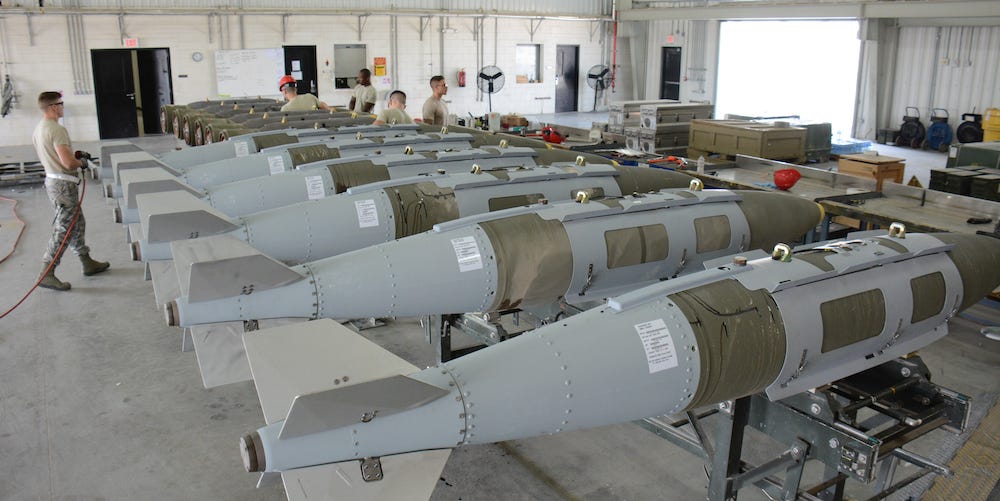
In modern air warfare, few upgrades sound as simple yet change the battlefield as dramatically as the Joint Direct Attack Munition, better known as the JDAM. At its core, a JDAM is not a brand-new bomb. It is a guidance kit that turns a conventional unguided bomb into a GPS-steered precision weapon. Think of it as giving an old-school iron bomb a navigation app, a steering wheel, and a much better sense of direction. Suddenly, what once relied heavily on aircraft position, pilot skill, weather, and luck can be aimed at fixed target coordinates with far greater accuracy.
That is why JDAMs in Ukraine became such a closely watched development. Ukraine entered Russia’s full-scale invasion with a largely Soviet-era air force, including MiG-29 and Su-27 fighters. The arrival of Western precision-guided munitions promised to improve Ukraine’s ability to hit Russian command posts, ammunition depots, bridges, troop concentrations, and fortified positions without relying only on unguided rockets or artillery. The JDAM-ER, or Extended Range version, added another important advantage: pop-out wings that allow the bomb to glide farther after release.
But this is Ukraine, not a clean test range in the desert. The airspace is crowded with surface-to-air missiles, drones, electronic warfare systems, radar, decoys, and old-fashioned battlefield chaos. JDAMs could provide great accuracy, but accuracy is never magic. It depends on GPS availability, aircraft survivability, target data, electronic countermeasures, and how quickly both sides adapt. In other words, the JDAM arrived in Ukraine with impressive promiseand then met the rude houseguest known as Russian jamming.
What Is a JDAM?
The Joint Direct Attack Munition is a U.S.-developed guidance tail kit that attaches to existing general-purpose bombs. Instead of manufacturing an entirely new weapon from scratch, the system upgrades bombs such as 500-pound, 1,000-pound, and 2,000-pound classes with a tail section containing an inertial navigation system and GPS guidance. Once released, the weapon steers itself toward preloaded coordinates.
The practical appeal is enormous. Militaries often have large inventories of unguided bombs sitting in storage. A JDAM kit transforms those stockpiles into precision-guided munitions at a fraction of the cost of more complex missiles. It is the military equivalent of renovating a sturdy old house instead of buying a luxury condo. Not glamorous, perhaps, but very useful.
Why GPS Guidance Matters
GPS guidance allows JDAMs to operate in conditions that can frustrate laser-guided bombs. Laser-guided weapons need a reflected laser spot to follow, which can be affected by clouds, smoke, dust, or line-of-sight issues. JDAMs, by contrast, navigate to coordinates using GPS-aided inertial guidance. That means they can be effective in poor weather and low-visibility environments, assuming the navigation data remains reliable.
Publicly available U.S. Air Force information has described JDAM accuracy as highly precise when GPS is available, with circular error probable figures often discussed in the single-digit meter range. In plain English, the bomb is designed to land very close to the intended coordinates. In a war where one side may need to hit a bunker, bridge span, command node, or ammunition site rather than flatten a neighborhood, that degree of accuracy matters.
Why JDAMs Matter for Ukraine
Ukraine’s air force has operated under brutal constraints. Russian air defenses are dense, layered, and dangerous. Ukrainian pilots cannot simply cruise comfortably over the battlefield as if filming a recruitment commercial. Aircraft often have to fly carefully, avoid detection, and make the most of limited windows of opportunity.
JDAMs offered Ukraine a way to improve the effect of each aircraft sortie. Instead of dropping unguided munitions that require closer release and less predictable results, Ukraine could use GPS-steered bombs to strike fixed military targets with better accuracy. The JDAM-ER made the concept more attractive by adding wings that extend the glide range, allowing the aircraft to release from farther away than a standard gravity bomb.
The JDAM-ER Advantage
JDAM-ER stands for Joint Direct Attack Munition-Extended Range. The key difference is the wing kit. After release, the wings deploy and help the bomb glide toward the target. Depending on launch conditions and variant, the extended-range kit can dramatically increase how far the weapon travels compared with a standard JDAM.
For Ukraine, this matters because every additional mile can reduce the risk to pilots. Russia’s air defense network has forced Ukrainian aircraft to operate in a highly contested environment. A longer glide range does not make an aircraft invinciblesadly, there is no “easy mode” button in modern air warbut it can help keep pilots farther from the most dangerous zones.
How Ukraine Integrated Western Bombs With Soviet-Era Jets
One of the most interesting parts of the JDAM story in Ukraine is integration. JDAMs were originally designed around Western aircraft systems. Ukraine’s MiG-29s and Su-27s were not built with U.S. smart bombs in mind. Yet throughout the war, Ukraine and its partners have repeatedly shown a talent for turning “that probably won’t fit” into “give us a wrench and five minutes.”
Public reporting has described Ukrainian aircraft carrying JDAM-ERs with specialized pylons and adapted cockpit interfaces. This is part of a broader trend in the war: Western weapons have been fitted to Soviet-designed platforms, including anti-radiation missiles, guided bombs, and other precision systems. It is not always elegant, but wartime engineering rarely wears a tuxedo.
These adaptations demonstrate a major lesson from Ukraine: interoperability is no longer just a peacetime planning slogan. It is a battlefield survival skill. The ability to connect Western weapons, Ukrainian pilots, Soviet-era airframes, and fast-changing intelligence has become a central feature of Kyiv’s defense effort.
Accuracy: The Big Promise of GPS-Steered Bombs
The headline appeal of JDAMs is accuracy. A conventional unguided bomb can be devastating, but its effectiveness depends heavily on release conditions. Even small errors in speed, altitude, wind, or aircraft angle can produce large misses. JDAMs reduce that uncertainty by correcting their flight path after release.
For Ukraine, that accuracy has several potential benefits. First, it improves the chance that a strike will destroy the intended military target. Second, it can reduce the number of bombs required for a mission. Third, when used properly against lawful military targets, precision can help limit unnecessary damage compared with area bombardment. Precision weapons are not automatically humanewar remains war, unfortunatelybut better accuracy can support more discriminating targeting.
Specific Examples of Battlefield Use
Public videos and defense reporting have shown Ukrainian aircraft using JDAM-ERs against Russian positions, including fortified sites, command locations, and logistics-related targets. Some footage has appeared to show accurate strikes against buildings or positions used by Russian forces. These examples helped confirm that Ukraine had not merely received the weapons; it had integrated and employed them.
The JDAM-ER also fits Ukraine’s broader strategy of targeting the systems that allow Russian forces to keep fighting: ammunition storage, command centers, bridges, staging areas, and drone-control infrastructure. In this sense, a JDAM is not just a bomb. It is part of a campaign to make the enemy’s logistics officer have a very bad day.
The Big Problem: Russian GPS Jamming
Now comes the cold shower. JDAMs depend heavily on navigation data, and Russia has invested deeply in electronic warfare. Russian jammers can interfere with GPS signals, reducing the accuracy of GPS-guided weapons. In Ukraine, this has affected multiple Western-supplied precision systems, including guided artillery, rockets, and glide bombs.
GPS jamming works by overwhelming or disrupting the satellite signal a weapon uses to determine its position. The bomb still has inertial navigation, but without dependable GPS updates, errors can grow. That means a weapon designed for pinpoint precision may drift farther from its aim point. On a battlefield where a few meters can separate success from failure, that is a serious issue.
Electronic Warfare Is the Invisible Front Line
Ukraine has shown that modern war is not only fought with tanks, trenches, drones, and artillery. It is also fought in the electromagnetic spectrum. Radios, drones, GPS receivers, radars, satellites, and jammers are all part of the contest. The side that controls information and signals often gains a major advantage.
Russia’s jamming campaign has forced Ukraine and its partners to adapt. The United States has pursued upgrades such as home-on-GPS-jam seekers for JDAM-ERs. These systems are designed to help a weapon detect and potentially home in on the source of jamming. In concept, that turns the jammer’s own signal into a kind of electronic “please hit me” sign. It is not a magic cure, but it shows how quickly countermeasures and counter-countermeasures are evolving.
JDAMs Versus Russian Glide Bombs
Any discussion of JDAMs in Ukraine should also mention Russia’s glide bombs. Russia has used large bombs fitted with guidance and wing kits to strike Ukrainian positions from outside the immediate reach of some defenses. These weapons have caused serious damage, especially against frontline towns and fortified positions.
The contrast is important. Ukraine’s JDAM-ERs give Kyiv a precision-strike option, but Russia has used its own glide-bomb campaign at much greater scale in certain sectors. Moscow’s advantage in aircraft numbers, bomb stocks, and nearby air bases has allowed it to apply repeated pressure. Ukraine’s challenge is not just obtaining precision weapons; it is obtaining enough aircraft, air defenses, electronic warfare tools, and munitions to use them consistently.
Why JDAMs Are Useful but Not a Silver Bullet
Defense analysts love the phrase “not a silver bullet,” and for once, the cliché earns its paycheck. JDAMs are valuable, but they cannot solve every problem Ukraine faces. They do not eliminate Russian air defenses. They do not create air superiority. They do not make old aircraft new. They do not prevent GPS jamming. And they certainly do not replace the need for intelligence, surveillance, reconnaissance, pilot training, maintenance, and secure communications.
What JDAMs can do is improve Ukraine’s ability to deliver accurate strikes when the conditions are right. They can make limited aircraft sorties more effective. They can help Ukraine hit targets that are difficult to attack with artillery alone. They can support a broader effort to disrupt Russian operations. That is usefulvery usefulbut not miraculous.
The Cost-Effectiveness Factor
JDAMs are attractive because they are relatively cost-effective compared with many missiles. A guidance kit attached to an existing bomb can deliver serious destructive power without using a scarce long-range cruise missile. For a long war, that matters. Wars are not only contests of courage and strategy; they are also contests of production lines, budgets, spare parts, and warehouse shelves.
The United States and its allies have had to balance support for Ukraine with their own stockpile concerns. JDAMs are part of that calculation because they exist in large numbers and can be produced or adapted more easily than some high-end weapons. For Ukraine, a steady supply of precision munitions can be more important than a small batch of exquisite weapons that make headlines and then disappear.
Humanitarian and Legal Considerations
Precision-guided munitions often sound cleaner than unguided weapons, but precision does not remove responsibility. The law of armed conflict still requires distinction, proportionality, and precautions to reduce civilian harm. A precise weapon aimed at the wrong target is still a disaster. A precise weapon used in a crowded civilian area can still cause devastating harm.
In Ukraine’s case, the strategic argument for JDAMs is tied to military necessity: striking invading forces, logistics, and infrastructure directly supporting combat operations. The ethical argument depends on how the weapons are used. Accuracy can help reduce unnecessary destruction, but it must be paired with reliable intelligence and lawful targeting decisions.
What JDAMs Reveal About the Future of War
The JDAM story in Ukraine reveals a future where weapons are constantly modified, jammed, upgraded, and reconfigured. A system that performs brilliantly in one conflict may struggle in another. A bomb that looks simple on a brochure may require complex integration on a legacy aircraft. A guidance system that depends on GPS may face a battlefield full of electronic interference.
The lesson is not that precision weapons are obsolete. Far from it. The lesson is that precision now requires resilience. Future munitions will need stronger navigation options, anti-jam antennas, multi-mode seekers, better software, and the ability to operate when the electromagnetic environment looks like a blender full of lightning.
Experience Notes: What Following JDAMs in Ukraine Teaches Readers, Analysts, and Defense Watchers
One of the most striking experiences in following the JDAM story in Ukraine is how quickly expectations can collide with reality. When the first reports appeared that Ukraine would receive JDAMs, many observers focused on their famous accuracy. That was understandable. A bomb that can turn an ordinary munition into a GPS-steered smart weapon sounds like exactly the kind of technology that changes the equation. And in some ways, it did. Ukraine gained another tool for precision airstrikes, and every additional tool matters when a country is defending itself against a larger invader.
But the battlefield experience has been more complicated and, frankly, more educational. The first lesson is that no weapon exists alone. A JDAM needs an aircraft, a trained crew, accurate target coordinates, mission planning, maintenance, and a survivable flight path. If any part of that chain breaks, the weapon’s theoretical accuracy becomes less impressive. This is a useful reminder for readers who encounter breathless headlines about “game-changing” weapons. The weapon may be excellent, but war is a team sport played in terrible weather by exhausted people under fire.
The second lesson is that adaptation happens fast. Ukraine adapted Soviet-era aircraft to carry Western munitions. Russia adapted by expanding electronic warfare and GPS jamming. The United States and partners responded with upgrades aimed at countering jammers. The cycle keeps moving. In peacetime, defense technology can look slow, bureaucratic, and buried under acronyms. In Ukraine, the pace has looked more like a high-stakes engineering sprint where nobody gets enough coffee.
The third experience is the importance of humility. JDAMs are accurate, but not invulnerable. Russian glide bombs are destructive, but not unstoppable. Electronic warfare is powerful, but it also reveals emissions that may be targeted. Every advantage creates a countermeasure, and every countermeasure creates another round of innovation. For analysts, that means the most honest answer is often, “It depends.” It depends on range, jamming, air defenses, stockpiles, training, intelligence, weather, and the enemy’s next move.
The fourth lesson is that precision is not just about technology; it is about choices. A GPS-steered bomb can reduce waste and improve effectiveness, but it must be used responsibly. In a war filled with cities, villages, power stations, bridges, and civilians trying to survive, accuracy matters deeply. Precision can support better military decisions, but it cannot replace judgment.
Finally, the JDAM experience in Ukraine shows why long wars become laboratories. That is an uncomfortable truth, but an important one. Ukraine has become a proving ground for drones, air defense, electronic warfare, artillery, glide bombs, and improvised integration. The lessons learned there will shape future weapons and future defense planning far beyond Ukraine’s borders. JDAMs may not decide the war by themselves, but their use has already helped redefine what precision airpower looks like when GPS is contested, aircraft are old, pilots are brave, and the enemy is constantly trying to jam the signal.
Conclusion: Great Accuracy, Real Limits, and a Battlefield That Fights Back
JDAMs in Ukraine represent both promise and reality. The promise is clear: GPS-steered bombs can provide great accuracy, extend the value of existing munitions, and give Ukraine a stronger precision-strike capability. JDAM-ERs add standoff range, making them especially valuable for pilots operating in dangerous airspace.
The reality is equally clear: Russia’s electronic warfare has complicated the performance of GPS-guided weapons. Accuracy depends on more than the bomb itself. It depends on navigation, aircraft integration, intelligence, target data, counter-jamming technology, and the broader air defense environment. JDAMs are not magic wands. They are toolsand good tools still need the right conditions and skilled hands.
In the end, the story of JDAMs in Ukraine is not just about bombs. It is about adaptation. Ukraine adapted Western weapons to Soviet aircraft. Russia adapted with jamming. The United States adapted with seeker upgrades. The war keeps forcing technology to evolve faster than anyone would prefer. And somewhere in that harsh contest, the JDAM remains what it has always been: a practical, cost-effective way to turn ordinary bombs into precision weaponsprovided the signal gets through.