There are two kinds of people in this world: people who see a LEGO minifigure and think, “That is a toy,” and people who see a LEGO minifigure and think, “That tiny plastic hobbit has unresolved emotional depth.” I am proudly in the second group. So one weekend, armed with a handful of LEGO Lord of the Rings minifigures, a suspiciously unstable pile of gray bricks, and the confidence of a wizard arriving precisely when he means to, I decided to create my own Middle-earth story.
This was not a scene-by-scene remake of The Lord of the Rings. Tolkien already did that job rather well, and Peter Jackson gave us the cinematic version with enough sweeping landscapes to make every vacation photo look underdressed. My goal was different: build a small original adventure using LEGO minifigures, practical sets, and a sense of play. The result became part fan fiction, part stop-motion storyboard, part tabletop theater, and part “Why is Gandalf’s hat under the couch?” mystery.
In this article, I’ll walk through how I created a Lord of the Rings story with LEGO minifigures, from choosing characters and building scenes to designing conflict, humor, atmosphere, and an ending worthy of a dramatic pan across a brick-built sunset.
Why LEGO Minifigures Are Perfect For A Lord Of The Rings Story
The magic of LEGO storytelling is that it turns epic fantasy into something touchable. Middle-earth is enormous: mountains, kingdoms, ancient evil, noble quests, tragic kings, mysterious forests, and at least one suspiciously persuasive piece of jewelry. LEGO, by contrast, is small, modular, and frequently found stuck to socks. Somehow, the combination works beautifully.
LEGO Lord of the Rings minifigures carry a surprising amount of personality. A hobbit’s short legs instantly tell you this character is not winning a sprint across Mordor. A wizard hat creates authority before the character even speaks. A cloak, sword, beard, or printed torso can suggest history, danger, royalty, or comic relief. That visual shorthand is useful when building a story because readers or viewers quickly understand who is brave, who is wise, who is probably going to knock something over, and who should never be trusted near a mysterious ring.
Official LEGO Lord of the Rings sets also show how much storytelling can be packed into a build. Rivendell uses architecture, foliage, statues, weapons, and minifigures to suggest not just a location, but a mood: wisdom, memory, and a calm before danger. Barad-dûr does the opposite, turning height, darkness, gates, and the Eye of Sauron into a visual warning label. The Shire brings warmth and comfort, while a Balrog book nook compresses one of fantasy’s most famous confrontations into a displayable scene. These sets inspired the way I approached my own smaller build: every brick needed a reason to exist.
The Story Idea: A Small Quest With Big Middle-earth Energy
My story began with a simple question: what if a forgotten map fragment appeared in the Shire, pointing to a lost Elven lantern hidden somewhere between an abandoned watchtower and the edge of a dark forest?
The object was deliberately modest. I did not want to invent a second One Ring, because Middle-earth has already suffered enough from powerful accessories. Instead, the Elven lantern became a symbol of memory. It did not defeat evil by blasting villains into dramatic smoke. It revealed hidden paths, old promises, and the true shape of things. That gave the story a quieter theme: courage is not always about fighting; sometimes it is about seeing clearly.
The Main Characters
I used a small cast to keep the story focused. The lead was a young hobbit named Milo Bramblefoot, built from spare hobbit-style pieces and given the personality of someone who says he wants peace and quiet but keeps volunteering for dangerous errands. His companion was an older dwarf named Bruni Stonecap, who treated every problem as if it could be solved with either an axe or a strongly worded complaint. A wandering ranger, Elenor Vale, provided mystery and skill. Gandalf appeared briefly, because every Middle-earth story improves when a wizard arrives, offers one vague sentence, and leaves everyone else to do the work.
The villain was not Sauron himself. That would be like using a dragon to scare someone away from eating your sandwich. Instead, I created a minor servant of shadow called Varkh the Ash-Bearer, represented by a dark-armored minifigure with a hood, a staff, and the unmistakable vibe of someone who has never laughed at a birthday party.
Building The LEGO Middle-earth Setting
For a LEGO Lord of the Rings story, the setting matters almost as much as the characters. Middle-earth is a world of contrasts: cozy homes against dark towers, green valleys against wastelands, ancient ruins against living forests. I wanted that contrast in miniature.
The Shire Corner
The opening scene took place in a small hobbit garden. I used green plates, round bricks, flowers, and a tiny curved doorway to suggest a hobbit hole without building a full Bag End. A bench, a mug, and a barrel made the scene feel lived-in. This is one of the best tricks in LEGO storytelling: you do not need to build everything. You need to build enough for the viewer’s imagination to finish the job.
In the scene, Milo finds the map fragment tucked inside an old seed box. Naturally, he assumes it is a gardening note. Naturally, it is not. Within minutes, Gandalf appears, looks at the map, becomes very serious, and says something like, “This road was forgotten for a reason.” Extremely helpful, Gandalf. Thank you for the anxiety.
The Abandoned Watchtower
The next location was a ruined tower made from gray slopes, cracked masonry pieces, and uneven plates. I intentionally made it asymmetrical. Perfect towers look too clean for a world that has survived centuries of war, weather, and orc-related property damage. I added vines, loose stones, and a hidden compartment where the next clue could be found.
This scene introduced the first action beat. Varkh’s scouts arrived, forcing Milo, Bruni, and Elenor to hide among the ruins. Rather than stage a giant battle, I focused on tension. A shadow crossing a broken wall can be scarier than ten minifigures swinging swords. Also, it is easier to photograph when your villain does not keep falling backward because of a heavy cape.
The Dark Forest Path
The forest was my favorite build. I used brown trunks, black leaves, dark green plates, and a narrow path made from tan tiles. The trick was to make the path feel like it was closing in. I angled trees toward the center, lowered branches over the characters, and placed small glowing pieces along the ground as hints of old Elven magic.
Here, the Elven lantern began to matter. When Milo lifted it, the forest path changed. A hidden bridge appeared. Ancient markings became visible. Bruni, who had spent most of the story doubting anything that could not be hammered, finally admitted that “glowing elf stuff” had practical value.
Writing A LEGO Story That Feels Like Lord Of The Rings
The biggest challenge was tone. A LEGO story naturally invites humor, but Lord of the Rings carries themes of sacrifice, friendship, temptation, and hope. I did not want the story to become a parody where everyone slips on bananas in Mordor. At the same time, minifigures are tiny plastic people with claw hands. A little comedy is unavoidable and, frankly, healthy.
So I used humor in character moments, not in the stakes. Bruni complained about walking. Milo worried about missing second breakfast. Gandalf gave cryptic advice with the confidence of a man who never has to explain his calendar. But when danger arrived, the story treated it seriously. That balance helped the world feel playful without becoming silly.
The Middle-earth Formula: Friendship, Burden, And Choice
A good Lord of the Rings-inspired story needs more than swords and scenery. It needs a moral choice. In my version, Milo eventually discovers that the lantern can reveal the safe path home or expose Varkh’s hidden army to nearby villages. If he uses it for himself, he escapes. If he uses it for others, the lantern goes dark and he must find his way back without it.
That choice gave the story its emotional center. The smallest character had to make the largest decision. That feels very Middle-earth. Hobbits matter because they are ordinary. They do not begin as kings, warriors, or legends. They become important because they keep choosing loyalty when fear would be easier.
Photographing The LEGO Minifigure Adventure
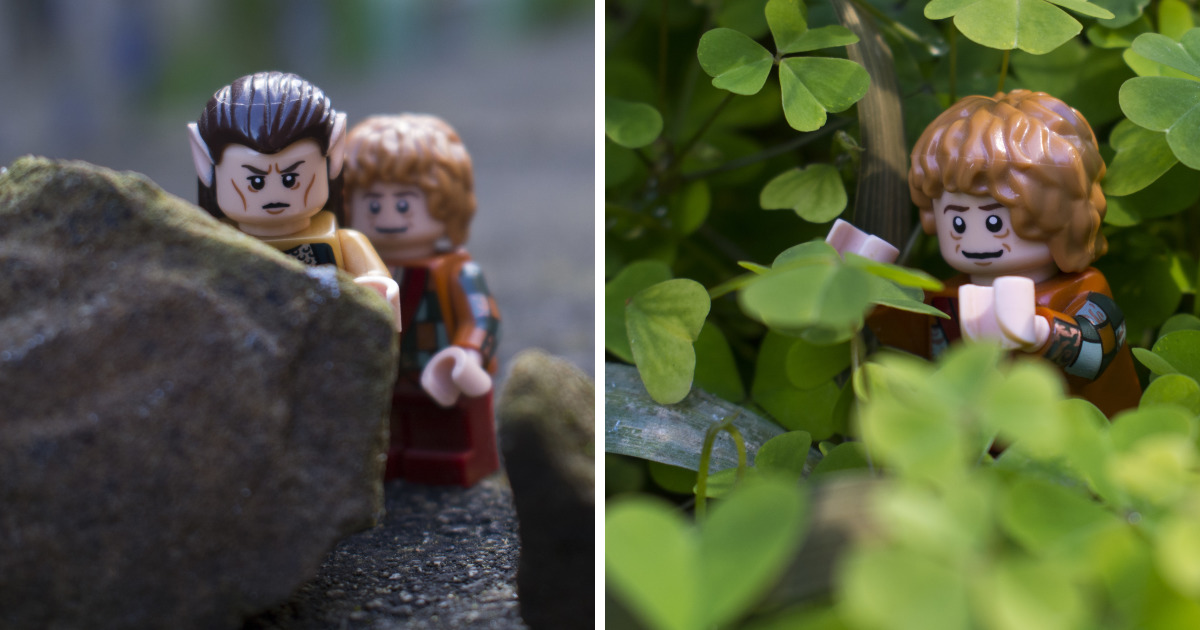
Once the scenes were built, I photographed them like a miniature movie. The camera angle changed everything. Shooting from above made the builds look like toys. Shooting at minifigure eye level made them feel like places. A two-inch wall suddenly became a fortress. A pile of dark bricks became a mountain pass. A desk lamp became the light of dawn, though admittedly dawn had a power cord.
I used warm lighting for the Shire, cool lighting for the ruins, and harsher shadows for the forest. For dramatic scenes, I placed the light behind the characters to create silhouettes. This made even simple minifigure poses feel cinematic. A hobbit holding a lantern at arm’s length can look surprisingly heroic if the background is dark enough and no one notices the coffee mug behind the set.
Practical Posing Tips
LEGO minifigures have limited movement, so tiny changes matter. Turning a head slightly can show suspicion. Tilting a sword downward can show exhaustion. Placing one character half a stud behind another can imply hesitation or fear. A cape blowing dramatically is harder, unless you are willing to use tape, wire, or the ancient builder’s technique known as “lean it against something and hope.”
I also learned that hands are important. A minifigure reaching toward a map tells a different story than one holding it tightly. Milo’s nervous grip on the lantern became a recurring visual motif. By the end, when he sets the lantern down to help others, the pose communicates his growth without needing a speech.
How The Final Story Played Out
The final act took place at a broken stone arch near the forest’s edge. Varkh caught up with the heroes and demanded the lantern. He believed it would reveal secret roads into peaceful lands. Milo realized the lantern was not a weapon, but a witness. It shone brightest when used selflessly.
Instead of fighting Varkh directly, Milo raised the lantern and revealed the hidden army moving through the trees. Elenor used a signal arrow to warn the nearby settlements. Bruni collapsed the old arch, blocking the enemy’s path and declaring that ancient ruins were “finally useful for something.” The lantern faded, but the danger was exposed.
The ending returned to the Shire. Milo came home changed, not because he had become fearless, but because he had learned that fear is not the opposite of courage. Running away is easy. Walking forward with shaking hands is the real adventure. Also, he learned to label seed boxes more carefully.
Why This Project Worked So Well
Creating a Lord of the Rings story with LEGO minifigures worked because the format forced me to focus. With unlimited words, fantasy can become enormous and messy. With LEGO, every scene asks a practical question: what do you actually need to show? A door, a map, a lantern, a broken wall, a forest path. The limitation becomes a creative advantage.
The project also reminded me why LEGO remains such a powerful storytelling tool for fans. It does not simply reproduce famous scenes. It invites participation. You can rebuild Rivendell, imagine a new corner of the Shire, create a side quest for a background ranger, or give an orc a surprisingly complex backstory involving bad management and helmet discomfort.
For SEO readers looking for LEGO Lord of the Rings ideas, the best advice is to start small. Do not begin with a full recreation of Minas Tirith unless you have time, space, budget, and a dining table your family has emotionally surrendered. Begin with one scene. Give one minifigure a problem. Add one object that matters. Then build outward.
Experience: What I Learned While Creating My LEGO Lord Of The Rings Story
The most enjoyable part of this project was how quickly the minifigures began to feel alive. At first, Milo was just a hobbit-style figure with a worried face. After a few scenes, he became the kind of character who would pack snacks before saving the world. Bruni started as comic relief, but by the tower scene, he had become the group’s stubborn heart. Elenor began as a mysterious ranger, then slowly turned into the person who understood that leadership sometimes means letting the smallest member of the group make the bravest choice.
I also learned that LEGO storytelling rewards patience. A scene that looks flat from one angle can look magical from another. Moving a tree two studs to the left can create depth. Raising a lantern by one plate can change the mood. The process feels less like building a toy and more like directing a very tiny theater company where the actors are cooperative but have no knees.
Another surprise was how useful imperfection became. A crooked tower looked better than a perfect one. A slightly uneven path felt more natural. A mismatched gray brick suggested age and damage. In normal building, I might have tried to make everything clean and symmetrical. For Middle-earth, the rough edges made the world believable. Ancient places should look as if rain, roots, time, and several bad decisions have shaped them.
The project also made me appreciate the storytelling intelligence behind official LEGO Lord of the Rings designs. Sets like Rivendell and Barad-dûr are not just large because large sets are impressive. They are full of narrative zones. A study suggests wisdom. A forge suggests preparation. A gate suggests threat. A table suggests council, disagreement, and someone definitely talking too long. Translating that idea into a smaller custom build helped me think like a designer: every area should invite action.
If I made the story again, I would plan the photography before finishing the builds. Some of my best-looking walls were nearly impossible to shoot because they blocked the camera. Some clever interiors were too dark. Some dramatic poses collapsed when touched by the breeze of a human sigh. Next time, I would build scenes like film sets, leaving removable walls and open angles for lighting.
Most importantly, I learned that fan creativity does not need to compete with the original story. My little LEGO adventure did not try to outdo Tolkien. That would be like challenging Mount Doom to a staring contest. Instead, it celebrated the feeling of Middle-earth: friendship under pressure, beauty in small places, darkness at the edge of the map, and hope carried by unlikely hands. That is the real joy of creating a Lord of the Rings story with LEGO minifigures. You are not just displaying characters on a shelf. You are giving them one more road to walk.
Conclusion
Creating a Lord of the Rings story with LEGO minifigures turned out to be one of the most satisfying fan projects I have ever attempted. It combined building, writing, photography, character design, and just enough chaos to keep things interesting. The best part was discovering that a story does not need a massive budget or a thousand-piece battlefield to feel epic. Sometimes all it needs is a hobbit, a lantern, a dark path, and a reason to keep going.
LEGO and Middle-earth fit together because both are built on imagination. One gives us bricks; the other gives us myth. Put them together, and suddenly your desk becomes a valley, your lamp becomes moonlight, and a minifigure with short legs becomes the hero of an adventure worth telling.
Note: This is an original, web-ready fan-style article inspired by real LEGO Lord of the Rings products, Tolkien’s Middle-earth, and practical LEGO storytelling methods. It is written for publication and does not copy official descriptions or source text.