There are two kinds of people in this world: those who look at a blank page and see paper, and those who look at it and think, “Excellent, a place to trap an entire galaxy before lunch.” If you are in the second group, welcome. If you are in the first group, do not panic. Galaxy drawing is one of the most beginner-friendly, imagination-powered, wonderfully messy art styles out there.
The phrase “Hey Pandas, Post Your Best Galaxy Drawing” feels like a cheerful invitation from the internet’s creative corner: show us your stars, your nebula clouds, your glittering spiral arms, your suspiciously dramatic black holes, and yes, even that one moon that accidentally looks like a potato. Space art is not about perfect realism. It is about mood, motion, color, depth, and the magical belief that a few dots of white paint can make people whisper, “Whoa.”
This guide explores what makes a galaxy drawing stand out, how real galaxies can inspire your artwork, which tools work best, and how to share your finished piece with confidence. Whether you draw with colored pencils, markers, watercolors, acrylics, pastels, or a tablet, your galaxy can become a tiny universe with its own personality.
Why Galaxy Drawings Are So Addictive
Galaxy drawings are popular because they offer something rare: freedom with structure. Real galaxies have recognizable forms, but they are also wild, colorful, and beautifully irregular. A spiral galaxy may have graceful arms curling around a bright core. An elliptical galaxy may look like a soft glowing cloud. An irregular galaxy may seem chaotic, as if the universe spilled glitter and refused to clean it up.
That flexibility makes galaxy art perfect for beginners and experienced artists alike. You can follow astronomy references closely, or you can create a fantasy galaxy with purple dust, teal stars, rose-gold clouds, and one tiny rocket ship cruising through the corner like it has somewhere important to be.
Galaxy Art Lets You Practice Core Drawing Skills
A strong galaxy drawing can teach color blending, contrast, composition, layering, texture, lighting, and depth. These are serious art skills, even if the process feels like playing with cosmic cotton candy. When you build dark backgrounds, add glowing centers, scatter stars, and soften nebula clouds, you are practicing the same visual principles used in landscape painting, digital illustration, fantasy concept art, and graphic design.
Real Galaxy Inspiration: What to Know Before You Draw
Before grabbing your pencils or brushes, it helps to understand what galaxies actually are. A galaxy is a massive system of stars, gas, dust, dark matter, and gravitational drama. Our home galaxy, the Milky Way, is a spiral galaxy with a broad disk of stars. Earth sits within one of its spiral arms, which means every time you draw a galaxy, you are technically making fan art of your cosmic neighborhood.
Galaxies come in several major types. Spiral galaxies have arms that curve outward from a bright central region. Elliptical galaxies are smoother and rounder, often appearing like glowing ovals. Irregular galaxies do not follow a neat shape, which is artist language for “permission to get wonderfully weird.”
Use Telescope Images as Mood Boards
Images from observatories like Hubble and the James Webb Space Telescope are excellent references for galaxy drawing ideas. They show glowing star-forming regions, dusty lanes, bright galactic centers, and layered clouds of gas. However, many space images are created by combining data from different wavelengths of light, including wavelengths human eyes cannot naturally see. That means the colors are often scientifically assigned, not simply snapped like a regular phone photo.
For artists, that is fantastic news. Space itself gives you permission to use expressive color. Blues can suggest hotter young stars, reds and oranges can hint at dust or glowing gas, and purples can create a dreamy nebula effect. Your galaxy drawing can be inspired by science without becoming a science exam. Nobody needs a pop quiz hiding behind the stars.
Best Materials for a Galaxy Drawing
You do not need expensive supplies to create a beautiful galaxy drawing. The best tools are the ones you enjoy using and can control with confidence. Still, some materials are especially friendly for space art because they blend well, layer smoothly, or create bright star effects.
Colored Pencils
Colored pencils are great for controlled galaxy drawings. They allow you to layer dark blues, violets, magentas, and black without overwhelming the paper too quickly. Use circular strokes for cloudy areas and sharper strokes for starbursts or comet trails. For smoother results, build color gradually instead of pressing hard from the start.
Soft Pastels and Chalk Pastels
Pastels are excellent for nebula clouds because they blend like a dream. You can smudge pink, blue, purple, and white into soft cosmic fog. The downside is that pastels are messy. Your fingers may look like you fought a unicorn and lost. Use fixative if needed, and protect finished work from smearing.
Watercolor
Watercolor creates airy, glowing galaxies with soft transitions. Wet-on-wet techniques work beautifully for space backgrounds. Drop blue, violet, pink, and black into damp paper and let the colors bloom naturally. Once dry, add stars with white gouache, acrylic ink, or a gel pen.
Acrylic Paint
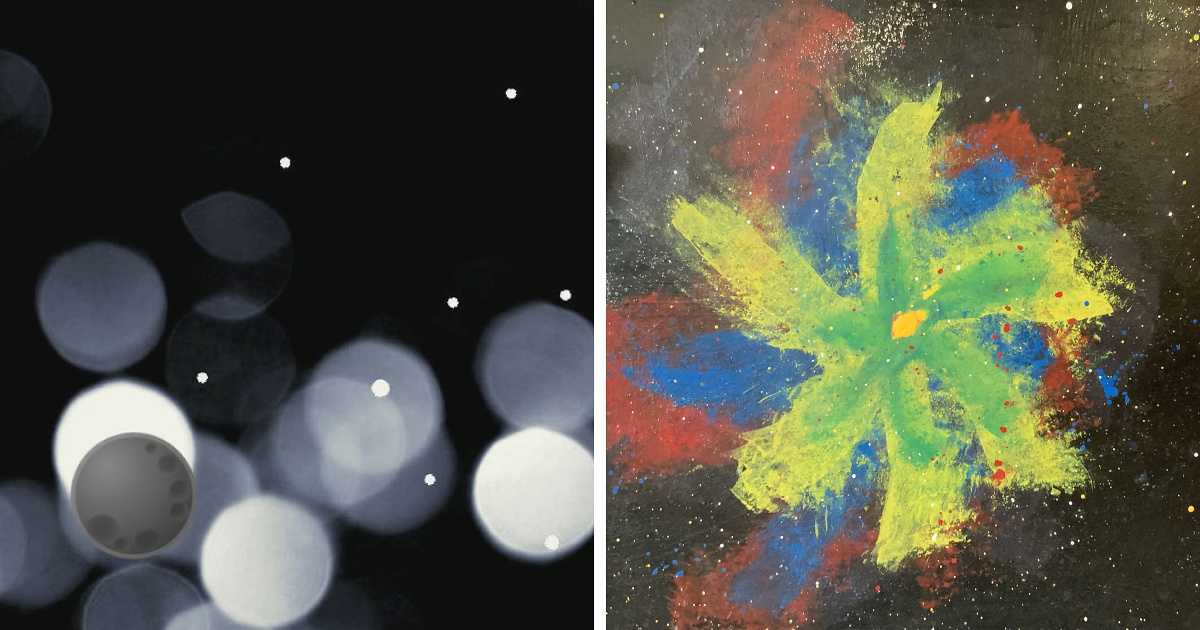
Acrylic is bold, forgiving, and dramatic. It is perfect for deep black space, bright galaxy cores, and splattered stars. Use a sponge for nebula textures, a dry brush for dust lanes, and an old toothbrush for star fields. Warning: star splattering is fun until your desk, shirt, and possibly your cat join the galaxy.
Digital Drawing Tools
Digital galaxy drawing gives you layers, undo buttons, glow effects, and blending brushes. Start with a dark canvas, add color clouds on separate layers, blur or smudge them, then use small brushes for stars. Add larger stars sparingly so the image does not turn into a glitter traffic jam.
How to Draw a Galaxy Step by Step
A galaxy drawing can look complicated, but the process becomes easier when you break it into layers. Think of it like building a sandwich, except the sandwich is made of stars and nobody should try to eat it.
Step 1: Choose Your Galaxy Type
Decide whether you want a spiral galaxy, a nebula-style galaxy scene, a Milky Way landscape, or an abstract cosmic composition. Spiral galaxies work well when you want movement. Nebula drawings are great for color blending. A Milky Way sky over mountains or trees adds storytelling and atmosphere.
Step 2: Create a Dark Background
Most galaxy drawings need a strong dark base. Use black, navy, deep violet, or a gradient of all three. Avoid making the entire page flat black unless you plan to layer plenty of color on top. A little variation in the darkness makes the final artwork feel deeper.
Step 3: Add the Main Glow
Every eye-catching galaxy drawing needs a focal point. For a spiral galaxy, this is usually the bright center. For a nebula, it might be a glowing cloud. Use white, pale yellow, light blue, or soft pink to build the brightest area. Keep the center intense and let the color fade outward.
Step 4: Build Color Clouds
Add layers of blue, purple, magenta, turquoise, red, or orange. Blend the edges so the colors feel smoky rather than stiff. Real space contains gas and dust structures, so uneven edges are your friend. Do not make every cloud symmetrical. The universe loves balance, but it is not obsessed with being tidy.
Step 5: Add Stars Carefully
Stars bring the drawing to life, but too many large stars can flatten the image. Use tiny dots for distant stars, medium dots for brighter stars, and a few larger starbursts for sparkle. Vary the spacing. Realistic star fields are not arranged like wallpaper. Some areas should feel crowded, while others remain quiet and dark.
Step 6: Add Details and Depth
Finish with dust lanes, shooting stars, planets, silhouettes, or tiny spacecraft. In a spiral galaxy, add curved dark streaks to separate the arms. In a nebula drawing, add wispy highlights and deeper shadows. In a galaxy landscape, place trees, mountains, rooftops, or a small figure in the foreground to create scale.
Galaxy Drawing Ideas for “Hey Pandas” Posts
If you are joining a community challenge like “Hey Pandas, Post Your Best Galaxy Drawing,” your artwork does not need to look like everyone else’s. In fact, the best submissions often have a personal twist. Try one of these ideas if your imagination is currently buffering.
1. A Spiral Galaxy With a Glowing Core
Draw a classic spiral galaxy with a bright center and sweeping arms. Use yellow-white for the core, blue and purple for the arms, and dark dust lanes for contrast. This style looks impressive and works well in both traditional and digital media.
2. A Galaxy Inside an Animal Shape
Create a silhouette of a panda, wolf, cat, whale, bird, or fox and fill it with a galaxy texture. This idea combines cute and cosmic energy. A panda filled with stars is especially fitting for the “Hey Pandas” theme, and frankly, the universe could use more space pandas.
3. A Milky Way Night Landscape
Draw a mountain range, desert road, forest, lake, or quiet backyard under a huge galaxy sky. This gives your drawing emotional depth. The contrast between a small Earth scene and a massive sky can make viewers feel calm, curious, and slightly dramatic in the best way.
4. A Fantasy Planet With Galaxy Rings
Design a planet surrounded by glowing galaxy rings instead of ordinary rings. Add small moons, distant stars, and colorful dust. This is a great option if you like science fiction art.
5. A Black Hole Scene
Draw a dark center surrounded by swirling light. Use curved lines and strong contrast to show motion. A black hole drawing can be mysterious, intense, and very fun to shade. Just avoid making it so dark that viewers need a flashlight and emotional support.
Composition Tips That Make Galaxy Art Look Better
Composition is the difference between “nice colors” and “I want this on my wall.” A galaxy drawing needs movement, contrast, and a clear focal point. Place the brightest area slightly off-center for a more dynamic look. Use curved lines to guide the viewer’s eye. Let dark space remain visible so the bright areas can shine.
Contrast matters most. A galaxy without dark areas can look flat, while a galaxy without highlights can disappear into the background. Think in layers: dark space, soft color, bright glow, tiny stars, crisp details. Each layer should have a job.
Color Palettes That Work Well
Classic galaxy palettes include navy, black, violet, magenta, and white. For a colder look, try black, indigo, teal, icy blue, and silver. For a warmer cosmic sunset, use burgundy, orange, gold, deep purple, and cream. For a dreamy fantasy style, mix lavender, pink, turquoise, and pearly white.
Common Galaxy Drawing Mistakes to Avoid
The most common mistake is adding too many stars of the same size. This makes the drawing feel flat and noisy. Use variety. Another mistake is over-blending until all the colors become muddy. Blend edges, but keep some areas vivid. Also, do not place every bright object in the center. A little asymmetry makes space art feel more natural.
Many beginners also forget about negative space. Empty dark areas are not wasted. They make the glowing parts feel brighter and give the viewer’s eye a place to rest. In galaxy art, darkness is not the enemy. It is the stage lighting.
How to Share Your Galaxy Drawing Online
When posting your galaxy drawing, good presentation matters. Photograph traditional art in natural light, avoid harsh shadows, and crop out clutter. If your paper is slightly warped from watercolor, place it under heavy books after it dries. If your drawing has metallic paint or glitter, take one straight-on photo and one angled photo to show the shine.
Write a caption that tells the story behind the piece. Mention your materials, your inspiration, and what you enjoyed most. For example: “I used watercolor and white gouache for this spiral galaxy. The hardest part was not turning my entire desk into a star field.” Captions make your post more human and encourage comments.
Helpful Hashtags and SEO Phrases
Useful phrases include galaxy drawing, space art, how to draw a galaxy, galaxy art ideas, nebula drawing, cosmic illustration, and Milky Way drawing. Use them naturally in your caption or post description. The goal is discoverability, not sounding like a robot who swallowed an art dictionary.
Why Community Art Challenges Matter
Online art prompts help people create without waiting for perfect inspiration. A title like “Hey Pandas, Post Your Best Galaxy Drawing” is simple, but it gives artists a reason to finish something and share it. That matters. Many drawings stay hidden in sketchbooks because the artist thinks they are not good enough. Community prompts gently push those drawings into the light.
Seeing other people’s galaxy drawings can also be motivating. One artist may use watercolor blooms. Another may create a digital neon galaxy. Someone else may draw a tiny panda astronaut floating through a spiral galaxy with the calm confidence of a creature who packed snacks. Each version expands what the prompt can mean.
Experiences Related to “Hey Pandas, Post Your Best Galaxy Drawing”
There is a special kind of excitement that comes with making a galaxy drawing for a community post. It starts with ambition. You sit down thinking, “Tonight, I will create a majestic cosmic masterpiece.” Ten minutes later, your hands are stained blue, your white pen is missing, and the first star splatter has landed somewhere it absolutely should not have. This is part of the experience. Galaxy art is not always neat, but it is almost always fun.
The best part is watching the drawing slowly transform. At first, the page may look like a dark smudge with commitment issues. Then you add violet, a little pink, a smoky blue cloud, and suddenly it begins to feel like space. The moment you add the first bright stars is usually when the magic happens. A few white dots can turn a flat background into distance. Add a glowing center, and the whole drawing begins to breathe.
Sharing the finished piece can feel surprisingly vulnerable. Even if the prompt is friendly, posting art online means letting strangers see your choices, your mistakes, and your style. But galaxy drawings are forgiving. They remind us that beauty does not always come from clean lines or perfect symmetry. Sometimes it comes from layers, accidents, soft edges, and brave color choices.
One memorable experience many artists have is discovering that their “mistake” becomes the best part of the drawing. A spilled watercolor bloom turns into a nebula. A smudged pastel mark becomes cosmic dust. A crooked spiral arm makes the galaxy feel more alive. Space is full of collisions, explosions, and strange shapes, so your imperfect mark may be more realistic than you think.
Another common experience is comparison. You post your galaxy drawing, then scroll through other submissions and see pieces that look polished, dramatic, or wildly creative. It is easy to think, “Mine is just a small star potato.” But community art is not a contest unless someone clearly says it is. The point is participation, growth, and shared inspiration. Your drawing might encourage another beginner to try. Your color palette might give someone a new idea. Your caption might make people laugh.
Galaxy drawing also has a calming quality. The repeated motions of blending, dotting stars, darkening corners, and adding highlights can feel almost meditative. You are not drawing a bowl of fruit under strict classroom lighting. You are building a universe. That gives the process a sense of wonder. For a little while, your desk becomes mission control, your pencil becomes a telescope, and your paper becomes a window into somewhere impossibly far away.
For younger artists, the prompt can be a doorway into both art and astronomy. For adult artists, it can be a playful break from practical responsibilities. Bills, emails, laundry, and grocery lists may be waiting, but for an hour, you can paint stars. That is not a small thing. Creativity gives people room to breathe.
So if you are wondering whether your galaxy drawing is worth posting, the answer is yes. Post the polished one, the messy one, the dramatic one, the cute one, the one with a panda in a spacesuit, or the one where the stars got slightly out of control. The internet has plenty of opinions already. What it needs more of is sincere creativity.
Conclusion
“Hey Pandas, Post Your Best Galaxy Drawing” is more than a fun title. It is an invitation to explore color, imagination, science, and personal style. A galaxy drawing can be realistic or whimsical, simple or detailed, soft or explosive. It can teach blending, contrast, composition, and storytelling while giving you plenty of room to experiment.
The best galaxy drawing is not necessarily the most technically perfect one. It is the one that feels alive. It has depth, mood, motion, and a little spark of personality. Whether you use pencils, paint, pastels, or digital brushes, your galaxy deserves to be seen. So gather your colors, dim the lights, add the stars, and post your universe proudly. Somewhere out there, another Panda is waiting to be inspired.