Some beach hotels whisper. Halcyon House arrives wearing cobalt stripes, floral upholstery, antique jewelry, and enough patterned tile to make minimalism quietly reconsider its life choices.
Set beside Cabarita Beach on the northern coast of New South Wales, Australia, Halcyon House is a master class in coastal interior design without the predictable driftwood signs, rope-wrapped lamps, or decorative anchors. It offers a different vision of seaside style: nostalgic but polished, luxurious but relaxed, and boldly patterned without becoming visually exhausting.
The boutique hotel occupies what was once the Hideaway Motel, a modest 1960s surf lodge. Sisters Elisha and Siobhan Bickle purchased the aging property in 2011, initially imagining a shared family vacation home. The project grew more ambitious, and the motel eventually became a 21-room retreat created with architect Virginia Kerridge and Brisbane interior designer Anna Spiro. Halcyon House opened in 2015 and quickly became one of Australia’s most recognizable design hotels.
Its enduring appeal comes from more than photogenic rooms. Halcyon House demonstrates how pattern, color, architecture, antiques, art, and hospitality can work together to create a complete sense of place. The hotel does not simply look Australian. It captures the emotional rhythm of an Australian beach vacation: sun-faded, informal, slightly nostalgic, and never too precious to accommodate sandy feet.
From Faded Surf Motel to Boutique Beach House
Adaptive reuse projects often erase their buildings’ former identities. Halcyon House took the opposite approach. Instead of pretending the property had always been a glamorous resort, the redesign preserved the easygoing proportions and social atmosphere of a mid-century coastal motel.
The low-rise structure, balconies, outdoor circulation, pool, and close relationship with the beach still evoke the democratic pleasure of an old-fashioned motor inn. What changed was the level of detail. Familiar motel architecture received carefully considered finishes, custom textiles, antique furniture, handmade tiles, tailored lighting, and rooms with distinct personalities.
This combination is essential to the hotel’s charm. A newly built luxury resort might have felt too formal for Cabarita Beach, a relatively quiet surf town positioned between the Gold Coast and Byron Bay. The retained motel character keeps Halcyon House grounded. Guests are offered luxury, but it is the barefoot varietythe kind that pairs crisp linens with wet swimsuits and excellent food with an afternoon nap.
A Renovation That Respects Memory
The original motel supplied something money cannot manufacture overnight: history. Even after an extensive renovation, its modest scale suggests family road trips, summer vacations, and childhood mornings spent racing toward the ocean before breakfast.
That nostalgic foundation gave Spiro permission to make the interiors feel collected rather than installed. Antique pieces appear to have accumulated over generations. Gallery walls resemble personal collections. Patterned fabrics feel like treasured remnants from travels rather than items ordered in identical quantities for a hotel chain.
The result is sophisticated without being anonymous. You know you are staying somewhere special, but you do not feel as though you have wandered into a showroom where sitting on the furniture might trigger an alarm.
Anna Spiro’s Fearless Approach to Pattern
Anna Spiro is known for interiors that combine color, old furniture, new textiles, artwork, and objects with cheerful confidence. At Halcyon House, she applied that philosophy at an unusually large scale while ensuring the hotel still felt coherent.
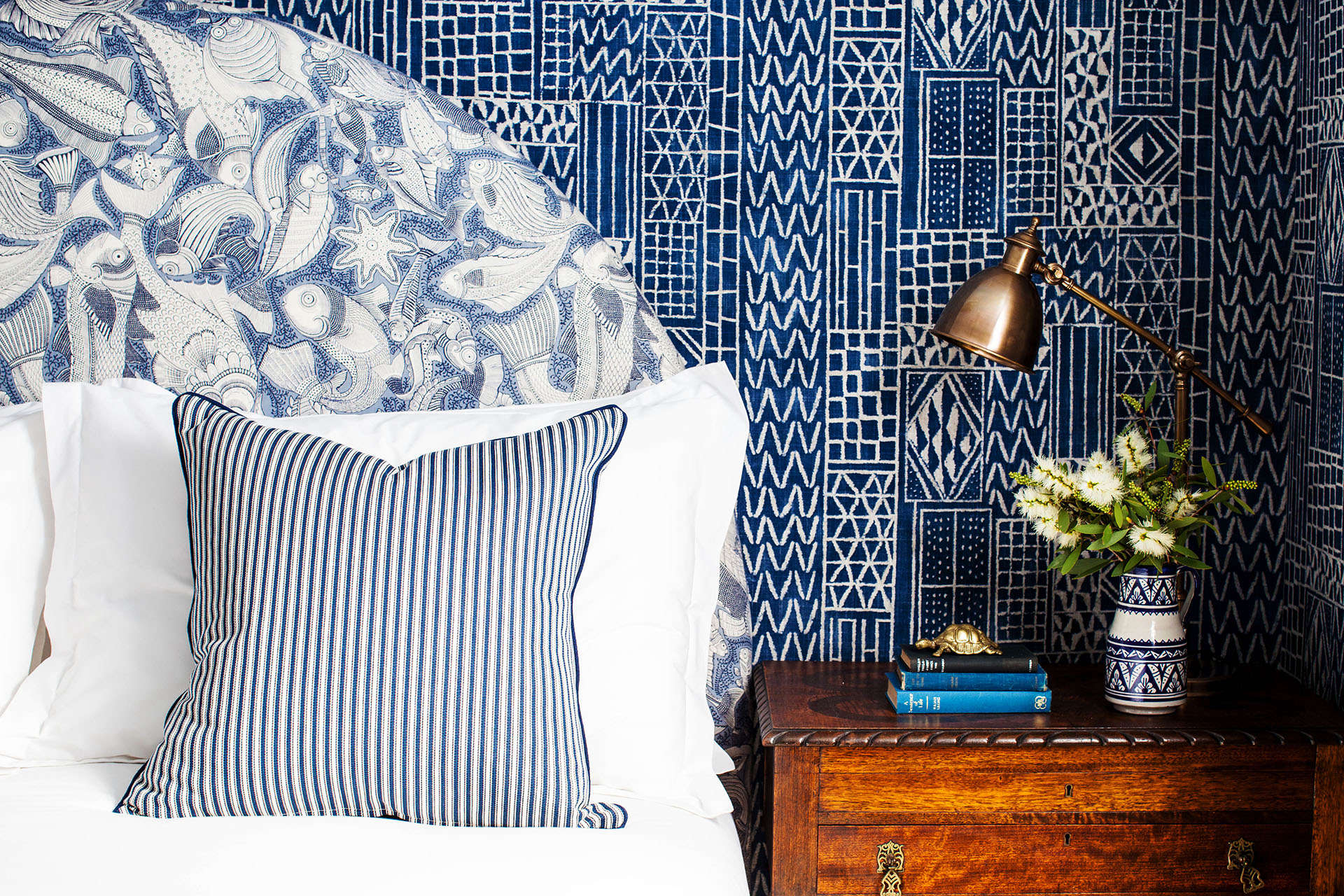
The most memorable spaces feature several patterns at once: florals beside stripes, geometric motifs against organic shapes, upholstered walls behind patterned headboards, and decorative tile beneath furniture wearing yet another print. On paper, this sounds like a design dispute requiring professional mediation. In person, the recurring palette and traditional forms create harmony.
Spiro has explained that successful mismatching needs a common thread, such as a repeated color or a strong solid tone that grounds the room. Halcyon House demonstrates that principle beautifully. Blue acts as the visual handshake connecting fabrics, tiles, furniture, art, and views of the ocean.
Why the Patterns Do Not Feel Chaotic
Pattern mixing works here because contrast is controlled rather than random. Large motifs are balanced with smaller prints. Curving florals sit beside disciplined stripes. Dark wood furniture interrupts expanses of blue and white, while plain linens provide moments of rest.
The architecture also helps. Guest rooms are not enormous, yet their basic layouts remain relatively straightforward. This structural simplicity allows fabrics and objects to become expressive without forcing the eye to decode an overly complicated floor plan.
Most importantly, the patterns share an emotional tone. They are upbeat, traditional, and vacation-minded. A floral print may differ from a geometric one, but both feel as though they belong in the same eccentric seaside family.
Blue and White, Without the Nautical Clichés
Blue and white are hardly revolutionary in coastal decorating. They appear in beach homes around the world, frequently accompanied by seashells, model sailboats, and at least one pillow announcing that life is better at the beach.
Halcyon House avoids that formula by treating blue as a broad spectrum rather than a single accent color. Navy, turquoise, aqua, cobalt, azure, and dusty blue appear in different rooms and materials. Some shades are crisp and graphic; others look softened by years of sunlight.
White provides breathing room, but it is rarely stark. Limewashed timber, natural fibers, aged surfaces, and warm textiles keep the palette from feeling clinical. The combination echoes the surrounding landscape without copying it literally: deep ocean water, pale foam, blue sky, bleached sand, and the shadowy greens of coastal vegetation.
Color as a Wayfinding Tool
Because every guest room is individually designed, color provides continuity throughout the property. One room may feature a dramatic floral wall while another leans toward stripes and checks, yet recurring blues make the spaces feel like chapters in the same story.
This is a useful lesson for home decorators. Repetition does not require duplication. You can vary motifs, furniture styles, and textures while maintaining cohesion through a limited family of colors. The rooms do not need to match like uniforms; they only need to look as though they are attending the same party.
Upholstered Walls Change Everything
One of Halcyon House’s most distinctive features is its use of fabric-upholstered walls. Imported patterned and plain textiles wrap rooms in softness, making the bedrooms feel intimate and residential.
Fabric behaves differently from paint or wallpaper. It absorbs sound, introduces subtle depth, and gives color a tactile quality. In a hotel bedroom, those qualities contribute to comfort. The room feels quieter, warmer, and more envelopingthe decorative equivalent of being handed a very elegant blanket.
Upholstered walls also allow pattern to become architectural. Instead of functioning as a small accent, a print defines the entire atmosphere of the room. Headboards, curtains, chairs, cushions, and wall fabrics then interact in layers.
How to Adapt the Idea at Home
Fully upholstered walls require skill and a healthy decorating budget, but the principle can be translated more simply. A fabric-covered panel behind a bed can create a similar sense of softness. An oversized upholstered headboard can establish a strong motif without covering the entire room.
Renters can experiment with framed textile panels, patterned curtains, fabric screens, or removable wallpaper. The important idea is not to reproduce Halcyon House inch for inch. It is to let one textile take up enough space to establish confidence.
Antiques Give the Hotel Its Soul
Pattern may grab the camera’s attention, but antiques keep the rooms from feeling superficial. Dark timber chests, vintage chairs, old mirrors, small tables, brass fixtures, and collected artworks add age and emotional weight.
No two guest rooms are exactly alike. Furniture and decorative objects were selected for individual spaces rather than repeated according to a standardized hospitality formula. That variety encourages discovery. Guests notice the character of a bedside table, the shape of a lamp, or the unusual arrangement of art because those details feel personal.
Vintage furniture is especially effective beside exuberant fabrics. The worn wood and traditional silhouettes provide stability, while colorful textiles prevent the antiques from feeling solemn. It is a productive decorative friendship: the old pieces calm the patterns, and the patterns persuade the old pieces to have some fun.
Gallery Walls That Feel Collected
Many rooms include salon-style arrangements of paintings, prints, mirrors, and small curiosities. The pieces vary in size and subject, creating the impression of a collection assembled over time.
The arrangements are dense but not rigid. Frames do not line up in perfect grids, and every piece does not share the same finish. This looseness contributes to the residential mood. The walls resemble those of an interesting relative who traveled widely, bought art impulsively, and never once asked whether everything matched.
Tile, Brass, and the Mediterranean Connection
The bathrooms and circulation spaces introduce another layer of pattern through blue-and-white handmade tiles. Geometric designs add durability and visual energy while connecting the Australian beach setting with Mediterranean resort imagery.
Brass fixtures warm the cool palette and develop character as they age. Paired with patterned floors, generous showers, timber elements, and crisp towels, the bathrooms feel glamorous without losing the informality of a beach house.
This Mediterranean influence prevents the design from becoming narrowly nautical. Halcyon House draws from several coastal traditions at once: Australian surf culture, Italian resort style, old family beach homes, mid-century motels, and the layered rooms of English country houses. The mix is difficult to categorize, which is precisely why it remains interesting.
Paper Daisy Extends the Design Story
A design hotel succeeds when its public spaces feel as memorable as its bedrooms. At Halcyon House, the restaurant Paper Daisy continues the relaxed coastal narrative through color, texture, local ingredients, and an atmosphere that encourages long meals.
The restaurant’s name comes from a flower found along the nearby headland, reinforcing the property’s relationship with its landscape. Its culinary identity has emphasized regional produce and contemporary interpretations of Australian flavors rather than formal resort dining.
That approach suits the interior. A heavily starched, hushed dining room would feel misplaced inside such a playful hotel. Paper Daisy instead supports the central promise of Halcyon House: thoughtful luxury that does not require guests to stop behaving like people on vacation.
What Halcyon House Teaches About Maximalism
Halcyon House is often described as maximalist, but its rooms are not simply filled with more things. Their success depends on selection, repetition, scale, and restraint in unexpected places.
Choose a Dominant Color Family
A narrow palette allows greater freedom with pattern. Blue and white unite the hotel’s stripes, florals, checks, tiles, and upholstery. At home, two or three dominant colors can perform the same job.
Mix Pattern Scales
Several large prints placed together may compete. Pairing a generous floral with a narrow stripe, tiny geometric motif, or mostly solid textile creates a more readable composition.
Use Natural Materials as Pauses
Tim motif, or mostly solid textileber, woven fibers, plain linen, and brass offer visual breaks. They keep patterned rooms from feeling flat while providing texture that does not demand immediate attention.
Add Objects With Personal Meaning
Maximalism becomes convincing when the objects look loved. Art, books, inherited furniture, travel finds, and handmade pieces carry stories. Filling a room with newly purchased “vintage-style” accessories can imitate the surface, but not the soul.
Let Rooms Differ
Consistency does not mean repeating the same formula everywhere. Halcyon House gives each room an identity while maintaining shared colors, materials, and emotional warmth. A home can do the same.
Why the Design Still Feels Fresh
Halcyon House became an international design favorite soon after opening, appearing in major travel and interiors publications and receiving repeated recognition from hotel critics and readers. Its influence remains visible in the popularity of highly decorated boutique hotels, revived roadside motels, and residential-s97420search1turn479554search2
Yet the property has aged better than many trend-driven interiors because its core ideas are not new. Blue and white are timeless. Antiques improve with age. Handmade tile has centuries of decorative history. Layered textiles have always made rooms more comfortable. Personal collections rarely become irrelevant.
The hotel’s originality comes from combining those familiar elements in a way that feels specific to its location and owners. It does not chase novelty for its own sake. Instead, it arranges enduring materials with enough confidence to make them feel unexpected.
The Halcyon Experience: A Pattern-Lover’s Aussie Escape
Imagine arriving at Cabarita Beach after driving south from the polished towers of the Gold Coast or north from the busier energy around Byron Bay. The town feels quieter than either destination. There is ocean air, low development, a broad beach, and the sense that nobody has scheduled a networking breakfast beside the pool. Then Halcyon House appearswhite walls, striped umbrellas, palms, and flashes of blue suggesting that the vacation has officially begun.
Entering a guest room becomes an exercise in noticing. First comes the dominant pattern, perhaps a blue floral stretched across upholstered walls. Then the secondary details emerge: the curve of an antique chair, a brass handle, a tiny framed picture, a striped cushion that should theoretically argue with the flowers but somehow behaves beautifully. The room rewards slow observation. Ten minutes after arriving, you are still spotting objects that seemed invisible at first glance.
The experience differs from entering a conventional luxury hotel room, where symmetrical nightstands and neutral carpeting announce that everything has been optimized for universal approval. At Halcyon House, the slight irregularities are the luxury. The furniture does not look as though it was produced by the acre. The art appears chosen rather than allocated. You feel like a guest in an unusually stylish beach home, except someone else makes the bed and you are not responsible for finding the missing television remote.
Morning light changes the interiors. Blues that looked deep and dramatic at night become brighter beside the coastal sun. Patterned tiles feel cooler underfoot, while white linens sharpen the room’s edges. Opening the balcony or terrace reconnects the decorative interpretation of the ocean with the real thing outside. That transitionfrom layered interior to open beachis one of the property’s strongest experiential contrasts.
A leisurely day might move between a swim, a bicycle ride, a spa treatment, the beach, and lunch at Paper Daisy. None of these activities requires a complicated strategy. The hotel’s scale keeps the experience intimate, while the restaurant and public spaces provide enough energy to prevent isolation. Guests can participate in the social atmosphere or retreat into a patterned cocoon for an afternoon nap.
The design also changes how people photograph and remember the stay. A plain hotel room may be recalled primarily through its view. At Halcyon House, individual surfaces become memory markers: the floral wall behind the bed, a tiled bathroom, a gallery arrangement, or the striped loungers beside the pool. The interiors create a visual vocabulary for the vacation.
Returning home after such a stay could be dangerous for anyone with access to fabric samples. Suddenly, a beige bedroom may seem to be underperforming. The temptation is to order six patterns, repaint every cabinet blue, and begin collecting tiny landscapes before unpacking the suitcase. The wiser lesson is more measured: introduce one confident textile, repeat a favorite color, display meaningful art, and allow a room to feel personal rather than perfect.
That is the most valuable Halcyon House experience. It expands the idea of what relaxation can look like. Calm does not always require empty white rooms, silent surfaces, and furniture the color of oatmeal. A space can be energetic, colorful, layered, and still feel restful when its elements are connected by affection, craftsmanship, and a strong sense of place.
Conclusion: More Than a Pretty Pattern
Halcyon House is frequently celebrated for its photogenic blue-and-white interiors, but the hotel’s real achievement is deeper. It transforms a former surf motel without erasing its informal character. It uses pattern to create atmosphere rather than spectacle. It combines antiques, art, tiles, textiles, architecture, food, and coastal landscape into one coherent experience.
The project proves that bold decorating can be comfortable, luxury can have a sense of humor, and nostalgia does not have to feel dusty. Most of all, it shows why memorable interiors are rarely built from perfectly matching objects. They emerge from relationshipsbetween old and new, polished and worn, local and global, floral and striped.
Note: Property details, design history, and hospitality features were synthesized from official project materials and established architecture, interiors, and travel publications. Hotel services, restaurant leadership, room configurations, and guest amenities may change over time.