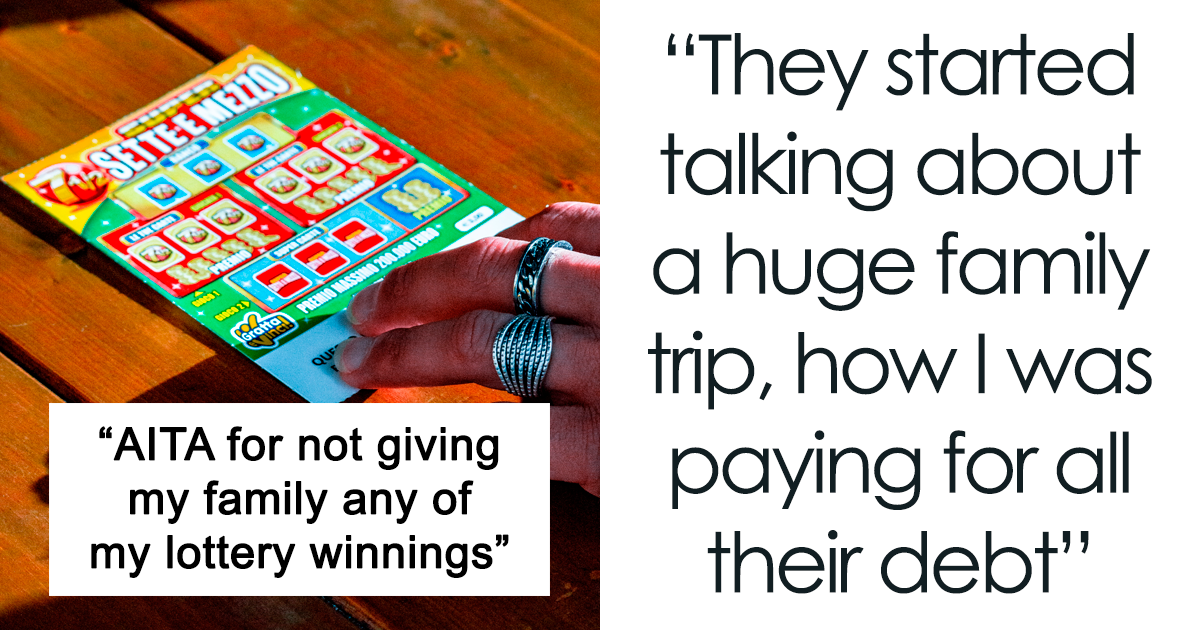
Winning $5.6 million sounds like the beginning of a feel-good movie. The winner pays off a few bills, buys a suspiciously large house, and gathers the family for a celebration where everyone cries happy tears.
That is not how this story reportedly unfolded.
According to a widely shared Reddit post, a 24-year-old man and his wife won approximately $5.6 million after choosing a lump-sum payment and accounting for taxes. They cleared their debts, invested the remaining money, and informed their relatives that they did not plan to distribute cash throughout the family. Instead of congratulations, they allegedly received requests for a luxury vacation, debt payoffs, and other financial help.
When the couple refused, the family reportedly told the man that he was no longer welcome.
The account quickly escaped Reddit and traveled across viral-news sites, where readers debated one irresistible question: Was the winner selfish, or was his family treating him like an ATM with a childhood photo album?
What Reportedly Happened After the $5.6 Million Lottery Win
The original account was posted anonymously in an online forum where users ask others to judge personal conflicts. Because the story was self-reported, the identities, prize, investments, and family conversations were not independently verified. It is more accurate to describe it as a viral account than as a confirmed biography.
In the post, the man said that he and his wife were both 24. After taxes, the lump-sum adjustment, and repayment of their student loans, mortgage, and car loans, they reportedly had about $5 million remaining.
The man claimed that approximately $3 million went into mutual funds, real estate investment trusts, and preferred-stock funds. The other $2 million was reportedly used as part of the purchase of a $5 million apartment property.
Then came the family announcement.
The winner expected his relatives to be excited about the couple’s good fortune and careful planning. Instead, he said they began discussing a major family trip and assumed that he would erase their debts. When he explained that the money had already been allocated and would not be divided among relatives, the conversation deteriorated dramatically.
Nothing says “Congratulations” quite like presenting the winner with an unofficial invoice.
Why the Story Became So Controversial
The situation touches several emotional nerves at once: money, family loyalty, fairness, envy, gratitude, and the belief that a wealthy relative should solve everyone else’s financial problems.
People often imagine a multimillion-dollar prize as unlimited wealth. In reality, even a fortune can shrink quickly when it is expected to support several households for decades. Homes, health expenses, taxes, education, emergencies, inflation, property maintenance, and investment losses do not disappear merely because a bank balance briefly contains an impressive number of zeros.
To the Couple, the Money Represented Security
The winner and his wife appeared to view the prize as a permanent financial foundation. They wanted to eliminate debt, create income-producing assets, and avoid spending the principal recklessly.
That mindset explains why the man resisted immediate gifts. Every dollar promised to a relative would reduce the amount available for the couple’s investments, emergencies, future children, retirement, and other long-term goals.
He did not appear to see himself as a man carrying a bag of free cash. He saw himself as the manager of a rare opportunity.
To the Family, the Money May Have Represented Shared Relief
Relatives may have interpreted the win differently. They may have seen it as a once-in-a-lifetime chance to remove debts, experience an expensive vacation, or escape years of financial pressure.
That does not automatically justify their demands. It does, however, explain why expectations can form almost instantly. When one member of a family becomes wealthy overnight, everyone else’s unresolved money worries remain in the room. They simply acquire a new target.
A person struggling with a $20,000 debt may look at someone with $5 million and think, “Paying this would be nothing to you.” The winner may look at ten relatives making similar requests and think, “Apparently I have opened a bank, and nobody bothered to tell me.”
Was the Lottery Winner Wrong to Refuse?
Based on the information in the post, refusing to distribute the winnings was not inherently wrong. The prize belonged to the couple, and relatives were not entitled to assign themselves portions of it.
Generosity is meaningful when it is voluntary. A gift demanded through guilt, threats, or exclusion is not really generosity. It is financial pressure wearing a family reunion name tag.
The couple also had obligations to each other. Major financial decisions within a marriage should consider the security, comfort, and goals of both spouses. Giving away large sums simply to prevent relatives from becoming angry could have created resentment inside the couple’s own household.
That said, being legally and financially justified does not mean every part of the conversation was handled perfectly. Tone matters. A blunt declaration that nobody will receive “a cent” may be interpreted as hostility, even when the underlying boundary is reasonable.
A calmer explanation might have reduced the temperature: the couple had created a long-term financial plan, was not making gifts or loans during the transition, and would reconsider charitable or family assistance only after receiving professional guidance.
Would that have satisfied everyone? Probably not. Money has a remarkable ability to turn a polite disagreement into a three-season television drama.
What the Couple Appeared to Do Right
They Paid Off Their Debts
Eliminating high-cost debt can reduce monthly expenses and create immediate financial stability. FINRA’s guidance on managing a windfall recommends understanding the actual after-tax amount, reviewing existing obligations, addressing financial essentials, and creating a deliberate long-term plan before making major lifestyle changes.
They Thought Beyond the First Celebration
The couple reportedly resisted the temptation to treat the entire prize as spending money. That is an important distinction. A windfall can finance a few spectacular years, or it can be managed as an asset intended to support decades of living expenses.
Setting aside money for investments and income-producing property suggests that the couple understood a basic principle: a jackpot is finite, even when it initially feels enormous.
They Did Not Make Immediate Promises
Once a winner promises to pay one relative’s debt, it becomes harder to refuse the next request. Helping one sibling may lead to questions from another sibling, parents, cousins, in-laws, and a mysterious uncle who has not called since flip phones were fashionable.
Delaying commitments allows a winner to calculate what can actually be given without damaging personal security.
Where the Winner’s Financial Claims Deserve Caution
The Reddit post described the chosen investments as steady, hands-off, and extremely low risk. That description should not be accepted without qualification.
Mutual funds, preferred stocks, real estate investment trusts, and apartment properties can all decline in value or produce less income than expected. Real estate may involve vacancies, repairs, legal disputes, financing costs, insurance, taxes, and management expenses. A large apartment purchase may also concentrate substantial wealth in one property or local market.
Investment professionals should be researched carefully, including their registration history, services, fees, conflicts, and disciplinary records. The Securities and Exchange Commission encourages investors to verify the background of anyone offering investment advice rather than relying on impressive titles or confident promises.
In other words, refusing relatives may have been sensible, but describing investments as nearly risk-free is less convincing. Money does not become safe merely because it is wearing a necktie.
The Famous “70% of Lottery Winners Go Broke” Claim Is Questionable
The original poster repeated a popular statistic claiming that 70% of lottery winners lose their money within a few years. That figure has circulated online for a long time, but it has not been supported by credible research from the organization to which it is often attributed.
Research paints a more nuanced picture. A major study of Swedish lottery winners found that large prizes were associated with lasting increases in overall life satisfaction, particularly satisfaction with personal finances. The effects remained visible more than a decade after the win, contradicting the idea that nearly every winner rapidly destroys the money and becomes miserable.
This does not mean every winner manages money successfully. Some make costly decisions, fall victim to fraud, or experience serious personal conflict. It means sensational stories should not be mistaken for the experience of all lottery winners.
“Winner quietly invests money and continues living normally” is a realistic outcome. It is simply a terrible headline.
Why Sudden Wealth Can Create Family Conflict
Money disagreements are rarely only about arithmetic. They also involve identity, trust, childhood experiences, power, and unspoken beliefs about what family members owe one another.
The American Psychological Association has noted that money conflicts can be especially intense and difficult to resolve. People develop financial beliefs through family experiences, and two people may assign completely different meanings to saving, spending, debt, and generosity.
For one relative, paying a parent’s mortgage may symbolize gratitude. For another, it may create dependency. One person may see a family vacation as a joyful celebration, while the winner sees it as the opening ceremony for unlimited requests.
Sudden wealth also changes social roles. The winner may no longer be treated as a brother, daughter, cousin, or friend. Instead, that person becomes “the rich one.” Ordinary decisions are then judged differently.
Buying an expensive car may be labeled selfish. Refusing a loan may be called cruel. Offering a smaller gift may be criticized because the winner could supposedly afford more. Even generosity can generate conflict if relatives compare what each person received.
A Better Way to Handle Requests From Relatives
A winner does not have to choose between giving everyone unlimited money and permanently cutting off the entire family. Clear policies can create a middle path.
Pause Before Giving an Answer
Large financial decisions should not be made during the first emotional days after a windfall. A temporary response such as “We are not making financial commitments until our plan is complete” creates breathing room without turning every request into a personal rejection.
Decide Whether Help Is a Gift or a Loan
Ambiguity causes trouble. If money is a gift, both sides should understand that repayment is not expected. If it is a loan, the amount, repayment schedule, and consequences of missed payments should be documented.
The Consumer Financial Protection Bureau recommends discussing family financial arrangements in advance and clearly identifying what is being provided, for how long, whether repayment is expected, and what happens if circumstances change.
Create a Fixed Family-Assistance Budget
Some wealthy individuals reserve a specific amount for helping relatives. Once that fund is exhausted, additional requests are declined. This prevents each conversation from becoming a new debate about the winner’s entire net worth.
The budget might support genuine emergencies, education, medical needs, or another clearly defined purpose. The important point is consistency. Rules reduce accusations that decisions are based on favoritism.
Consider Paying Providers Directly
A person who wants to help with tuition or medical care may be able to pay the institution directly rather than transferring unrestricted cash. Tax treatment can vary, so significant gifts should be discussed with a qualified tax professional.
Federal gift-tax rules also distinguish between various types and sizes of transfers. A large gift can create reporting responsibilities for the donor even when no immediate gift tax is due.
Protect Privacy
The fewer people who know the exact amount, the easier it may be to preserve ordinary relationships. Sharing a jackpot figure invites mental accounting by people who do not own the account.
Privacy will not solve every problem, especially where winner information is publicly disclosed. It can, however, limit fraud attempts, unsolicited proposals, and the sudden appearance of acquaintances who begin messages with, “Hey, stranger!”
The Internet’s Verdict Versus Real Family Life
Online commenters overwhelmingly sided with the couple. Many argued that relatives who ended the relationship over money had revealed that their affection was conditional.
That reaction is understandable, but internet judgments simplify messy situations. Readers usually receive one person’s account, written during a conflict, without hearing the relatives’ version. Details about previous promises, family support, or the exact wording of conversations may be missing.
Still, the reported ultimatum is difficult to defend. Telling someone that they are no longer part of the family because they will not pay other people’s debts converts emotional connection into a financial transaction.
A healthier family could express disappointment, ask respectful questions, or disagree with the decision while maintaining the relationship. Love should not come with a minimum distribution requirement.
Experiences and Practical Lessons Related to the $5.6 Million Family Dispute
Sudden-wealth stories repeatedly show that the hardest part of receiving money may not be choosing investments. It may be discovering how differently other people behave once they know the money exists.
A common experience begins with a seemingly modest request. A relative asks for help with a credit card balance, a vehicle, or a house deposit. The winner agrees because the amount appears small compared with the jackpot. Then another family member hears about the gift and asks for equal treatment.
Soon, the winner is not evaluating need. The winner is managing a fairness contest.
Different requests also carry different emotional weights. Refusing money for a luxury vacation may feel easy. Refusing money for medical treatment, housing, or a child’s education can be much harder. Even when the winner has valid reasons, saying no may produce guilt.
Another familiar experience is the confusion between ability and obligation. A wealthy person may have the ability to pay a relative’s debt, but that does not automatically create a duty to do so. Families often disagree about where responsibility begins and ends.
Consider a hypothetical couple that receives a large windfall and gives $100,000 to each of four relatives. The gifts total $400,000 before any additional costs or tax reporting. If those relatives later return with new emergencies, the couple must either continue helping or establish a boundary that probably should have existed from the beginning.
Now imagine the couple instead announcing a written policy: no personal loans, no repayment of consumer debt, and a limited annual fund for education or urgent medical expenses. Some relatives may dislike the rules, but everyone receives the same answer.
The second approach feels less spontaneous, yet it may preserve relationships better because it removes constant negotiation.
Another lesson involves communication between spouses. When extended family members ask for money, they sometimes approach whichever partner seems easier to persuade. That can create conflict inside the marriage. Couples need a shared response so that neither person becomes the generous hero while the other is cast as the villain guarding the vault.
Professional advisers can also provide useful distance. Instead of saying, “I do not want to help you,” a winner can honestly explain that any gift must fit an established financial and tax plan. The adviser should not be used as a fictional scapegoat, but an objective process can prevent emotional decisions.
Finally, winners may learn that helping is not always limited to handing over cash. They might pay for financial counseling, support job training, contribute to education, or assist during a genuine emergency. Those forms of help can create opportunity without establishing a permanent expectation of rescue.
The most important experience reflected in this story is that boundaries are easier to create before the first payment than after the tenth. Once someone becomes the family’s emergency fund, canceling the service can be emotionally expensive.
Conclusion: A Fortune Does Not Belong to the Entire Family
The man in the viral story was not automatically selfish because he refused to divide his $5.6 million lottery win among relatives. He and his wife reportedly paid their debts, invested for the future, and chose security over instant generosity.
His family was free to feel disappointed. They were not entitled to plan vacations or debt payments using money that did not belong to them. If they truly ended the relationship solely because he refused their demands, the conflict revealed a problem that the jackpot created but did not invent.
The story also offers a warning for anyone receiving an inheritance, settlement, business payout, or other major windfall. Pause before making promises. Understand the real after-tax value. Protect personal information. Establish consistent family boundaries. Document loans and substantial gifts. Verify financial professionals and remember that every investment carries some level of risk.
Money can remove many practical problems, but it cannot automatically create healthy relationships. Sometimes it simply turns on the lights and shows everyone what was already in the room.
Note: The central story originated as an anonymous, self-reported online post and was later republished by multiple media outlets. Its personal details have not been independently confirmed. This article is an analysis of the reported dispute and provides general educational information, not individualized legal, tax, or investment advice. Lottery games are based on chance and should not be treated as a financial plan.