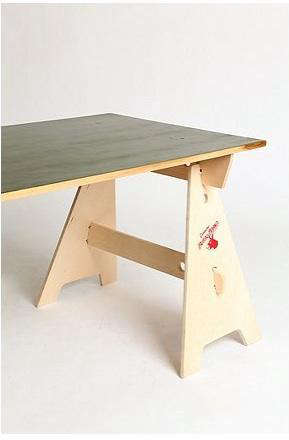
Some furniture arrives as a complete, carefully coordinated object. Other furniture looks at you and says, “Here are the legs. You figure out the rest.” Burro Brand Table Legs, once offered through Urban Outfitters, belonged proudly to the second category.
These lightweight birch plywood trestles turned an ordinary tabletop, slab, door, or sheet of plywood into a surprisingly handsome desk or dining table. The concept was almost suspiciously simple: place two Burro legs on the floor, add a suitable top, and suddenly your apartment had a table that looked intentional rather than improvised.
Remodelista documented the Urban Outfitters version in March 2010 as a 28-inch-high Burro saw trestle priced at $28 per leg. The product description identified birch plywood construction, American manufacturing, tool-free setup, and the need to purchase two supports for a complete table. Burro Brand itself remains associated with American-made sawhorses and traces its history to 1978 in Southern California.
Today, the original Urban Outfitters Burro listing is best treated as an archived design find rather than a current catalog staple. Urban Outfitters still sells an extensive range of tables and small-space furniture, but its present table assortment favors complete pieces made from wood, metal, MDF, veneers, and other materials.
What Were Burro Brand Table Legs?
Burro Brand Table Legs were essentially furniture-ready sawhorses. Instead of disguising their workshop heritage, they celebrated it. Their silhouette came directly from the kind of trestle a carpenter might use to support lumber, doors, or sheet goods while working.
That industrial origin was the whole charm.
A traditional dining table hides engineering beneath aprons, joints, brackets, and permanent legs. A sawhorse table puts its structure on display. You see exactly what is holding the surface up. There is something refreshingly honest about that, especially in an era when plenty of inexpensive furniture tries very hard to look more complicated than it is.
Original Burro Table Leg Specifications
According to archived product information preserved by Remodelista, the Urban Outfitters model included several notable features:
- Approximately 28 inches high
- Birch plywood construction
- Light natural-wood appearance
- Made in the United States
- Simple assembly without conventional tools
- Sold individually rather than as a pair
- Designed to accept a separate tabletop
The historical Urban Outfitters description also promoted an unusually high load capacity when two supports were used together. That figure should be understood as an archived manufacturer or retailer claim, not as a recommendation to recreate a small suspension bridge in your dining room. For furniture use, the tabletop, its attachment method, floor conditions, spacing, and lateral stability matter just as much as the theoretical vertical capacity of the trestles.
Why the Burro Table Concept Was So Appealing
1. It Made Custom Furniture Approachable
Custom furniture normally sounds expensive. The Burro approach flipped that idea around. Rather than commissioning a complete table, you could choose your own surface and let two inexpensive supports do the structural work.
A birch plywood sheet could create a Scandinavian-style worktable. A reclaimed wood top could move the same legs toward rustic industrial design. A smooth painted panel could become a colorful studio desk. Even a carefully finished hollow-core door could work as a lightweight surface in the right application.
The Spruce continues to feature plywood, reclaimed wood, premade legs, and other simple components in DIY furniture projects, while Apartment Therapy has highlighted sawhorse desks as an easy way to build unusually long work surfaces. The basic philosophy behind the Burro system clearly has staying power.
2. The Table Could Change With Your Life
Modularity is wonderful when your address seems to change more often than your streaming passwords.
A conventional dining table can be heavy, bulky, and thoroughly uninterested in fitting through narrow staircases. A trestle table can often be separated into a flat top and two independent supports. That makes storage and moving dramatically easier.
This same principle remains valuable for apartment dwellers and makers today. Apartment Therapy, for example, has covered folding work supports designed specifically around compact storage and removable work surfaces. Dwell has also featured architect-designed spaces where sawhorse legs and birch plywood were combined to create flexible dining and working surfaces.
3. It Looked Better Than the Price Suggested
There is a narrow line between “minimalist furniture” and “I have not finished moving in yet.” The Burro legs succeeded because their plywood construction and deliberate geometry helped them land on the furniture side of that line.
Pair them with a clean wood top, and the result could feel almost architectural. The repeating angles of the trestles added enough visual detail to make a plain rectangular surface interesting without turning the table into the decorative equivalent of someone shouting through a megaphone.
The Beauty of Birch Plywood
Birch plywood was particularly appropriate for this design. Plywood is created from layers of wood veneer arranged so adjacent grain directions alternate. That construction helps produce a stable sheet material while creating the recognizable striped edge that modern designers often leave exposed intentionally.
For inexpensive contemporary furniture, that exposed plywood edge can become decoration rather than something that needs to be hidden.
DIY furniture publications regularly rely on plywood because it offers a relatively flat, predictable surface and can be easier to work with than assembling a large top from individual solid-wood boards. Family Handyman notes the usefulness of plywood for creating stable work surfaces, while numerous DIY furniture projects use the material for desks, tables, cabinets, and benches.
Sawhorse Furniture: Workshop Engineering Meets Interior Design
The cleverness of the Burro table was not that somebody invented the sawhorse. People have been putting boards across trestles for approximately forever.
The clever part was recognizing that a practical workshop object could become attractive domestic furniture with almost no redesign.
The Home Depot describes sawhorses as common job-site supports for lumber and other materials, while This Old House emphasizes their usefulness as sturdy foundations for temporary work surfaces. Popular Mechanics has likewise demonstrated how two sawhorses and a sheet of plywood can instantly become a functional table or work platform.
In other words, the Burro table was not fighting the sawhorse’s identity. It was giving the sawhorse a nicer apartment.
How to Build a Table Around Burro-Style Legs
If you find vintage Burro Brand Table Legs or a comparable pair of furniture-grade trestles, the tabletop determines much of the finished table’s character.
For a Home Office Desk
A top approximately 48 to 72 inches long can work well depending on your available space. A deeper surface is useful if you use multiple monitors, drawing equipment, speakers, or enough coffee mugs to raise questions about your sleep schedule.
Birch plywood gives the desk visual continuity with plywood trestles. Hardwood butcher block adds weight and warmth. A laminated panel is practical when easy cleaning matters more than showing off wood grain.
For a Dining Table
Dining tables generally need more attention to lateral stability because people lean on them, bump them, drag chairs against them, and occasionally place an impressive Thanksgiving turkey near one edge.
Position the supports far enough apart to distribute weight but not so close to the ends that the tabletop develops excessive unsupported overhang. If the top is especially long or flexible, reinforcement underneath may be appropriate.
Professional and DIY woodworking guides consistently emphasize that table stability depends on leg geometry, bracing, square assemblies, sound joints, and suitable material dimensions. This Old House and Bob Vila both demonstrate how angled legs, crosspieces, gussets, and carefully squared assemblies improve sawhorse stability.
For a Temporary Studio or Craft Table
This may be the natural habitat of a trestle table. Artists, designers, architects, photographers, and serious crafters often need lots of horizontal space without wanting another permanent piece of furniture.
A removable top means the entire workspace can be disassembled when the project ends. That flexibility is one reason sawhorse-style work surfaces remain popular decades after the original Urban Outfitters listing appeared.
How to Keep the Tabletop From Sliding
Simply placing a smooth board on two smooth supports is convenient, but gravity is not a complete furniture-fastening system.
For a lightly used desk, high-friction pads between the top and supports may reduce movement. A more secure installation can use cleats attached to the underside of the tabletop so the supports nest between them. Depending on the trestle design, removable fasteners or brackets can provide even greater security.
Lowe’s customer guidance for creating temporary tables with sawhorses similarly notes that securing structural members to the tabletop helps prevent movement. The exact attachment method should always suit the specific supports and tabletop being used.
If children might climb on the table, if the surface will hold expensive equipment, or if the table will be pushed frequently, treat secure attachment as essential rather than optional.
Styling Burro Brand Table Legs
Minimalist
Pair natural plywood legs with a pale birch or maple top. Add a simple task lamp, neutral chair, and as little clutter as your personality will permit.
Industrial
Use a darker stained or reclaimed wood surface. Combine the table with black metal lighting, open shelving, or vintage workshop accessories.
Colorful Modern
Paint the tabletop while keeping the plywood legs natural, or reverse the formula. A saturated red, cobalt blue, deep green, or warm yellow can turn the simple structure into a statement piece without changing its geometry.
Eclectic Urban Outfitters Style
Urban Outfitters’ current furniture catalog still leans into eclectic apartment living, including natural wood, sculptural shapes, chrome, metal, rattan, upholstered pieces, and compact designs. That mix helps explain why something as utilitarian as Burro trestles once felt completely at home in the store.
What the Burro Legs Got Right About Small-Space Furniture
The Burro design anticipated several ideas that remain relevant in modern interiors.
First, furniture does not always need to be permanently assembled. Second, buyers increasingly appreciate pieces that can change functions. A generous trestle table might serve as a weekday workstation, a weekend dining table, and a temporary project bench the next month.
Third, inexpensive materials do not automatically produce cheap-looking furniture. Good proportions and visible construction can make plywood feel intentional.
Finally, furniture for smaller homes benefits from being easy to move. Current design coverage frequently emphasizes flexible and multifunctional pieces for compact spaces, and Urban Outfitters itself continues to market furniture toward apartments and small-space living.
Potential Drawbacks
For all their charm, sawhorse tables are not perfect.
You Need to Choose the Top Yourself
That is wonderful for DIY-minded buyers and mildly annoying for anyone who just wants a table to appear after clicking “Add to Cart.”
Leg Placement Matters
Set trestles too far inward and you create large cantilevered ends. Set them too far outward and seated users may have less convenient legroom near the ends.
Not Every Sawhorse Is Furniture
A job-site sawhorse may be strong but rough, oversized, or equipped with surfaces that can scratch a tabletop. Furniture applications require attention to finish quality, dimensions, and stability.
Loose Tops Can Move
If the surface is not fastened or restrained, sideways force can cause shifting. A stable structure under vertical load is not automatically stable against lateral movement.
That distinction appears throughout practical woodworking guidance: good furniture and workbench construction depend on level components, sound connections, consistent dimensions, and properly braced legs.
Burro Brand Today
Although the specific Urban Outfitters furniture collaboration belongs to an earlier retail era, Burro Brand itself is not merely a name preserved in a design blog archive. The company currently presents itself as an American manufacturer specializing in sawhorses and states that founder Jim Frey began producing them in the 1970s, with the business established around Southern California lumber yards by 1978.
That background makes the Urban Outfitters product more interesting. This was not simply a fashion retailer manufacturing a sawhorse-shaped desk leg for decoration. The appeal came from taking a genuine utilitarian object and moving it into the home.
Why This 2010 Furniture Idea Still Feels Current
Furniture trends change rapidly. One decade loves glossy lacquer. Another rediscovers rattan. Then suddenly everyone owns something with rounded edges and fluted doors.
Simple trestle furniture survives because it is less of a trend than a construction strategy.
The underlying ingredients remain useful: two stable supports, one appropriately sized surface, and the freedom to customize. Dwell has featured sophisticated interiors using precisely that formula, while Better Homes & Gardens and Architectural Digest continue to show how distinctive structural and furniture details can become part of a room’s visual identity.
The Burro Brand Table Legs therefore belong to an appealing category of design: objects that solve a practical problem without pretending they are something else.
Experience: Living With a Burro-Style Trestle Table
The most interesting thing about using a trestle table is how quickly you stop thinking of it as “DIY furniture.” Once the proportions are right, it simply becomes the table.
Imagine setting up a work-from-home desk in a small apartment. You place two lightweight trestles roughly four feet apart and test them on the floor. One rocks slightly because an old apartment floor has apparently spent the last century developing opinions about level surfaces. A small furniture pad fixes the problem.
Then comes the top: a finished sheet of birch plywood with softly sanded edges. You lower it onto the supports and immediately understand the appeal. There are no complicated rails underneath, no giant drawer pedestal stealing knee space, and no forty-step instruction booklet containing one mysterious leftover screw.
The open base makes the desk feel visually lighter than a conventional cabinet desk. A rolling file cabinet can slide beneath one side. A wastebasket fits under the other. Cables can be clipped neatly to the underside of the top instead of disappearing into a wooden maze.
The First Lesson: Positioning Changes Everything
At first, it is tempting to place the trestles directly under the ends of the tabletop. That looks logical but can make the furniture feel oddly stretched. Moving each support inward often improves the proportions while leaving a modest overhang.
The exact spacing depends on the tabletop’s stiffness and length. A thick hardwood top behaves differently from a thin sheet of plywood. The goal is to find the point where the surface feels supported without placing the legs where knees and chairs need to go.
The Second Lesson: Secure the Top
A freestanding top may behave perfectly while you are typing. Then somebody leans against an edge to reach a charger and the tabletop reminds everyone that friction has limits.
Adding unobtrusive underside cleats makes a dramatic difference. They can prevent the top from sliding sideways while preserving the ability to lift the surface off when moving. For a permanent installation, more substantial fastening may be appropriate.
The Third Lesson: Plywood Can Look Surprisingly Good
There is a moment during sanding when ordinary sheet material begins to look like actual furniture. Round the sharp edges slightly, finish the surface evenly, and suddenly the plywood layers become a decorative stripe.
A clear finish keeps the pale Scandinavian character. A warmer finish gives the piece more contrast. Painting only the top produces a sharper contemporary effect.
The table can also evolve. A 48-inch desktop might later be replaced by a 72-inch top when you move into a larger room. The trestles remain useful. Few conventional desks offer that kind of upgrade without requiring the ceremonial disposal of the entire desk.
The Fourth Lesson: The Table Encourages Reuse
Because the support and surface are separate, replacing one component does not necessarily mean replacing everything. A damaged top can be refinished or swapped. The legs can support another project. The original surface can become shelving, a workbench top, or something else entirely.
That modularity is not glamorous in the way a marble pedestal table is glamorous. It is better: useful.
The Fifth Lesson: Simple Furniture Exposes Bad Measurements
Minimalist construction has nowhere to hide mistakes. If one trestle is slightly lower, you notice. If the tabletop is warped, you notice. If the supports are not parallel, you definitely notice.
The cure is wonderfully boring: measure carefully, test everything before fastening it, check the floor, verify the tabletop is flat, and step back to inspect the proportions.
Professionals building sawhorses and worktables use the same basic discipline. Popular Mechanics stresses matched dimensions when constructing paired supports, while Home Depot and Bob Vila instructions repeatedly emphasize accurate measurement, square assemblies, and stable leg geometry.
Would I Choose This Style Again?
For a home office, creative studio, temporary dining area, or apartment where furniture needs to move easily, absolutely. A trestle table delivers an unusual combination of low visual weight, generous surface area, customization, and straightforward construction.
For a formal dining room where the table is expected to become a multigenerational heirloom, a fully joined hardwood table may make more sense. But that comparison somewhat misses the point. Burro Brand Table Legs were appealing precisely because they rejected the idea that every table needed to be a permanent monument.
Sometimes you just need two clever supports and a beautiful board.
Conclusion
Furniture: Burro Brand Table Legs at Urban Outfitters is an excellent snapshot of early-2010s accessible design, but the concept has aged remarkably well. The original 28-inch birch plywood trestles transformed the humble sawhorse into modular furniture that could support a desk, dining surface, or creative workspace without unnecessary complexity.
The original Urban Outfitters listing may now be history, yet the idea behind it remains extremely relevant. Small homes need flexible furniture. Renters need pieces that move easily. DIY enthusiasts want customization without building an entire table from raw lumber. Designers continue to appreciate honest materials and visible structure.
That is the real legacy of the Burro table legs. They proved that good furniture does not always require more parts. Occasionally, the smartest design decision is knowing exactly what can be left out.
Note: The $28 price, 28-inch height, Urban Outfitters availability, and related specifications discussed above refer to archived product information from around 2010 and should not be interpreted as current retail availability or pricing. Research for this article synthesized information from Remodelista, Urban Outfitters, Burro Brand, The Spruce, Apartment Therapy, Dwell, This Old House, Bob Vila, Popular Mechanics, The Home Depot, Lowe’s, HGTV, Better Homes & Gardens, Architectural Digest, and Family Handyman.