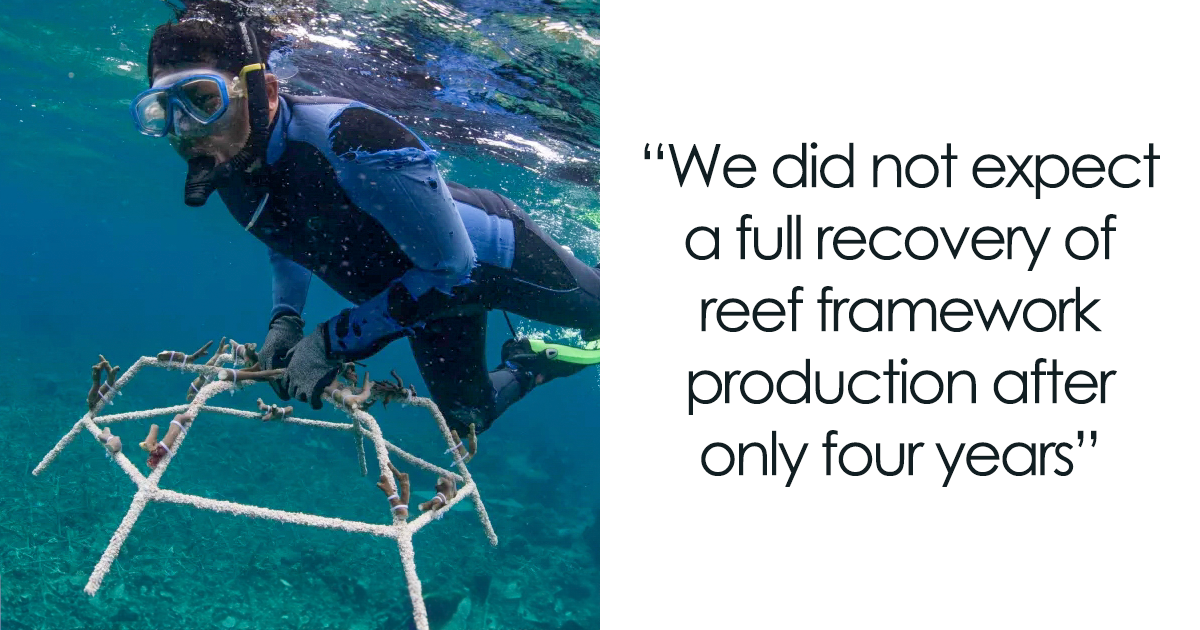
A coral reef that looks dead is not always finished. Sometimes, it is less like a graveyard and more like a very dramatic garden waiting for someone to stop stepping on the seedlings. A recent study has delivered one of the rare pieces of environmental news that does not require a box of tissues: a badly damaged coral reef can regain key signs of healthy growth in only four years when restoration is done carefully, at scale, and with local support.
The study, published in Current Biology, examined restored reefs in South Sulawesi, Indonesia, where blast fishing had turned living reef into unstable fields of broken coral rubble. For decades, the area had not bounced back naturally. Young corals could not settle because the loose rubble shifted around like a bad office chair. Then came a restoration system using “Reef Stars,” sand-coated steel frames that hold coral fragments in place and stabilize the seafloor. Four years later, researchers found that restored sites were growing reef framework at rates comparable to nearby healthy reefs.
That does not mean every damaged reef on Earth can be magically revived with a metal star and optimism. Coral reefs still face serious threats from ocean warming, bleaching, pollution, overfishing, and coastal development. But the finding does show something powerful: when the right reef, the right method, and the right community come together, recovery can move faster than many scientists expected.
What Did the Study Actually Find?
The phrase “full recovery” can sound like the reef simply pressed a reset button and returned to its original condition. Nature, being nature, is rarely that tidy. What the researchers found was more specific and more scientifically meaningful: the restored reefs recovered a key ecosystem function called reef framework production.
In simple terms, healthy corals build reefs by producing calcium carbonate skeletons. At the same time, fish, urchins, storms, and natural erosion break down parts of the structure. Scientists measure the balance between building and erosion through something called a carbonate budget. A positive carbonate budget means the reef is growing. A negative one means it is shrinking, which is bad news for fish, coastlines, and anyone who enjoys beaches not being eaten by waves.
At the Indonesian restoration sites, coral cover increased rapidly, the reef surface became more complex, and carbonate production rose to levels similar to healthy control reefs within four years. The researchers reported that coral cover rose from about 17 percent to about 56 percent, while net carbonate budgets tripled and became statistically similar to nearby healthy reefs. In plain English: the reef was not just looking prettier for the underwater photo album. It was functioning again.
Why This Coral Reef Had Become “Lifeless”
The reef in South Sulawesi was damaged heavily by blast fishing, a destructive practice that uses explosives to kill or stun fish. It may produce a quick catch, but it shatters coral structures that took decades or centuries to build. Imagine remodeling a cathedral with dynamite, then wondering why the stained glass has trust issues.
Once the reef breaks into rubble, the problem becomes self-reinforcing. Coral larvae need stable surfaces to attach and grow. Loose rubble rolls and shifts with waves, crushing young corals before they have a chance. Even if nearby reefs release plenty of larvae, the damaged area may remain stuck in a low-recovery state for decades.
This is why passive protection alone may not always be enough. Stopping destructive fishing is essential, but if the seafloor remains unstable, baby corals still need a safe place to land. The restoration project gave the reef that missing foundation.
How Reef Stars Helped Bring the Reef Back
The Mars Assisted Reef Restoration System, often called MARRS, uses small hexagonal steel structures known as Reef Stars. These frames are coated in sand and linked together across damaged rubble beds. Coral fragments are attached to the frames, and the connected web helps hold the broken substrate in place.
The design is clever because it solves two problems at once. First, it stabilizes loose coral rubble. Second, it gives transplanted corals a raised, secure platform where they can grow outward and downward. Over time, the corals expand, the metal frames become hidden inside the reef structure, and new corals can naturally settle in the area.
Another important detail is that the system involves local communities. Reef restoration is not just a science project with scuba gear. It is also a social project. Local residents help make, deploy, and monitor Reef Stars, which creates skills, jobs, and a stronger reason to protect the restored area. A reef that feeds families, protects islands, and supports tourism is not an abstract ecosystem. It is neighborhood infrastructure with clownfish.
Why Four Years Is Such a Big Deal
Coral reefs are often described as slow-growing ecosystems, and many are. Massive corals can take a long time to build large structures. Recovery after severe damage is often measured in decades, not years. That is why the four-year timeline surprised researchers.
The key is that the restoration project used fast-growing branching corals. These species can rapidly increase coral cover and build habitat complexity. Branching corals create the nooks, crannies, and tiny underwater apartment complexes that fish and invertebrates love. When these corals grow well, the reef can quickly regain three-dimensional structure.
However, speed comes with a trade-off. Branching corals are often more vulnerable to heat stress and bleaching than some slower-growing massive corals. So while the restored reef showed impressive functional recovery, scientists also caution that long-term resilience depends on coral diversity, natural recruitment, and future exposure to marine heatwaves.
What Coral Recovery Means for Marine Life
A coral reef is not just a pretty underwater rock garden. It is a city. Corals are the buildings, algae are the landscaping crew, fish are residents and commuters, crabs are the suspicious neighbors, and every crevice has someone trying to make a living.
Healthy coral reefs support about a quarter of marine species despite covering less than one percent of the ocean floor. That is an astonishing return on real estate. When reefs collapse, fish lose shelter, breeding areas decline, coastal food systems weaken, and biodiversity drops. When reef structure returns, marine life can return with it.
Restored reef framework also matters for coastal protection. Coral reefs act like natural breakwaters, reducing wave energy before it reaches shore. In island communities, this protection can help limit erosion and storm damage. A growing reef is not just an ecological win; it is also a living seawall that does not require concrete, gray paint, or a municipal committee meeting.
The Hopeful Part: Restoration Can Work
One reason this study caught global attention is that coral news is usually served with a side of dread. Mass bleaching events have become more frequent and more severe as ocean temperatures rise. Pollution, sediment runoff, disease, and overfishing add extra pressure. Many reefs are fighting a war on several fronts at once.
That is why the Indonesian recovery story matters. It does not cancel the bad news, but it gives conservationists a practical example of what successful intervention can look like. The study shows that active coral restoration can bring back important ecosystem functions in a relatively short period when environmental conditions are still suitable for coral growth.
The phrase “environmental conditions” is doing a lot of work here. Restoration is most likely to succeed where the main local damage has been removed or reduced. If a reef is still being blasted, polluted, overheated, or smothered with sediment, planting coral fragments is like installing new carpet during a house fire. It may look hopeful for five minutes, but the larger problem wins.
The Caution: Restoration Is Not a Climate Escape Hatch
Coral restoration should not be treated as permission to ignore climate change. Rising ocean temperatures remain the biggest long-term threat to reefs worldwide. When water gets too warm, corals can expel the microscopic algae living inside their tissues. This causes bleaching, turning corals pale or white. Bleached coral is not automatically dead, but it is stressed, hungry, and more likely to die if heat continues.
In other words, restoration is a tool, not a miracle wand. It can help repair local damage, rebuild habitat, and buy time. But it cannot fully protect reefs from repeated marine heatwaves unless global greenhouse gas emissions fall and local stressors are controlled.
The best future for coral reefs will probably combine several strategies: cutting emissions, improving water quality, protecting herbivorous fish, reducing destructive fishing, creating marine protected areas, restoring damaged reefs, and supporting scientific monitoring. It is not glamorous, but ecosystems rarely ask for glamour. They ask for stability, patience, and fewer humans behaving like toddlers with bulldozers.
Why Local Communities Are Essential
The South Sulawesi project also highlights a truth sometimes forgotten in big conservation headlines: reefs do not recover in isolation from people. Coastal communities depend on reefs for food, jobs, shoreline protection, and cultural identity. If restoration projects ignore local needs, they may look beautiful in grant reports but fail in real life.
Community involvement helps restoration become practical and durable. Local teams can build Reef Stars, attach coral fragments, install structures, monitor growth, and protect the site from renewed damage. This turns restoration from a one-time intervention into an ongoing relationship.
There is also a dignity issue. People living closest to reefs are often described only as threats or victims. In reality, they are frequently the most important partners in reef recovery. The Indonesian project shows how local knowledge, scientific research, and scalable design can work together. That combination is far more powerful than parachuting in with a clipboard and a heroic documentary soundtrack.
Can This Method Work Everywhere?
No single coral restoration method works everywhere. Reef Stars are especially useful for rubble fields where unstable substrate prevents coral settlement. Other reefs may need different strategies, such as coral gardening, larval propagation, artificial reef structures, improved fisheries management, wastewater control, or heat-tolerant coral research.
Site selection matters. Restoration teams must ask several hard questions before starting. Is the water quality good enough? Are damaging activities controlled? Are there nearby healthy reefs that can supply larvae? Will restored corals survive future heat stress? Are local communities involved? Is there funding for long-term monitoring?
The Indonesian study is inspiring because it is specific, not because it is universal. It says, “Under the right conditions, this can work surprisingly well.” That is much more useful than vague optimism. Good conservation is not built on fairy dust. It is built on evidence, maintenance, and occasionally a lot of zip ties.
What This Means for the Future of Coral Reef Restoration
The success of the South Sulawesi restoration effort could influence how scientists, governments, nonprofits, and coastal communities approach damaged reefs. It supports the idea that restoration should focus not only on coral cover but also on ecosystem function. A reef should not merely look alive; it should grow, shelter marine life, and protect coastlines.
Future restoration projects may also place more emphasis on measuring carbonate budgets, reef complexity, species diversity, and resilience after heat stress. Counting coral cover is useful, but it is only one piece of the puzzle. A restored reef dominated by one fast-growing coral type may recover quickly but still need time and management to become more diverse and resilient.
The study also strengthens the case for scaling restoration carefully. Small pilot projects can teach valuable lessons, but large-scale reef decline requires methods that can be repeated efficiently without sacrificing ecological quality. Reef Stars are promising partly because they can be made locally, installed by trained community teams, and deployed across meaningful areas.
Experience Section: What a Recovering Reef Teaches Us
Spending time around a damaged reef can change the way you think about environmental recovery. On land, destruction is easy to recognize. A burned forest, a clear-cut hillside, or a polluted river announces its suffering loudly. Underwater, the damage can be quieter. A broken reef may still sparkle in the sunlight. Small fish may still dart around. Blue water may still look inviting from a boat. But once you look closely, the silence becomes obvious.
A lifeless rubble field lacks the layered busyness of a healthy reef. There are fewer hiding places, fewer colors, fewer tiny movements in the cracks. Instead of coral branches reaching upward like underwater trees, there are fragments shifting with the surge. It feels unfinished, as though someone paused the ecosystem and forgot to press play again.
That is what makes coral restoration so emotionally powerful. The first signs of recovery are often modest. A coral fragment stays attached. A fish returns. Algae growth is controlled. A new coral recruit appears where there used to be only unstable rubble. To a casual observer, these changes may seem small. To restoration workers, they are fireworks.
By the second or third year, the reef can begin to feel different. Branching corals create height. Small fish gather in schools. Invertebrates move into the new structure. The reef starts producing that wonderful sense of organized chaos that healthy ecosystems have. Nothing is posing for the camera, yet everything seems to be exactly where it belongs.
The four-year recovery finding is exciting because it gives people a timeline they can imagine. “Decades” can feel distant and discouraging. “Four years” feels like a college degree, a child starting school, or a small business finding its footing. It is long enough to require commitment but short enough to prove that effort matters.
For coastal communities, the experience of reef recovery can be even more personal. A restored reef may mean more fish habitat, better shoreline protection, new tourism opportunities, and renewed pride in local waters. It can also change how young people see conservation. Instead of learning only that nature is disappearing, they can see that damaged places can heal when people stop the harm and help the process along.
There is a lesson here beyond coral reefs. Recovery is rarely instant, and it is rarely perfect. But ecosystems are not passive victims. Given stability, protection, and smart assistance, they often respond with surprising force. The South Sulawesi reef did not come back because someone wished hard enough. It came back because people studied the problem, stabilized the rubble, planted corals, monitored results, and stayed involved.
That is the kind of hope worth keeping. Not the fluffy kind that says everything will be fine, but the useful kind that grabs a tool, joins a team, and gets saltwater in its shoes.
Conclusion
The discovery that a severely damaged coral reef can recover key growth functions within four years is a bright signal in a difficult era for ocean conservation. The South Sulawesi study shows that active coral reef restoration, when matched to the right conditions and supported by local communities, can rebuild coral cover, restore reef complexity, and bring back essential ecosystem functions faster than many expected.
Still, the message is not “problem solved.” Coral reefs remain under intense pressure from climate change, marine heatwaves, pollution, and destructive human activity. Restoration can help reefs recover, but it must work alongside emission reductions, better coastal management, and long-term protection. The real lesson is both hopeful and practical: reefs are vulnerable, but they are not helpless. With science, community effort, and serious climate action, even a reef that looks lifeless may still have a comeback story waiting below the waves.
Note: This article is written as an original, SEO-friendly web article based on real coral reef restoration research, especially the 2024 findings on rapid reef framework recovery in South Sulawesi, Indonesia.