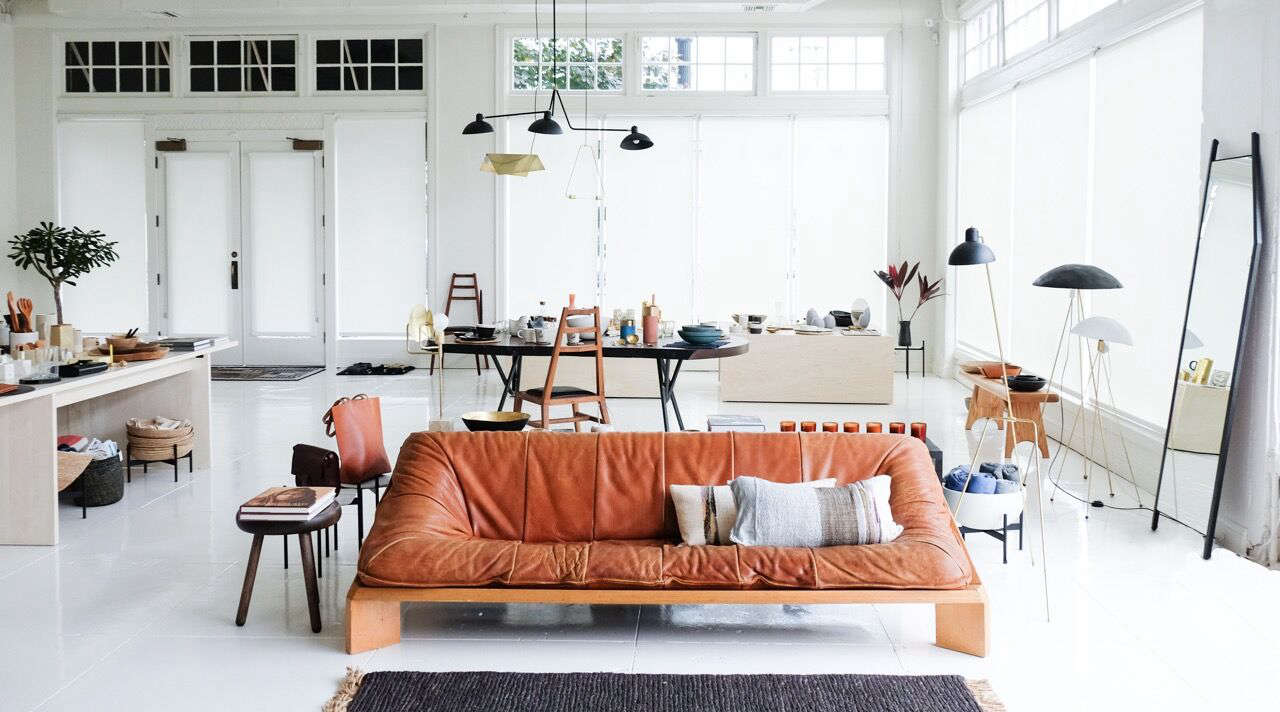
Some design stores opproach. Its Portland showroom gives furniture, lighting, ceramics, glass, and art enough breathing room to reveal why each piece deserves attention. The result feels less like a conventional home goods store and more like the beautifully composed apartment of a collector who has excellent taste and, apparently, never leaves unopened mail on the counter.
Spartan began in Austin, Texas, in 2008 as a small independent shop founded by Currie Person. After Person and her family relocated to Portland, Oregon, the brand opened a Pacific Northwest outpost in October 2016. The move introduced Spartan’s carefully edited approach to a city already known for independent makers, creative reuse, craft traditions, and a healthy suspicion of anything mass-produced.
Although the Portland location is no longer “new” in the literal sense, its arrival remains an instructive story about retail design, thoughtful expansion, and the value of creating a physical space that communicates a brand before anyone checks a price tag.
Spartan Shop Started Small in Austin
Before Spartan became a Portland design destination, it occupied a modest space in Austin. Person opened the original shop after working for years in film production and location scouting, including time in New York and Paris. Those cities helped shape her appreciation for intimate neighborhood stores filled with unusual, useful, and beautifully made objects.
When she returned to her hometown, the American retail landscape looked different from the one shoppers know today. Independent design was not instantly available through thousands of online boutiques, and social media had not yet turned every ceramic mug into a minor celebrity. Big-box stores dominated home furnishings, while smaller makers often struggled to reach customers beyond local craft markets.
Spartan offered an alternative. The Austin shop focused on handmade and independently designed goods for the home, choosing a limited number of objects rather than filling every shelf. Ceramics, textiles, small furnishings, personal accessories, and practical household items appeared together in quiet arrangements. The selection was modern without feeling sterile and artistic without becoming impractical.
A Curated Store Rather Than a Crowded One
The word “spartan” often suggests simplicity, restraint, and an absence of unnecessary decoration. The store embraced that spirit, but not in the sense of bare rooms and uncomfortable chairs. Its simplicity came from editing. Instead of offering twelve nearly identical bowls, Spartan might present one bowl whose proportions, glaze, and handmade character made the choice feel obvious.
That approach helped the Austin shop build a loyal following. Customers did not visit merely to buy household supplies. They came to discover designers, study materials, and see how seemingly unrelated objects could share a visual language. Spartan was selling products, certainly, but it was also selling confidence: the confidence that one well-chosen object could do more for a room than a shopping cart full of decorative filler.
Why Spartan Moved From Austin to Portland
The road from Austin to Portland began, appropriately enough, with a road trip. Person and her husband, Patrick Newell, became interested in Portland after visiting the city and eventually relocated there. Rather than immediately transplanting the business, they took time to understand the local community and search for a space that could support Spartan’s next phase.
That patience mattered. Portland already had a strong culture of independent retail, architecture, furniture making, ceramics, and small-scale production. A new design shop could not simply arrive, place a fiddle-leaf fig near the entrance, and declare itself local. Spartan needed to connect with the city’s creative ecosystem while maintaining the perspective that had made the Austin store distinctive.
For a period, the Austin storefront continued operating while Portland became the headquarters of Spartan’s growing online business. The Portland showroom eventually became the flagship, while the original Austin chapter gave way to an expanded focus on design consulting, sourcing, styling, and collaboration.
Two Creative Cities With Different Rhythms
Austin and Portland share several qualities that made the transition feel natural. Both cities value independent businesses, creative experimentation, good food, strong neighborhood identities, and people who can discuss chair construction with surprising intensity.
Yet their design personalities are not identical. Austin brings warmth, color, informality, and a lively mixture of modern and regional influences. Portland often leans toward natural materials, subdued palettes, craftsmanship, and objects that reveal how they were made. Spartan’s visual language can operate comfortably in both environments: restrained but not cold, elevated but not precious, and modern without becoming disposable.
Inside Spartan’s Portland Showroom
Spartan found its Portland home at 1210 SE Grand Avenue in the Central Eastside. The showroom occupies part of a historic 1923 building that has served several purposes over the decades, including use as a bottling facility. Its industrial background provides character without dictating the interior design.
The most immediate feature is the light. Two walls of tall windows wrap the corner space, helping the showroom remain luminous even during Portland’s famously gray months. Natural light moves across the glossy white floors, pale walls, sculptural furniture, textured ceramics, and reflective glass. Objects change throughout the day as shadows lengthen and surfaces become more pronounced.
Person collaborated with Ruth and Peter De Jong of De Jong & Co. on the store design and custom fixtures. The renovation was deliberately restrained. The team added a dividing wall, installed shades on the large windows, and used white paint to unify the floors and walls. This sounds simple until one remembers that selecting the “correct” white paint can make otherwise reasonable adults stare at tiny sample cards for three weeks.
A Showroom That Lets Objects Breathe
The spacious Portland location allowed Spartan to display larger furniture and lighting collections alongside its familiar ceramics and art objects. Rather than stacking products by category, the team arranged them in room-like compositions. A chair might sit beside an expressive floor lamp, a low table, a woven rug, and a handmade vessel. Together, they demonstrate scale, texture, and visual balance.
This presentation is especially valuable for furniture and lighting. Online photographs can show dimensions, but they rarely communicate presence. A sculptural chair may appear severe on a white product page yet feel inviting in a layered setting. A pendant light may look delicate until it hangs above a substantial dining table. Spartan’s showroom helps visitors understand how collectible design can function in real homes.
Furniture, Lighting, Ceramics, Glass, and Art
Spartan’s assortment has evolved considerably since the early Austin years. The Portland location now operates as both a gallery and a furniture and lighting showroom, representing independent artists, established studios, local makers, and international design brands.
Its collections have included work from De Jong & Co., Lambert & Fils, Workstead, De Sede, Grain, BZIPPY, Cody Hoyt, Coil + Drift, Danny Kaplan, and numerous ceramic, glass, textile, and furniture designers. The specific mix changes as exhibitions open, new work arrives, and collaborations develop.
That variety does not weaken the store’s identity because the selection is guided by a consistent point of view. Spartan tends to favor strong silhouettes, tactile materials, visible craftsmanship, and objects that reward a closer look. A piece may be minimal in shape but unusual in scale. Another may use an earthy material with an unexpected color or exaggerated texture.
Local and International Design in Conversation
One of the most interesting features of Spartan Shop Portland is the way local and international work shares the same floor. A Portland-made ceramic planter can appear near Canadian lighting, American studio furniture, European seating, and handmade glass. The arrangement avoids treating local craft as a separate, lower-priced category. Instead, everything is evaluated through the same lens of quality, originality, and lasting appeal.
This creates productive visual conversations. A rough, heavily glazed vessel may soften the geometry of a polished table. A vintage leather sofa can make a contemporary lamp feel less formal. An expressive artwork can prevent a neutral room from becoming so calm that it appears to be holding its breath.
More Than a Portland Home Goods Store
Spartan gradually expanded beyond traditional retail into consulting, sourcing, and interior styling. The team has worked with interior designers and helped develop spaces for homes, restaurants, hotels, and other commercial projects. Many represented brands also offer customization in dimensions, finishes, materials, or upholstery.
This service-oriented model makes sense for a store built on careful selection. Choosing a lamp for a residential hallway and specifying lighting for a restaurant require different levels of planning, but both depend on scale, atmosphere, durability, and context. Spartan’s experience combining objects in the showroom naturally translates into helping clients assemble complete environments.
The store also hosts exhibitions and artist presentations, reinforcing its role as a gallery. These events give visitors an opportunity to see deeper collections rather than isolated products. They also help artists place new work in front of collectors, designers, architects, and curious members of the public.
How the Pandemic Changed Spartan’s Direction
Like many independent retailers, Spartan faced a major disruption during the COVID-19 pandemic. The physical shop closed for an extended period, but the interruption encouraged another evolution. When the showroom reopened, it moved further away from the concept of an elevated general store and more decisively toward collectible art, furniture, lighting, and gallery programming.
The change illustrates a useful lesson for small retailers. A recognizable aesthetic is valuable, but a fixed business model can become a trap. Spartan preserved its curatorial identity while adjusting what it sold, how it served clients, and how the physical space functioned.
Why the Portland Location Works
Spartan’s Portland showroom succeeds because the building, neighborhood, product selection, and business model reinforce one another. The Central Eastside’s mix of warehouses, workshops, showrooms, restaurants, and creative businesses gives the store an appropriate setting. Visitors can imagine that the furniture and objects belong not only in pristine design photographs but also in converted industrial buildings, compact urban homes, restaurants, and modern offices.
The corner storefront also serves as a kind of physical advertisement. Large windows reveal portions of the showroom to pedestrians and passing traffic. At night, illuminated furniture and suspended lighting turn the interior into a three-dimensional display. The shop does not need flashing signs or giant discount banners. The room itself explains the brand.
Lessons for Independent Retailers
Spartan’s journey offers several practical lessons for other small businesses. First, a strong point of view can be more memorable than a huge inventory. Second, a physical store should provide something that e-commerce cannot: sensory experience, conversation, scale, material detail, and discovery.
Third, expansion works best when it responds to place. Spartan did not reproduce the Austin store piece by piece. It adapted to Portland’s architecture, climate, design community, and customer base. Finally, collaboration can turn a retail interior into a richer expression of the products being sold. By working with designers represented in the shop, Spartan made its fixtures and displays part of the story.
A Visitor’s Experience at Spartan Shop Portland
A visit to Spartan is likely to begin before the door opens. From the sidewalk, the tall windows offer a wide view into the showroom, where furniture appears in generous arrangements rather than retail rows. There is no visual shouting match between competing displays. The room looks composed, bright, and calm, which may cause visitors to stand outside for a moment and reconsider every object currently occupying their own living rooms.
Inside, the experience rewards slow movement. Large pieces establish the structure of the space, while smaller works invite closer inspection. A sofa may draw attention first, but the object that remains in memory could be a hand-thrown cup, a small bronze sculpture, or a lamp with an unexpectedly clever joint. Materials become more important at close range. Wood grain, glaze variation, woven fibers, hammered metal, and tiny irregularities reveal the difference between an ordinary product and an object shaped by a particular maker.
The showroom format also makes it easier to learn. Someone shopping for a dining table can study how different chairs affect its proportions. A visitor interested in lighting can compare warm pools of light, directional fixtures, and sculptural lamps without relying entirely on technical specifications. Even customers who are not ready to purchase a major piece can leave with a clearer understanding of scale, composition, and material compatibility.
What to Notice During a Visit
Begin with the overall arrangements rather than immediately inspecting price tags. Notice the distance between pieces and the use of empty space. Spartan’s displays demonstrate that rooms do not need to be filled to feel complete. In fact, fewer objects can create a stronger atmosphere when each one has a clear role.
Next, examine how contrasting materials are paired. A glossy ceramic object may sit on rough wood. Soft upholstery may balance a metal lamp. A boldly colored glass vessel may provide the only bright note in an otherwise neutral composition. These combinations offer practical decorating ideas that can be adapted at many budgets.
Visitors should also ask about the makers and customization possibilities. The showroom represents designers whose work may be available in multiple sizes, woods, finishes, fabrics, or configurations. A piece that initially seems unsuitable might become ideal with a different material or proportion. Conversations with the staff can reveal the production story, lead time, care requirements, and reasoning behind a design.
Turning Inspiration Into a Livable Home
The greatest risk of visiting an exceptionally curated store is returning home convinced that every possession must be replaced by Tuesday. Fortunately, Spartan’s approach suggests a more reasonable strategy. Start with observation. Identify what attracted you: Was it the sculptural lighting, the restrained palette, the handmade texture, or simply the absence of clutter?
Then make one deliberate change. Replace a weak focal point with a meaningful artwork. Upgrade a frequently used chair instead of buying several decorative accessories. Add a handmade vessel to a table that needs texture. Improve lighting before purchasing more furniture. The showroom’s real lesson is not that every home needs expensive collectible design. It is that every object should earn its space.
For design enthusiasts visiting Portland, Spartan can also fit into a broader Central Eastside itinerary. The neighborhood supports showrooms, vintage sources, maker spaces, restaurants, and architecture-related businesses. Exploring several destinations in one trip provides a useful comparison between contemporary design, reclaimed materials, local production, and historic industrial character.
Ultimately, the visitor experience is less about completing a shopping list than refining one’s eye. Spartan Shop Portland demonstrates how retail can become a form of visual education. You may enter looking for a lamp and leave thinking about proportion, craftsmanship, and why your bookshelf contains seven objects that appear to be actively avoiding one another.
From Austin Roots to a Portland Design Destination
Spartan’s move from Austin to Portland was not simply a change of address. It marked the transformation of a small home goods shop into a broader platform for furniture, lighting, art, exhibitions, consulting, and collaboration.
The Portland showroom preserves the qualities that defined the original business: independent design, disciplined curation, useful beauty, and respect for makers. At the same time, its greater scale and gallery-like setting allow Spartan to present more ambitious work and serve clients with more complex needs.
In an era when almost any product can be ordered from a phone, Spartan offers a persuasive argument for visiting a physical store. Materials need to be touched. Chairs need to be sat in. Light needs to be seen in a room. Art needs enough space to surprise you. The Portland shop provides all of that, along with the dangerous realization that the perfect coffee table may have been waiting in Oregon the entire time.