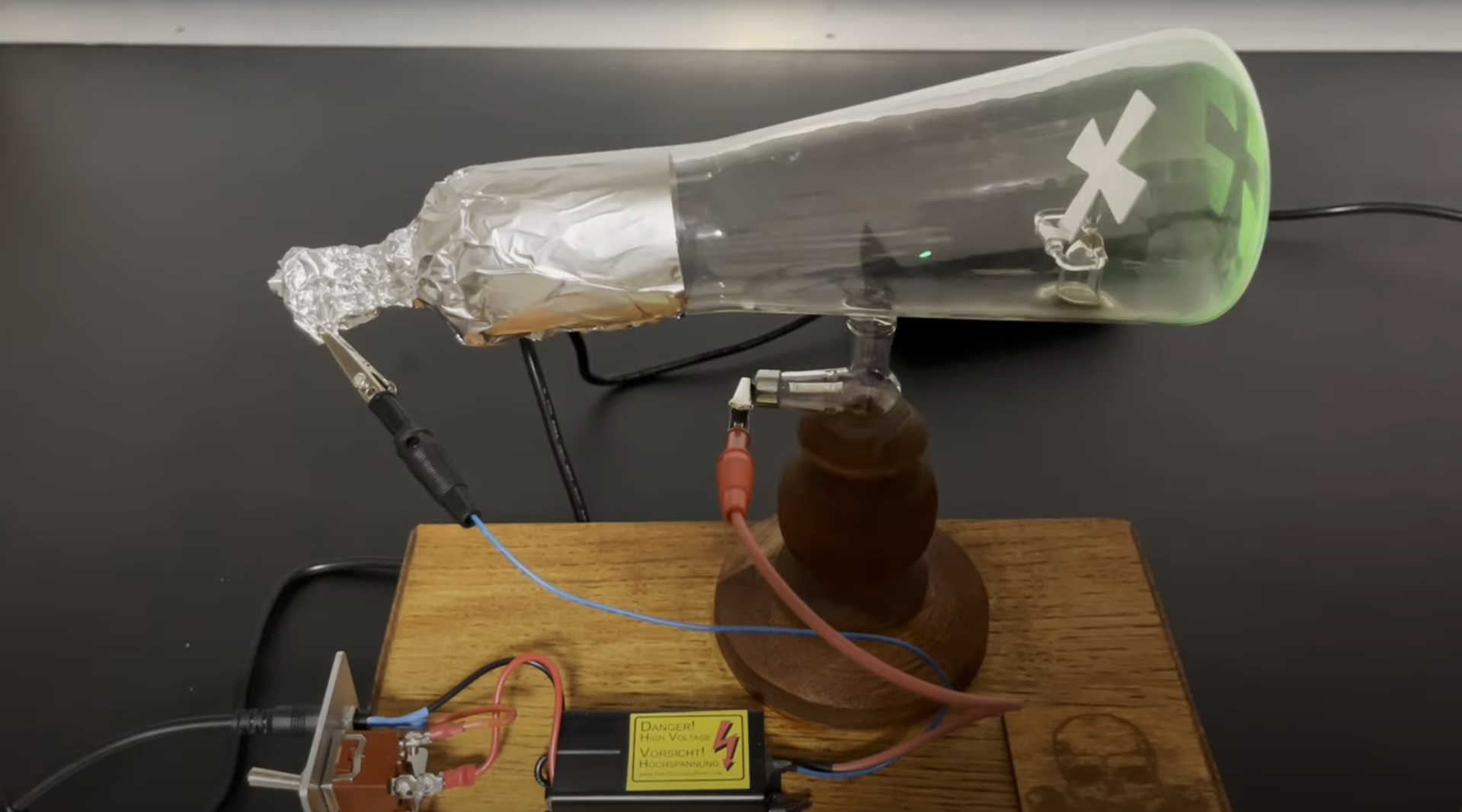
Some science projects whisper. Others glow mysteriously in the dark like they just escaped from a Victorian laboratory and are now looking for a dramatic soundtrack. A Crookes tube belongs firmly in the second group. It is glass, vacuum, voltage, electrons, history, and a tiny dash of mad-scientist theater all rolled into one beautiful piece of apparatus.
The title “Foil Leyden Jar Helps Bring Crookes Tube To Life” sounds almost like a hardware fairy tale: the old vacuum tube refused to shine, a sheet of aluminum foil entered the story, and suddenly the invisible world of cathode rays became visible again. But the trick is not magic. It is capacitance, electrostatics, charge storage, and the same basic physics that helped early experimenters move from party-trick sparks to the discovery of the electron.
At the center of the story is a Crookes tube, a high-voltage discharge tube with partially evacuated glass and internal electrodes. When the conditions are right, electrons stream from the cathode and interact with the glass or phosphor coating, producing a visible glow. When the conditions are not right, however, the tube may sit there doing absolutely nothing, like a cat ignoring an expensive toy. In one modern build, wrapping the cathode end in aluminum foil created an effective Leyden jar, adding the capacitance needed to help the tube operate properly.
What Is a Crookes Tube?
A Crookes tube is an early type of vacuum discharge tube used to study cathode rays. It was named after Sir William Crookes, one of the 19th-century scientists who investigated how electricity behaves in low-pressure gases. These tubes usually contain two electrodes sealed inside glass. When high voltage is applied between the cathode and anode, electrons are accelerated through the partial vacuum.
In a classic Crookes tube demonstration, the electron stream travels in straight lines. If an object such as a Maltese cross is placed in the path of the beam, it casts a shadow on the glowing glass. That simple shadow is historically important because it showed that cathode rays behaved like directional streams rather than a vague electrical mist. Today we understand cathode rays as streams of electrons, but in the 1800s, that conclusion was still waiting backstage.
Why the Glow Matters
The glow of a Crookes tube is not just a pretty effect. It is visual evidence of electrons interacting with matter. Depending on the tube design, the glow may come from fluorescence in the glass, a phosphor screen, or the ionization of residual gas inside the tube. Dim the room lights, raise the voltage carefully, and the invisible suddenly becomes visible.
That is why Crookes tubes remain popular in physics demonstrations. They connect abstract textbook ideas to something the eye can follow. Electric fields, magnetic fields, electron beams, vacuum pressure, fluorescence, and charge-to-mass ratio stop being lonely vocabulary terms and start behaving like characters in a tiny glass stage play.
The Leyden Jar: The Original Capacitor With Main Character Energy
Before modern capacitors became tiny components hiding on circuit boards, the Leyden jar stored electrical charge in a gloriously dramatic form. A traditional Leyden jar uses two conductors separated by an insulator. In many classic versions, metal foil coats the inside and outside of a glass jar. The glass acts as the dielectric, and the metal coatings hold opposite charges.
Early experimenters first believed that water inside the jar stored the electricity. Later work showed that the key ingredients were not water and mystery, but conductor, insulator, and charge separation. Benjamin Franklin and other electrical pioneers helped clarify how metal coatings on both sides of glass made the jar more powerful. In modern language, the Leyden jar is a capacitor: it stores energy in an electric field.
How Aluminum Foil Turns Glass Into a Capacitor
When aluminum foil is wrapped around part of a glass tube, it can form one plate of a capacitor. The glass wall becomes the dielectric. The electrode or conductive structure inside the tube can behave like the opposite plate. Put those pieces together, and the setup begins to resemble a Leyden jar, even if it does not look like the old-school jar from a museum display.
That is exactly why the foil trick is so clever. It does not add a modern circuit board, a hidden microcontroller, or some suspicious black-box gadget. It uses the same physics that has been around since the 18th century. The foil increases capacitance near the cathode end and gives the high-voltage system a better way to store and release charge during operation.
Why a Crookes Tube May Refuse to Work
A Crookes tube can be fussy. It needs high voltage, suitable gas pressure, proper electrode connections, and enough electrical behavior in the surrounding circuit to initiate and sustain the discharge. If any of those conditions are slightly off, the tube may produce weak results or no visible glow at all.
In the project that inspired this article, the tube was connected to a high-voltage generator and switch, but nothing happened. The likely problem was not that the tube had suddenly developed stage fright. Instead, the system lacked the right capacitance behavior. Adding foil around the cathode end created a Leyden-jar-like structure and helped the discharge begin.
Capacitance as the Missing Ingredient
Capacitance is the ability to store electric charge for a given voltage. In high-voltage electrostatic systems, capacitance can influence how charge builds, how fields form, and how discharges start. A tiny change in geometry can produce a noticeable change in behavior because electric fields are extremely sensitive to shape, spacing, insulation, and nearby conductors.
Wrapping foil around the cathode region changed the local electric environment. It gave the system an external conductive surface separated from internal conductive elements by glass. That arrangement supports charge separation and helps establish stronger electric-field conditions near the tube. In plain English: the foil gave the electrons a better reason to get moving.
The Beautiful Link Between Old and New Science
What makes this project so satisfying is that it bridges centuries of experimentation. The Leyden jar belongs to the age of Franklin, electrostatic machines, sparks, and public demonstrations where “science show” sometimes meant “everyone hold hands and try not to yelp.” The Crookes tube belongs to the age of vacuum physics, cathode rays, and the path toward discovering the electron.
Put them together, and the result is a compact lesson in how scientific tools evolve. The Leyden jar taught people that electricity could be stored. The Crookes tube showed that electricity moving through a partial vacuum could reveal something deeper about matter itself. The foil-wrapped tube reminds us that old ideas are not obsolete simply because they are old. Sometimes they are exactly the missing puzzle piece.
From Cathode Rays to the Electron
Crookes tubes helped prepare the way for one of the most important discoveries in physics: the electron. In 1897, J. J. Thomson used cathode-ray experiments to show that cathode rays were made of negatively charged particles much smaller than atoms. That finding changed atomic theory and helped open the door to modern electronics.
It is easy to forget how enormous that discovery was. Today, we talk about electrons casually. They power devices, create images on screens, move through wires, and explain chemical bonds. But before cathode-ray experiments, the atom was often treated as indivisible. Crookes tubes and related discharge experiments cracked that idea open.
The Maltese Cross Demonstration
One of the most famous Crookes tube designs uses a small Maltese cross inside the tube. When the cross is placed upright between the cathode and the glass face, it blocks the cathode rays and creates a shadow. This demonstrates that the rays travel in straight lines from the cathode.
That visual simplicity is part of the charm. You do not need a PhD to appreciate a glowing screen with a crisp shadow. The demonstration says, “Something invisible is traveling through here,” and it says it clearly. The same kind of direct visual evidence makes the foil Leyden jar modification so satisfying: add foil, change the capacitance, and the tube comes alive.
How the Foil Leyden Jar Helps the Tube Work
In a high-voltage Crookes tube setup, the cathode region is critical. The electric field near the cathode helps initiate electron emission and supports the movement of charged particles through the tube. If the circuit cannot build the right field conditions, the tube may remain dark.
The foil wrapping acts like an external capacitor plate. The glass wall separates that foil from the internal conductive region, just as glass separates the inside and outside coatings of a Leyden jar. Because charge can accumulate on the foil and induce opposite charge nearby, the electric field around the cathode changes. That field adjustment can help the discharge start and become visible.
Think of it as giving the high-voltage system a small electrical reservoir. The foil does not “power” the tube in the ordinary battery sense. Instead, it shapes how charge is stored and distributed. In electrostatics, shape is destiny. A strip of foil in the right place can matter more than a box full of expensive parts in the wrong place.
Safety: High Voltage Is Not a Toy
Any discussion of Leyden jars and Crookes tubes needs a serious safety note. High voltage can shock, burn, damage equipment, or create unexpected hazards. Even small capacitors can store uncomfortable or dangerous energy when charged to high voltage. Some vacuum tubes can also produce X-rays under certain conditions, especially when high voltages accelerate electrons into glass or metal targets.
For that reason, Crookes tube demonstrations should be handled by trained people using appropriate power supplies, insulation, current limiting, grounding, shielding, and discharge procedures. The fun part is watching the tube glow. The not-fun part is learning electrical safety by becoming the discharge path. Nobody needs that kind of hands-on education.
Why This Project Captures the Imagination
The foil Leyden jar Crookes tube project has a special appeal because it is practical, historical, and visually striking. It also shows a kind of troubleshooting that good experimenters love: observe the failure, understand the physics, change the geometry, and test again.
The solution is wonderfully low-tech. Aluminum foil is not glamorous. It does not come with a touchscreen. It does not ask for a firmware update. Yet when placed correctly, it transforms the behavior of the system. That is the beauty of physics-based making: the simplest material can become powerful when the principle is right.
Specific Example: The Foil-Wrapped Cathode End
Imagine a glass Crookes tube mounted on a wooden stand, with brass details giving it a polished antique look. The high-voltage generator is connected. A switch is added. Expectations are high. The operator turns it on and waits for that eerie glow. Nothing happens.
Now the troubleshooting begins. The tube is not necessarily broken. The power supply may be working. The missing factor may be the electrical environment around the cathode. Wrapping aluminum foil around the cathode end changes the capacitance and effectively creates a Leyden jar using the tube glass as the dielectric. When the system is powered again, the tube finally glows. That moment is half science, half “Aha!” and possibly half “Why didn’t I try that sooner?” Yes, that is three halves, but high-voltage enthusiasm does strange things to arithmetic.
Lessons for Makers, Teachers, and Curious Readers
This project offers several useful lessons. First, historical devices still have modern teaching power. A Crookes tube is not just a relic; it is a visible gateway into electron behavior. Second, capacitance is not limited to components labeled “capacitor.” Any two conductive surfaces separated by an insulator can create capacitance. Third, physical layout matters. In high-voltage work, where conductors are placed can be just as important as what components are used.
For teachers, the project is a reminder that students often understand electricity better when they can see an effect. A glowing tube, a moving beam, a magnetic deflection, or a shadow inside glass can turn a difficult topic into a memorable one. For makers, it is a reminder that elegant solutions often come from understanding the principle rather than buying more parts.
Experience Notes: Working With the Idea Behind a Foil Leyden Jar and Crookes Tube
Experiences related to “Foil Leyden Jar Helps Bring Crookes Tube To Life” usually begin with curiosity and quickly become a lesson in patience. The first thing one notices about vintage-style electrostatic projects is that they do not behave like ordinary low-voltage electronics. With a battery-powered LED circuit, if the wiring is correct and the battery is fresh, the LED lights. With a Crookes tube or Leyden jar arrangement, the invisible details matter more. Humidity, dust, surface leakage, electrode spacing, glass thickness, grounding, and the placement of nearby conductors can all change the result.
That is part of the charm. A foil Leyden jar modification feels almost too simple when described on paper, but in practice it teaches a deep lesson: the circuit is not only the wires. The surrounding space is part of the system. The glass is part of the system. The foil is part of the system. Even the bench surface and the operator’s hand can influence electrostatic behavior. Working with this kind of apparatus trains the mind to see electricity as a field phenomenon, not merely as something that travels inside copper wire.
Another experience is the emotional rhythm of troubleshooting. At first, the silent Crookes tube can be disappointing. You expect a ghostly glow and get a dark piece of glass. Then you begin asking questions. Is the voltage high enough? Is the polarity correct? Is there a poor contact? Is the tube pressure suitable? Is charge leaking away? When the foil is added and the tube finally responds, the payoff is memorable because the solution is visible. The glow becomes proof that the diagnosis was right.
The project also encourages respect for old scientific instruments. A Crookes tube is not merely decorative glassware. It represents a period when scientists were learning that atoms had internal structure and that electricity could reveal hidden particles. The Leyden jar, meanwhile, represents an earlier stage of discovery, when storing charge was itself a breakthrough. Combining the two makes the experiment feel like a conversation between centuries.
For readers, the most useful takeaway is not “wrap everything in foil and hope for the best.” The real lesson is to think like an experimentalist. Ask what the system needs. Identify where charge is stored. Consider how electric fields are shaped. Look for the missing condition, not just the missing component. The foil succeeds because it changes capacitance in the right location. That is a far better lesson than any plug-and-play instruction.
Finally, the project reminds us why hands-on physics remains powerful. A glowing Crookes tube does what a diagram cannot fully do: it makes the invisible dramatic. It turns electrons into a show. It gives capacitance a personality. And it proves that sometimes the humble sheet of aluminum foil in the kitchen drawer is only one clever idea away from helping a 19th-century vacuum tube steal the spotlight.
Conclusion
The story of a foil Leyden jar bringing a Crookes tube to life is more than a clever maker trick. It is a compact tour through the history of electricity, from early charge storage to cathode rays and the discovery of the electron. By wrapping foil around the cathode end of the tube, the builder created a capacitor-like structure that changed the local electric field and helped the tube operate. Simple material, serious physics, beautiful result.
For anyone interested in electrostatics, vintage scientific apparatus, or educational demonstrations, this project is a reminder that the best experiments often combine curiosity with careful observation. A Crookes tube glows because electrons move. A Leyden jar works because charge can be stored across an insulator. Put those ideas together, and the past lights upliterally.