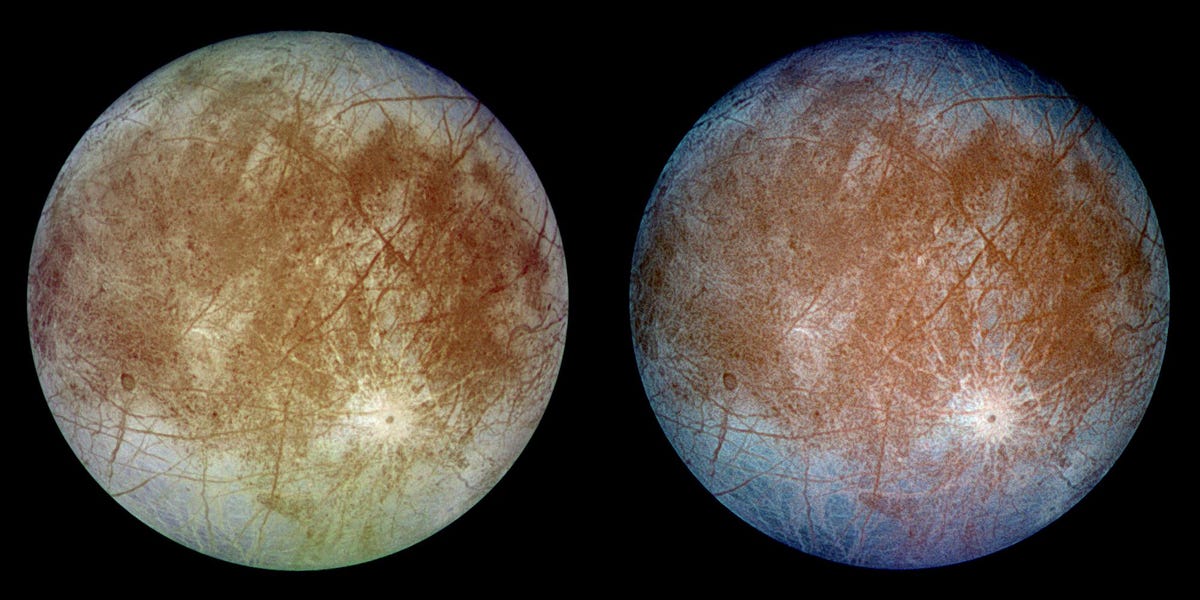
Europa looks like a frozen marble that someone dropped, cracked, and hastily glued back together. Beneath that bright, scarred crust, however, may lie one of the most compelling environments in the solar system: a vast saltwater ocean wrapped around a rocky world. That possibility has turned Jupiter’s icy moon into a leading target in the search for habitable places beyond Earth.
The excitement is not based on one dramatic photograph or a suspiciously enthusiastic science-fiction writer. It comes from decades of spacecraft images, magnetic measurements, geological mapping, laboratory research, and telescope observations. Europa may possess liquid water, useful chemistry, and long-lasting energythe three major ingredients scientists consider when evaluating whether an environment could support life. That is not proof of Europan microbes, fish, or highly organized squid governments. It is a scientifically grounded reason to investigate.
What Is Europa?
Europa is one of the four large moons of Jupiter discovered by Galileo Galilei in 1610. Along with Io, Ganymede, and Callisto, it belongs to the group known as the Galilean moons. Europa is about 1,940 miles, or 3,100 kilometers, acrossroughly 90% the diameter of Earth’s Moon. Its surface is mostly water ice, making it unusually bright and reflective.
Europa Moon Fast Facts
- Parent planet: Jupiter
- Diameter: About 1,940 miles (3,100 kilometers)
- Orbital period: Approximately 3.5 Earth days
- Surface: Water ice crossed by ridges, fractures, bands, and chaotic terrain
- Interior: Likely an iron core, rocky mantle, global saltwater ocean, and thick ice shell
- Best-known mystery: Whether its ocean has conditions suitable for life
- Major active mission: NASA’s Europa Clipper, launched October 14, 2024
Europa is tidally locked to Jupiter, meaning the same hemisphere generally faces the giant planet. Its slightly elliptical orbit matters enormously. As Europa moves closer to and farther from Jupiter, the planet’s gravity repeatedly stretches and relaxes the moon. This tidal flexing can generate internal heat. Think of bending a paper clip back and forth, except the paper clip is an icy moon and the hand doing the bending is the largest planet in the solar system.
Why Scientists Believe Europa Has an Ocean
The strongest evidence for Europa’s ocean came from NASA’s Galileo spacecraft, which explored the Jupiter system from 1995 to 2003 and completed 12 close flybys of Europa. Galileo measured disturbances in Jupiter’s magnetic field around the moon. The best explanation is an induced magnetic field created by a deep, electrically conductive layer. A global ocean containing dissolved salts fits that evidence remarkably well.
Europa’s surface geology tells a complementary story. The moon has relatively few large impact craters, suggesting that its exterior has been renewed during geologically recent times. Its icy plains are cut by double ridges, long fractures, and broad bands. In regions called chaotic terrain, blocks of crust appear to have broken apart, shifted, rotated, and refrozen.
The U.S. Geological Survey’s global map identifies extensive ridged plains, disruption zones, immense linear structures, and bands as wide as roughly 37 miles. Together with magnetic and gravitational evidence, these features are consistent with a mobile ice shell floating above a briny ocean.
How Much Water Could Europa Hold?
Although Europa is far smaller than Earth, its ocean may contain more than twice as much liquid water as all of Earth’s oceans combined. Traditional models commonly placed the ice shell at roughly 10 to 15 miles thick and the ocean at approximately 40 to 100 miles deep.
Recent Juno measurements have refined part of that picture. Microwave data gathered during a 2022 flyby indicate that the cold, rigid outer ice layer averaged about 18 miles thick in the region observed. A warmer, slowly convecting ice layer beneath it could make the total shell even thicker. Dissolved salts, meanwhile, could reduce the estimate by several miles.
The thickness matters. A thinner shell might allow easier exchange between the ocean and surface. A thicker shell provides stronger protection from Jupiter’s radiation but creates a longer route for oxygen, nutrients, and ocean material. Europa appears to enjoy making every scientific answer arrive with two new questions attached.
Europa’s Strange and Beautiful Surface
Europa’s exterior is among the smoothest solid surfaces in the solar system, yet “smooth” does not mean boring. It is covered with reddish-brown streaks, intersecting cracks, raised ridges, pits, domes, and fragmented landscapes. Some fractures run for thousands of kilometers.
The dark material along these features may contain salts and sulfur-bearing compounds altered by relentless radiation. The exact recipe remains uncertain, but its composition could reveal whether material has moved upward from the ocean or from reservoirs trapped within the ice. Based on Europa’s small number of visible craters, NASA estimates that much of the surface may be only 40 million to 90 million years olda youthful complexion by planetary standards.
Chaos Terrain and Tara Regio
One especially interesting area is Tara Regio, a region of young, disrupted terrain. Observations by the James Webb Space Telescope found carbon dioxide concentrated there. Researchers concluded that the carbon probably came from Europa’s interior and may ultimately have originated in its ocean rather than being delivered mainly by meteorites.
Carbon dioxide does not remain stable for long on Europa’s irradiated surface. Its presence in geologically young terrain therefore strengthens the case for relatively recent exchange between the moon’s interior and exterior. It also gives scientists a way to investigate ocean chemistry without immediately drilling through miles of ice, which is convenient because interplanetary drilling equipment does not fit neatly in a carry-on bag.
Could Life Exist on Europa?
Scientists are careful with the word habitable. It means that an environment may have conditions capable of supporting life; it does not mean life has been discovered. Europa is compelling because it may combine liquid water, essential chemical elements, a rocky seafloor, and energy sources that could persist for billions of years.
Liquid Water
Water is the most obvious attraction. Europa’s ocean may be global rather than confined to isolated pockets, giving chemical reactions an enormous environment in which to operate. The ocean may also have existed for much of the solar system’s history, providing plenty of time for complex chemistry to develop.
Biologically Important Chemistry
Water alone is not enough. Life on Earth relies on elements such as carbon, hydrogen, nitrogen, oxygen, phosphorus, and sulfur. Webb’s detection of internally sourced carbon dioxide provides evidence that biologically important carbon chemistry may be present. Europa’s rocky interior could also interact with ocean water, releasing minerals and creating useful chemical gradients.
A Possible Source of Energy
Sunlight cannot penetrate miles of ice, so photosynthesis would be an unlikely foundation for a Europan ecosystem. Chemical energy is the better candidate. Tidal heating may drive seafloor activity, possibly including hydrothermal processes similar in principle to those found in Earth’s deep oceans.
At the surface, Jupiter’s radiation breaks water molecules into hydrogen and oxygen. Juno measurements indicate that oxygen is continually produced, although at a lower rate than many earlier estimates. If oxidants move downward through the ice and encounter chemically reduced materials rising from the seafloor, that imbalance could provide energy for microbial metabolism.
What Might Europan Life Look Like?
The responsible answer is simple: nobody knows. Microbial life is more plausible than giant animals because simple organisms can survive in dark, high-pressure, chemically powered environments on Earth. Even that comparison has limits. Europa’s ocean chemistry, circulation, pressure, nutrient supply, and seafloor activity remain uncertain. An alien ocean is under no obligation to follow Earth’s casting choices.
Does Europa Have Water Plumes?
For years, possible water plumes were among Europa’s most exciting reported features. Hubble observations were interpreted as vapor rising above the moon, and later analysis of old Galileo measurements appeared consistent with the spacecraft passing through a plume. If real and connected to the ocean, such jets could allow a future spacecraft to sample subsurface material without drilling through the ice.
The evidence is now less secure. Webb did not detect a plume during its observation, although a temporary or intermittent jet might simply have been inactive at that moment. More significantly, a 2026 reanalysis of years of Hubble data found that image-alignment errors and Europa’s faint global hydrogen glow could explain the original signal.
The revised analysis substantially weakened the claim that Hubble detected localized water plumes. Plumes remain possible, but they should no longer be described as confirmed.
This revision is not a failure of science. It is science doing maintenance: checking old measurements, improving methods, and removing a dramatic conclusion when the evidence no longer pays the rent.
Europa Clipper: The Mission Built for This Mystery
NASA launched Europa Clipper on October 14, 2024. It is the first mission designed for a detailed investigation of Europa and remains active on its journey to Jupiter. The spacecraft is scheduled to reach the Jupiter system in April 2030, enter orbit around Jupiter, and conduct 49 close flybys of Europa. Some passes are planned to bring it within about 16 miles of the surface.
Europa Clipper will not orbit Europa directly because the radiation environment near the moon is punishing. Instead, it will follow elongated loops around Jupiter, rushing past Europa to gather observations and then retreating to safer distances. This strategy allows the spacecraft to examine different regions while reducing its total radiation exposure.
What Europa Clipper Will Measure
The spacecraft carries nine science instruments plus a gravity investigation. Cameras will map the surface in far greater detail. Spectrometers will identify chemicals. Ice-penetrating radar will probe the shell and search for internal layers, water pockets, and structural boundaries.
Magnetic and plasma instruments will help characterize the ocean and Europa’s interaction with Jupiter. A thermal imager will search for warmer areas that could indicate recent geological activity. Dust and gas instruments can analyze particles surrounding the moon. The mission’s three broad objectives are to investigate the ice shell and ocean, determine composition, and characterize geology.
Europa Clipper is not formally a life-detection mission. It is a habitability mission. Its job is to determine whether Europa contains environments where life could survive and to identify the most scientifically valuable regions for later exploration.
The Long Route to Jupiter
The spacecraft’s journey covers about 1.8 billion miles. It used Mars for a gravity assist in March 2025 and is scheduled to swing past Earth in December 2026 before continuing toward Jupiter. Europa flybys are expected to begin in early 2031, with the prime mission planned through 2034. Space travel, like a suspiciously cheap airline ticket, may include several connections.
Why Europa Matters Beyond One Moon
Europa changed how scientists think about habitability. A world does not necessarily need warm sunshine, blue skies, or surface lakes to be biologically interesting. It may remain habitable beneath an ice shell, powered by gravity and chemistry.
That idea expands the search for life to other ocean worlds, including Saturn’s Enceladus and Titan, Jupiter’s Ganymede and Callisto, and perhaps icy bodies far beyond the giant planets. Europa is therefore more than one moon with an intriguing ocean. It is a test case for an entirely different category of potentially habitable environment.
A positive result would be profound even if no organisms were discovered. Evidence of a stable ocean, active chemistry, material exchange, and usable energy would demonstrate that potentially habitable environments can develop far outside a star’s traditional habitable zone.
Finding life would be more revolutionary still. Two independent origins of life in one solar system would suggest that biology may emerge readily when water, chemistry, energy, and time cooperate.
Experiencing Europa From Earth: A 500-Word Learning Adventure
No traveler can currently visit Europa, and standing on its surface would be a terrible vacation plan unless “extreme radiation, lethal cold, and no breathable atmosphere” appears on your resort checklist. People can still create a surprisingly vivid Europa experience through observation, scale models, digital exploration, and a little disciplined imagination.
Start With Jupiter in the Night Sky
The most direct experience begins by locating Jupiter when it is visible. To the unaided eye, Jupiter appears as a bright, steady point. Through a small telescope, its four Galilean moons can often be seen as tiny lights arranged near the planet. Their positions change as they orbit.
Europa itself will look like a dot rather than a cracked ice world, but that tiny point produces a powerful sense of scale. The moon with a possible ocean larger than Earth’s is suddenly not just an illustration. It is physically there, sharing the eyepiece with three sibling worlds.
Use a reputable astronomy application or planetarium program to identify which dot is Europa. Sketch the moons’ positions, then return on another night and compare. This recreates, in miniature, the pattern-watching that led early astronomers to recognize that the moons orbit Jupiter rather than Earth.
It also turns a static fact into an experience: the solar system continues moving while you are doing ordinary things such as making coffee and forgetting where you left the telescope’s lens cap.
Build a Scale Model of the Ice and Ocean
A useful indoor activity is to create a cutaway model. Use a ball for Europa, then mark a thin outer surface, a thick ice shell, a global ocean, a rocky mantle, and a metallic core. Exact proportions remain uncertain, so label the model as an interpretation rather than a solved diagram. Add reddish lines to represent fractures and broad, broken patches for chaos terrain.
The model exposes the central challenge of Europa exploration. The scientifically interesting environment is hidden beneath ice that may be many miles thick. A future lander could investigate surface chemistry, but reaching the ocean would require an extraordinarily capable probe, reliable communication through ice, strict planetary-protection safeguards, and enough power to operate hundreds of millions of miles from Earth.
Drilling through a frozen pond is manageable. Drilling through an alien moon while preventing terrestrial microbes from contaminating the experiment is engineering on nightmare difficulty.
Take a Digital Flyby
NASA imagery, interactive solar-system viewers, mission animations, and three-dimensional models can simulate a flyby. Focus on the contrast between Europa and nearby Io. Io is colorful, volcanic, and openly chaotic. Europa stores most of its drama beneath a pale shell.
Compare old Voyager photographs with sharper Galileo and Juno views. The progression shows how exploration changes a world from a fuzzy object into a geological place containing named regions, measurable structures, and testable hypotheses.
Imagine a Scientific Visit, Not a Fantasy Vacation
For a final exercise, write a mission log from the perspective of a scientist receiving Europa Clipper data in the 2030s. Describe a radar profile, thermal anomaly, unusual chemical signature, or newly mapped fracture.
Then separate observation from interpretation. “The instrument detected a warmer strip” is an observation. “Warm water recently rose beneath it” is a hypothesis. That distinction captures the real experience of planetary science. Europa is thrilling not because every mystery already has an answer, but because each measurement narrows the possibilities.
By the end of this experience, Europa stops being merely “Jupiter’s icy moon.” It becomes a world you can locate, model, compare, question, and follow as new evidence arrives. That is about as close as anyone can currently getand unlike an actual Europa landing, it does not require a radiation vault.
Conclusion
Europa Moon is a compact world with an oversized scientific reputation. Magnetic measurements point to a global saltwater ocean. Young, fractured terrain suggests continuing geological change. Carbon dioxide in disrupted surface regions hints at exchange with the interior, while radiation and tidal heating may help create chemical energy.
Newer results have also made the picture more nuanced. Juno data favors a substantial outer ice layer in the region measured, and the once-famous plume evidence is now doubtful rather than definitive.
Europa Clipper is designed to replace broad guesses with detailed maps, chemical measurements, radar profiles, and repeated close observations. Whether Europa proves habitable or simply stranger than expected, it will teach scientists how ocean worlds workand how many places in the solar system might deserve a second look.