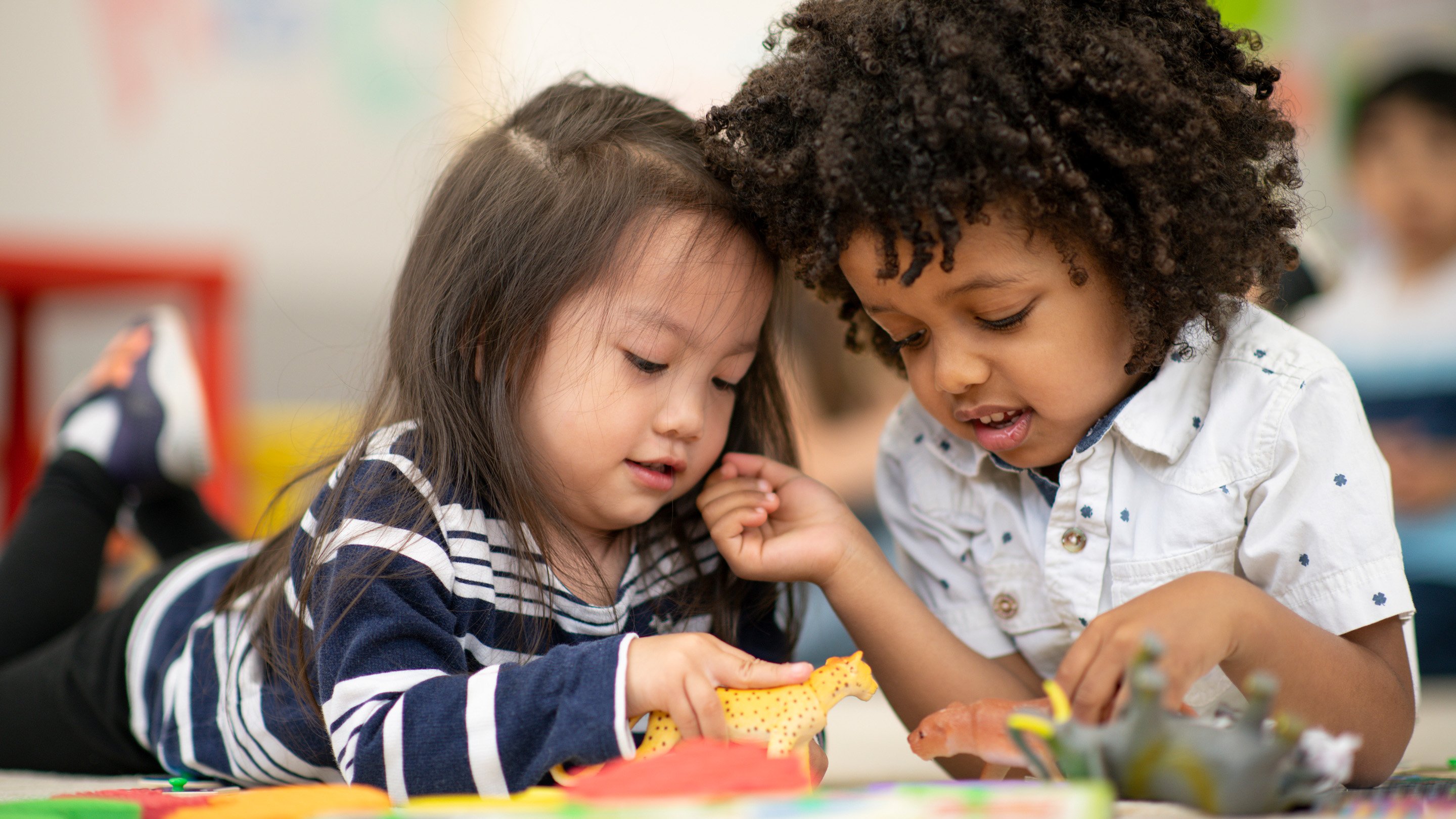
Play is not a break from learning in early childhood. It is one of the primary ways learning takes place. Through play, children practice language, negotiate social rules, explore cause and effect, represent ideas symbolically, take manageable risks, and build stories about how the world works.
Project-based learning provides a larger context for those experiences. A child running a pretend bakery is not merely wearing an apron and moving plastic muffins around. The child may be counting orders, writing signs, comparing quantities, negotiating roles, solving supply problems, and experimenting with the idea of exchanging money for goods.
A strong project can include all three. During a neighborhood project, children might freely build homes with blocks, investigate bridge stability with teacher guidance, and participate in a teacher-led map-symbol game. The goal is not to force every playful moment into an academic objective. The goal is to recognize when play naturally opens a door to deeper investigation.
Benefits of Combining Project-Based Learning and Play
Learning Connects Across Subject Areas
Young children do not divide their thinking into neat folders labeled “math,” “science,” and “literacy.” A project about creating a classroom garden can integrate measurement, plant biology, weather, drawing, vocabulary, storytelling, cooperation, and environmental responsibility.
This interdisciplinary approach makes skills more meaningful. Children count because they need enough seeds. They write because the garden needs labels. They compare lengths because one plant appears to be growing faster than another. Academic skills stop feeling like isolated drills and start behaving like useful tools.
Children Strengthen Executive Function Skills
Projects require children to remember plans, focus attention, manage impulses, switch strategies, and persist when an idea fails. These behaviors draw on executive function and self-regulation skills.
Pretend play adds another layer. When children agree that the block area is now an airport, they must remember roles and follow shared rules. The pilot cannot suddenly become a dinosaur unless the group renegotiates the storylinewhich, to be fair, may produce an exciting new airline.
Research basis: 3>Voice and Choice Build Agency
High-quality early childhood PBL allows children to make meaningful decisions. They may choose which question to investigate, what materials to use, which role to play, or how to share what they learned.
Choice does not mean complete instructional anarchy. Teachers still establish boundaries, ensure safety, connect experiences to learning standards, and support equitable participation. Within those boundaries, children gain the powerful experience of seeing their ideas influence the direction of classroom learning.
Collaboration Becomes Necessary, Not Decorative
In many projects, the final goal is too large for one child to complete alone. Building a pretend hospital, designing a class museum, or creating a habitat model requires children to communicate, divide responsibilities, listen, compromise, and repair conflicts.
These social skills are not interruptions to academic learning. In early childhood, they are essential learning outcomes.
Research basis: tion>
How to Design a Play-Rich PBL Experience
Start With a Question Children Can Own
A useful driving question should be open-ended, connected to children’s lives, and capable of supporting multiple investigations. “What color are apples?” has a quick answer. “How can we create an apple market for our families?” can lead to sorting, weighing, pricing, sign making, dramatic play, recipe exploration, interviewing, and design.
Teachers can introduce a puzzling object, read a story, take a neighborhood walk, show a photograph, invite a visitor, or discuss a classroom problem. Children’s comments and questions should then help shape the project.
Research basis: 3>Prepare the Environment Without Planning Every Move
The classroom environment should encourage investigation. Teachers might add magnifying glasses, measuring tools, recycled materials, nonfiction books, photographs, writing supplies, costumes, clipboards, loose parts, maps, or natural objects.
However, avoid building the entire project before children arrive. When every model is preassembled and every role is predetermined, students become visitors in the teacher’s idea. Leave physical and intellectual space for children to change the environment themselves.
Research basis: 3>Observe Before Intervening
Intentional teaching often begins with observation. Listen to children’s language. Notice recurring problems, misconceptions, interests, and social patterns. A teacher watching children build a bridge might observe that they repeatedly make the center taller but ignore the base.
Instead of announcing the correct engineering principle, the teacher could ask, “What happens when the toy truck reaches this part?” or offer photographs of different bridges. A well-timed question can extend thinking without taking ownership away from the children.
Research basis: 3>Use Mini-Lessons Strategically
Playful PBL does not eliminate explicit teaching. Short, targeted lessons can provide knowledge or skills children need to move forward. A teacher may demonstrate how to use a balance scale, model how to ask an interview question, introduce vocabulary such as “habitat,” or show how writers stretch out a word to hear its sounds.
The key is timing. Teach the skill when children have a reason to use it. A lesson on making tally marks becomes far more memorable when students need to record which playground insects they observed.
Document the Process, Not Only the Product
Photographs, children’s drawings, transcripts of conversations, planning charts, models, and learning stories make thinking visible. Documentation helps teachers assess progress and decide what to offer next. It also helps children revisit their ideas.
A child who sees a photograph of yesterday’s collapsing tower may suddenly recognize why the base needs to be wider. That is reflection in action, even if the official analysis sounds more like, “Oh! The bottom was too skinny!”
Research basis: tion>
A Practical PBL Example: Building a Pollinator-Friendly Playground
Consider the driving question: How can we make part of our playground friendlier to butterflies and bees?
Phase 1: Launch Curiosity
The class takes a short playground walk and looks for insects, flowers, shade, water, and hiding places. Children photograph observations or draw what they notice. Back in the classroom, the teacher records their questions: Where do butterflies sleep? Do bees drink water? Why are insects visiting one area but not another?
Phase 2: Investigate Through Play
The dramatic-play area becomes a garden center. Children pretend to buy seeds, recommend plants, create receipts, and advise customers. In the block area, they build model gardens. At a science table, they examine flowers with magnifying glasses and sort pictures of pollinators.
The teacher reads nonfiction books, introduces relevant vocabulary, and invites a gardener or local environmental educator to speak with the class. Children prepare questions before the visit.
Phase 3: Design, Test, and Revise
Small groups create garden plans using drawings, collage materials, blocks, or clay. They consider where insects might find food, water, and shelter. The class compares designs and combines promising ideas.
If planting is possible, children help prepare a small garden or container area. If it is not, they might build insect watering stations, create educational signs, or develop a proposal for school leaders. The project remains authentic because the children’s work responds to a real place and audience.
Phase 4: Share the Learning
Children host a playground tour, create a family display, record a short video, or present their plans to another class. Each child can contribute in a developmentally appropriate way. One may explain a drawing, another may demonstrate a model, and another may confidently announce that butterflies prefer flowers over cheese crackers.
Assessing Learning Without Ruining the Fun
Assessment in play-based PBL should be ongoing, authentic, and connected to observable learning goals. Teachers can collect evidence through conversations, photographs, checklists, work samples, dictated reflections, and performance tasks.
For example, during a restaurant project, a teacher might observe whether children:
- Count objects accurately during pretend transactions.
- Use new vocabulary in conversation.
- Represent ideas through drawing or early writing.
- Plan and revise a structure or system.
- Take turns and solve disagreements with support.
- Explain what they discovered during the project.
The purpose is not to grade every block tower or dramatic-play conversation. Constant adult evaluation can make children cautious and reduce experimentation. Assessment should help the teacher understand learning, not make the classroom feel as though a tiny compliance officer is hiding behind the sensory table.
Making PBL and Play Inclusive
Flexible projects can provide multiple entry points for children with different languages, abilities, sensory preferences, cultural experiences, and communication styles. One child may contribute by speaking, another by constructing, another by drawing, and another through gesture or assistive communication.
Teachers can support inclusion by offering visual schedules, picture vocabulary, adaptive tools, quieter work areas, repeated experiences, predictable routines, and materials that can be manipulated in different ways. Roles should rotate so that confident speakers do not become permanent project managers while quieter children are assigned lifelong careers in glue-stick support.
Project topics and materials should also reflect children’s families and communities. Invite caregivers to share relevant skills, stories, languages, tools, traditions, or professional knowledge. Family participation should be flexible and accessible rather than dependent on daytime availability or expensive contributions.
Research basis: tion>
Common Mistakes to Avoid
Choosing a Topic Without Listening to Children
A teacher may adore a four-week project about medieval castles, but the children may be passionately investigating worms. Productive PBL balances curriculum goals with genuine student interest.
Confusing a Theme With a Project
A collection of disconnected activities about transportation is a theme. A sustained investigation into how to reduce congestion in the classroom’s block city is a project. PBL needs a meaningful question, an investigative process, student decision-making, revision, and some form of authentic outcome.
Overcontrolling the Final Product
If every child follows the same steps to produce the same object, there is little room for planning, problem-solving, or creativity. Shared standards do not require identical products.
Removing Play to “Make Time” for PBL
In early childhood, this is like removing water to make more room for swimming. Play is not competing with the project. It is one of the most important ways children investigate the project.
Expecting Young Children to Work Independently Too Soon
Choice requires scaffolding. Children may need visual options, modeled collaboration, short planning meetings, clear routines, and adult support. Independence grows through supported practice, not through a teacher cheerfully saying, “You’ve got this,” and disappearing behind a laptop.
Conclusion: Serious Learning Can Look Playful
Combining PBL and play in early childhood classrooms respects both the intellectual capabilities and developmental needs of young children. Projects provide purpose, continuity, and authentic problems. Play provides imagination, experimentation, movement, social negotiation, and joy.
The teacher’s role is neither to control every decision nor to stand completely aside. Effective teachers design inviting environments, listen carefully, introduce useful tools and knowledge, ask productive questions, document learning, and help children reflect on their discoveries.
The result may not look silent or perfectly organized. It may involve cardboard, mud, dramatic debates, unfinished models, and a surprising number of clipboards. Yet within that lively environment, children are learning to think, communicate, collaborate, create, and recognize themselves as capable contributors.
Practice-Based Experiences: What Teachers Often Learn
The following composite classroom experiences illustrate practical lessons that commonly emerge when educators combine project-based learning and play.
Experience 1: The Best Driving Question May Appear During Free Play
In one preschool classroom, children repeatedly built animal homes with wooden blocks. The original weekly plan focused on shapes, but teachers noticed that the children were debating which animals needed water, warmth, doors, or trees. Instead of redirecting the conversation toward a predetermined craft, the teaching team documented the children’s questions.
The discussion eventually became a project about designing a temporary care center for lost neighborhood animals. Children examined pet carriers, interviewed a veterinary technician, created intake forms, measured block enclosures, and operated a pretend animal clinic. Shape vocabulary remained part of the learning, but it now had a purpose. Rectangles became doors, cylinders became water containers, and triangles became roofs.
The experience demonstrated that careful observation can uncover a stronger project than the one an adult originally intended.
Experience 2: Young Children Need Visible Planning Tools
During a classroom restaurant project, teachers initially asked groups to discuss what they needed and begin working. The result was energetic but confusing. Several children started cooking, nobody created menus, and one highly motivated manager attempted to fire the entire staff.
The teachers introduced a simple picture-planning board with sections for food, furniture, jobs, signs, and supplies. Children placed drawings or photographs beneath each heading before choosing tasks. The board reduced repeated arguments and helped students remember the larger plan.
The lesson was not that children were incapable of planning. They simply needed planning to become visible, concrete, and manageable.
Experience 3: Productive Failure Needs Emotional Support
In a bridge-building investigation, one group’s structure collapsed every time a toy bus crossed it. The children became frustrated and wanted the teacher to fix the bridge. Rather than supplying a finished design, the teacher acknowledged the disappointment, photographed the collapsed model, and invited the group to study two successful bridges built by classmates.
The children noticed that both had wide supports. They returned to their design, added larger bases, and tested it again. The revised bridge held. More importantly, the children experienced failure as information rather than as proof that they were “bad” at building.
Teachers often discover that persistence grows when adults provide emotional reassurance without immediately removing the problem.
Experience 4: Family Knowledge Can Transform a Project
A class studying neighborhood buildings invited families to contribute photographs and stories. One caregiver worked in construction, another repaired elevators, and a grandparent remembered how the neighborhood had changed over several decades. These contributions expanded the investigation beyond what classroom books alone could provide.
Children compared old and new photographs, tested building materials, created elevators with baskets and string, and designed a model neighborhood. Families who could not visit during the school day contributed voice recordings, labeled photographs, or short written answers.
The project became more inclusive because participation was not limited to parents who had flexible schedules or formal teaching experience.
Experience 5: The Public Product Does Not Need to Be Fancy
Teachers sometimes imagine that every PBL unit must end with an elaborate exhibition, polished documentary, or event involving enough decorations to alarm the school custodian. In practice, a simple authentic audience is often more powerful.
After investigating playground litter, one kindergarten class created illustrated sorting signs and presented them to the school principal. The signs were placed near outdoor trash and recycling containers. Children later observed whether playground behavior changed and discussed possible improvements.
The final product was modest, but it mattered. Students saw that their research and design choices could influence a shared environment. That sense of contribution is one of the greatest strengths of combining PBL and play: children do not merely pretend to be thinkers, designers, writers, scientists, and community members. With thoughtful support, they begin doing the real work.
Note: The classroom experiences above are composite, practice-based illustrations created from widely used early childhood teaching principles rather than reports from one identified school.