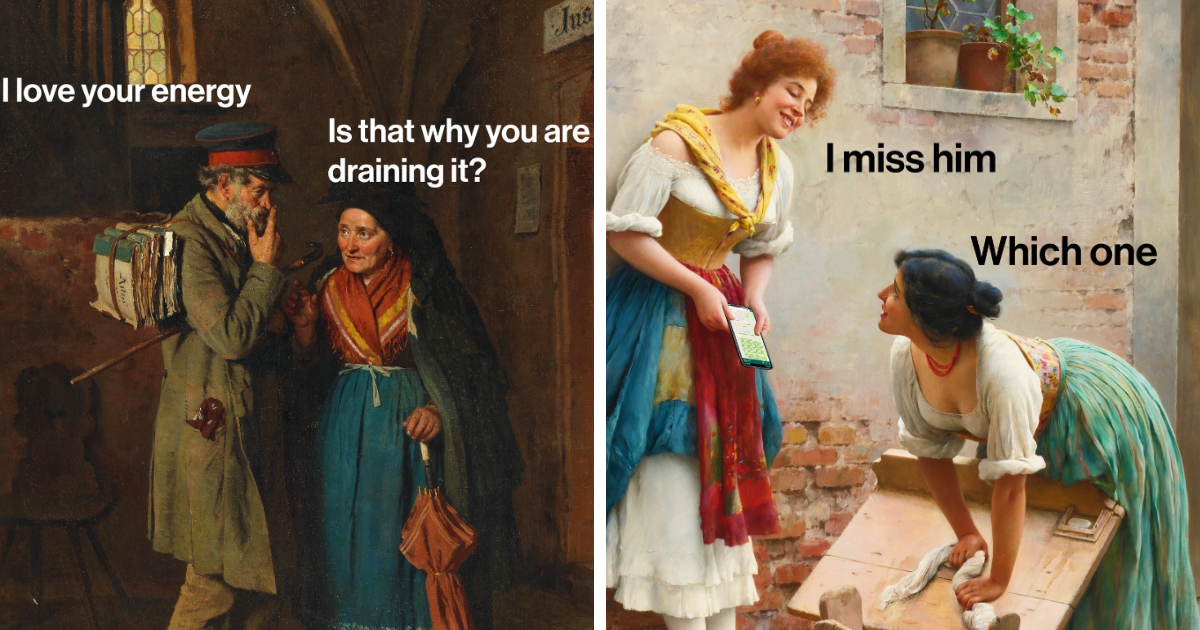
There are two kinds of people on the internet: the ones who politely admire classical paintings in a museum, and the ones who look at a 17th-century portrait and think, “That guy absolutely just said, ‘Per my last email.’” The second group, bless them, is the reason classical art memes keep thriving. When old master paintings collide with modern captions, something magical happens. A solemn duchess becomes the patron saint of social anxiety. A dramatic shepherd turns into the human embodiment of “I said I’m fine.” A cherub suddenly looks less heavenly and more like a toddler who found your phone and ordered six pounds of gummy worms.
That is the delight behind collections like “Classical Paintings Meet Internet Humor In These 70 Hilarious Edits”. These edits are not just random jokes slapped onto dusty canvases. The best ones reveal something sneaky and wonderful: people in old paintings may be separated from us by centuries, powdered wigs, and some truly aggressive collars, but their faces still read like modern reaction images. They look annoyed, dramatic, confused, smug, exhausted, and mildly inconvenienced in ways that feel suspiciously current.
And that is why this corner of internet humor works so well. It is not only funny. It is strangely human. It turns art history into a group chat, and suddenly everyone is invited.
Why Classical Paintings Make Such Ridiculously Good Memes
Classical paintings were not made for meme culture, but wow, they adapted quickly. The reason is simple: artists from past centuries were already experts at exaggerating emotion. Long before someone invented the side-eye GIF, painters were building entire compositions around longing glances, dramatic gestures, scandalized faces, and the universal posture of “I cannot believe this is happening.”
Internet humor loves instantly readable emotion, and classical art delivers it in bulk. A single painting can contain jealousy, heartbreak, disbelief, flirtation, social embarrassment, and one random dog who looks like he knows too much. Add a sharp caption and the image transforms from historical object into comic gold. It feels familiar, but with better lighting and more velvet.
There is also the contrast factor. Humor often lives in the gap between tone and message. Put a painfully modern complaint into a grand, serious painting and the joke practically writes itself. A noblewoman in satin saying, “Me pretending I didn’t see that message” is funny because the image promises elegance while the caption delivers chaos. It is the digital equivalent of a violin concerto getting interrupted by a ringtone.
The Faces Are Timeless
The internet is powered by facial expressions. Reaction memes, screenshots, gifs, and cursed selfies all depend on that split-second recognition of mood. Classical paintings offer the same thing, just with more oil paint and fewer ring lights. A raised eyebrow from 1780 still lands. A despairing stare from 1645 still communicates, “This meeting should have been an email.” Human emotion ages better than milk.
The Drama Is Built In
Many older paintings are unapologetically theatrical. They were designed to tell stories, signal status, or freeze a moment of emotional intensity. In meme terms, that is premium material. Big gestures read clearly. Crowded scenes give editors multiple characters to caption. Religious and mythological paintings, in particular, are basically ancient cinematic universes, complete with betrayal, family drama, bad decisions, and consequences that spiral fast.
The Formal Style Makes the Joke Hit Harder
Fancy visual language makes ordinary problems seem gloriously overblown. A caption about avoiding responsibilities becomes funnier when attached to a painting full of golden light and moral seriousness. The grandeur amplifies the silliness. It says, “Yes, this is a historic masterpiece, but it is also about pretending not to hear your alarm.” That tension is the whole joke.
What These 70 Hilarious Edits Actually Reveal
At first glance, collections of classical painting memes look like harmless entertainment. And to be fair, they are. But they also reveal how internet culture works. The best edits are not simply jokes about art. They are jokes about daily life using art as a dramatic costume.
Scroll through enough of them and patterns emerge. Relationships are a huge theme. So are work stress, awkward conversations, procrastination, social media habits, family dynamics, and the universal experience of trying to act normal while internally narrating your own downfall. The edits succeed because they turn paintings into emotional mirrors. Viewers are not laughing only at the image. They are laughing at themselves.
That is also why these memes pull in people who might never voluntarily read a museum label. They lower the barrier to entry. Nobody needs an art history degree to understand a captioned painting about being ignored in the group chat. Humor acts like a side door into visual culture. You come for the joke and accidentally leave with a stronger eye for composition, gesture, symbolism, and period style. Congratulations, you were tricked into learning.
And honestly, that may be the internet at its finest: chaotic, unserious, and weirdly educational when you least expect it.
How Museums and the Internet Accidentally Became Comedy Writing Partners
One reason classical art memes have flourished is that images are easier to access than ever. Major museums and cultural institutions have spent years expanding digital collections, releasing public-domain images, and encouraging reuse. That matters. Meme culture runs on available material, and the art world has opened the vault much wider than it once did.
As a result, old paintings are no longer trapped behind textbooks, glossy coffee-table books, or the kind of museum silence that makes you afraid to breathe too loudly. They live online now. They are downloadable, shareable, remixable, zoomable, and searchable. Once those images enter social platforms, they stop behaving like remote objects of prestige and start mingling with ordinary internet life. That is when the captions begin.
Some institutions have even embraced this playful energy. Social media challenges, digital exhibitions, meme-friendly educational programming, and open-access initiatives all signal the same thing: art does not have to be sealed behind reverence to be meaningful. A painting can be historically important and still be hilarious on a Tuesday afternoon.
This does not cheapen the artwork. In many cases, it does the opposite. Humor creates attention, and attention can become curiosity. Someone laughs at a meme, then searches for the original painting, then reads about the artist, then falls into a rabbit hole about Dutch portraiture at 1:12 a.m. That is not cultural decline. That is a very weird and very modern form of engagement.
Why Old Art Feels So Current Online
Classical paintings work online because human behavior has not evolved nearly as much as our gadgets would like to think. Sure, the clothes changed. The furniture improved. The group chats became unavoidable. But the emotional core of people remained reassuringly messy.
People centuries ago still dealt with envy, boredom, pride, romance, insecurity, status anxiety, family tension, and public embarrassment. Painters captured those tensions in posture, facial expression, and scene construction. The internet simply adds captions that translate those emotions into current slang and recognizable situations. In other words, the meme is not inventing the feeling. It is updating the subtitle.
That is why these edits never feel entirely forced when they are done well. A mother glaring at her child in a Renaissance painting can plausibly become a joke about discovering an online shopping charge. A cluster of aristocrats whispering in a salon can instantly read as office gossip. A tragic mythological scene can become a caption about student loans. We laugh because the emotional wiring still matches.
There is something comforting about that. The internet often makes the present feel wildly unstable, but classical art memes remind us that humans have always been dramatic little creatures with feelings too big for the room. Now we just post about it faster.
The Fine Line Between Smart Meme and Lazy Caption
Not every art meme is a masterpiece. Some are one-note. Some confuse random text for wit. Some feel like a caption got lost and wandered into the wrong painting. The strongest edits, however, respect the image enough to work with it rather than against it.
A smart classical painting meme notices body language, hierarchy, eye contact, symbolism, or composition. It sees that one figure looks exhausted while another looks smug and builds the joke from that tension. It understands rhythm. It uses the image like a script instead of a background. The result feels inevitable, as though the painting had been waiting 300 years to complain about modern inconvenience.
That is also why the best meme creators in this niche develop loyal audiences. They are not merely recycling famous paintings. They are reading them closely, selecting expressive moments, and crafting captions that balance surprise with recognition. In a strange way, it is a form of micro-interpretation. Art criticism with better timing.
Beyond the Laughs: Why This Trend Actually Matters
It is easy to dismiss classical painting memes as disposable internet fluff, but that is too shallow a read. These edits sit at the intersection of visual literacy, participatory culture, and public access. They show how audiences actively reinterpret cultural material instead of passively consuming it. That matters in a media environment where the ability to remix, reference, and respond has become a core part of communication.
They also challenge the old assumption that art appreciation must be solemn to be sincere. Humor is not the enemy of depth. In many cases, it is the invitation to depth. Laughter gets people looking closely. It rewards observation. It creates memory. You may forget a standard lecture slide, but you will absolutely remember the 18th-century woman whose expression looked exactly like someone hearing “circle back” for the fifth time.
There is a democratic quality here, too. Meme culture allows more people to participate in visual interpretation. You do not need elite language to respond to a painting. You need eyes, a sense of timing, and enough confidence to say, “This angel looks like he just overheard something messy.” That kind of participation can be frivolous, yes, but it can also be culturally alive.
Conclusion: The Internet Did Not Ruin Classical Art, It Gave It a New Punchline
“Classical Paintings Meet Internet Humor In These 70 Hilarious Edits” works because it taps into a truth both art history fans and terminal scrollers understand: people have always been unintentionally funny. Classical painters preserved those moments in oil and canvas. The internet simply gave them captions, timing, and an audience that understands the emotional devastation of unread messages.
These edits are funny because they are observant. They connect past and present without turning either into a joke at the other’s expense. They prove that old art is not frozen. It keeps changing as viewers bring their own language, problems, and absurd little daily dramas to it. One generation sees virtue and allegory. Another sees “me trying to be chill while everything is on fire.” Both are valid, and one is admittedly easier to share on social media.
So yes, laugh at the aristocrats. Laugh at the cherubs. Laugh at the saint who looks one minor inconvenience away from losing composure. But also appreciate the small miracle happening in the process: a painting made centuries ago still has enough life in it to become part of today’s humor. That is not just meme culture. That is cultural endurance with excellent comedic timing.
Personal and Cultural Experiences Around Classical Art Memes
One of the funniest things about classical art memes is how quickly they become social experiences. Nobody stares at a great captioned painting alone for long. You send it to a friend. They send one back that is even better. Suddenly you are both discussing Baroque facial expressions like unpaid graduate students with Wi-Fi. It turns scrolling into a shared language.
For many people, that shared language is the real hook. The joke is rarely just about the painting itself. It is about recognition. You see a caption over a grand historical scene and immediately think of your roommate, your boss, your sibling, your situationship, or yourself at 2 a.m. making bold life decisions while eating cereal over the sink. The old image becomes oddly personal. It is no longer “a painting.” It is “the exact face I made when I opened my bank app.”
That feeling is part of why the trend has staying power. Classical painting memes do not only entertain; they create tiny moments of identification. People who feel intimidated by museums often discover that these images are not distant at all. They are expressive, theatrical, and full of behavior we still recognize. The humor acts like a translator. It says, “Relax, these people were dramatic too.”
There is also a strangely satisfying experience in seeing something old become useful in a new way. The internet is obsessed with speed, novelty, and trends that expire before lunch. Classical art memes do the opposite. They take images with real historical weight and give them fresh circulation without requiring people to pretend they are experts. That is liberating. It lets audiences approach art through instinct first, then curiosity second.
Teachers, students, casual art fans, and even people who mostly came online for sports scores or recipe videos can all meet in the same comment section under a meme of a distressed nobleman. That kind of overlap is rare. Humor smooths out the social friction. Once people are laughing, they are more open to learning where the painting came from, what period it belongs to, and why the original scene mattered before it became a joke about burnout.
On a personal level, there is something deeply comforting about realizing that emotional chaos is not a modern invention. Every time an old portrait gets turned into a joke about stress, oversharing, bad texting habits, or social awkwardness, it quietly reminds us that human nature has always been a little ridiculous. The technology is new. The feelings are ancient. And somehow that makes the present feel less lonely.
Maybe that is the secret ingredient in these hilarious edits. Beneath the wit, they offer continuity. They tell us that across centuries, across styles, across all the distance between painted salons and smartphone screens, people remain gloriously recognizable. We worry, pout, gossip, preen, avoid, perform, and overreact. The internet did not invent that behavior. It just found a really funny archive of it.
SEO Tags
Note: This body-only HTML article is original, web-ready, and cleaned of unnecessary citation placeholders or publishing artifacts.