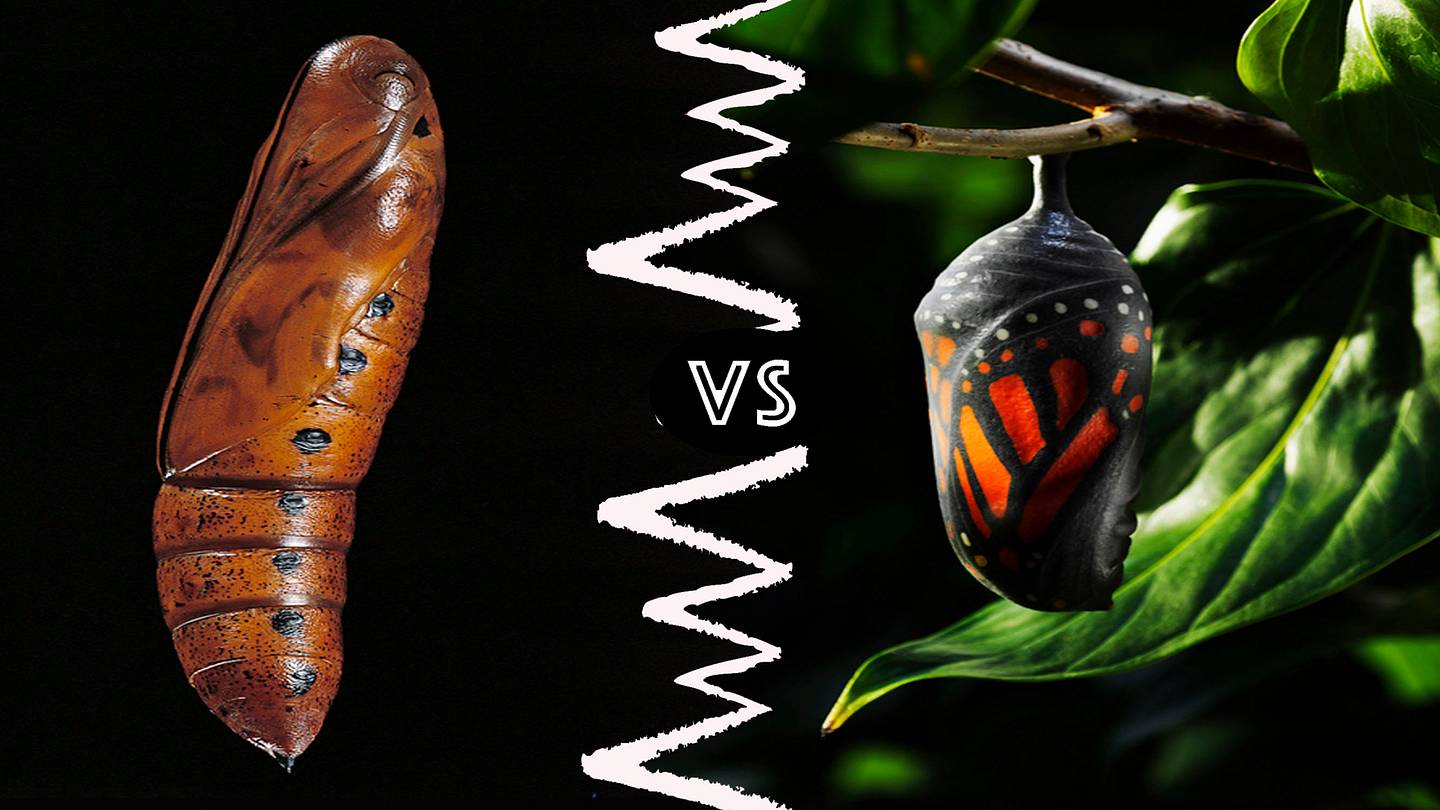
A caterpillar disappears into something small, quiet, and mysterious. Days or months later, a winged insect emerges. Naturally, people call the mysterious object a cocoon, a chrysalis, or a pupaoften while crossing their fingers and hoping one of those words is correct.
The three terms are related, but they are not interchangeable. A pupa is a developmental stage in an insect’s life cycle. A chrysalis is the pupa of a butterfly. A cocoon is a protective covering, usually made of silk, that surrounds the pupa of certain insects, especially many moths.
In other words, the pupa is the transforming insect. A chrysalis is a particular kind of pupa. A cocoon is the sleeping bag around some pupae. One is a life stage, one is a specialized name, and one is a structure. Entomology suddenly feels less like vocabulary roulette.
Core terminology verified with museum, university extension, and federal entomology resources.
The Quick Answer
| Term | What It Means | Common Example | Made of Silk? |
|---|---|---|---|
| Pupa | The developmental stage between larva and adult | A moth pupa buried in soil | Not necessarily |
| Chrysalis | The pupa of a butterfly | A green monarch chrysalis | No; it is the insect’s hardened pupal exterior |
| Cocoon | A protective case surrounding a pupa | A silkmoth cocoon attached to a twig | Usually, although leaves and other materials may be incorporated |
The easiest memory trick is this: the pupa is inside the cocoon, but the chrysalis is the pupa.
What Is a Pupa?
A pupa is the non-feeding developmental stage found in insects that undergo complete metamorphosis. Their life cycle includes four major stages:
- Egg
- Larva
- Pupa
- Adult
Butterflies and moths belong to the insect order Lepidoptera, and their larvae are called caterpillars. A caterpillar’s main assignment is to eat, grow, molt, and store enough energy to complete its transformation. When it reaches the end of its larval development, it stops feeding, finds a suitable location, and prepares to pupate.
The pupa may hang from a plant, rest inside a curled leaf, lie beneath leaf litter, occupy an underground chamber, or sit inside a silk cocoon. Its location and appearance depend on the species.
Although a pupa looks inactive, it is not simply asleep. Adult organs and body structures continue developing as the insect reorganizes its anatomy. Wings expand internally, adult legs and antennae become defined, muscles change, and the adult body takes shape beneath the pupal covering.
Complete metamorphosis and the role of the pupal stage are supported by NPS, NC State, Smithsonian, and USDA resources.
Is a Pupa Always Enclosed?
No. This is one of the most common sources of confusion. A pupa can be:
- Exposed and attached to a plant
- Protected by a silk cocoon
- Hidden in a folded or rolled leaf
- Buried in loose soil
- Placed inside a small earthen chamber
- Concealed beneath bark, stones, or leaf litter
Many sphinx moths, including familiar garden hornworms, leave their host plants and burrow into the ground. There they become smooth, brown pupae without spinning the fuzzy, branch-hanging cocoon people expect from cartoons. Finding one can feel like discovering a tiny polished artifact or an unusually well-organized alien.
Naked moth pupae and underground pupation are documented by USDA Forest Service, Colorado State University Extension, and Oregon State University Extension.
What Is a Chrysalis?
A chrysalis is a butterfly pupa. The word does not refer to a silk container surrounding the butterfly. It refers to the actual pupal-stage insect beneath its hardened outer cuticle.
When a butterfly caterpillar is ready to pupate, it usually creates a small silk attachment point. Depending on the species, it may hang upside down from that silk pad or secure itself upright with a silk girdle around its body. It then sheds its caterpillar skin one final time. The newly exposed pupa hardens into the structure called a chrysalis.
This means a caterpillar does not technically “spin a chrysalis.” It may spin the silk used to support itself, but the chrysalis is formed through a molt. Think of it as changing into a new biological exterior rather than knitting a tiny sleeping pod.
Why Do Chrysalises Look So Different?
Butterfly chrysalises come in an impressive variety of forms. Some are smooth and bright green. Others are brown, angular, bark-colored, leaf-shaped, speckled, striped, or decorated with reflective metallic spots.
These differences often provide camouflage. A chrysalis attached to a stem may resemble a dried leaf, seedpod, broken twig, or bird dropping. Because the pupa cannot fly away from danger, looking unappetizing or practically invisible is a useful survival strategy.
The monarch offers the famous green-and-gold example. Its caterpillar hangs in a J-shaped position before molting into a jade-green chrysalis marked with metallic-looking accents. Swallowtails often form more angular chrysalises held against stems by a silk girdle. Skippers may build loose leaf shelters in which their pupae remain concealed.
Butterfly attachment methods and chrysalis variation are described by Smithsonian, Missouri Department of Conservation, and USDA sources.
Is a Chrysalis Hard?
A mature chrysalis commonly has a firm outer cuticle, but it is not an empty shell or a completely rigid stone. The living pupa is immediately inside that exterior. Some pupae can wiggle when disturbed, although poking one to test this fact is strongly discouraged. Wildlife does not appreciate unsolicited durability inspections.
Near the end of development, the chrysalis may darken or become more transparent. In some species, the adult butterfly’s wing colors become visible shortly before emergence.
What Is a Cocoon?
A cocoon is a protective case created around a developing insect, usually by the larva before it becomes a pupa. In moths, the caterpillar typically produces silk from modified salivary glands and spins it around its body. It then molts into a pupa inside the completed enclosure.
The cocoon and the pupa are therefore two separate layers:
- The cocoon is the outer shelter.
- The pupa is the developing insect inside it.
Cocoons vary considerably. Some are soft, white, and fuzzy. Others are thin and nearly transparent. Large silkmoths may produce tough, brown, papery cocoons that incorporate leaves. Certain caterpillars mix silk with hairs, bark fragments, soil particles, or plant material, creating a shelter that blends into its surroundings.
A cocoon helps reduce exposure to weather, predators, parasites, and physical damage. It is not an airtight vault, however. The insect still needs suitable temperature, moisture, and gas exchange while it develops.
Do All Moths Make Cocoons?
No. “Moths make cocoons, and butterflies make chrysalises” is a useful beginner’s rule, but it is not a universal law.
Many moth caterpillars spin cocoons, including giant silkmoths such as luna and cecropia moths. Other moths pupate without a silk enclosure. They may burrow underground, hide in leaf litter, rest beneath bark, or pupate inside a chamber made from soil or folded foliage.
Therefore, a moth pupa may be inside a cocoon, but it may also be completely cocoon-free. The word pupa remains correct in every case.
Moth cocoon diversity and cocoon-free moth pupation are supported by the Florida Museum, USDA Forest Service, Illinois Extension, and Western Washington University.
Chrysalis vs. Cocoon: The Structural Difference
The most important physical difference is where each structure comes from.
A Chrysalis Comes From the Insect’s Body
The chrysalis is formed when a butterfly caterpillar sheds its final larval skin. Its pupal cuticle is part of the animal. The outlines of wings, abdomen, antennae, or other adult structures may be visible on its surface.
A Cocoon Is Built Around the Insect
A cocoon is constructed from silk and sometimes other materials. It surrounds the pupa but is not part of the pupal body. If a cocoon were carefully openedwhich should not be done merely out of curiositya separate pupa would normally be found inside.
A useful comparison is a person wearing a winter coat. The person represents the pupa, while the coat represents the cocoon. A chrysalis is different: it is more like the pupa’s own temporary developmental exterior.
What Happens Inside a Pupa?
Popular descriptions sometimes claim that a caterpillar completely dissolves into liquid and is rebuilt from scratch. The reality is more organized and more interesting.
Some larval tissues are broken down and recycled, but many structures persist or are extensively remodeled. Groups of developing cells and organ precursors are already present before pupation. The transformation begins during the caterpillar stage and continues inside the pupa under hormonal control.
The insect uses nutrients stored during larval feeding to support this reconstruction. Adult wings, compound eyes, reproductive organs, legs, flight muscles, antennae, and mouthparts develop or mature. The chewing mouthparts of a caterpillar may be replaced by the coiled proboscis used by many adult butterflies and moths.
The process is not instant and does not always follow the same timetable. Temperature, species, season, day length, and environmental conditions can affect development. Some insects emerge within days or weeks. Others enter diapause, a programmed pause that may carry them through winter or another unfavorable season.
Development inside the pupa, preexisting adult structures, and tissue remodeling are described by USDA monarch-monitoring material and Smithsonian research.
How Does the Adult Get Out?
When development is complete, the adult insect emerges from the pupal stage in a process called eclosion.
A butterfly splits the chrysalis and pulls itself free. A moth inside a cocoon must escape both its pupal covering and the surrounding cocoon. Depending on the species, it may push through a prepared weak point, cut fibers mechanically, or release fluids that help soften the silk.
A newly emerged butterfly or moth looks crumpled and vulnerable. Its wings are soft and folded. The insect must hang in a suitable position while fluid is pumped through the wing veins, expanding the wings to their full size. The wings then harden before normal flight is possible.
This is why an emerging adult needs open vertical space. A cramped container or badly positioned obstruction can prevent proper wing expansion.
Eclosion terminology and adult emergence are documented by USDA monarch biology resources.
Common Examples
Monarch Butterfly
The monarch caterpillar attaches itself to a silk pad, hangs in a J shape, and molts into a smooth green chrysalis. It does not make a cocoon. Under favorable conditions, the adult butterfly commonly emerges after a relatively brief pupal period.
Swallowtail Butterfly
A swallowtail pupa is a chrysalis. Instead of hanging only from the rear, many swallowtail species are supported upright by a silk girdle. Their chrysalises may be green or brown and can resemble leaves or pieces of bark.
Cecropia or Luna Moth
These large silkmoths usually pupate inside substantial silk cocoons. A cecropia cocoon may be attached to a twig, while a luna moth commonly incorporates leaves into its cocoon. The pupa is hidden inside the silk case.
Tomato Hornworm
A tomato or tobacco hornworm develops into a sphinx moth. The mature caterpillar typically leaves the plant and burrows into soil, where it becomes a brown pupa. No hanging silk cocoon is required.
How to Identify What You Found
When you discover a mysterious object on a branch, fence, wall, or garden bed, examine its structure without opening or squeezing it.
- Silky, fuzzy, papery, or woven: It is probably a cocoon.
- Smooth, angular, and shaped like an insect: It may be an exposed pupa or butterfly chrysalis.
- Brown capsule found underground: It may be a naked moth pupa.
- Attached by a silk pad or girdle: It is likely a butterfly chrysalis.
- Wrapped inside a folded leaf: It could be either a concealed pupa or a cocoon, depending on the silk construction and species.
Location provides clues, but appearance alone may not identify the species. A regional extension office, natural-history museum, or insect-identification service can often help when supplied with clear photographs and information about where the specimen was found.
Common Myths and Mistakes
Myth 1: Every Caterpillar Makes a Cocoon
Butterfly caterpillars generally form chrysalises, while many moth caterpillars make cocoons. Some moths, however, pupate without cocoons.
Myth 2: A Chrysalis Is a Fancy Cocoon
A chrysalis is not a silk container. It is the butterfly pupa itself.
Myth 3: The Pupa Is Dead or Sleeping
The pupa is alive and metabolically active. Major developmental changes are occurring even when no movement is visible.
Myth 4: The Caterpillar Becomes Biological Soup
Some tissues break down, but the insect is not erased and rebuilt from an unstructured puddle. Development is controlled, complex, and already underway before the caterpillar sheds its final skin.
Myth 5: Every Hanging Object Should Be Brought Indoors
Moving a pupa into a heated home may disrupt seasonal timing, especially when the species requires cold conditions to remain in diapause. Unless the object is in immediate danger, leaving it in its natural environment is often the safest choice.
Experience-Based Observations: What You Notice When Watching Metamorphosis
Watching a butterfly or moth develop makes the vocabulary much easier to remember. The differences stop feeling like dictionary trivia because each structure behaves differently.
The Chrysalis Appears Through a Molt
One of the most striking observations is how quickly a caterpillar can change during pupation. A monarch may spend hours hanging quietly in its J-shaped position. Then the caterpillar’s skin splits, revealing a soft green pupa underneath. The animal twists and contracts until the old skin is pushed upward and discarded.
The fresh chrysalis initially looks soft and oddly shaped. Over time, it settles into a more defined form and hardens. Seeing this sequence makes one fact unforgettable: the caterpillar did not weave the chrysalis around itself. It molted into the chrysalis.
A Cocoon Hides the Main Event
Observing a moth caterpillar is a different experience. Silk may first appear as scattered threads connecting leaves, bark, or the sides of a container. The caterpillar gradually creates a denser enclosure until its body disappears.
After that, the transformation becomes private. The visible object is the cocoon, while the pupa remains concealed inside. A large silkmoth cocoon can feel surprisingly sturdy, almost like handmade paper. That toughness makes sense when the occupant may spend an entire winter exposed to changing weather.
A Soil Pupa Breaks the Cocoon Stereotype
Gardeners sometimes find a large brown pupa while digging and assume it is a seedpod, beetle, or tiny science-fiction prop. Sphinx moth pupae are especially memorable because some have a curved external case that protects the developing proboscis.
This discovery is often the moment people realize that moths do not always make silk cocoons. The soil itself provides concealment and physical protection. Returning the pupa gently to loose soil near where it was found is usually wiser than carrying it indoors for inspection.
Patience Matters More Than Intervention
A motionless chrysalis or cocoon can make an observer worry that something has gone wrong. The temptation to touch it, open it, spray it repeatedly, or relocate it every afternoon is understandable but risky.
Healthy development may involve long periods with no visible activity. Some pupae respond to disturbance by moving, but lack of movement does not prove that the insect is dead. Color changes can also be normal, particularly shortly before emergence. The best observational skill is often restraint.
Emergence Is Only Half the Transformation
The adult is not immediately ready to fly when it exits. Its wings begin folded and soft. It must hang while they expand and harden. Observing this stage reveals why clearance around a chrysalis or cocoon matters so much.
An adult that falls onto a cluttered surface may struggle to expand its wings correctly. In natural settings, the insect’s choice of attachment point helps provide the necessary space. What looks like an arbitrary twig, overhang, or branch may actually be a carefully selected launch platform.
Seasonal Timing Can Be Surprisingly Long
Not every pupa produces an adult within two weeks. Some species remain in the pupal stage through winter. Their development is synchronized with temperature, day length, rainfall, and the seasonal availability of food plants.
This explains why bringing an overwintering cocoon into a warm room can cause trouble. The moth may emerge when outdoor temperatures are unsuitable and mates or nectar sources are unavailable. Successful observation means respecting the insect’s calendar rather than replacing it with the household thermostat.
These experiences turn three confusing terms into a simple biological picture. A pupa is the transforming animal. A chrysalis is the exposed pupa of a butterfly. A cocoon is a shelter built around certain pupae. Once you have watched each process, mixing them up becomes considerably harder.
Seasonal diapause, outdoor care, and overwintering guidance are supported by Illinois Extension, Smithsonian Gardens, and extension entomology resources.
Why the Difference Matters
Correct terminology improves more than trivia-night performance. It helps gardeners, teachers, naturalists, and insect enthusiasts understand what they are observing and how the animal may need to be protected.
Recognizing a chrysalis can prevent someone from scraping it from a wall as an abandoned shell. Identifying a moth cocoon can stop unnecessary pruning. Understanding that pupae may overwinter in dead leaves gives gardeners a reason to avoid removing every bit of natural debris too early.
These structures also demonstrate the diversity of insect survival strategies. One species hangs in plain sight while disguised as a leaf. Another builds a silk fortress. A third disappears underground without producing silk at all. The goal is similarsurvive the vulnerable pupal stagebut evolution has supplied many different solutions.
Conclusion
The difference between a chrysalis, cocoon, and pupa becomes simple once the terms are placed in the correct order.
Pupa is the broad biological term for the developmental stage between larva and adult. Chrysalis is the name commonly given to a butterfly pupa. Cocoon is a protective structure, usually made of silk, that surrounds the pupa of many moths and certain other insects.
A butterfly caterpillar typically molts into a chrysalis. A moth caterpillar may spin a cocoon and then become a pupa inside it, although many moths pupate without cocoons. The transforming insect is always the pupa; the packaging depends on the species.
Note: “Butterflies make chrysalises and moths make cocoons” is a helpful introductory rule, not an exception-free scientific law. Moths use several pupation strategies, including exposed, underground, leaf-wrapped, and silk-covered pupae.