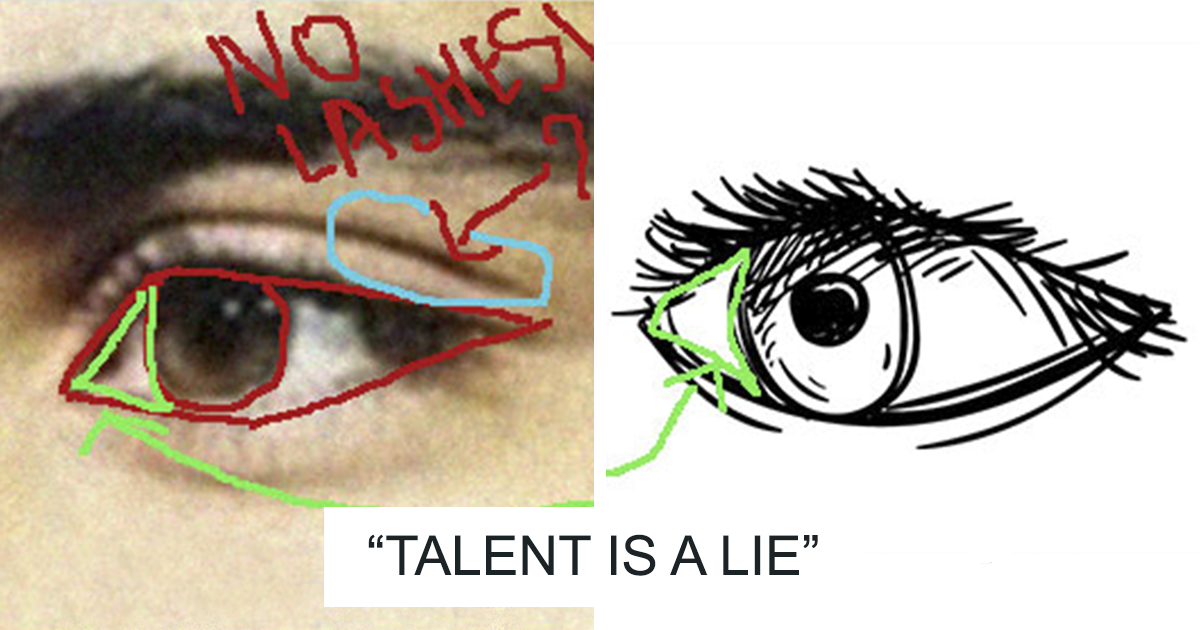
Every beginner artist has met the same tiny villain: the brain. Not the whole brain, of course. The brain is useful for remembering passwords, avoiding hot stoves, and pretending we understand modern art at gallery openings. But when it comes to drawing realistically, the brain loves to barge in wearing a cape and shout, “Relax, I know what an eye looks like!”
Unfortunately, that is exactly when the drawing starts looking less like the reference and more like a suspicious sticker from a school notebook. The artist sees an eye, a nose, a hand, or a mouth, but instead of drawing the actual shapes in front of them, they draw the mental shortcut their brain stored years ago. That shortcut is called symbol drawing, and it is one of the biggest beginner artist mistakes.
The good news is that this problem is not a sign of “no talent.” It is simply a seeing problem. Realistic drawing is not only about moving a pencil; it is about training your eyes to notice shapes, values, angles, negative spaces, proportions, and relationships. In other words, the goal is to draw what is actually there, not what your brain thinks should be there.
Why Beginner Artists Draw With Their Brain
When people say “draw what you see, not what you know,” they are pointing to a very real habit. The brain is designed to simplify the world. It labels things quickly: eye, tree, hand, chair, cat, sneaker, banana. That is helpful when you are walking through a room, but it can be a disaster when you are trying to draw.
For example, a beginner may look at an eye and immediately draw an almond shape, a perfect circle for the iris, black lashes sticking out like spider legs, and a neat eyebrow floating above it like a decorative mustache. But in a real reference photo, the eye may be partly covered by the eyelid, tilted at an odd angle, softened by shadow, and shaped more like a crooked puzzle piece than a textbook “eye.”
The mistake happens because the artist stops observing and starts naming. Once the subject is named, the brain pulls out a symbol. That symbol is usually flat, generalized, and outdated. It may come from childhood drawings, cartoons, emojis, or the last time someone doodled a face in the corner of a math worksheet.
The Main Mistake: Drawing Symbols Instead of Shapes
The biggest issue beginner artists face is not shaky hands. It is drawing symbols instead of shapes. A symbol is the brain’s simplified idea of something. A shape is the actual visual information in front of you.
Consider eyelashes. A beginner may think, “Eyelashes are long curved lines,” and then draw every lash individually. In reality, eyelashes often appear as clusters, shadows, dark edges, or barely visible textures. Sometimes they disappear completely in the light. Drawing every lash can make the eye look stiff, fake, or unintentionally dramatic, like it is auditioning for a soap opera.
The same thing happens with teeth. Many beginners outline each tooth, creating a row of little white tiles. But in real life, teeth are usually described by subtle value changes, soft edges, and shadow. Draw every tooth too clearly, and the portrait starts looking like it wants to sell toothpaste at midnight.
Observation Drawing: The Skill Behind Real Improvement
Observation drawing is the practice of carefully studying what is in front of you and translating it onto the page. It sounds simple, but it requires patience. Instead of asking, “What am I drawing?” the artist asks better questions:
- What shape is this area really?
- How dark or light is it compared with the area beside it?
- Where does this edge line up with another feature?
- Is the angle vertical, horizontal, or slanted?
- What is the negative space around the object doing?
These questions force the artist to look longer. And looking longer is where drawing improves. A common beginner habit is spending 80 percent of the time staring at the paper and only 20 percent glancing at the reference. A stronger approach is the opposite: look at the reference constantly, compare it with the drawing, make adjustments, and repeat.
The Upside-Down Drawing Trick
One of the most useful exercises for breaking symbol drawing is turning the reference upside down. This sounds like a prank, but it works because it confuses the brain’s labeling system. When a face is upside down, it becomes harder to say, “That is a nose, so I will draw my usual nose symbol.” Instead, the artist sees abstract shapes, angles, dark patches, and light spaces.
Upside-down drawing helps beginners stop thinking in names and start thinking in relationships. The cheek becomes a slanted shape. The eyelid becomes a small edge. The shadow under the lip becomes a value block. Suddenly, the drawing is less about “face” and more about visual problem-solving.
This exercise can feel strange at first. That is the point. Your brain is being gently escorted out of the driver’s seat. It may complain. Let it. The eyes are driving now.
Blind Contour Drawing: Training the Eye-Hand Connection
Blind contour drawing is another classic exercise that helps artists draw with their eyes. In this practice, you choose a subject, place your pencil on the paper, and draw slowly while looking at the subject instead of the page. The final drawing may look delightfully unhinged, like a portrait drawn during an earthquake, but the result is not the main goal.
The real purpose is to train your eyes and hand to move together. Your eye traces the edge of the subject, and your hand follows. You begin noticing tiny bumps, curves, angles, and shifts you normally ignore. Blind contour drawing teaches patience, focus, and direct observation.
Beginners often want every exercise to produce a pretty drawing. That is understandable. Nobody dreams of filling a sketchbook with wobbly mystery creatures. But some exercises are like push-ups for perception. They are not meant to hang in a museum; they are meant to build the muscles that eventually help you make better art.
Values Matter More Than Outlines
Another common beginner drawing mistake is relying too heavily on outlines. Outlines feel safe because they define the object. But realistic drawing depends heavily on values, which means the lightness or darkness of an area.
A portrait, for example, is not just a collection of lines around the eyes, nose, lips, and jaw. It is a pattern of light and shadow. The side of the nose may be defined less by a line and more by a soft shadow. The cheekbone may appear because one plane is lighter than another. The mouth may look realistic only when the artist stops outlining the lips and starts observing the dark and light shapes around them.
A helpful trick is to squint at the reference. Squinting reduces detail and helps you see the big value groups. The tiny eyelashes, skin texture, and stray hairs become less distracting. You can focus on the large shapes first. Details should come later, after the structure is working.
Drawing Details Too Soon
Details are tempting. They sparkle. They whisper, “Draw me now.” Beginner artists often start with an eye, a button, a strand of hair, or the shine on a lower lip before the big shapes are correct. The problem is that details cannot save a weak foundation.
Imagine building a house by decorating the doorknob before checking whether the walls are standing. That is what happens when an artist spends twenty minutes shading eyelashes on a face where the eyes are in the wrong place. The detail may be lovingly rendered, but the drawing still feels off.
A better process is to work from big to small. Start with the overall shape. Then place the major proportions. Then block in large shadows. After that, refine smaller shapes. Only near the end should you add details. This workflow may not feel as exciting at first, but it prevents the heartbreaking moment when you realize your beautifully shaded eye has to be erased because it is floating in the wrong zip code.
Proportion Mistakes: When the Brain Guesses
Proportion errors happen when the artist guesses instead of measures. The brain says, “Hands are about this big,” or “Eyes go around here,” and suddenly the portrait has a forehead the size of a garage door.
To improve proportions, compare constantly. Check how wide one shape is compared with another. Notice where a corner lines up vertically or horizontally. Ask whether the mouth is closer to the nose or chin. Look at the angle from the ear to the eyebrow. Use the edge of the paper, a pencil, or simple sighting methods to compare distances.
Proportion is not about memorizing one perfect formula for every subject. It is about measuring the subject in front of you. A child’s face, an elderly face, a tilted head, and a dramatic camera angle all change the relationships. Your eyes must stay involved.
Negative Space: The Secret Weapon Beginners Ignore
Negative space is the area around and between objects. It may sound like art-school vocabulary wearing fancy shoes, but it is incredibly practical. If drawing a chair feels overwhelming, draw the shapes between the chair legs. If drawing a hand is intimidating, observe the spaces between the fingers.
Negative space helps because the brain is less likely to have a stored symbol for “weird triangle between thumb and index finger.” That means you are more likely to observe it accurately. The subject becomes a collection of abstract shapes rather than a scary object with a reputation.
This is especially useful for hands, hair, plants, furniture, and figures. Instead of drawing “a hand,” draw the shadow shape beside the thumb, the wedge between two fingers, and the curve where the wrist meets the palm. Piece by piece, the drawing becomes more accurate.
Gesture Drawing: Seeing Movement, Not Just Edges
While observation is essential, artists also need to understand gesture. Gesture drawing focuses on the movement, rhythm, and action of a subject. It is especially important in figure drawing because a technically detailed figure can still feel stiff if the gesture is missing.
Beginners often trace the outer contour of the body, carefully copying bumps and edges. But the pose may lose energy. Gesture asks, “What is the body doing?” Is it leaning, twisting, stretching, collapsing, reaching, or balancing? A few confident lines that capture the action can be more useful than a slow outline that misses the movement.
This does not mean proportions and structure do not matter. They do. But gesture helps the drawing feel alive before details arrive. Think of it as the drawing’s skeleton of energy. Without it, the finished piece may look accurate in pieces but oddly frozen overall.
How to Practice Drawing With Your Eyes
Improving observation does not require expensive supplies. A pencil, paper, and a subject are enough. What matters is how you practice. Start with simple objects: a mug, shoe, plant, spoon, or your own hand. Choose something real, not only a photo, because drawing from life teaches depth, light, and spatial relationships.
Set a timer for ten minutes. Spend the first minute only looking. Do not draw yet. Notice the largest shapes, the darkest darks, the lightest lights, and the angles. Then sketch lightly. Keep your lines flexible. Do not press so hard that every mistake becomes a permanent historical document.
As you draw, compare constantly. Treat the process like a “spot the difference” game. Does the shape on your page match the shape in the reference? Is the shadow too dark? Is the eye too high? Is the angle too straight? Adjust without drama. Erasing is not failure; it is editing. Even professional artists redraw, revise, and correct. The eraser is not a shame stick. It is a tiny rubber assistant.
Common Beginner Artist Mistakes and Better Habits
1. Mistake: Drawing the Name of the Object
Better habit: Draw the shapes you actually see. Replace labels like “eye” or “hand” with visual descriptions such as “dark triangle,” “soft curve,” or “narrow shadow.”
2. Mistake: Outlining Everything
Better habit: Use value, edges, and contrast. Some edges are sharp, some are soft, and some disappear completely in light.
3. Mistake: Starting With Details
Better habit: Block in the big shapes first. Details should decorate a solid structure, not distract from a broken one.
4. Mistake: Avoiding Corrections
Better habit: Redraw boldly. If a jawline is too far out or a hand is too small, fix it. Your drawing will not file a complaint.
5. Mistake: Looking at the Paper Too Much
Better habit: Look at the reference more than the drawing. Observation is the engine; the pencil is just the tires.
Why “Talent” Is Not the Whole Story
Many beginners believe good artists are born with magical pencil powers. In reality, strong drawing is built through repeated observation, practice, correction, and patience. Some people may start with a better visual memory or more confidence, but skill grows when artists train how they see.
This is encouraging because it means beginner mistakes are not permanent. Drawing symbols, misjudging proportions, overusing outlines, and rushing details are all fixable habits. The artist who learns to slow down and observe carefully will improve faster than the artist who keeps guessing beautifully.
Experience Section: What It Feels Like to Stop Drawing With Your Brain
The first time a beginner truly tries to draw with their eyes, the experience can feel awkward. You may sit in front of a reference and realize you have never actually looked at an eye before. You have seen thousands of eyes, of course. You have made eye contact, avoided eye contact, rolled your eyes, and probably drawn cartoon eyes in the margins of notebooks. But studying one eye as a shape is different.
You begin noticing that the white of the eye is not pure white. It has shadows, reflections, and color shifts. The iris is not always a perfect circle because the eyelid cuts across it. The lower lid may not even be a line; it may be a soft change in value. The eyelashes may be less visible than expected. The eyebrow may not sit where your brain wanted to put it. At this point, your brain becomes offended. It thought it knew eyes. It did not appreciate being corrected by reality.
Many artists describe this stage as frustrating but exciting. Your drawings may initially look messier because you are no longer hiding behind neat symbols. You are wrestling with actual visual information, and actual visual information is complicated. A real face has asymmetry. A real hand has strange angles. A real shoe has perspective. A real plant has leaves that refuse to behave like polite little ovals.
One helpful experience is to draw the same object several times. Draw a mug the usual way first. Then draw it upside down from a photo. Then draw only the negative spaces around the handle. Then do a blind contour drawing of it. The first version may look like your brain’s idea of a mug. The later versions may look less polished, but they often contain more truth: a better angle, a more accurate handle shape, a stronger sense of volume.
Another powerful experience is comparing old drawings with new ones after a few weeks of observation practice. The improvement is often not flashy at first. You may not suddenly become a portrait wizard who can draw a celebrity on a napkin during lunch. But your lines become more thoughtful. Your proportions become less random. Your shading starts describing form instead of just filling space. You notice when something is wrong sooner, which is a huge step. Catching mistakes is not a weakness; it is proof that your eyes are getting sharper.
There is also an emotional shift. Beginners often panic when a drawing goes wrong. More experienced artists expect the drawing to go wrong several times. They know the early sketch is a negotiation, not a final verdict. A crooked line can be moved. A shadow can be adjusted. A feature can be erased. The page is not a courtroom; nobody is sentencing you for a misplaced nostril.
Over time, drawing with your eyes becomes less of a trick and more of a habit. You start seeing the world differently. Shadows on a sidewalk become value studies. A coffee cup becomes an ellipse lesson. Someone’s profile becomes a collection of angles and soft edges. This is when drawing becomes addictive in the best way. The world stops being a set of labels and becomes a buffet of shapes, light, rhythm, and form. Your brain is still invited, of course. It helps with structure, anatomy, memory, and creative decisions. But it no longer gets to bully the eyes. The best artists use both: the eyes to observe honestly, and the brain to understand what those observations mean.
Conclusion
The mistake beginner artists make is not that they lack talent. It is that they often draw from mental symbols instead of direct observation. They draw what their brain expects to see: almond eyes, individual teeth, cartoon lashes, generic hands, and outline-heavy faces. To improve, artists must learn to slow down, compare, measure, squint, observe negative space, practice contour drawing, and build from big shapes to small details.
Drawing with your eyes does not mean turning off your brain completely. It means stopping the brain from replacing reality with shortcuts. When artists learn to truly look, their drawings become more accurate, more expressive, and more alive. And yes, the process includes erasing, fixing, failing, and occasionally drawing something that looks like a haunted potato. That is normal. Every awkward sketch is part of the training. Keep looking. Keep comparing. Keep drawing. Your eyes know more than you think.

