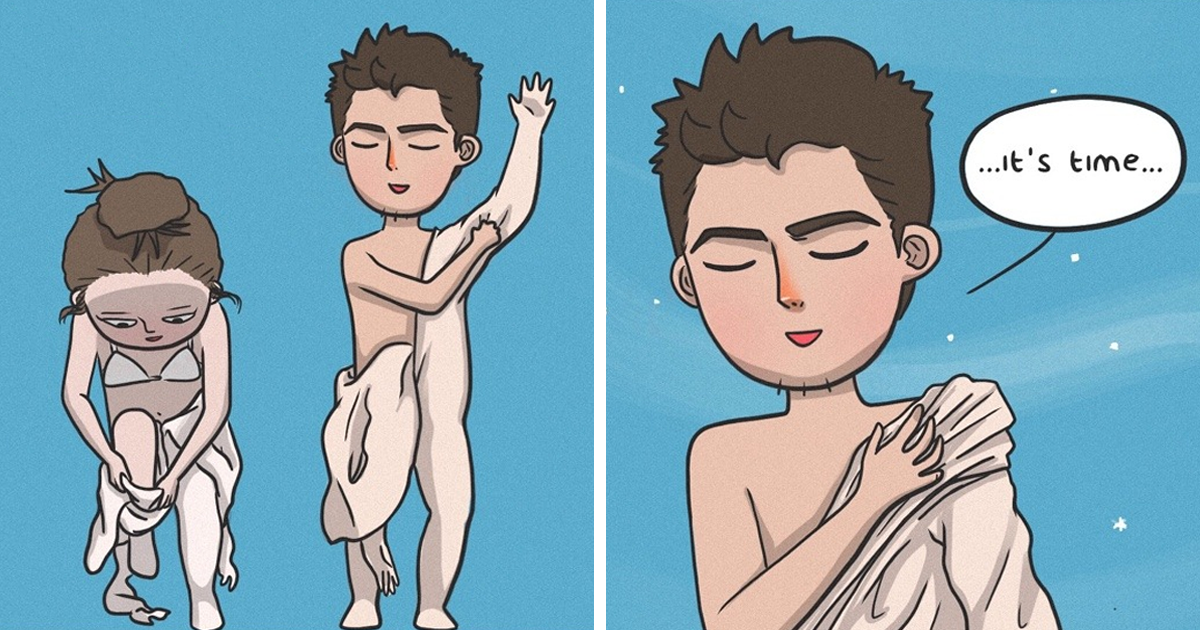
Romantic movies have spent decades convincing us that true love involves candlelit dinners, dramatic airport reunions, and at least one passionate conversation in the rain. Real relationships, meanwhile, are more likely to involve stolen hoodies, mysterious crumbs in the bed, unfinished arguments about groceries, and a cat sitting directly on the one object you need.
That less glamorousand much funnierversion of love is the heart of Murrz, a slice-of-life webcomic created by artist Mary Park. In this collection of 42 funny comics, everyday life with a boyfriend and a cat becomes a parade of tiny victories, ridiculous misunderstandings, personal insecurities, lazy weekends, food-related negotiations, and feline interruptions.
The comics are cute without pretending that adulthood is graceful. They are romantic without turning every moment into a greeting card. Most importantly, they understand that a stable relationship is often built from experiences that look completely ordinary to everyone except the people living them.
Meet Mary Park, the Artist Behind Murrz
Mary Park, better known online as Murrz, is a California-based graphic designer and cartoonist from Los Angeles. Her professional background includes digital media, visual design, branding, and product development. She began drawing comics inspired by her own life during her free time, gradually transforming those observations into a recognizable webcomic series.
Instead of inventing superheroes or distant fantasy kingdoms, Park discovered that her apartment already contained a complete cast: herself, her boyfriend, their pets, and the unpredictable villain known as Responsible Adulthood.
The name “Murrz” became both her creative identity and the name associated with her illustrated alter ego. Her comics gained an audience through social media and later reached readers through WEBTOON, where the series was featured between 2018 and 2022. The stories regularly explore relationships, aging, anxiety, awkward social situations, generational differences, and the considerable challenge of behaving like a functioning grown-up before noon.
What the 42 Funny Comics Capture So Well
The collection works because it does not depend on elaborate plots. Each strip begins with something recognizable: getting dressed, going to the gym, shopping, eating too much, working late, borrowing clothes, relaxing on the couch, or attempting to communicate with a cat that has rejected the concept of cooperation.
Across the featured comics, Park turns gym exhaustion, makeup experiments, stolen hoodies, grocery frustration, period pain, “food babies,” pet litter, toe-bean obsession, and the fear of growing up into compact visual jokes. These are not heroic adventures, but they can feel equally dramatic when you are the person trying to survive them.
The Comfortable Stage of a Relationship
Early dating often involves careful outfits, polite laughter, and pretending you do not own a drawer filled with tangled charging cables. A long-term relationship eventually replaces that performance with honesty. Both people discover each other’s strange sleeping positions, questionable snack combinations, and impressive ability to lose an item while holding it.
Murrz and her boyfriend are funny because they behave like two people who no longer need to impress each other every minute. They tease, annoy, cuddle, compete for food, and communicate through expressions that would make no sense to an outsider. Their romance is not presented as perfect. It is presented as safe enough to be ridiculous.
This comfortable stage produces much of the comic’s humor. Affection may appear as a hug, but it may also appear as surrendering the final bite of dessertor at least considering surrendering it for three difficult seconds.
The Cat Is a Character, Not a Decoration
In weaker stories, a pet appears mainly to look adorable. In these everyday-life comics, the cat is an active participant with its own priorities, timing, and apparent belief that household rules are merely brainstorming suggestions.
The animal can interrupt a romantic moment, interfere with work, demand attention, create suspicious smells, or stare at its humans as though their lifestyle choices have become deeply embarrassing. That unpredictability gives Park an endless source of punchlines. A couple may believe they control the apartment, but the cat has reviewed the lease and reached a different conclusion.
The affection behind the jokes also feels authentic. Research has found that domestic cats can form distinct attachment bonds with their human caregivers, helping explain why their aloof behavior and unexpected moments of closeness carry so much emotional weight.
Womanhood Without the Polished Filter
Park also draws from experiences involving beauty routines, body image, hormones, clothing, social expectations, and the gap between how a person imagines an activity and how that activity actually unfolds.
A glamorous shopping trip can end in financial regret. A fitness goal can collapse after one exhausting session. Carefully applied makeup can become nearly invisible to a confused boyfriend. A productive Sunday can transform into six hours under a blanket while the laundry develops political independence.
The comedy does not come from suggesting that women are incapable. It comes from admitting that real people are inconsistent. Someone can be ambitious at 9 a.m., overwhelmed at 11 a.m., hungry at noon, and completely devoted to becoming a couch cushion by 2 p.m.
Why Murrz Comics Feel So Relatable
They Begin With Specific Details
Relatable humor is strongest when it avoids vague observations. “Relationships are funny” is not much of a joke. “My partner said he did not want fries and then ate half of mine” is practically an international treaty violation.
Park notices the small details that define shared life: clothing migration from one closet to another, the false confidence that appears before a workout, the facial expression of someone asked to share food, and the strange intimacy of discussing subjects that would be unacceptable during a first date.
Specificity allows readers to recognize themselves. The details may come from one artist’s household, but the emotional pattern belongs to thousands of couples.
Simple Drawings Leave Room for Big Reactions
The clean, expressive style of Murrz keeps each comic easy to understand. Readers do not have to study a crowded background before finding the joke. Posture, facial expressions, timing, and a few carefully selected objects carry the story.
Cartoonists often create meaning through tiny variations in a face or gesture. A lowered eyebrow, a frozen smile, or a character slowly turning toward a suspicious sound can communicate an entire paragraph without using one. Comics scholar and cartoonist Ivan Brunetti has similarly discussed how simplified faces and minor changes to basic forms can carry substantial emotional meaning.
The Reader Completes the Joke
Comics do not show every second of an event. The empty space between panels asks readers to imagine what happened in the missing moment. Researchers studying comic narratives describe this process as connecting fragmented scenes into a complete story.
Park uses that natural rhythm to sharpen her punchlines. One panel establishes confidence. The next reveals disaster. The reader mentally supplies the doomed activity in between.
For example, a character may announce a healthy new routine in one frame and appear surrounded by snacks in the next. No detailed explanation is necessary. We know exactly where the plan went wrong because we have personally attended that meeting.
Recurring Sources of Comedy in the Collection
Food Is Basically a Supporting Character
Food creates conflict, comfort, temptation, celebration, and digestive consequences. It can repair a bad mood faster than a serious conversation, although it may also start a new argument when someone takes a bite without permission.
Murrz treats cravings honestly. The characters may discuss exercise and self-control, but delicious food soon enters the scene wearing the confident expression of someone who already knows the outcome.
Borrowed Clothes Are Never Returned
A boyfriend’s hoodie begins as an ordinary garment. Once borrowed, however, it becomes emotional property. It is warmer, softer, and apparently protected by laws that no court has yet successfully challenged.
This familiar relationship ritual is ideal for a visual comic because the joke is instantly readable. One character has lost a hoodie. The other has gained comfort. Negotiations are over.
Fitness Expectations Meet Physical Reality
Exercise looks attractive in advertising. Everyone is smiling, their hair remains perfect, and no one appears to be bargaining with a treadmill. Murrz replaces that fantasy with sweat, exhaustion, awkward movement, and the immediate question of what to eat afterward.
The humor comes from the collision between the imagined version of the self and the actual version currently lying on the floor.
Adulting Is an Unfinished Group Project
Many comics capture the strange realization that adulthood does not arrive with clear instructions. Bills still need paying, appointments still need scheduling, and groceries somehow disappear even though going to the store happened approximately yesterday.
Park’s characters are not irresponsible caricatures. They are adults doing their best while privately wondering when a more qualified adult will arrive.
Why Relationship Comics Create Such a Strong Connection
Readers are not simply laughing at Murrz and her boyfriend. They are remembering their own household jokes, embarrassing accidents, affectionate arguments, and private traditions.
Shared laughter can strengthen a sense of similarity and closeness between people. Research summarized by the Greater Good Science Center found that people who laughed together reported more positive feelings and greater satisfaction with their relationships than people whose laughter was not shared.
A relationship comic recreates this effect on a wider scale. The artist says, “This strange thing happened in my home,” and thousands of readers answer, “It happens in mine too.” The joke becomes a small form of community.
Slice-of-life comics are especially effective at producing that response because ordinary struggles do not require complicated introductions. Readers already understand creative frustration, career uncertainty, romance, family expectations, and the chaos of living with another creature. These themes have helped autobiographical and everyday-life comics remain accessible even to audiences unfamiliar with traditional comic books.
There Is More Than Cuteness Behind the Punchlines
Murrz may look lighthearted, but its emotional appeal comes from vulnerability. Park is willing to draw herself as tired, jealous, anxious, lazy, overly dramatic, insecure, or completely defeated by a minor inconvenience.
That honesty matters. Social media often presents relationships as carefully arranged collections of vacations, gifts, anniversary dinners, and coordinated outfits. These comics present the unedited middle: the hours spent waiting for food delivery, the failed attempts to be productive, the disagreements that dissolve into laughter, and the silent companionship of two people occupying the same couch.
The result is reassuring rather than cynical. Love does not disappear when people stop behaving perfectly. In many cases, affection becomes more visible after perfection has left the building and taken the matching throw pillows with it.
Experiences That Feel Like They Belong in a Murrz Comic
The 6 A.M. Breakfast Emergency
Anyone who lives with a cat eventually discovers that feline timekeeping is impressively precise whenever food is involved. The cat begins with a quiet stare from the doorway. When that fails, it advances to walking across a sleeping human’s ribs. The final stage may include knocking a small object from a table while maintaining direct eye contact.
One partner wakes up and pretends to be asleep. The other partner also pretends to be asleep. Both are performing for an animal that can hear their breathing change. Eventually, someone gets up, feeds the cat, and returns to bedjust in time for the cat to decide breakfast was exhausting and take the warmest sleeping spot.
The Hoodie Custody Dispute
A shared closet creates an interesting imbalance. One person believes clothing ownership is determined by who purchased the item. The other believes ownership is determined by who currently looks cutest wearing it.
The boyfriend searches for his favorite sweatshirt and discovers it on his partner, who is curled beneath a blanket and insists she has “always had this.” Evidence, receipts, and photographic records are dismissed. The cat settles on her lap, making removal of the hoodie physically and morally impossible.
The Grocery Store Communication Test
Before shopping, the couple agrees to purchase only essentials. Inside the store, “essentials” expands to include three kinds of chips, an experimental beverage, bakery cookies, and a seasonal snack that may never be available againor may still be available next Tuesday.
One person asks whether they need milk. The other confidently says no. At home, they discover an empty carton in the refrigerator, preserved by someone who apparently hoped it would regenerate.
The cat investigates every bag and selects the least expensive paper receipt as the most exciting purchase.
The Work-From-Home Supervisor
A laptop is open. A deadline is approaching. The human is finally focused. This is precisely when the cat decides that the keyboard is a premium heated mattress.
The owner gently relocates the animal. The cat returns. A second relocation produces an offended expression normally reserved for historical betrayal. The boyfriend suggests closing the office door, but this causes scratching, meowing, and a level of emotional pressure that would concern an international mediator.
The cat is eventually allowed back inside and falls asleep beside the laptop without touching it, proving the entire conflict was about principle.
The Streaming Negotiation
The couple spends 25 minutes choosing something to watch. One person wants comedy. The other wants suspense. They compromise on a show neither truly wants, then spend the first episode discussing whether they should have chosen something else.
Halfway through, one partner falls asleep but wakes instantly when the other reaches for the remote. “I’m watching,” the sleeping person announces with closed eyes.
The cat, having ignored an expensive pet bed, is asleep inside the cardboard box in which it arrived.
The Quiet Ending to an Ordinary Day
Not every relatable experience needs a dramatic punchline. Sometimes the couple sits together after a tiring day, each looking at a different screen. The room is quiet except for a purring cat and the occasional question about whether anyone remembered to lock the door.
From the outside, nothing important appears to be happening. Yet this may be the most accurate picture of long-term intimacy: being tired together, sharing space without pressure, and knowing that the person beside you will still be there tomorrowprobably wearing your hoodie.
What Aspiring Comic Artists Can Learn From Murrz
The success of relatable comics does not mean creators should copy popular jokes or reproduce familiar scenarios without adding anything personal. The strongest lesson from Murrz is to observe closely.
A useful comic idea may be hidden in the way a partner pronounces a particular word, the nightly competition for blankets, a pet’s reaction to a vacuum cleaner, or the difference between a carefully planned weekend and what actually happens.
Artists should also protect the people who inspire their work. A funny story can remain honest without exposing private information or turning a partner into a permanent target. Affection is what separates playful observation from public humiliation.
Finally, simple artwork still requires thoughtful design. Character silhouettes must remain recognizable, expressions must communicate quickly, and the final panel must arrive at exactly the right moment. Drawing fewer details does not remove the need for skill; it makes every selected detail more important.
Conclusion: Ordinary Life Is Already a Story
“Artist Illustrates Everyday Life With Her Boyfriend And A Cat In 42 Funny Comics” is more than a collection of cute relationship drawings. It is a reminder that humor does not require extraordinary circumstances. The best material may already be waiting in the kitchen, hiding under the bed, stealing your clothes, or asking whether you want anything from the store after they have already left.
Mary Park’s Murrz comics celebrate relationships after the polished introduction has ended. They show affection mixed with annoyance, confidence interrupted by reality, and domestic peace supervised by a cat with unpredictable intentions.
That is why the comics remain so enjoyable. Readers do not merely recognize the characters. They recognize the tiny, ridiculous moments that make their own lives worth remembering.
Note: This original editorial feature was developed from research across 14 reputable sources, including creator profiles, interviews, established comics publications, visual-storytelling research, relationship studies, and animal-behavior research. It does not reproduce the original comic panels or captions.