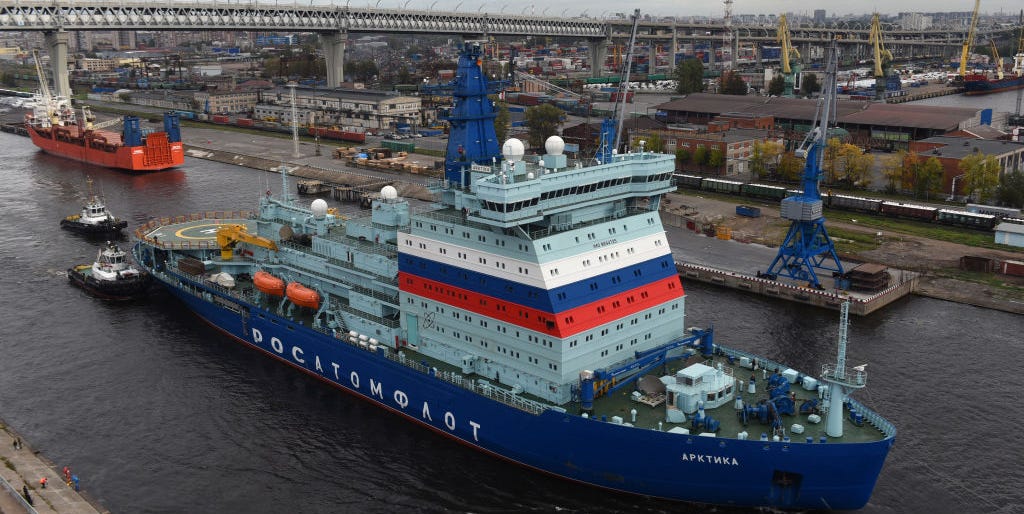
The Arctic is not exactly famous for rolling out the welcome mat. It is cold, dark for long stretches of the year, covered in thick sea ice, and generally behaves like a giant frozen bouncer guarding the top of the planet. Yet Russia has spent decades building ships designed to say, politely but firmly, “Excuse me, coming through.” The most famous of its new generation is the Arktika icebreaker, a massive nuclear-powered vessel built to keep shipping lanes open across Russia’s icy northern coast.
The Arktika is not just another large ship with a tough hull. It is the lead vessel of Russia’s Project 22220 class, also known as the LK-60Ya series, a family of nuclear-powered icebreakers designed for the Northern Sea Route. This route runs along Russia’s Arctic coastline and has become increasingly important as Moscow looks north for energy exports, trade access, and geopolitical influence.
In simple terms, Arktika is a floating power plant, a snowplow, a maritime escort, and a national strategy statement wrapped into one steel giant. It is the kind of ship that makes ordinary vessels look like they forgot leg day.
What Is the Arktika Icebreaker?
The Arktika nuclear-powered icebreaker is Russia’s flagship new-generation icebreaker and the first completed vessel in Project 22220. It entered official service in October 2020 after sea trials that included a voyage through Arctic waters and a passage via the North Pole. Its job is to escort cargo ships, tankers, and other vessels through ice-covered waters, especially along the Northern Sea Route.
The name “Arktika” carries history. A previous Soviet nuclear icebreaker with the same name became the first surface ship to reach the North Pole in 1977. The modern Arktika borrows that legacy but upgrades almost everything: size, power, reactor technology, propulsion systems, and operational flexibility.
At about 173 meters long and 34 meters wide, Arktika is one of the largest and most powerful icebreakers ever built. It is designed to break through ice up to roughly three meters thick, which is around ten feet. That is not “thin skating pond” ice. That is “your SUV has disappeared under a frozen wall” ice.
Why Russia Built Arktika
Russia’s geography explains much of the story. The country has a vast Arctic coastline, large energy reserves in the far north, and a long-standing ambition to turn the Northern Sea Route into a reliable commercial corridor. The challenge is obvious: ships cannot move through solid ice unless something powerful clears the way.
That is where nuclear icebreakers come in. Unlike diesel-powered vessels, nuclear-powered icebreakers can operate for long periods without refueling. This matters in the Arctic, where fuel logistics are difficult, weather changes quickly, and ports are few and far between. Arktika gives Russia the ability to support shipping, energy projects, scientific activity, and state presence in remote waters that would otherwise be extremely difficult to access.
The ship is also part of a wider political and economic goal. Moscow wants year-round or near-year-round navigation along parts of the Northern Sea Route. That would help move liquefied natural gas, oil, minerals, construction materials, and other cargo from Arctic regions to markets in Europe and Asia. In that sense, Arktika is not merely a ship. It is infrastructure with propellers.
Inside the Power of the Arktika Icebreaker
Twin RITM-200 Nuclear Reactors
The heart of the Arktika icebreaker is its nuclear power system. The vessel uses two RITM-200 pressurized water reactors, a modern reactor design developed for Russia’s newest icebreaker fleet. These reactors generate heat, which produces steam, which powers turbine generators, which then drive the ship’s electric propulsion system.
That may sound like a lot of steps, but the result is simple: enormous and steady power. Arktika’s propulsion system delivers around 60 megawatts to its shafts. That is the muscle needed to push the ship’s reinforced bow into thick ice, ride up onto it, and crush it under the vessel’s weight.
Nuclear propulsion gives Arktika a major endurance advantage. Reactor fuel can last for years, while food and supplies limit the crew more than fuel does. In the Arctic, where “quick stop at the next gas station” is not a realistic operational plan, that endurance is a big deal.
A Hull Built to Bully Ice
An icebreaker does not cut through ice like a kitchen knife. It uses a specially shaped hull to climb onto the ice and break it downward. Arktika’s bow is rounded, strong, and engineered for repeated impact. The hull is reinforced for polar operations, and the propulsion system is built to keep pushing even when the sea looks less like water and more like a parking lot made of frozen concrete.
Its three-shaft propulsion system gives it the force and maneuverability needed in difficult ice conditions. In open water, Arktika can reach about 22 knots. In thick ice, speed drops sharply, but speed is not the main point. The point is power, control, and persistence.
The Dual-Draft Design: Two Jobs in One Ship
One of Arktika’s cleverest features is its dual-draft design. Draft refers to how deep a ship sits in the water. Arktika can adjust its draft by taking on or discharging ballast water. With a deeper draft, it can work in heavy Arctic seas. With a shallower draft, it can operate closer to river mouths and coastal areas.
This flexibility matters because the Northern Sea Route is not one neat, uniform highway. It includes deep Arctic waters, shallow approaches, river estuaries, and coastal zones. A ship that can shift between these conditions is far more useful than one designed for only a single environment.
Russia has described this design as a way of getting two types of icebreaker capability from one class of ships. That may sound like marketing, but in practical terms it means Arktika can support both ocean-going transit and regional Arctic logistics.
Arktika and the Northern Sea Route
The Northern Sea Route runs from the Kara Sea in the west toward the Bering Strait in the east, following Russia’s Arctic coast. For some journeys between Europe and Asia, it can be much shorter than the traditional route through the Suez Canal. In theory, shorter distance means less fuel, faster delivery, and lower costs.
In practice, the Arctic has a habit of laughing at theory. Ice, storms, limited ports, insurance costs, search-and-rescue challenges, shallow waters, environmental risks, and political complications all make the Northern Sea Route difficult. A shipping company cannot simply draw a line across the top of the map and declare victory.
Arktika’s role is to reduce some of that uncertainty. By escorting ships through dangerous ice, it helps create a more predictable corridor. This is especially important for Russia’s Arctic energy projects, where cargoes of LNG, oil, and industrial supplies need dependable movement through remote regions.
Why Nuclear Icebreakers Still Matter as Arctic Ice Declines
At first glance, melting Arctic sea ice might seem like bad news for icebreakers. If there is less ice, why build more ships to break it? The answer is that the Arctic is still icy, unpredictable, and dangerous for much of the year. Declining sea ice does not mean the Arctic becomes a warm blue-water freeway. It means ice conditions become more variable.
Older, thicker multi-year ice has declined sharply, but seasonal ice, drifting floes, pressure ridges, and sudden freeze-ups remain serious hazards. In some ways, thinner and more mobile ice can create its own problems because it moves unpredictably with wind and current. Ships still need escorts, especially during shoulder seasons and winter operations.
So Arktika is not a relic of a frozen past. It is a tool for a changing Arctic. Russia is betting that as the region becomes more accessible, icebreaker demand will grow rather than disappear.
How Arktika Compares With Older Icebreakers
Russia has operated nuclear-powered icebreakers since the Soviet era, but Arktika represents a new generation. Older vessels such as Yamal and 50 Let Pobedy were powerful and iconic, but Project 22220 ships bring greater size, modern reactors, updated propulsion, and improved operational flexibility.
The modern Arktika is larger than many earlier Russian icebreakers and is designed for a longer service life. Its reactors are more compact than older designs, and its systems are intended to support long-term Arctic deployment. Compared with conventional icebreakers, its nuclear power gives it a distinct advantage in endurance and heavy-ice capability.
That does not mean Arktika is perfect. The ship’s construction faced delays, and early service included technical issues, including propulsion-related repair work. That is not unusual for first-of-class ships, especially vessels this complex. When you build a floating nuclear-powered ice crusher the size of a city block, the troubleshooting manual is probably not a pamphlet.
The Project 22220 Fleet: Arktika Is Only the Beginning
Arktika is the lead ship, but it is part of a larger fleet. Sister ships include Sibir, Ural, Yakutiya, and additional vessels under construction or planned. Together, these ships are meant to replace older nuclear icebreakers and expand Russia’s capacity along the Northern Sea Route.
Each Project 22220 vessel shares the same core mission: escort ships, keep Arctic lanes open, support industrial projects, and strengthen Russia’s operational presence in the north. The fleet is central to Russia’s Arctic ambitions because no amount of strategy works if cargo ships get stuck in ice hundreds of miles from help.
There is also an industrial angle. Building these ships supports Russian shipyards, nuclear engineering firms, reactor manufacturers, and maritime technology suppliers. However, sanctions and supply-chain challenges have complicated parts of the program, especially where foreign-made components were previously used.
Commercial Value: More Than a Symbol
It is tempting to see Arktika mostly as a symbol of national power, and it certainly is that. But the commercial side is equally important. Russia’s Arctic contains major resource projects, including LNG, oil, minerals, and infrastructure developments. These projects need transport links.
An icebreaker like Arktika helps move cargo vessels that carry equipment, fuel, construction materials, and export commodities. Without icebreaker support, many routes would be seasonal, risky, or impossible. With support, shipping windows can expand, schedules become more realistic, and industrial projects become easier to supply.
This is why the Arktika icebreaker matters beyond naval pride. It is a working vessel in a region where logistics can decide whether a project succeeds or freezes into a very expensive sculpture.
Environmental Questions Around Nuclear Icebreakers
No discussion of a nuclear-powered ship in the Arctic is complete without environmental concerns. Nuclear propulsion reduces the need for large volumes of marine fuel, but it also brings questions about reactor safety, waste management, emergency response, and long-term decommissioning.
Russia has decades of experience operating nuclear icebreakers, and modern reactor designs include multiple safety systems. Still, the Arctic is a fragile environment. Any accident involving fuel, radioactive material, or heavy industrial activity would be difficult to manage in such remote waters.
There is also the broader climate paradox. Icebreakers help support shipping and energy extraction in a region being transformed by climate change. As the ice retreats, more industrial activity becomes possible, but that activity can bring new environmental risks. Arktika is therefore both a response to Arctic change and a contributor to the debate over how the Arctic should be used.
Geopolitical Importance of the Arktika Icebreaker
The Arctic is no longer a quiet corner of the world map. It is increasingly discussed in terms of shipping, energy, national security, climate science, and great-power competition. Russia, the United States, Canada, Norway, Denmark, Finland, Sweden, and China all have interests in the region, though their geography and priorities differ.
Russia’s advantage is physical presence. It has the longest Arctic coastline and the world’s most developed nuclear icebreaker fleet. Arktika strengthens that advantage by giving Moscow a powerful tool to operate in waters where many other countries have limited capability.
For the United States and its allies, Russia’s icebreaker fleet highlights a capability gap. The U.S. Coast Guard has far fewer heavy polar icebreakers, and new shipbuilding programs have faced delays and funding challenges. This does not mean Arktika is a warship; it is a civilian icebreaker. But in the Arctic, civilian infrastructure often carries strategic weight.
Is the Northern Sea Route the Future of Global Shipping?
The Northern Sea Route has promise, but it is not about to replace the Suez Canal overnight. The Suez route has established ports, predictable infrastructure, year-round service, mature insurance models, and global familiarity. The Arctic route is shorter for some voyages but harder to manage.
For specialized cargo, Russian energy exports, and seasonal transit, the Northern Sea Route can be attractive. For mainstream container shipping, it remains complicated. Weather risk, ice conditions, limited rescue options, political uncertainty, and environmental rules all raise costs.
Arktika improves the route’s practicality, but it cannot solve every problem. A powerful icebreaker can crush ice; it cannot magically create ports, remove sanctions, calm storms, or make insurers cheerful. Still, without ships like Arktika, the Northern Sea Route would be much less realistic as a commercial corridor.
Conclusion: Why Arktika Matters
The Arktika icebreaker is one of the most important ships in modern Arctic transportation. It combines nuclear endurance, heavy-ice capability, flexible draft, and strategic purpose. As the lead vessel of Russia’s Project 22220 fleet, it marks a major step in the country’s effort to expand Arctic shipping and strengthen control over the Northern Sea Route.
Its importance goes beyond engineering. Arktika sits at the intersection of climate change, energy logistics, maritime technology, and geopolitics. It shows how the Arctic is changing from a remote frozen frontier into a contested transportation and resource zone.
Whether viewed as a technical marvel, a commercial tool, or a geopolitical signal, Arktika is difficult to ignore. It is massive, powerful, nuclear-powered, and built for one of the harshest environments on Earth. In other words, it is exactly the kind of ship the Arctic demands: tough enough to argue with ice and usually win.
Experience Perspective: Understanding Arktika Beyond the Numbers
To appreciate the Arktika icebreaker, it helps to move beyond specifications and imagine the experience of depending on such a ship in Arctic waters. Picture a cargo vessel approaching the Northern Sea Route in late season. The map shows a passage. The satellite images show ice. The forecast changes. The captain knows that confidence in the Arctic should always be served in small portions.
Then an icebreaker like Arktika arrives. It does not make the Arctic friendly, but it makes the route possible. For the crew of an escorted vessel, the icebreaker becomes more than a ship ahead on the horizon. It becomes the difference between progress and delay, between a schedule and a crisis. Watching a nuclear icebreaker move through heavy ice must feel like seeing a road being built in real time.
For engineers, Arktika is fascinating because it solves several problems at once. It must generate huge power, protect its reactors, survive violent contact with ice, operate in extreme cold, and remain maneuverable in narrow channels. Every system has to work under conditions that punish weakness. A small failure in a warm port is an inconvenience. A small failure in the Arctic can become a very large problem wearing a snow hat.
For logistics planners, the experience is different. Arktika represents predictability. Arctic shipping is expensive because uncertainty is expensive. If a vessel is delayed by ice, costs ripple through contracts, crews, ports, customers, and insurance. Icebreaker support reduces that uncertainty. It does not make Arctic shipping easy, but it makes it more manageable.
For environmental observers, the experience is more conflicted. On one hand, nuclear icebreakers are remarkable examples of engineering. On the other hand, they help open a fragile region to heavier industrial activity. The sight of Arktika breaking through ice can inspire awe and concern at the same time. It is a symbol of human capability, but also a reminder that capability is not the same thing as wisdom.
For ordinary readers, the most memorable part may be the scale. A ship longer than one and a half football fields, powered by nuclear reactors, pushing through ice thicker than a tall person is not everyday machinery. It sounds like something from a science-fiction film, except it is real, registered, crewed, maintained, and sent to work.
That is the deeper experience of Arktika: it makes the Arctic feel less abstract. Climate change, trade routes, energy exports, sanctions, shipbuilding, and national power can sound like distant policy language. But put them into the shape of one enormous icebreaker, and suddenly the story has steel, reactors, propellers, and a bow that climbs onto ice and crushes it. Arktika is not just a vessel moving through the Arctic. It is a sign of how quickly the top of the world is becoming central to the future of shipping, energy, and global strategy.