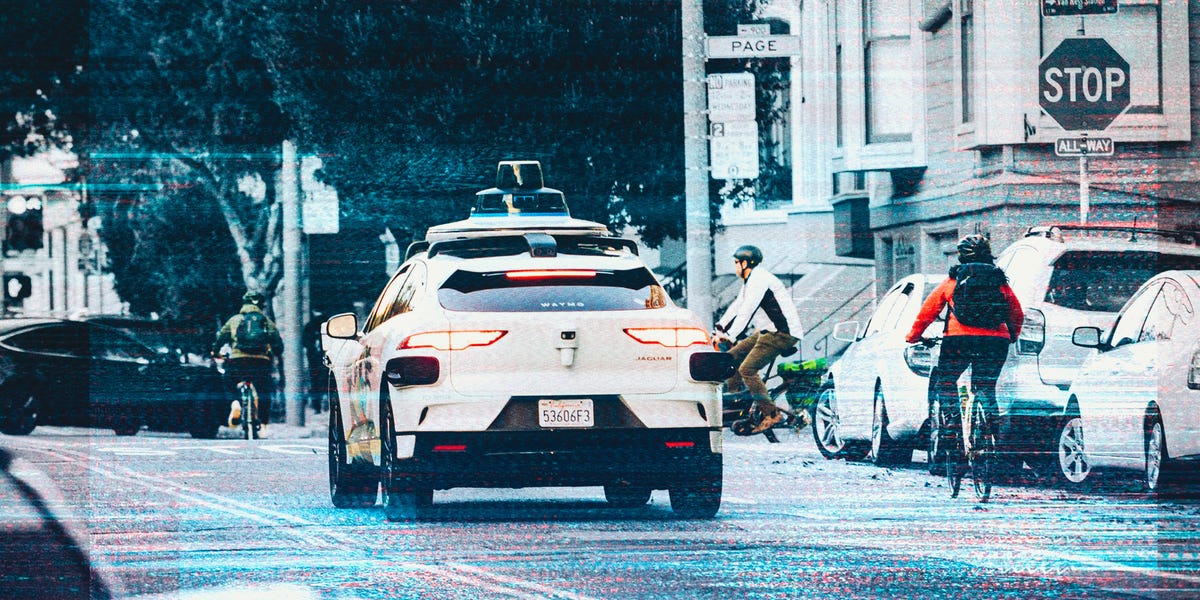
For cyclists, sharing the road with cars has always involved a certain amount of detective work. Is that driver looking at me? Did they see my hand signal? Are they about to turn right across the bike lane while simultaneously checking a text message and balancing an iced coffee?
Self-driving cars promise to remove some of those human variables. Computers do not get sleepy, angry, impatient, intoxicated, or distracted by a notification announcing that someone liked a photo from 2017. In theory, an automated vehicle equipped with cameras, radar, lidar, detailed maps, and sophisticated prediction software should be an excellent neighbor for someone riding a bicycle.
Reality, unsurprisingly, is more complicated.
Current evidence suggests that advanced automated driving systems may eventually make roads substantially safer for cyclists. Some deployed Level 4 vehicles are already showing encouraging overall crash results. But researchers and U.S. transportation agencies continue to identify important challenges involving cyclist detection, unpredictable movements, blocked sightlines, communication, mixed traffic, and unusual road situations.
Research basis: NHTSA, IIHS, FHWA and PBIC.
First, What Counts as a Self-Driving Car?
The phrase “self-driving car” gets thrown around rather casually, sometimes describing everything from a robotaxi with no driver to a family SUV that can briefly steer itself on the interstate. Those technologies are not equivalent.
NHTSA distinguishes automated driving systems from Level 2 driver-assistance systems. At Level 2, technology can control steering and speed simultaneously, but the human driver must remain attentive and responsible. Higher-level automated driving systems are intended to perform the driving task within specific operating conditions without continuous human control.
Source: NHTSA Standing General Order guidance.
This distinction matters enormously to cyclists. A Level 2 car with an inattentive driver creates a different risk from a Level 4 robotaxi whose automated driving system is actually responsible for watching the road.
Why Self-Driving Cars Could Be Good News for Cyclists
They Do Not Get Distracted
Human drivers miss cyclists for depressingly ordinary reasons. They look at phones, adjust navigation systems, check mirrors too late, become fatigued, or simply fail to notice someone approaching in a bike lane.
A properly functioning automated vehicle continuously monitors its surroundings. Modern systems may combine multiple cameras with radar, lidar, mapping, positioning, and machine-learning software. Sensor fusion gives the vehicle several ways to identify where a cyclist is, estimate where that cyclist is going, and calculate whether the vehicle’s planned movement creates a conflict.
Companies developing Level 4 systems also train their software using simulations containing unusual cycling situations. These can include cyclists merging around parked cars, riding in groups, traveling at different speeds, suddenly entering traffic, or even falling into the roadway.
Sources: Waymo cyclist research and University of Michigan AV testing research.
Computers Can Be Extremely Patient
A cyclist climbing a hill at 11 mph may inspire some human drivers to attempt the automotive version of squeezing toothpaste through a keyhole: passing despite insufficient room.
An automated vehicle does not become annoyed because the bicycle ahead is slower. Its software can be designed to wait until sufficient passing distance exists, maintain a safe following gap, reduce speed, and abandon a pass if conditions change.
That predictability could become one of automation’s greatest cycling-safety advantages. A cautious robot does not care that it is 37 seconds late for brunch.
Speed Control Could Reduce Crash Severity
Speed is especially important for vulnerable road users because cyclists have no steel passenger compartment, airbags, or crumple zones protecting them. Federal safety guidance emphasizes reducing traffic speeds and separating vulnerable road users from faster vehicles when possible.
The Federal Highway Administration’s Safe System approach treats speed management as a fundamental part of protecting pedestrians and bicyclists. Automated vehicles potentially add another layer because they can be programmed to obey operating limits consistently rather than treating the speed-limit sign as an opening bid in a negotiation.
Sources: FHWA Safe System guidance and NTSB Safe System recommendations.
So, Are Cyclists Already Safer Around Autonomous Cars?
There is encouraging evidence, but declaring victory would be premature.
A July 2026 Insurance Institute for Highway Safety study compared Waymo Level 4 driverless vehicles with human drivers in Phoenix, San Francisco, Los Angeles, and Austin. Across the studied deployments, Waymo vehicles had a 68% lower rate of crashes that researchers considered police-reportable compared with human drivers operating in comparable locations and periods.
That is significant. It is also not proof that every autonomous vehicle is 68% safer for cyclists.
The study concerned one company’s Level 4 system operating inside defined environments. The researchers specifically warned against assuming the results automatically apply to other companies, future operating areas, or every road condition. The operational environments also differed from the full range of places where humans drive.
Source: IIHS 2026 Level 4 crash study.
More importantly for cyclists, overall crash statistics cannot answer every cyclist-specific question. Bicycle encounters are less common than vehicle-to-vehicle encounters, so researchers need considerably more exposure data before they can confidently compare rare but severe bicycle crashes across technologies.
The stakes remain high. NHTSA reported that 1,103 bicyclists died in U.S. traffic crashes in 2024. Improving vehicle technology therefore matters, but it is being introduced into a road environment that already presents serious risks to people on bikes.
Source: NHTSA bicycle safety statistics.
The Hardest Problem: Seeing Is Not the Same as Understanding
Cyclists Are Complicated Moving Objects
Recognizing a bicycle is only step one. An autonomous car must also predict what its rider will do.
A cyclist might remain in the bike lane, swing left to avoid a pothole, move around a delivery truck, turn without signaling, stop unexpectedly, accelerate downhill, or temporarily leave the roadway. An e-bike may look similar to a conventional bicycle while approaching much faster.
Researchers have therefore focused increasingly on bicycle “corner cases”rare or unusual situations that automated vehicles nevertheless need to handle safely. University of Michigan research, for example, has explored models capable of predicting behaviors such as sudden lateral movement by cyclists.
Source: University of Michigan Transportation Research Institute research.
Occlusion Is a Major Challenge
Even excellent sensors cannot directly observe something completely hidden behind another object.
Imagine a cyclist traveling beside a row of parked SUVs. At an intersection, the cyclist may be temporarily invisible to a turning vehicle. Delivery vans, landscaping, buses, construction barriers, and other cars can create similar problems.
Southwest Research Institute has highlighted this issue in work on connected transportation systems. Infrastructure-mounted sensors and vehicle-to-everything communication could eventually warn vehicles about cyclists obscured from their onboard sensors.
Source: Southwest Research Institute.
In other words, the safest autonomous car may someday receive information not merely from what it can see but from intersections, other vehicles, and connected infrastructure around it.
Night, Weather, and Weird Conditions Still Matter
Automated perception is powerful, but environmental conditions complicate the job. Darkness, glare, rain, fog, unusual clothing, road construction, dirty sensors, faded lane markings, and complicated intersections can all make detection or classification more difficult.
Research on today’s automatic emergency braking and pedestrian-detection technology provides a useful warning against assuming that machine perception is flawless. IIHS studies have found that crash-prevention performance can vary substantially depending on lighting and other conditions. In a particularly interesting 2025 experiment, some highly reflective clothing designed to make pedestrians more visible to humans interfered with certain pedestrian crash-prevention systems.
That research involved pedestrians rather than autonomous cyclist detection, but the broader lesson applies: sensor behavior is not always intuitive from a human perspective.
Sources: IIHS crash prevention research.
Communication Without Eye Contact
Cyclists and drivers constantly communicate without realizing it.
A driver slows. A cyclist looks toward the windshield. Someone waves. The cyclist rolls forward. The driver waits. Nobody signs a treaty, yet everyone understands what just happened.
A driverless vehicle complicates this tiny social ritual because there may be nobody behind the steering wheel to make eye contact with.
Researchers studying automated vehicles and vulnerable road users have therefore examined external communication systems, sometimes called external human-machine interfaces. These might use lights, displays, or other signals to communicate that a vehicle has detected a cyclist or intends to yield.
However, creating another blinking light on a car does not automatically produce universal understanding. Signals need to be standardized, intuitive, visible in different weather conditions, and understandable to children, tourists, older adults, and people who have never read an autonomous-vehicle instruction manualwhich is approximately everyone.
Sources: TRB and PBIC automated-vehicle interaction research.
Mixed Traffic May Be the Awkward Stage
A future road where every vehicle follows standardized automated rules could be relatively predictable. The transition period is considerably messier.
Cyclists increasingly encounter a mixture of conventional drivers, vehicles with driver-assistance systems, highly automated robotaxis, buses, delivery vehicles, scooters, and pedestriansall interpreting one another differently.
FHWA specifically identifies mixed fleets as an important area for automated-driving and vulnerable-road-user research. It has also warned that people may overestimate what automated vehicles can detect and consequently take unnecessary risks.
Source: FHWA Vulnerable Road User Research Plan.
That creates an important rule for cyclists: never assume a vehicle will stop simply because you believe it is autonomous.
Better Cars Cannot Fix Bad Streets by Themselves
It is tempting to imagine autonomous vehicles as a software patch for dangerous road design. Unfortunately, transportation does not work like updating a phone.
Protected bike lanes, lower vehicle speeds, safer intersections, adequate lighting, shorter crossings, better sightlines, and thoughtful curb management remain essential. Federal Safe System guidance emphasizes designing roads so inevitable human mistakes do not result in death or catastrophic injury.
This becomes particularly relevant as robotaxis and autonomous delivery vehicles increase curbside pickups and drop-offs. A vehicle stopping across a bike lane may be operating autonomously, but the cyclist still has to steer around it.
FHWA has explicitly identified automated rideshare and delivery pickup locations as potential new conflict points with vulnerable road users.
Sources: FHWA Vulnerable Road User Research Plan and U.S. DOT infrastructure guidance.
What Cyclists Can Do Around Self-Driving Cars
Until the technology and rules mature further, cyclists should treat automated vehicles much as they would cautious but unfamiliar human drivers.
- Remain predictable. Hold a reasonably consistent line and signal turns when practical.
- Do not deliberately test the vehicle. Stepping or swerving into its path to see whether it stops is not safety research; it is an unnecessarily exciting Tuesday.
- Stay visible. Use legally required bicycle lighting and appropriate visibility equipment, especially at night.
- Watch vehicle movement. Deceleration, wheel position, lane placement, and turning behavior remain useful clues regardless of whoor whatis driving.
- Expect occlusion problems. Be particularly careful when emerging from behind buses, trucks, parked vehicles, or construction barriers.
- Use protected infrastructure when available. Physical separation reduces the number of situations in which vehicle intelligence has to rescue everyone from bad geometry.
NHTSA continues to recommend defensive riding, following traffic laws, maintaining visibility, and giving all road users adequate space. Those principles remain relevant whether the approaching vehicle contains a human driver, a computer, or both.
Source: NHTSA bicycle safety guidance.
What Autonomous-Vehicle Developers Still Need to Solve
Protecting cyclists requires testing much more than a standard adult riding neatly down a sunny bike lane.
Automated-driving systems need exposure to children on bicycles, cargo bikes, recumbent bicycles, adaptive cycles, e-bikes traveling at higher speeds, cyclists riding in groups, riders carrying unusual objects, bicycles emerging between parked vehicles, nighttime situations, work zones, roundabouts, hills, poor pavement, and riders suddenly maneuvering around obstacles.
Testing also needs to evaluate overtaking distance, right hooks, left turns across bicycle traffic, door-zone avoidance, merging behavior, and safe responses when cyclists violate expected traffic patterns.
Federal researchers are already studying many of these interaction problems. FHWA’s research agenda includes bicyclist interactions in dedicated lanes, shared lanes, roundabouts, mixed fleets, and environments involving connected infrastructure.
Source: FHWA Vulnerable Road User Research Plan.
Transparency Will Matter Almost as Much as Technology
Determining whether autonomous vehicles are genuinely safer requires reliable crash and exposure data.
NHTSA currently requires specified manufacturers and operators to report certain crashes involving automated driving systems and Level 2 driver-assistance technologies. Vulnerable-road-user collisions are specifically included in the reporting framework.
However, NHTSA warns that the resulting data have limitations. Companies differ in telemetry, operating conditions, fleet size, mileage, and their ability to learn that a crash happened. Consequently, simply counting reported crashes from two companies can produce misleading comparisons.
The meaningful question is not “How many crashes occurred?” It is closer to: “How frequently did comparable crashes occur per mile, under comparable conditions, with comparable reporting thresholds?”
Source: NHTSA Standing General Order data limitations.
Conclusion: Are Cyclists Safe Around Self-Driving Cars?
Potentially safer, yes. Automatically safe, no.
Advanced automated vehicles have characteristics that could eliminate some of the biggest threats cyclists face from human drivers: distraction, fatigue, intoxication, aggression, impatience, and inconsistent attention. Early real-world Level 4 data from Waymo are encouraging, and researchers are developing increasingly sophisticated ways to detect and predict vulnerable road users.
Yet autonomous vehicles still operate in environments filled with blind corners, unusual behavior, bad pavement, poor lighting, mixed traffic, unpredictable people, and infrastructure designed decades before anyone imagined a robotaxi.
The best future is therefore unlikely to come from self-driving technology alone. Cyclist safety will depend on combining safer automated vehicles with lower speeds, protected bicycle infrastructure, better intersections, rigorous cyclist-specific testing, transparent crash data, and transportation policies that assume machines can make mistakes too.
A robot that never texts while driving is progress. A street designed so that one imperfect decision does not kill somebody is better.
Real-World Experience: What Riding Near Autonomous Cars May Feel Like
Statistics tell us whether technology appears safer across millions of miles. Individual cycling encounters feel much more personal. A difference of two feet, half a second, or one uncertain merge can completely change a rider’s impression of an automated vehicle.
Experience 1: The Surprisingly Patient Follower
Imagine riding down a narrow residential street where parked cars leave no safe passing room. With a human driver behind you, the growing engine noise may create pressure to squeeze toward the curb, even when doing so puts you dangerously close to opening doors.
A conservative automated vehicle may simply remain behind the bicycle. For the cyclist, that can initially feel strange. The car is obviously capable of traveling faster, yet it refuses to perform the questionable six-inch pass that impatient motorists occasionally attempt.
After several seconds, the experience may actually become reassuring. The cyclist can maintain a safe road position rather than trying to disappear into the gutter.
Experience 2: The Intersection Standoff
Now picture a cyclist arriving at an intersection while an autonomous car approaches from another direction. The vehicle slows early. The bicycle slows too. The autonomous car waits. The cyclist waits because there is no visible driver making eye contact.
Everyone is wonderfully safe and spectacularly inefficient.
This illustrates why communication matters. Human road users rely heavily on subtle cues. If automated vehicles consistently demonstrate recognizable yielding behavioror eventually use standardized external signalsthe awkward “you go; no, you go” routine could become much easier.
Experience 3: The Parked-Van Problem
A cyclist travels along a bike lane and approaches an intersection beside a large delivery van. A turning autonomous vehicle cannot initially obtain a clean view of the rider.
A robust system should recognize the occlusion itself as a hazard. Rather than assuming an unseen area is empty, it can reduce speed and prepare for a cyclist, pedestrian, scooter, or surprisingly athletic raccoon to emerge.
For cyclists, this is one of the most important behaviors to watch. Good automated driving is not merely identifying objects once they appear. It is anticipating where hidden road users could plausibly exist.
Experience 4: When the Cyclist Does Something Unexpected
Real cyclists rarely behave like perfectly animated objects in a computer demonstration.
A rider spots broken glass and moves left. Another avoids a storm drain. Someone’s grocery bag slips toward the wheel. A child wobbles. An e-bike accelerates much faster than expected.
This is where automated prediction becomes critical. The vehicle must preserve enough space that a modest deviation does not instantly become a collision course.
From a cyclist’s perspective, generous passing distance is often more reassuring than sophisticated displays or futuristic sensor towers. Space provides a safety margin both humans and computers can understand.
Experience 5: Learning Not to Trust the Technology Too Much
Perhaps the strangest long-term challenge will appear when autonomous vehicles become consistently cautious.
Cyclists may begin assuming that robotaxis always detect them and always yield. Pedestrians could develop similar expectations. Researchers have already identified overtrust as a concern because people may behave more aggressively when they believe an automated vehicle will inevitably protect them.
Source: FHWA and TRB research priorities.
The safest habit is therefore deliberately boring: ride predictably, preserve escape space, follow traffic rules, and never make your safety dependent on perfect machine perception.
The arrival of autonomous cars does not mean cyclists can stop paying attention. It may eventually mean they need to worry less about whether the person behind them is texting, speeding, angry, sleepy, or simply not looking.
For anyone who regularly rides a bicycle in traffic, that would be a meaningful improvement.
Note: This article synthesizes current U.S. transportation-safety guidance and research from sources including NHTSA, FHWA, NTSB, IIHS, the AAA Foundation for Traffic Safety, the Pedestrian and Bicycle Information Center, U.S. DOT, Transportation Research Board resources, University of Michigan transportation researchers, Southwest Research Institute, and published autonomous-vehicle safety research. Findings about individual automated-driving systems should not be generalized to every vehicle or manufacturer.
Additional research sources supporting synthesis: AAA Foundation perceptions research and NTSB bicyclist safety research.