Human beings have always enjoyed building big things. First came stone circles, then pyramids, skyscrapers, suspension bridges, and airports with terminals apparently designed by people who dislike walking. Theoretical megastructures take this habit to its cosmic conclusion.
These colossal engineering concepts range from rotating space settlements to machines that could capture a star’s energy or move an entire solar system. Some began as serious scientific proposals, while others emerged from thought experiments or science fiction. None of the largest designs is close to construction, but studying them helps researchers explore orbital mechanics, energy management, artificial gravity, advanced materials, and the possible signatures of extraterrestrial technology.
Here are ten of the most fascinating theoretical megastructures, ranked broadly by scale, ambition, and their ability to make an ordinary skyscraper feel like a decorative toothpick.
What Is a Theoretical Megastructure?
A theoretical megastructure is an enormous engineered system whose dimensions, mass, or energy requirements exceed those of conventional structures by several orders of magnitude. Depending on the design, it might surround a planet, orbit a star, provide living space for billions of people, or function as a civilization-sized computer.
Not all megastructures violate known physics. Space elevators, rotating habitats, and orbital rings can be described using established engineering principles. Their obstacles are mainly materials, economics, construction logistics, and reliability. Star-enclosing shells and black-hole-scale worlds are far more speculative, often requiring active support systems, planetary quantities of material, or technologies that have never been demonstrated.
10. Space Elevator
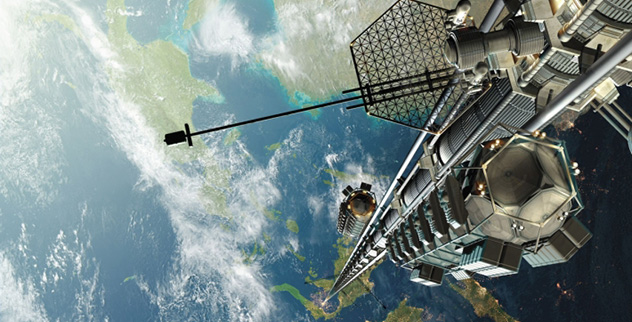
A space elevator would connect Earth’s surface to a counterweight beyond geostationary orbit using an extremely long tether. Electrically powered climbers could travel along that tether, transporting cargo without using a conventional rocket for most of the journey.
Why It Could Transform Spaceflight
Once operating, a space elevator might reduce the energy and recurring cost associated with reaching orbit. Cargo could ascend gradually rather than riding several hundred tons of controlled explosion. The same basic concept has also been considered for the Moon and Mars, where lower gravity makes the engineering less punishing.
Earth’s version faces a decisive materials problem. The tether must be light yet strong enough to support its own enormous weight while surviving wind, lightning, radiation, temperature changes, debris, and oscillations. Carbon nanotubes and graphene are frequently discussed as candidates, but manufacturing a flawless tether tens of thousands of miles long remains beyond current capability.
9. Orbital Ring
An orbital ring is a planet-encircling transportation and support system. In one widely discussed configuration, a rapidly moving inner cable or stream of mass travels around Earth at orbital velocity. Magnetic coupling transfers some of its outward force to platforms that remain approximately stationary relative to the ground.
A Highway Above the Atmosphere
Tethers could connect the supported platforms to the surface, allowing elevators to carry passengers and freight upward. The ring might serve as a launch facility, power network, communications backbone, or starting point for interplanetary travel.
Unlike a conventional satellite, however, the system would depend on continuous control. A failure could affect thousands of miles of infrastructure, which is a slightly larger maintenance concern than a broken office elevator. Engineers would need advanced magnetic bearings, precise stabilization, redundant segments, and reliable ways to assemble the structure without disrupting existing satellites.
8. Stanford Torus
The Stanford torus emerged from a 1975 NASA-sponsored space-settlement study. Its classic design describes a rotating, doughnut-shaped habitat approximately 1.1 miles across, intended to support about 10,000 residents. At roughly one rotation per minute, the torus would create an effect similar to gravity along its outer interior.
Living Inside a Rotating Ring
Large mirrors would direct sunlight into the habitat, while farms, homes, parks, and workshops would occupy the enclosed living area. The central hub could provide low-gravity docking and industrial facilities.
The proposal is smaller than most stellar megastructures, but it addresses practical questions those grander ideas often wave away: Where does the oxygen come from? How is waste recycled? How are crops grown? What happens to excess heat? Radiation shielding alone could require millions of tons of material, possibly obtained from the Moon or asteroids rather than launched from Earth.
7. O’Neill Cylinder
Physicist Gerard K. O’Neill popularized immense cylindrical space habitats during the 1970s. His famous Island Three concept featured two counter-rotating cylinders, each several miles wide and roughly 20 miles long. The rotation would produce artificial gravity, while counter-rotation would help balance angular momentum.
A Manufactured World in Orbit
Alternating window and land sections were envisioned along the cylinders, with external mirrors directing sunlight inside. The inhabited valleys could contain towns, lakes, forests, and agriculture. Operators could adjust rotational speed to create different effective gravity levels, making the habitat more customizable than a planet.
Constructing an O’Neill cylinder would require large-scale space mining, automated manufacturing, closed-loop life support, radiation shielding, and extraordinary quality control. Even a tiny defect could become a serious problem in a structure holding an atmosphere. Still, among theoretical megastructures, rotating habitats remain comparatively grounded in known physics.
6. Alderson Disk
An Alderson disk is a colossal, flat structure shaped like a compact disc, with a star positioned in its central opening. The concept is associated with scientist and science-fiction enthusiast Dan Alderson. Its surface could theoretically provide living space vastly greater than that of every rocky planet in a typical solar system combined.
An Artificial World with Permanent Twilight
Because light would strike the inner regions at a shallow angle, potentially habitable zones might exist near the star-facing edges. Day and night would not occur naturally in the familiar planetary sense, so artificial cycles, moving shades, or enormous mirrors would be needed.
The design creates major gravitational and structural difficulties. The star would not automatically remain centered, and the disk would experience tremendous stresses. It would also require an almost comical amount of matter. Building one might involve dismantling planets, moons, asteroids, and everyone’s favorite scenic overlook.
5. Shkadov Thruster
The Shkadov thruster is a theoretical stellar engine: a machine designed to move a star. Its primary component would be an enormous curved mirror positioned near the star. The mirror would reflect a portion of the star’s radiation in one direction, creating a tiny but continuous imbalance in momentum.
Moving an Entire Solar System
The acceleration would be extraordinarily small, but stars have long lifetimes. Over millions of years, persistent thrust could alter a star’s path through the galaxy. Because planets are gravitationally bound to the star, much of the planetary system would travel with it.
A sufficiently advanced civilization might use such a stellar engine to avoid a predicted close encounter, migrate toward useful resources, or reposition its system over geological timescales. The mirror would need careful placement and stabilization so radiation pressure and gravity remained balanced. This is not a practical solution for anyone hoping to relocate before the weekend.
4. Ringworld
A Ringworld is a continuous band surrounding a star, most famously explored by author Larry Niven. Unlike a modest planetary ring, this structure could have a radius comparable to Earth’s orbit. Its inner surface would face the star and offer a habitable area equal to millions of Earths.
The Ultimate Belt-Shaped Habitat
The ring would rotate to generate artificial gravity. Giant shadow panels closer to the star could create alternating periods of daylight and darkness. Mountains or immense walls along the edges would help retain the atmosphere.
The problems are correspondingly gigantic. A rigid ring around a star is not passively stable; small positional errors can grow unless active systems continually correct them. The rotating structure would also experience tension beyond the performance of known materials. Even hypothetical ultra-strong substances would need to be manufactured on an astronomical scale.
3. Birch Planet
A Birch planet is a nested system of artificial shells built around a supermassive black hole. The idea is named after engineer Paul Birch, who explored extremely large structures supported through dynamic or active systems rather than ordinary static strength.
A World Larger Than a Solar System
In its most extreme interpretation, the outer shell could offer extraordinary amounts of living area while the central black hole supplied gravity and potentially energy. Multiple layers might be arranged at different distances, turning the structure into a vast stack of artificial worlds.
The scale is difficult to communicate without insulting ordinary numbers. Construction could require the resources of many star systems. Heat disposal, shell stabilization, radiation, transportation, and communication delays would all become civilization-defining problems. A Birch planet sits near the border where engineering analysis shakes hands with cosmic mythology.
2. Matrioshka Brain
A Matrioshka brain is a hypothetical star-powered computer composed of multiple layers of energy-collecting and computing systems. Its name refers to nested Russian dolls: an inner layer uses high-temperature stellar energy, then radiates waste heat outward, where cooler layers attempt to use the remaining energy.
Computation on a Stellar Scale
Such a system might run immense scientific simulations, support vast numbers of digital minds, model entire civilizations, or calculate whether building the thing was a sensible budget decision. Its architecture is related to a Dyson swarm, but its primary purpose is computation rather than simply gathering power.
Thermodynamics imposes unavoidable limits. Every calculation produces waste heat, and each outer layer must operate at a lower temperature. Recent theoretical work suggests that adding many nested layers may not always provide the dramatic efficiency gains imagined in earlier descriptions. Nevertheless, the Matrioshka brain remains one of the boldest concepts in theoretical computing and astroengineering.
1. Dyson Swarm or Dyson Sphere
Freeman Dyson popularized the idea that an advanced civilization might capture a significant portion of its star’s energy by surrounding it with artificial collectors. The scientifically plausible interpretation is not a solid shell. It is a Dyson swarm containing an enormous number of independently orbiting solar-energy collectors, habitats, factories, and communication platforms.
Harnessing the Power of a Star
A Sun-like star produces roughly 400 yottawatts of power. Capturing even a small fraction would provide energy on a scale incomprehensible to modern civilization. A swarm could grow incrementally as automated factories processed asteroids or dismantled planets for raw materials.
A rigid Dyson shell would be far less practical. It would not behave like an ordinary orbit, would require impossible material strength at many proposed dimensions, and would need active stabilization. A decentralized swarm avoids several of these problems, although managing collisions, orbital traffic, maintenance, and energy transmission would still be a historic challenge.
A Dyson swarm could also produce an observable technosignature. Energy cannot simply disappear, so the system would release waste heat, potentially creating unusual infrared emissions. Astronomers have searched for these patterns, but no candidate has been confirmed as extraterrestrial engineering. Space dust and natural stellar phenomena remain highly talented cosmic impersonators.
Could Humanity Ever Build a Megastructure?
The smaller concepts are not necessarily forbidden by physics. Rotating habitats, large solar-power satellites, lunar elevators, and parts of orbital-ring technology could emerge from advances in robotics, reusable launch systems, in-space manufacturing, and asteroid mining.
The more ambitious structures would require self-replicating industrial systems. Instead of launching every beam and bolt from Earth, robotic factories could use extraterrestrial materials to manufacture additional machines and structural components. Growth would become exponential if each generation of equipment helped build the next.
Energy is only one obstacle. A successful space civilization would also need to manage waste heat, radiation, orbital stability, ecological cycles, governance, maintenance, and debris. The larger the structure, the more dangerous tiny errors become. Megastructure engineering is therefore as much about reliability and systems management as it is about dramatic architecture.
Experiencing the Ideas Behind Theoretical Megastructures
No travel agency currently offers a weekend package to a Dyson swarm, but these concepts can still become surprisingly tangible. The best way to experience theoretical megastructures is to combine observation, physical scale models, simulations, and a little disciplined imagination.
Begin with a Scale Walk
Start outdoors with a scale model of the solar system. If the Sun is represented by a grapefruit, Earth becomes a tiny dot roughly 50 feet away. A Ringworld following Earth’s orbit would form a band with a circumference of nearly 600 million miles in reality. Walking even a miniature version quickly reveals why phrases such as “very large structure” are doing heroic amounts of work.
The exercise also exposes an important difference between planetary and stellar engineering. A Stanford torus might span a few miles, making it enormous but still imaginable as a city. A Dyson swarm is distributed across hundreds of millions of miles. The two structures belong to completely different industrial eras.
Explore Rotating Habitats Through Simulation
Interactive orbital simulators and space-settlement models can demonstrate how rotation produces apparent gravity. Increase the radius while holding rotational speed constant, and the effective force grows. Increase rotation too much, however, and residents may experience motion sickness because the head and feet move at noticeably different speeds.
Try designing a cylinder with homes, farms, reservoirs, radiators, and radiation shielding. The glamorous skyline usually consumes the first ten minutes. The next hour tends to revolve around sewage, heat rejection, and emergency oxygen. This is the authentic megastructure-design experience: every beautiful artificial world eventually asks where the plumbing goes.
Visit Space and Science Exhibits
Science museums, aerospace centers, observatories, and university exhibitions often display models of rotating stations, solar-power satellites, rockets, or closed ecological systems. Even when a museum does not feature a full megastructure exhibit, spacecraft hardware provides useful context. Looking at the complexity of a real life-support component makes an O’Neill cylinder feel less like a picture and more like millions of interconnected engineering obligations.
Planetarium programs can add the astronomical scale. Seeing the Sun projected overhead while imagining collectors filling its orbital neighborhood gives the Dyson-swarm concept an emotional impact that diagrams rarely achieve.
Conduct a Megastructure Design Workshop
A group can choose one concept and divide into teams responsible for structure, power, food, transportation, safety, and government. Each team receives a limited mass and energy budget. The transportation team may demand more docking space, agriculture may request additional lighting, and safety engineers will cheerfully explain why everyone else’s plan is dangerous.
This exercise reveals that megastructures are not merely oversized buildings. They are integrated civilizations. Architecture, economics, biology, politics, and thermodynamics must work together for generations. The most valuable experience is not drawing an enormous ring; it is discovering how many ordinary human needs must be satisfied inside it.
Look for Waste Heat in the Night Sky
During a stargazing session, consider how astronomers might recognize an artificial structure across interstellar distances. They cannot photograph individual apartments in a distant Dyson swarm. Instead, they examine changes in starlight, unusual transit patterns, and excess infrared radiation that might represent waste heat.
This perspective turns theoretical megastructures into a real scientific question. Although no confirmed example has been found, researchers can use existing telescopes and astronomical surveys to test specific predictions. The universe may not provide an alien construction site on demand, but it allows us to investigate what one might look like.
Conclusion
Theoretical megastructures stretch engineering from the challenging to the almost mythological. Space elevators and rotating habitats extend technologies humanity already understands. Dyson swarms, stellar engines, and Birch planets ask what might become possible after thousands or millions of years of technological development.
Whether these structures are ever built is almost beside the point. They expose the limits imposed by materials, gravity, thermodynamics, and orbital mechanics while encouraging scientists and engineers to search for creative solutions. They also remind us that the universe is exceptionally large, and apparently someone had to propose decorating it.
Note: Every structure in this article remains hypothetical. Some are based on established physics, while others require materials, active-support systems, resources, or construction capabilities far beyond present technology.