Some vacations promise sunshine, cocktails, and the kind of hotel towel art that makes you briefly consider becoming a swan collector. Others offer steaming craters, ancient underworld myths, cave mouths, sulfur clouds, ghost cities, lava fields, and the distinct feeling that the planet has a basementand someone forgot to install cheerful lighting.
Welcome to the strange world of entrances to hell that you can visit. These places are not cartoon trapdoors guarded by pitchfork-wielding receptionists. They are real destinations shaped by geology, religion, mythology, folklore, archaeology, and human imagination. Ancient Greeks saw caves and volcanic lakes as doorways to Hades. Medieval Christians imagined remote islands as portals to purgatory. Travelers today stand at crater rims and say, with scientific seriousness, “Well, that looks extremely infernal.”
This guide explores ten real locations around the world that have been called gates to hell, portals to the underworld, or earthly previews of the afterlife’s less tourist-friendly neighborhoods. Some are active volcanoes. Some are sacred sites. Some are theatrical attractions. All of them prove one thing: when humans see smoke, darkness, boiling water, or a cave that looks like it was designed by a dramatic poet, we immediately start naming it after the underworld.
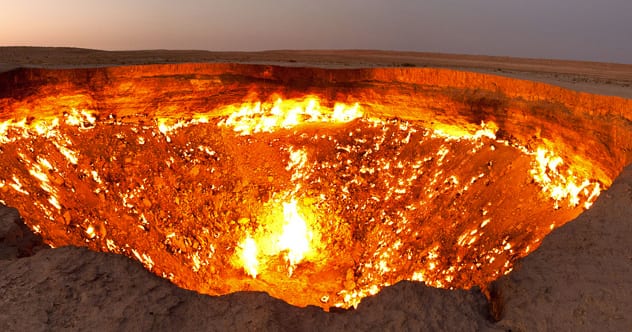
1. Darvaza Gas Crater, Turkmenistan: The Door to Hell
If the underworld had a welcome sign visible from space, it might look like the Darvaza Gas Crater in Turkmenistan’s Karakum Desert. Known worldwide as the “Door to Hell,” this fiery pit has burned for decades, fueled by natural gas escaping from the ground. By day, it looks like a giant scorched bowl in the desert. By night, it becomes a glowing furnace that makes campfire stories feel underfunded.
The crater is commonly linked to Soviet-era gas exploration, though exact details vary. What is certain is that the ground collapsed, gas escaped, and the fire became one of the most surreal dark tourism destinations on Earth. Travelers typically visit with a local guide because the site is remote, desert conditions can be harsh, and this is not the kind of place where you want your rental car to develop “character.”
Why it feels like hell
It is a burning hole in the middle of a desert. Honestly, marketing barely has to wake up for this one. The heat, wind, darkness, and endless flame create an unforgettable scene. It is less “tourist attraction” and more “planetary warning label.”
2. Pluto’s Gate at Hierapolis, Turkey
At the ancient city of Hierapolis near Pamukkale, Turkey, visitors can see the remains of the Ploutonion, also known as Pluto’s Gate. In Greco-Roman religion, Pluto was associated with the underworld, and this sanctuary was believed to be a doorway to his realm. The site’s eerie reputation was not built on superstition alone. A natural fissure releases carbon dioxide, which can collect near the ground and create dangerous conditions in enclosed areas.
Ancient observers described the place as deadly to animals, while priests appeared to survive the rituals. Modern science gives the explanation a little less thunderbolt and a little more chemistry: carbon dioxide is heavier than air and can pool at low levels. Today, the site is part of an archaeological area, and visitors view it safely rather than strolling into the invisible gas like contestants on a very bad reality show.
Why it feels like hell
Few places combine myth, temple architecture, geology, and genuine danger so neatly. Pluto’s Gate is a reminder that many ancient “supernatural” places began with real environmental mysteries people could see, smell, or fear.
3. Lake Avernus, Italy: Rome’s Underworld Entrance
Near Naples, Lake Avernus sits inside a volcanic crater in the Campania region. To the ancient Romans, it was no ordinary lake. Writers associated it with the entrance to the underworld, and Virgil famously placed Aeneas’s descent into the realm of the dead near this dark, volcanic landscape in the Aeneid.
The name Avernus is often connected with the idea of a birdless place, supposedly because no birds could fly over its vapors. Whether that detail is poetry, observation, or ancient public relations with a flair for gloom, the lake’s atmosphere still feels mythic. Visitors today can walk near the water, explore nearby ruins, and imagine Roman heroes consulting prophets before taking the least relaxing guided tour in literature.
Why it feels like hell
Lake Avernus is beautiful, but not in a cheerful postcard way. Its power lies in atmosphere: volcanic history, classical mythology, and the feeling that the ancient world left a trapdoor under the Italian sunshine.
4. Cape Tainaron, Greece: The Cave of Hades
At the southern tip of mainland Greece, Cape Tainaron, also known as Cape Matapan, reaches into the sea like a stone finger pointing toward myth. Ancient Greeks believed a cave in this region was one of the entrances to Hades. This was the place where stories placed heroic journeys, divine crossings, and the dramatic logistics of entering the land of the dead.
Today, visitors hike across a rugged, windswept landscape with ruins, sea views, and a lighthouse at the edge of the Mani Peninsula. The area is stark, bright, and lonely in the best possible way. It does not need fake cobwebs or spooky background music. The geography handles the drama all by itself.
Why it feels like hell
The cape combines isolation, ancient ruins, caves, and mythic storytelling. Standing where land gives way to open sea, it is easy to understand why ancient people imagined this as a border between worlds.
5. Hekla Volcano, Iceland: Medieval Gateway to Hell
Iceland’s Hekla Volcano has been feared, admired, and mythologized for centuries. In medieval Europe, Hekla gained a reputation as a gateway to hell. Its eruptions were powerful enough to inspire religious terror, and its smoky presence helped turn the mountain into one of Iceland’s most famous volcanic legends.
Hekla remains an active volcano, so visiting requires caution, current local guidance, and a strong respect for nature’s ability to ruin a schedule. Travelers may see it from surrounding areas, visit nearby landscapes, or include it in a broader South Iceland itinerary. The mountain’s shape is not cartoonishly evil; that would be too easy. Instead, it has the calm menace of something that knows it once frightened half a continent.
Why it feels like hell
Hekla’s reputation comes from real eruptions and medieval imagination. It is a perfect example of how volcanoes became spiritual symbols before they became geological case studies.
6. Masaya Volcano, Nicaragua: The Mouth of Hell
Masaya Volcano in Nicaragua has one of the most dramatic nicknames in travel: the “Mouth of Hell.” Spanish colonizers reportedly used the phrase after seeing the active crater, smoke, and glow. A cross was placed near the crater in an attempt to counter the feared forces below, which is certainly one way to decorate a volcano.
Masaya Volcano National Park is relatively accessible from Managua, making it one of the rare places where visitors can experience active volcanic scenery without an expedition that involves three pack animals and a personal crisis. Still, volcanic conditions can change. Access to viewpoints may be limited or closed depending on activity, gas levels, or safety rules.
Why it feels like hell
Few things say “underworld entrance” like staring into a smoking volcanic crater after sunset. Masaya blends natural spectacle with colonial-era fear, indigenous reverence, and modern science.
7. Fengdu Ghost City, China
On Ming Mountain in Chongqing, Fengdu Ghost City is a large complex of temples, shrines, statues, bridges, and symbolic tests connected to the Chinese afterlife. Instead of one fiery pit, Fengdu offers an entire cultural landscape devoted to judgment, morality, spirits, and the journey beyond death.
The site’s legends are often linked to Taoist, Buddhist, and folk beliefs. Visitors encounter halls, sculptures, and stories that present the afterlife as a place of trials and consequences. It is theatrical, philosophical, and occasionally weird in that marvelous way only ancient spiritual architecture can be. Think of it as an underworld theme park, except the theme is “please reconsider your life choices.”
Why it feels like hell
Fengdu is not just a spooky attraction. It reflects centuries of belief about justice, ethics, spirits, and the afterlife. The result is one of the world’s most fascinating hell-related travel destinations.
8. St. Patrick’s Purgatory, Ireland
On Station Island in Lough Derg, County Donegal, St. Patrick’s Purgatory has been one of Europe’s most famous pilgrimage sites for centuries. Medieval legend said Saint Patrick was shown a cave or pit connected to purgatory, giving doubters a physical sign of the afterlife. The original cave is no longer part of the modern pilgrimage experience, but the island remains a powerful religious destination.
This is not a casual selfie stop. Lough Derg is a living pilgrimage site, and visitors should approach it with respect. Its atmosphere is less “spooky vacation” and more “serious spiritual endurance.” The underworld here is not a lava spectacle; it is a tradition of fasting, reflection, prayer, and symbolic passage.
Why it feels like hell
St. Patrick’s Purgatory shows how the idea of an underworld entrance could become a place of transformation rather than entertainment. It is haunting because people went there seeking moral and spiritual change.
9. Hellfire Caves, England
The Hellfire Caves in West Wycombe, England, were excavated in the 18th century and later became associated with Sir Francis Dashwood and the notorious Hellfire Club. The tunnels lead through chalk passages, chambers, and even a symbolic underground river named the Styx. Subtle? Absolutely not. Memorable? Very.
Unlike many natural “gates to hell,” this one is partly theatrical by design. Visitors can walk through the man-made tunnels and learn about local history, folklore, aristocratic mischief, and the kind of elite club branding that practically begs future generations to gossip. The caves are a reminder that humans do not merely discover hellish landscapes; sometimes we dig them ourselves and add mood lighting.
Why it feels like hell
It is an underground attraction with a river named after the boundary of the Greek underworld. That is not just leaning into the theme; that is doing a full dramatic bow.
10. The Hells of Beppu, Japan
In Beppu, Japan, the famous Hells of Beppu, or jigoku, are steaming hot springs meant for viewing rather than bathing. These geothermal pools bubble, hiss, steam, and glow in colors ranging from bright blue to rusty red. Chinoike Jigoku, often translated as Blood Pond Hell, is one of the oldest and most visually striking.
Despite the dramatic name, Beppu’s hells are organized, visitor-friendly, and often surprisingly charming. You can see steaming ponds, try foods cooked with geothermal steam, and enjoy the strange pleasure of visiting “hell” before lunch. Just do not touch the water. These are not spa pools; they are extremely hot geothermal features, and your fingers are not stronger than physics.
Why it feels like hell
Beppu turns geothermal fury into a sightseeing route. It is colorful, steamy, educational, and just touristy enough to prove that even hell can have snack options.
How These “Entrances to Hell” Became Travel Destinations
The idea of an entrance to hell usually begins with a place that feels physically unusual. A cave swallows sound. A volcano breathes smoke. A crater burns through the night. A hot spring boils with impossible color. Long before scientific instruments explained gases, minerals, lava tubes, and geothermal pressure, people explained these places through story.
That does not make the old myths foolish. In many ways, mythology was an early form of landscape interpretation. Ancient people recognized that certain environments demanded respect. They may not have said “carbon dioxide accumulation” or “hydrothermal activity,” but they knew some places were dangerous, sacred, or emotionally overwhelming. Calling them gates to the underworld was a way of saying: pay attention.
Modern visitors arrive with cameras, trail shoes, translation apps, and a dangerous confidence in snack bars. Yet the emotional effect remains surprisingly similar. Stand beside a volcanic crater at night, and the rational part of your brain may know what magma, methane, or fumaroles are doing. The older part of your imagination still whispers, “Maybe do not lean too far over that.”
Tips for Visiting Hell Without Making It Too Real
First, check official conditions before you go. Volcanoes close. Caves flood. Sacred sites may have limited access. Archaeological areas may restrict entry for safety or preservation. The underworld may be eternal, but opening hours are not.
Second, respect the site. Some of these destinations are active religious places, not spooky props. Others are fragile geological or archaeological environments. Stay on paths, follow guides, avoid touching formations, and do not treat sacred objects like accessories for your social media masterpiece.
Third, dress for reality, not just the photo. Desert nights can be cold. Lava fields can be sharp and hot. Caves can be wet, slippery, or physically demanding. Volcano viewpoints can involve gas, wind, and sudden closures. Hell may be famous for fire, but you may still need a jacket.
Experience Add-On: What It Feels Like to Visit the Edge of the Underworld
The experience of visiting one of these so-called entrances to hell usually begins with a strange contradiction: you know you are going to a real place, but the name makes your imagination arrive first. Before the landscape appears, you are already picturing smoke, shadows, ancient priests, lost souls, and perhaps a gift shop selling mugs that say “I survived eternal punishment.” Then the actual site comes into view, and reality proves more interesting than the fantasy.
At volcanic sites such as Darvaza, Hekla, or Masaya, the first impression is often scale. Photographs flatten these places. In person, a crater is not just a circle; it is a wound in the ground, a reminder that Earth is not a quiet rock but a restless machine. The heat, sulfur smell, wind, or distant glow creates a full-body awareness. You do not simply look at the landscape. You feel it arguing with your comfort zone.
Cave-related destinations create a different mood. At places like Cape Tainaron, Hellfire Caves, or the underworld caves of ancient traditions, the drama comes from descent. Human beings are daylight creatures. We like windows, exits, and knowing that the ceiling is not made of geological time. Step underground, and your senses adjust. Sound changes. Air changes. Your confidence puts on a smaller hat. That is why caves so easily became entrances to the afterlife in myth. They feel like the world is asking you to leave the ordinary rules upstairs.
Then there are cultural underworlds like Fengdu Ghost City, St. Patrick’s Purgatory, and the Hells of Beppu. These places are powerful because they show how different societies imagined moral consequences, purification, spirits, or cosmic order. They are not just spooky; they are thoughtful. Fengdu turns the afterlife into architecture. Lough Derg turns purgatory into pilgrimage. Beppu turns geothermal chaos into a walkable route where visitors can admire boiling pools and then calmly buy pudding. Humanity is nothing if not adaptable.
The best way to experience these destinations is with curiosity rather than cynicism. You do not have to literally believe a cave leads to Hades or a crater opens into damnation. The point is to understand why people once didor why the metaphor still works. These places feel like thresholds. They sit between science and story, beauty and danger, tourism and reverence. Visit them well, and you come away with more than photos. You get a sharper sense of how landscapes shape belief, and how belief gives landscapes a second life.
There is also a practical lesson hidden in the drama: “hell” is often a place where nature refuses to be cute. It steams, burns, collapses, echoes, stains, and warns. That makes these sites thrilling, but it also asks visitors to behave like guests rather than conquerors. The perfect underworld trip is not about proving bravery. It is about standing at the edge, feeling small in the best possible way, and returning with your shoes muddy, your camera full, and your common sense still intact.
Conclusion: Hell Is RealAt Least on the Travel Map
The world’s most famous entrances to hell that you can visit are not all alike. Some are natural wonders, some are sacred landscapes, some are archaeological sites, and some are delightfully theatrical attractions. What connects them is the human habit of turning mysterious places into meaningful stories.
That habit is not going away. Even in an age of satellite imagery and scientific explanation, we still love destinations that feel like the edge of something bigger. A burning crater is not just a gas field. A steaming spring is not just hot water. A cave is not just a hole in limestone. With the right history behind it, each becomes a doorwaynot necessarily to hell, but to imagination.
Note: These destinations are based on real places, but access, safety rules, religious protocols, and travel conditions can change. Always check official visitor information before planning a trip, especially for active volcanic areas, caves, archaeological sites, and pilgrimage locations.