Long before smart speakers, app-connected miniatures, and tabletop games with companion software, Mattel Electronics tried something wonderfully strange: it put a tiny computer inside a plastic dungeon and asked players to trust the beeps. The result was the Dungeons & Dragons Computer Labyrinth Game, an electronic board game released in 1980 that combined fantasy adventure, hidden movement, audio clues, and a very humble but historically fascinating microcontroller.
At first glance, it looks like a castle-shaped board game from the glorious age of wood paneling, toy catalogs, and commercials narrated as if every product could change civilization. But inside the shell is a little slice of computing history. The game’s chip is marked M34012, yet modern teardown work has shown it belongs to the Texas Instruments TMS1100 family, a 4-bit microcontroller descended from the famous TMS1000 line. In other words, this is not just a Dungeons & Dragons collectible. It is also a tiny, beeping fossil from the early age of consumer electronics.
And yes, it fought dragons with less computing power than your toaster. Possibly your doorbell. Definitely your toothbrush if your toothbrush has Bluetooth, which is still a sentence humanity needs to think about.
What Was the Dungeons & Dragons Computer Labyrinth Game?
The Dungeons & Dragons Computer Labyrinth Game was Mattel Electronics’ attempt to turn the mood of D&D into a self-contained electronic board game. It was not a role-playing campaign in a box. There were no sprawling character sheets, no dungeon master hiding behind a screen, and no dramatic argument over whether a torch could be used as a club. Instead, it distilled dungeon adventure into a compact race through an invisible maze.
The board used an 8-by-8 grid, roughly chessboard-like, with touch-sensitive spaces. Players moved metal adventurer pieces across the board while the internal computer secretly tracked walls, doors, treasure, and the dragon. The goal was simple: find the treasure, grab it, and return to your secret room before your opponent or the dragon ruined your heroic retirement plan.
A Castle, a Grid, and a Bossy Little Computer
The physical design helped sell the fantasy. The game board looked like a squat plastic castle, complete with a raised border and storage drawer for the pieces. Inside that drawer lived the wall markers, the dragon, the treasure, and the warrior figures. These die-cast metal pieces were not just decorative. Their weight helped the board detect placement, turning the pieces into part of the input system.
There was no screen. No scrolling text. No map display. Instead, the game communicated through sound. Players learned what different tones meant: a wall, an illegal move, the treasure, a dragon alert, victory, defeat, and other dungeon incidents. It was part board game, part memory test, part “please stop beeping at me, plastic castle.”
The TMS1100: The Tiny Brain Behind the Dungeon
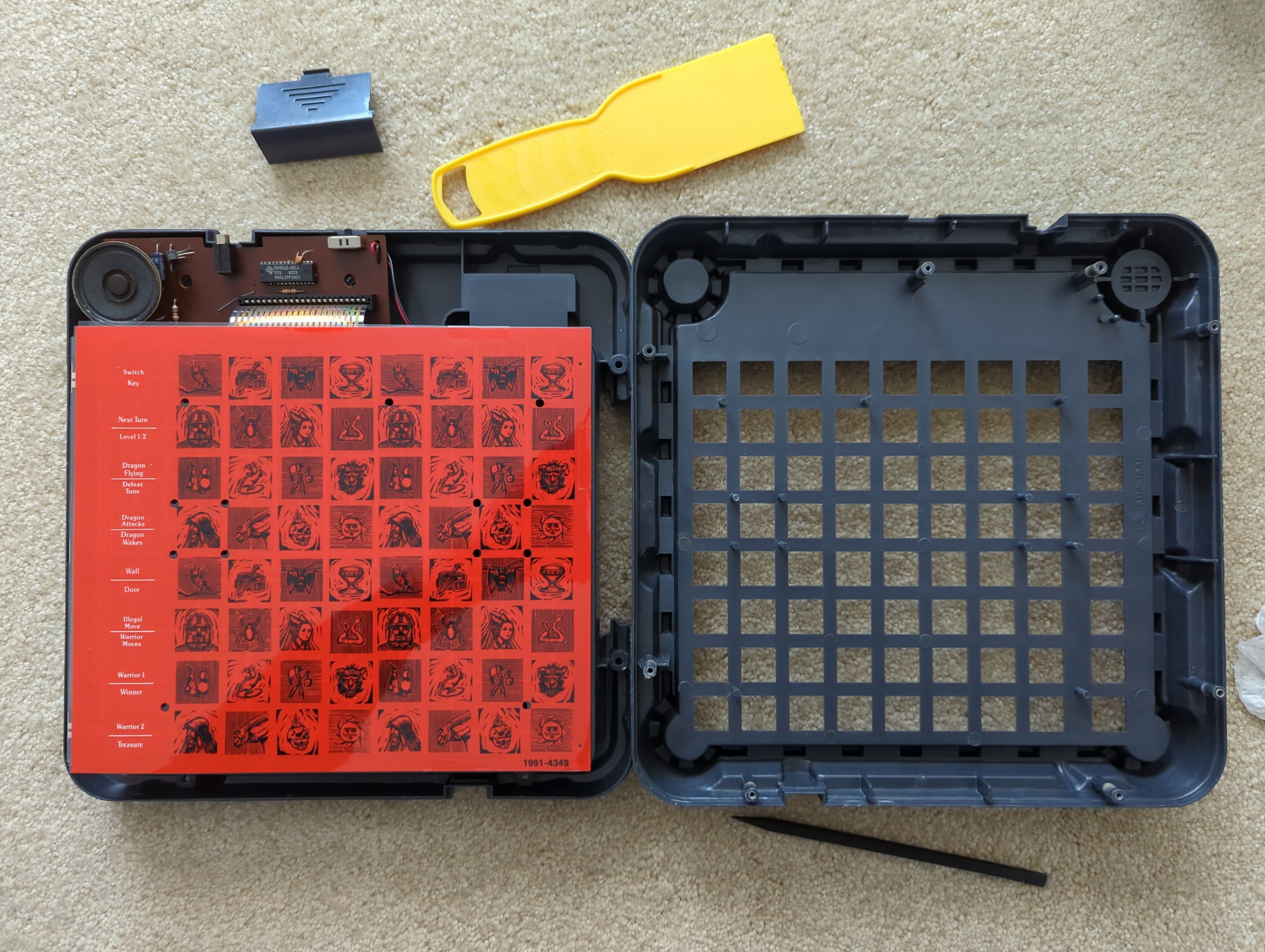
The most interesting part of this vintage Dungeons & Dragons board game is hidden under the plastic. Teardowns show a small circuit board with very few components: a 28-pin Texas Instruments chip, a transistor, and a handful of passive parts. That chip, labeled M34012, is essentially a customized member of the TMS1100 microcontroller family.
The TMS1100 was an expanded relative of the Texas Instruments TMS1000, a landmark “computer on a chip” design from the 1970s. These chips combined a CPU, ROM, RAM, and input/output lines into a single package. For toy makers, calculator manufacturers, and appliance designers, that was magic. Instead of building complicated logic boards from many chips, a company could order a custom-programmed microcontroller that handled the product’s behavior.
Why a 4-Bit Chip Was Enough
By modern standards, the TMS1100 sounds almost comically limited. It was a 4-bit microcontroller, meaning it processed data in tiny chunks. Depending on the specific part and implementation, the family offered limited ROM, small amounts of RAM, and a modest number of input and output lines. But that was plenty for a toy that needed to scan a grid, remember a maze, generate simple sound cues, and enforce game rules.
That is the beauty of early embedded design. The chip did not need to render a dragon. It only needed to make players believe one was nearby. A few beeps, some hidden rules, and a metal dragon piece were enough to create tension. The TMS1100 did not draw a dungeon; it made your imagination do the rendering. Conveniently, imagination has excellent graphics and no battery requirements.
How the Game Actually Played
The gameplay loop was clever because the maze began invisible. When a player moved across the grid and hit a wall, the game produced a cue. The player then placed a plastic wall marker on the board, slowly revealing the labyrinth. This gave the game a sense of discovery. You were not reading a map; you were building one through failure, which is also a fair description of adulthood.
Players chose secret rooms as starting points. Somewhere in the hidden maze was the treasure. The dragon began asleep, but as players approached the treasure area, it would wake and begin hunting. Unlike the players, the dragon could ignore walls, which is deeply unfair but very on-brand for dragons.
Treasure Changes the Game
The treasure mechanic made the design more interesting than a simple “find the square” game. Once a player found the treasure, they still had to carry it back to their secret room. Carrying treasure reduced movement, turning the second half of the game into a tense escape. The player who had been confidently mapping the maze could suddenly become a slow, shiny snack for a dragon with zero respect for property law.
In two-player mode, the game added a competitive edge. Players could interfere with each other, race for the treasure, and potentially battle over possession. Although traditional Dungeons & Dragons is usually cooperative, this electronic board game leaned into player-versus-player tension. That made it feel more like a family-room duel than a tabletop campaign.
Why This 1980s D&D Board Game Still Feels Smart
The Dungeons & Dragons Computer Labyrinth Game remains interesting because it solved design problems with extreme restraint. No screen? Use sound. No digital map? Let players build the maze physically. No dungeon master? Let the microcontroller hide information and enforce the rules. No cinematic animation? Put a dragon miniature in the box and let players panic anyway.
Modern game designers often talk about “hybrid” tabletop experiences as if digital assistance began with smartphones. Mattel was experimenting with the same idea in 1980. The computer handled secrecy, randomization, and feedback, while players handled movement, memory, deduction, and table presence. The result was not a video game and not a traditional board game. It was a strange middle creature, like a gelatinous cube wearing a pocket protector.
Audio as Interface
The most unusual design choice is the reliance on audio. Since there was no display, players had to interpret the game’s sounds. The left-side buttons could replay cues so players could learn them, which was an elegant solution. The board taught its own language. Once players understood the cues, the game became faster and more atmospheric.
That design still has lessons for modern tabletop games. A good interface does not always need a screen. Sometimes the strongest interaction is tactile, audible, and memorable. When a game asks players to listen closely, it changes the room. People lean in. They stop multitasking. They argue over whether that last tone meant “wall” or “you are about to become dragon chow.” That kind of social friction can be delightful.
The Hardware Teardown: Simple, Cheap, and Brilliant
The internal hardware is a reminder that good engineering is often invisible. The circuit board inside the game is surprisingly simple. The TMS1100-style chip handles the logic. The speaker provides feedback. The board matrix detects input. The game runs on a 9-volt battery, with the PMOS chip family being well suited to that kind of simple power arrangement.
This was exactly the point of microcontrollers in early consumer products. A toy company could create a product that seemed “computerized” without building a full computer. The custom chip contained the program in mask ROM. Once manufactured, every copy of the game carried the same dungeon logic. The consumer saw a magical electronic opponent. The engineer saw cost control, low component count, and a custom input-scanning challenge squeezed into a plastic castle.
The M34012 Mystery
The chip marking M34012 is part of the charm. Many custom chips in consumer products did not advertise their family identity in a way casual owners could understand. Only later, through teardown work, die photography, emulator research, and microcontroller documentation, did the TMS1100 connection become clear. For retrocomputing fans, that kind of detective work is irresistible. It turns an old toy into a puzzle about manufacturing, firmware, chip architecture, and preservation.
There is something poetic about that. A game built around exploring an invisible labyrinth now asks modern collectors to explore an invisible silicon labyrinth. The dungeon was under the board all along.
Collecting and Preserving the Computer Labyrinth Game
Today, the Dungeons & Dragons Computer Labyrinth Game appeals to several overlapping groups: D&D collectors, vintage board game fans, retrocomputing hobbyists, Mattel Electronics historians, and people who simply love weird old toys that make noises. Complete copies are more desirable because the pieces matter. The metal warriors, dragon, treasure, wall markers, secret room markers, drawer, manual, and box all contribute to the full experience.
Condition also matters. Because the game depends on the board’s input system and sound output, a visually nice copy is not automatically a working copy. Battery compartments can corrode. Membrane-style input layers can become unreliable. Speakers can fail. Plastic parts can crack. Manuals vanish into the same alternate dimension that eats remote controls and one sock from every laundry load.
Emulation Keeps the Dragon Awake
One reason this game has renewed attention is preservation. Emulator projects and community documentation help keep the game playable even when original hardware becomes fragile. The MAME ecosystem includes support for many electronic handheld and tabletop games, and records for this title identify the Mattel Electronics release, the TMS1100 chipset, and the relevant ROM/PLA files used for emulation.
That matters because electronic board games are harder to preserve than cardboard-only games. A traditional board game can survive with scanned rules and replacement tokens. An electronic game needs firmware, hardware behavior, timing assumptions, and input mapping. Without preservation work, the dragon eventually goes silent.
What Modern Game Designers Can Learn From It
The Dungeons & Dragons Computer Labyrinth Game offers several lessons for modern creators. First, limitations can create personality. The lack of a screen forced the game to become tactile and mysterious. Second, hidden information is powerful. The invisible maze gave players a reason to explore, remember, and collaborate or compete. Third, a mid-game trigger can transform the emotional arc. Once the dragon wakes, the game changes from search to escape.
Modern tabletop games often use apps for bookkeeping, narration, random events, or campaign tracking. That can work beautifully, but this 1980s design shows that digital assistance should have a clear purpose. The computer in Mattel’s game is not there as a gimmick. It hides the dungeon, enforces the dragon, and creates uncertainty. It does what cardboard alone would struggle to do cleanly.
A Better Kind of “Smart” Game
Many modern “smart” products feel smart because they connect to a cloud service. The Computer Labyrinth Game feels smart because it creates suspense. That is a more durable kind of intelligence. Nobody needed an account, a firmware update, or a privacy policy longer than the Monster Manual. You inserted a battery, pressed buttons, listened to the tones, and hoped the dragon had chosen someone else for lunch.
Why the TMS1100 Gives This Game Historical Value
The TMS1100 connection gives the game significance beyond nostalgia. It sits at the intersection of tabletop play, early embedded computing, and licensed fantasy branding. In 1980, Dungeons & Dragons was already becoming a cultural force, while electronic toys were becoming more affordable and more ambitious. Mattel Electronics stood in the middle of that moment, experimenting with ways to make plastic toys feel alive.
The chip inside the game is not powerful, but it represents a huge shift. Consumer products were becoming programmable. Toys could respond, remember, randomize, and enforce rules. The Dungeons & Dragons Computer Labyrinth Game did not need a full computer to feel computerized. It only needed enough logic to turn a board into a secret-keeping dungeon master.
That is why retro enthusiasts still care. The game is not merely quaint. It is a working example of how designers used early microcontrollers to create interactive experiences before home computers were common in every household. It is an artifact from a period when “electronic” on a box still felt futuristic, and when a few tones from a speaker could make a child believe a dragon had just woken up.
Conclusion
The Dungeons And Dragons Board Game From The 1980s Holds A TMS1100 story is more than a fun teardown headline. It is a reminder that innovation often arrives in odd shapes. Here, it arrived as a castle-shaped board game with metal figures, hidden walls, sound cues, and a tiny 4-bit brain.
Mattel’s Dungeons & Dragons Computer Labyrinth Game may not offer the depth of a full tabletop campaign, but it captures something essential about adventure: uncertainty. You move into the unknown, discover barriers, chase treasure, and suddenly realize something hungry is chasing you back. The TMS1100-style chip made that possible with almost laughably limited resources, proving that clever design can do a lot with very little.
For collectors, it is a conversation piece. For retrocomputing fans, it is a beautiful example of embedded design. For game designers, it is a lesson in restraint. And for D&D fans, it is a charming artifact from the era when fantasy gaming and consumer electronics first started sharing a dungeon.
Experience Notes: Playing, Restoring, and Appreciating a Tiny Dragon Computer
Spending time with a game like the Dungeons & Dragons Computer Labyrinth is different from playing a modern board game straight out of shrink wrap. The first experience is usually not “let’s play.” It is “does this thing still work?” You open the battery compartment with the cautious energy of an archaeologist lifting a tomb lid. If there is no corrosion, you feel lucky. If the speaker chirps after installing a 9-volt battery, you feel as if you have personally restarted 1980.
The next surprise is how physical the game feels. The metal pieces have weight. The wall markers make the maze visible one mistake at a time. The board demands attention because the sounds matter. In a modern room full of glowing screens, that feels refreshing. Nobody is reading notifications while the dragon wakes. Everyone is listening for the cue, looking at the grid, and trying to remember which corridor became a dead end three turns ago.
The game also creates a funny kind of table talk. Since the computer knows the maze and players do not, every move becomes a tiny gamble. Someone says, “I’m sure this path is clear,” and two seconds later the board replies with the electronic equivalent of “absolutely not.” Another player confidently approaches the treasure, only to trigger the dragon and suddenly look less like a hero and more like a snack with shoes. The humor comes naturally because the game is strict, mysterious, and slightly absurd.
Restoring or maintaining a copy teaches patience. You learn that vintage electronics are not immortal, even when they look sturdy. Contacts may need careful cleaning. Battery terminals may need attention. Missing pieces can be difficult to replace. The manual becomes more than paperwork; it is the bridge between the beeps and the rules. Without it, the game can feel like being shouted at by a tiny robot owl.
Yet the experience is rewarding because the design still has personality. It does not try to simulate every part of Dungeons & Dragons. It chooses one fantasy scenethe dangerous maze with hidden treasure and a lurking dragonand commits to it completely. That focus makes it easy to appreciate. The game is not deep by modern hobby standards, but it is clever, memorable, and historically important.
Most of all, it gives players a direct connection to early electronic play. The TMS1100 inside is not an abstract technical detail; it is the reason the board can hide information, react to movement, and create suspense. When the game beeps, you are hearing a tiny custom computer do exactly what it was designed to do more than four decades ago. That is the magic. Not flashy magic. Not high-resolution magic. Just a small chip, a plastic dungeon, and a dragon that still knows how to make people nervous.
SEO Tags
Note: This HTML article is written for web publishing, with source links intentionally omitted from the body text as requested.