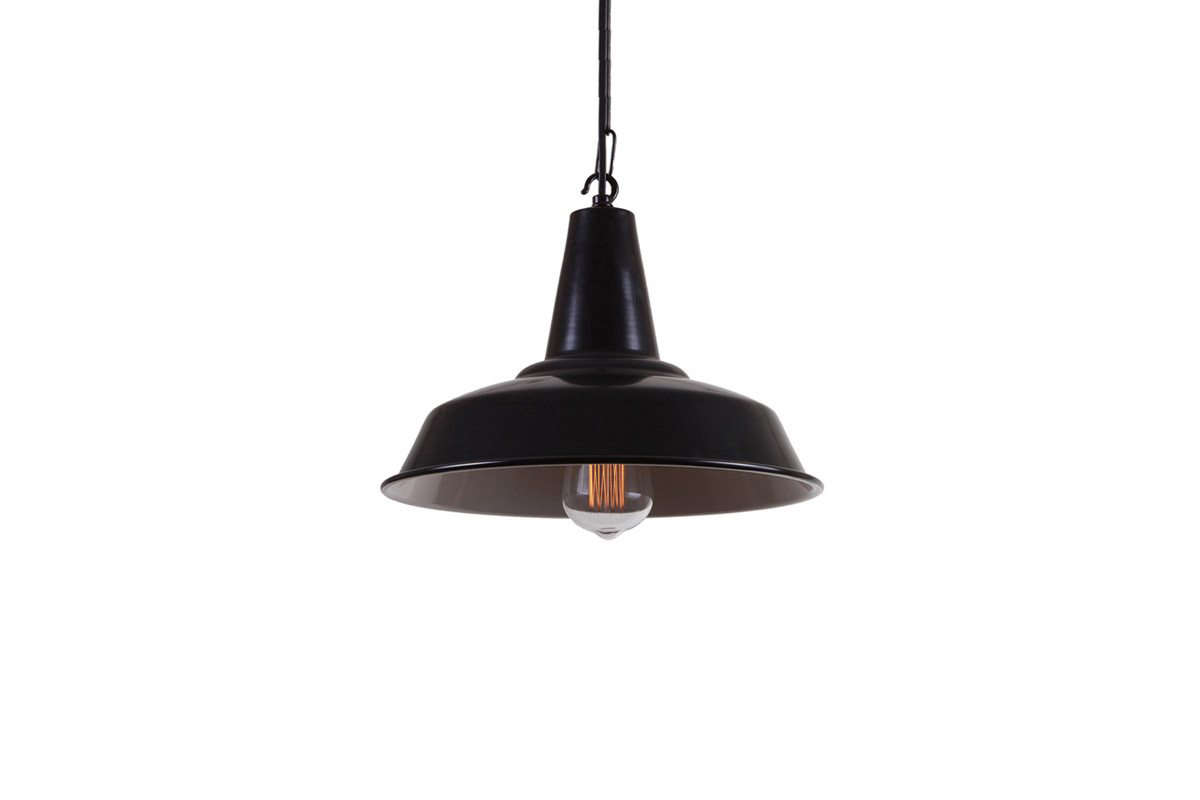
The Aire Lighting Typical Factory Lamp looks as though it has spent decades illuminating a hardworking Irish workshop, listening to riveting conversations about rivets. In reality, it is a thoughtfully made industrial pendant light designed to bring that practical, timeworn character into modern homes, restaurants, studios, and retail spaces.
Its appeal comes from a surprisingly disciplined recipe: a deep aluminum shade, a graduated dome, chain suspension, straightforward proportions, and a generous selection of powder-coated colors. Nothing is added merely to look clever. The design is useful first, handsome second, and pleasantly free of decorative acrobatics.
That simplicity also makes the lamp more adaptable than its factory-inspired name suggests. It can focus light over a kitchen island, give a breakfast nook visual structure, soften an open loft, or add a cheerful splash of racing green, orange, or yellow to an otherwise restrained room. Industrial lighting does not have to mean black pipe, bare brick, and a mandatory beard. This fixture proves it.
What Is the Aire Lighting Typical Factory Lamp?
The Aire Lighting Typical Factory Lamp is a handmade pendant inspired by traditional industrial fixtures associated with workshops, breweries, factories, and Irish public interiors. Its profile is instantly recognizable: a rounded upper dome steps outward into a broad, deep shade that directs illumination toward the surface below.
The fixture measures approximately 23 centimeters high and 30 centimeters in diameter, or roughly 9 inches tall and just under 12 inches wide. That scale places it in a useful middle category. It is noticeable enough to serve as a design feature, yet compact enough to install in pairs or groups without making the ceiling look like an airport hangar.
Key Product Specifications
| Primary material | Aluminum shade with chain and PVC cable |
|---|---|
| Fixture height | Approximately 23 cm |
| Shade diameter | Approximately 30 cm |
| Ceiling cup diameter | Approximately 10 cm |
| Standard suspension | Approximately 100 cm, with longer options available from some retailers |
| Weight | Approximately 760 grams |
| Socket | E27 |
| Maximum listed power | 60 watts |
| Bulb | Generally sold separately |
Specifications, wiring, certifications, finish availability, suspension lengths, and included hardware can vary by seller or destination market. American buyers should verify compatibility before ordering, especially because the listed E27 socket and electrical components may differ from common U.S. E26 fixtures and local certification requirements.
Why the Factory-Lamp Shape Still Works
Traditional factory pendants were not created to win beauty contests. Their job was to throw useful light onto benches, counters, tools, and production areas. The broad metal shade helped control the beam while reducing glare from the sides. Form followed function so closely that the two eventually started sharing a lunchbox.
The Aire Lighting version preserves that functional silhouette without feeling like a stage prop. Its deep shade visually contains the bulb and directs attention downward. This makes it particularly appropriate over surfaces where people cook, eat, read, arrange flowers, package products, or pretend to finish paperwork while browsing vacation rentals.
A Softer Interpretation of Industrial Style
Some industrial lighting can feel severe. Exposed cages, rough steel, imitation rust, and visible plumbing hardware may be effective in the right setting, but using all of them at once can make a dining room resemble an escape room.
This lamp takes a gentler route. The dome is rounded rather than angular, while the painted aluminum surface introduces color and a cleaner finish. The result fits industrial interiors but also works with farmhouse, Scandinavian, cottage, coastal, transitional, and contemporary decorating schemes.
Materials: Lightweight Aluminum and a Durable Finish
Aluminum is a practical material for a suspended fixture because it combines low weight with useful strength and natural resistance to corrosion. At approximately 760 grams, the lamp is considerably lighter than many vintage cast-metal factory fixtures. That does not eliminate the need for secure installation, but it makes handling and positioning less awkward.
The shade is offered in powder-coated finishes. Powder coating is applied as a dry material and cured to create a uniform surface that can resist ordinary wear better than many conventional liquid-painted finishes. For a pendant, this means the exterior should tolerate normal dusting and everyday household conditions without demanding ceremonial maintenance.
Available Color Personalities
Listings have shown choices such as glossy black, matte black, white, gray, racing green, pale green, red, yellow, orange, and a bronze-toned powder coat. Availability may change, but the broad palette is central to the design.
Black is the obvious choice for a classic workshop mood, although matte black generally feels quieter and more architectural than a glossy finish. White blends easily into bright kitchens and small rooms. Gray works with concrete, stainless steel, and cooler wood tones. Racing green introduces heritage character without shouting across the room.
Yellow, red, and orange behave more like punctuation marks. A bright orange pendant above a plain oak table can rescue a neutral room from becoming an extremely tasteful bowl of oatmeal. Pale green is gentler, pairing naturally with cream cabinets, handmade tile, butcher-block counters, and botanical colors.
Where the Aire Lighting Typical Factory Lamp Works Best
Over a Kitchen Island
The 30-centimeter shade is well suited to small and medium kitchen islands. One lamp can center a compact prep station, while two or three can create rhythm over a longer counter. A common starting point is to position pendant shades approximately 30 to 36 inches above the countertop, then adjust for ceiling height, sightlines, and the height of household members.
Spacing should feel balanced rather than mechanically calculated. With multiple fixtures, leaving roughly 24 to 30 inches between shade centers often produces an orderly composition. Before drilling anything, make cardboard circles the same diameter as the lamps and tape them to the ceiling. This inexpensive rehearsal can prevent an expensive interpretive dance with an electrician.
Above a Dining Table
A single Typical Factory Lamp works nicely over a round café table, breakfast table, or small square dining table. For a long rectangular table, a pair usually provides better visual coverage. The deep shade creates an intimate pool of light, helping define the eating area within an open-plan room.
Warm light is especially flattering here. A color temperature around 2700K creates a cozy, familiar glow, while 3000K feels slightly cleaner without becoming clinical. Cooler lamps can be useful in work-oriented spaces, but a 5000K bulb over dinner may make the mashed potatoes feel as though they are undergoing laboratory testing.
In a Home Office or Creative Studio
Because the shade directs light downward, the lamp can support a layered office-lighting plan. It should not be the only light source in the room; combine it with a desk lamp or wall lighting to reduce harsh contrast. The pendant then provides general focus while the task lamp handles detailed work.
Studios benefit from the fixture’s utilitarian appearance. It looks comfortable near open shelving, worktables, cutting mats, drafting tools, ceramics, and framed prints. A bold color can also help distinguish the creative zone from the rest of a multipurpose room.
In Cafés, Bars, Shops, and Hospitality Spaces
The lamp’s Irish industrial character makes it a natural candidate for pubs, breweries, bakeries, cafés, and boutique retail interiors. Repetition is particularly effective in commercial design. A row of identical pendants can lead the eye along a counter, while mixed colors create a more playful atmosphere.
Commercial purchasers in the United States should verify that the exact version, wiring, socket, canopy, and installation hardware are acceptable for the intended location. A fixture that is visually perfect but lacks required documentation can turn a smooth project into a very attractive headache.
Choosing the Right Bulb
The published specification lists an E27 socket and a maximum power of 60 watts. The maximum wattage is an electrical and heat limit, not a target. There is no prize for reaching it.
A modern LED bulb can provide the brightness associated with a traditional 60-watt incandescent lamp while consuming far less electricity. For general reference, approximately 800 lumens is commonly considered similar in brightness to a traditional 60-watt incandescent bulb. A 450-lumen bulb creates a softer pool of light, while 1,100 lumens may be more appropriate when stronger task illumination is needed, provided the bulb is compatible with the fixture.
Bulb Shape
A standard A-shaped LED is the practical choice. A clear globe or vintage-style filament LED can complement the nostalgic design, although much of the bulb may be hidden by the deep shade. That is not necessarily bad; it keeps the lamp from becoming another exposed-bulb cliché wearing a tiny metal hat.
Color Temperature
Choose 2200K to 2700K for a warm pub-like atmosphere, 3000K for a versatile residential white, or 3500K to 4000K for a cleaner studio or workroom effect. Higher Kelvin values appear cooler and bluer. The finish also influences perception: warm bulbs enrich red, orange, bronze, and green shades, while neutral white light looks crisp with gray, white, and black.
Dimming and Color Quality
When dimming is desired, use an LED specifically labeled dimmable and confirm that it works with the installed dimmer. Mismatched products can flicker, buzz, refuse to dim smoothly, or behave like a tiny electrical poltergeist.
Color rendering matters in kitchens, studios, and dining areas. An LED with a color rendering index of 90 or higher generally helps food, wood, textiles, paint, and skin tones appear more natural.
Installation and Safety Considerations
A hardwired pendant should be installed in accordance with the manufacturer’s instructions and applicable electrical codes. The ceiling electrical box and mounting hardware must support the fixture, and the chain should carry mechanical weight rather than leaving that responsibility to the electrical cable.
For a product being imported into the United States, confirm voltage compatibility, grounding provisions, conductor specifications, socket type, canopy fit, replacement parts, and recognized safety certification. UL standards and the National Electrical Code address important risks involving shock, fire, wiring, mounting, and location suitability.
Installation in a bathroom, damp basement, covered porch, or other moisture-prone setting requires a fixture specifically rated for that environment. The nostalgic factory appearance does not automatically make the lamp suitable for an actual factory, hazardous workplace, damp location, or outdoor installation.
When any specification is unclear, have a licensed electrician evaluate the fixture. Electricity is famously resistant to improvisational comedy.
How to Style the Lamp Without Building a Theme Park
The easiest approach is to use industrial lighting as a contrast rather than repeating the same idea throughout the room. Pair a black or gray lamp with warm oak, linen curtains, handmade ceramics, and softly painted walls. The fixture supplies structure, while the natural materials prevent the room from feeling cold.
In a traditional kitchen, try racing green above a marble or soapstone counter. In a Scandinavian-inspired space, choose white, pale green, or gray with light wood and minimal hardware. For a retro-modern room, yellow or orange can echo colorful chairs, artwork, or tile without requiring every object to join the parade.
Useful Pairings
- Matte black with walnut, aged brass, cream tile, and warm white bulbs
- Racing green with oak, leather, stone, and muted red accents
- Pale green with off-white cabinetry, terracotta, and natural linen
- White with birch, stainless steel, pale gray, and clean 3000K light
- Orange or yellow with concrete, dark blue, charcoal, and graphic artwork
Avoid matching every finish perfectly. Industrial interiors are more convincing when materials look collected over time. A painted aluminum pendant can sit comfortably near brass cabinet pulls, a black faucet, and stainless appliances. The finishes do not need matching uniforms; they only need to attend the same meeting.
Cleaning and Long-Term Care
Turn off the power and allow the bulb to cool before cleaning. Use a soft microfiber cloth or duster on the shade, chain, cable, and ceiling cup. For fingerprints or kitchen residue, wipe the powder-coated surface with a lightly dampened cloth and a small amount of mild soap, then dry it promptly.
Avoid abrasive pads, aggressive solvents, metal polish, and gritty cleaning powders. These can dull or scratch the coated surface. Periodically inspect the suspension, canopy, cable, and socket for loosening, discoloration, cracking, or heat damage. Any electrical concern should be handled by a qualified professional.
Advantages and Possible Drawbacks
Reasons to Consider It
- Authentic industrial proportions without excessive decorative gimmicks
- Compact dimensions suitable for single or grouped installations
- Lightweight aluminum construction
- Multiple powder-coated color choices
- Downward light distribution appropriate for tables and counters
- A design that works beyond strictly industrial interiors
Points to Check Before Buying
- E27 socket and electrical compatibility for American installations
- Safety certification required by the installer or local authority
- Whether the bulb, mounting hardware, and adapters are included
- Suspension length in relation to the ceiling height
- International shipping costs, lead times, returns, and replacement parts
- Whether the downward beam provides enough room-wide illumination
The focused shade is excellent for a table or island but may leave upper walls and corners comparatively dim. A successful room usually combines the pendant with recessed lights, sconces, floor lamps, undercabinet lighting, or natural daylight.
Experiences With the Aire Lighting Typical Factory Lamp
The most revealing way to understand a factory-style pendant is not to stare at a catalog photograph. It is to imagine how the fixture behaves through an ordinary day. In a compact kitchen, the 30-centimeter shade feels substantial when first removed from the box, yet once suspended above an island, its proportions become surprisingly polite. It marks the work surface without swallowing the room.
The deep shade creates a noticeable boundary around the light. Chopping vegetables, reading a recipe, or pouring coffee beneath it feels pleasantly focused. The effect is less like flooding the kitchen with brightness and more like placing a useful circle of attention exactly where it belongs. That said, anyone expecting one pendant to illuminate an entire open-plan space may be disappointed. Its strength is direction, not omnipresence.
Color changes the experience more dramatically than expected. Matte black emphasizes the silhouette and can make the lamp appear slightly larger. White visually recedes, especially against a pale ceiling. Racing green feels traditional from a distance but reveals more personality up close. Orange immediately becomes part of the conversation. Guests may not compliment the carefully selected cabinet hinges, but they will probably notice the orange lamp.
The lightweight aluminum body is also convenient during installation. Holding a heavy vintage enamel fixture overhead while someone searches for the correct screwdriver can test both shoulder strength and relationships. At roughly 760 grams, this lamp is easier to position, although secure mounting remains essential.
Choosing the bulb often takes more experimentation than choosing the finish. A clear filament LED looks attractive when viewed from below, but an overly bright version can create uncomfortable glare. A frosted LED softens the experience and is often preferable above a table. Around 800 lumens works as a sensible starting point for an island, while a lower-output bulb may feel better over an intimate breakfast table.
Warm 2700K light enhances the lamp’s nostalgic personality. It flatters wood, food, and evening gatherings. A 3000K bulb is more practical when the same surface serves as both dining table and workstation. In a studio, 3500K can provide a cleaner impression, but cooler light exposes the fixture’s industrial roots more strongly and may reduce its cozy pub-like charm.
Over time, the powder-coated shade is refreshingly undemanding. Dust is most visible on black finishes, while white shades reveal cooking residue sooner. A quick microfiber wipe normally restores the surface. The chain, however, deserves attention because dust likes to settle into every link as though paying rent.
The lamp is especially satisfying in interiors that avoid trying too hard. Place it above an old wood table, next to modern cabinets, or within a room containing a mixture of new and inherited pieces. It contributes history without demanding that the entire home cosplay as a nineteenth-century machine shop.
The main practical lesson is to plan the installation before falling in love with the color. Measure the shade diameter, ceiling height, desired clearance, canopy location, and suspension length. Verify the electrical details with the retailer and installer. Once those less glamorous questions are resolved, the Aire Lighting Typical Factory Lamp becomes what good industrial design should be: useful, durable-looking, visually memorable, and confident enough not to decorate itself with fake gears.
Final Verdict
The Aire Lighting Typical Factory Lamp succeeds because it does not overcomplicate a proven idea. Its aluminum construction, deep 30-centimeter shade, chain suspension, powder-coated colors, and compact proportions give it the honest character of traditional industrial lighting while keeping it appropriate for contemporary interiors.
It is best used as focused lighting over a defined surface and supported by other ambient or task lights. Buyers in the United States should carefully verify electrical compatibility and certification before installation. With those practical details settled, the fixture can bring warmth, color, and workshop-inspired character to kitchens, dining areas, offices, cafés, and studios without turning the space into an industrial-theme restaurant.