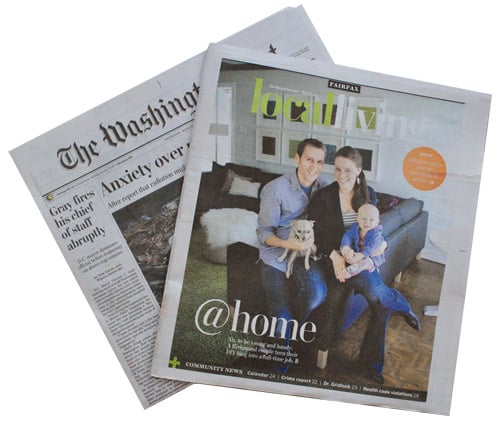
There are exciting mornings, and then there are mornings when you open a major newspaper and discover your house, your work, your family, and possibly your slightly questionable decorating decisions staring back at you.
For John and Sherry Petersik, the married couple behind the home improvement blog Young House Love, March 2011 delivered exactly that kind of surprise. The Washington Post published a substantial feature about how two self-taught renovators in Richmond, Virginia, had transformed an online renovation diary into a full-time creative business.
The headline alone was enough to cause happy dancing. The scale of the coverage made the moment even more surreal. This was not a tiny mention tucked beside a classified ad for a suspiciously inexpensive lawn mower. The story received prominent treatment in the newspaper’s Local Living section, accompanied by photographs, project details, a budget breakdown, an online gallery, and a live reader discussion.
It was recognition from one of the most established names in American journalism. More importantly, it was proof that a useful, funny, highly personal DIY blog could grow into something much larger than its creators originally imagined.
A Full-Circle Washington Post Moment
The feature carried an especially personal meaning for John. Long before he earned a living writing about paint, thrift-store furniture, and the occasional renovation mishap, one of his first jobs involved delivering The Washington Post as a sixth grader.
That meant waking up painfully early, helping distribute newspapers, and probably wondering why respectable employment could not begin at a more civilized hour. Years later, the same publication arrived with his family on the page. It was the sort of full-circle moment that sounds suspiciously like a movie scene, except the movie would need more sanding dust and a Chihuahua named Burger.
The couple’s announcement captured the emotional jumble that often accompanies major media coverage: pride, disbelief, gratitude, and immediate concern about whether everyone looked normal in the photographs. Readers saw an established DIY brand. John and Sherry still saw themselves as two people learning as they went and sharing the results online.
That gap between public perception and private reality is one reason the story remains relatable. Success rarely feels as polished from the inside as it appears in print.
What The Washington Post Saw in Young House Love
The newspaper did not profile the Petersiks simply because they owned a photogenic house. Plenty of attractive homes exist, and most of them do not receive a multi-part newspaper feature.
The more interesting story was how the couple had built a recognizable online publication around affordable home improvement. At the time of the feature, Young House Love had been operating for roughly three and a half years and was drawing millions of page views each month. New posts routinely generated hundreds of reader comments.
The blog had also become the family’s primary source of income through advertising and related editorial work. That was still unusual enough in 2011 to make a compelling newspaper story. Blogging had moved beyond online journaling, but the creator economy had not yet become the giant professional ecosystem it is today.
They Were Self-Taught, Not Untouchable Experts
John and Sherry were not trained interior designers or professional contractors. They had started with little home improvement experience and learned through research, experimentation, mistakes, and repetition.
Rather than hiding that fact, they made it central to the blog. Readers did not have to admire a flawless finished room from a safe distance. They could follow the entire process, including the decisions that worked, the ones that changed, and the projects that required a second attempt.
This made their advice feel accessible. A reader could reasonably think, “Maybe I can do that,” rather than, “Wonderful. I simply need a design degree, a construction crew, and the budget of a minor royal family.”
They Turned Projects Into Stories
A Young House Love post rarely consisted of a finished photograph and a list of materials. The couple documented the problem, the plan, the shopping, the cost, the labor, the unexpected complications, and the final result.
A ceiling light was not merely installed. It became part tutorial, part household debate, and part comedy. A thrift-store chair was not merely painted. It received a backstory, a price breakdown, progress photographs, and possibly a nickname.
The Washington Post recognized that the storytelling was as important as the decorating. The couple’s homes supplied the setting, but their personalities kept readers returning.
The Budget-Friendly Philosophy Behind the Feature
The newspaper coverage highlighted one of Young House Love’s strongest themes: a stylish home did not require unlimited money.
John and Sherry regularly reused existing pieces, visited thrift stores, searched secondhand listings, and shopped at architectural salvage or nonprofit reuse centers. Old wooden furniture could be sanded, repaired, painted, or repurposed instead of being sent to a landfill because its finish had entered an unfortunate orange phase.
Their room makeovers often included detailed cost information. Readers could see what came from a major retailer, what had been bought secondhand, what was already owned, and how much paint or hardware added to the final total.
This transparency accomplished two things. First, it made the projects practical. Second, it established trust. The audience was not being shown a “budget makeover” in which the allegedly affordable room quietly contained several thousand dollars of unmentioned furniture.
The message was simple: work with what you have, improve what you can, and spend strategically. That philosophy helped distinguish Young House Love from aspirational design media that presented beautiful spaces without explaining how an average homeowner might create them.
The Work Behind a Successful DIY Blog
The Washington Post profile also revealed that blogging full time was not an endless parade of paint samples and cheerful before-and-after photographs.
The Petersiks described long workdays in which one parent handled the blog while the other cared for their young daughter. They completed projects, photographed each stage, edited images, wrote and proofread posts, answered reader questions, managed sponsors, organized giveaways, maintained social media accounts, and handled technical website work.
At the time, they were reportedly responding to roughly 200 reader questions on a typical day. That is not a comment section. That is a small customer-service department hiding inside a home office.
The actual decorating and building represented only part of the job. The invisible labor included planning, communication, accounting, coding, scheduling, and maintaining a consistent publishing routine.
This remains one of the most valuable lessons from the feature. Online success often looks effortless because audiences see the result rather than the production system behind it. A well-maintained blog is not simply a collection of ideas. It is an editorial operation.
The Interview, Photo Shoot, and Live Reader Chat
Being contacted by a major newspaper can sound intimidating, particularly when the interview will take place inside your home. Every pile of laundry suddenly appears to have developed political ambitions and is clearly planning to enter the photograph.
John and Sherry later described Washington Post writer Terri Sapienza as friendly and easy to welcome into their space. The resulting profile preserved the same grounded atmosphere that readers encountered on the blog. Their home looked lived in because it was lived in. Their dog could be found burrowed under bedding. Everyday clutter still existed beyond the camera’s preferred angle.
The coverage expanded online through project galleries and a live Home Front discussion. Readers asked about decorating choices, furniture, paint, curtains, and blogging boundaries. Some sharp-eyed fans even noticed new accessories in the photographs before those items had appeared on the blog.
In effect, the newspaper accidentally published a few project spoilers. For a DIY audience, this was approximately as dramatic as leaking the ending of a superhero movie, except the surprise involved a rug.
The live chat also demonstrated why the couple had built such a loyal community. Their answers were practical but conversational. They were willing to admit when they had not tried a product rather than pretending to possess universal decorating knowledge.
The Feature Revealed Another Major Announcement
The Washington Post article did more than celebrate the growth of Young House Love. It also revealed that the Petersiks had signed a book deal with Artisan, an imprint of Workman Publishing.
The deal followed a lengthy proposal process. After receiving interest from literary agents and publishers, the couple spent about a year developing a substantial book proposal. Their agency presented it to publishers, multiple companies expressed interest, and the Petersiks eventually chose a collaborative publishing team that understood their preference for an affordable, practical idea book rather than an expensive decorative showpiece.
The first book would contain hundreds of approachable ways to update a home. Most of the projects and photographs were created specifically for the publication rather than copied directly from the blog.
The completed book became a New York Times bestseller. A second home design book later achieved bestseller status as well. Their work also expanded into product collaborations and a long-running podcast.
None of those later accomplishments can be attributed to one newspaper story alone. The Washington Post feature was nevertheless an important public milestone. It documented the moment when a personal blog had clearly become a durable media brand.
Why Major Media Coverage Matters
Earned media differs from advertising because the subject does not purchase the editorial space. A journalist and publication independently decide that the story is worth presenting to their audience.
That third-party interest can create powerful credibility. A creator can describe a blog as popular, useful, or influential all day long. When an established newspaper examines the operation, interviews the people involved, verifies details, and publishes a feature, the recognition carries a different weight.
Media coverage can also introduce a niche creator to readers who would never have discovered the work through social media or search results. A home improvement fan may arrive for a furniture tutorial, while a business reader may become interested in the transformation from hobby to full-time company.
The best coverage does not replace owned content. It strengthens it. New visitors may discover the brand through the newspaper, but they remain because the original site offers useful archives, a distinctive voice, and an active community.
What Creators Can Learn From “We Made The Washington Post!”
Create Something Worth Covering
Journalists need a story, not a collection of promotional adjectives. Young House Love offered several strong angles: a couple turning a DIY hobby into a full-time business, millions of monthly page views, transparent renovation budgets, an engaged audience, and a new publishing deal.
The lesson is not that every creator needs millions of views. It is that the work should contain a clear point of interest. A useful method, an unusual result, an original dataset, a meaningful local impact, or a surprising personal journey gives reporters something concrete to explore.
Make the Evidence Easy to Understand
The Petersiks had a deep archive of tutorials, photographs, cost breakdowns, reader discussions, and completed renovations. Their claims could be supported by visible work.
Creators hoping to attract serious media attention should maintain accurate background information, strong images, clear contact details, and examples that demonstrate expertise. A reporter should not need to conduct an archaeological expedition across seventeen forgotten social accounts to understand the story.
Be Honest About the Messy Parts
Authenticity was one of Young House Love’s competitive advantages. The couple documented mistakes and acknowledged the unglamorous workload behind the blog.
This honesty did not weaken their authority. It made their knowledge more credible because readers could see how it had been earned. Useful content explains not only what succeeded but also what required adjustment.
Use the Attention Without Abandoning the Audience
Major exposure can tempt creators to suddenly reinvent themselves. The Petersiks instead reassured readers that the blog would remain central even as they worked on a book.
That decision protected the community responsible for the opportunity in the first place. Press coverage should function as a doorway into the creator’s best work, not as an excuse to neglect it.
Experiences Behind the Headline: What a Major Press Feature Really Feels Like
The phrase “We made The Washington Post!” sounds like the final scene of a success story. In practice, publication day is usually the middle of the adventure.
The experience begins before the article appears. There may be emails to answer, interview times to coordinate, old facts to confirm, photographs to prepare, and nervous discussions about which rooms are suitable for human observation. When the interview happens at home, even ordinary objects become suspicious. Is that stack of mail evidence of relatable domestic life, or should it be hidden in a drawer before the reporter arrives?
Then comes the interview itself. Good reporters often ask questions that force creators to explain routines they normally perform without thinking. Why was the blog started? When did it become a business? How are projects selected? What does an average workday actually involve? Answering these questions can help people understand their own growth more clearly.
The photo session creates another layer of self-consciousness. Creators who comfortably publish pictures of furniture may feel very differently when the camera turns toward them. Suddenly, nobody remembers how arms are supposed to rest during normal human standing.
After the reporting is finished, control shifts to the publication. The subject generally does not choose the headline, select every photograph, or decide which comments become central to the finished piece. That uncertainty can be uncomfortable, but it is part of legitimate editorial coverage.
Publication morning brings a rapid sequence of emotions. First comes disbelief. Then excitement. Then detailed inspection of every image. Then messages from relatives, readers, former coworkers, neighbors, and people who have not made contact since high school but have apparently maintained an active newspaper-clipping department.
Website traffic may rise quickly. New readers arrive without knowing years of backstory, so cornerstone pages and clear navigation become especially important. The regular audience also wants to celebrate, ask questions, and discuss every detail the article revealed.
For Young House Love, the live Washington Post discussion meant responding to decorating questions while readers examined the newspaper photographs like detectives. A pillow, rug, light fixture, or unfinished project could become breaking news within the community.
Once the initial celebration settles, the most important experience is returning to work. A press feature offers validation, but it does not complete the next project, publish tomorrow’s article, or answer the waiting inbox.
That return to routine is healthy. It prevents recognition from becoming the entire identity of the brand. The lasting value of the coverage comes from placing it within a larger body of consistent work.
Creators can preserve the moment by saving print copies, screenshots, photographs, and accurate publication details. They can add the feature to a press page, mention it in professional materials, and share it with their community without turning every future sentence into “As seen in…”
The emotional lesson is equally valuable: celebrate fully, thank the people who helped, and remain grounded. A newspaper feature is a remarkable milestone. It is not a magical certificate confirming that every future decision will be brilliant. There will still be projects that fail, paint colors that look strange after sunset, and furniture that refuses to fit through the door.
That combination of pride and perspective is what made the Young House Love announcement so appealing. The couple understood that the coverage was a big deal, yet they responded with humor, gratitude, and genuine disbelief rather than presenting themselves as overnight decorating royalty.
Conclusion: More Than a Newspaper Clipping
“We Made The Washington Post!” represents more than the thrill of seeing familiar faces in a national publication. It captures a pivotal moment in the evolution of independent online publishing.
John and Sherry Petersik began with a renovation diary, developed a recognizable voice, shared practical information, disclosed costs, answered readers, and treated mistakes as part of the story. That combination turned Young House Love into a full-time business and gave The Washington Post a compelling subject.
The milestone also illustrates a durable principle for modern creators: meaningful recognition usually follows sustained usefulness. A major feature may arrive on one extraordinary morning, but it is built from hundreds of ordinary days spent creating, revising, documenting, and engaging with an audience.
And sometimes, after years of that work, the newspaper you once delivered before sunrise ends up delivering your own success story.
Note: This article is an original editorial synthesis of documented events surrounding Young House Love’s 2011 Washington Post feature. It does not reproduce the original newspaper or blog articles.