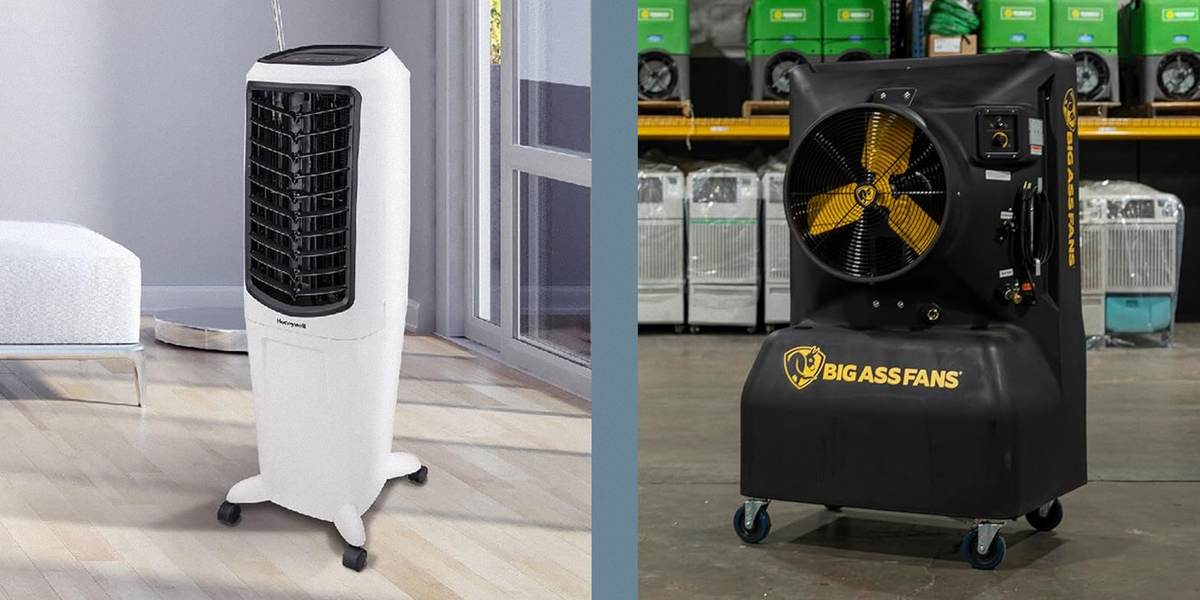
When summer turns your garage into a pizza oven and your patio chair starts feeling like a skillet, an evaporative cooler can be the low-energy hero your sweaty household deserves. Also called a swamp cooler, this appliance cools air by pulling hot, dry air through water-saturated media, then blowing the cooled air back into your space. It is not a traditional air conditioner, and it will not turn a humid Florida afternoon into a crisp mountain morning. But in the right climate, especially the dry Southwest, high-desert towns, workshops, garages, patios, and screened porches, the best evaporative coolers of 2025 can make hot air much more livable without the energy appetite of compressor-based AC.
This guide focuses on real-world buying factors: airflow, coverage area, water capacity, portability, noise, maintenance, durability, and value. Instead of pretending one cooler is perfect for every room, we selected seven models for different needs, from a powerful garage unit to a desk-friendly personal cooler. The goal is simple: help you buy the right swamp cooler the first time, not the one that becomes an expensive plant stand by July.
Quick Comparison: Best Swamp Coolers of 2025
| Rank | Model | Best For | Key Strength |
|---|---|---|---|
| 1 | Hessaire MC37M / MC37V | Best overall | Strong airflow, large coverage, garage-friendly design |
| 2 | VEVOR 2100 CFM Evaporative Air Cooler | Best value | High CFM for the price, remote, timer, big tank |
| 3 | Honeywell CO48PM | Best outdoor patio cooler | Weather-resistant design and strong air throw |
| 4 | NewAir / Frigidaire EC300W | Best indoor room cooler | Compact tower shape with practical coverage |
| 5 | Dreo Evaporative Cooler 712S | Best smart tower cooler | Quiet operation, oscillation, modern controls |
| 6 | Evapolar evaCHILL | Best personal desk cooler | USB-powered cooling for one person |
| 7 | Portacool Jetstream 220 | Best workshop/pro cooler | Rugged build and job-site airflow |
How Evaporative Coolers Work
An evaporative cooler uses one of nature’s oldest cooling tricks: evaporation. Water absorbs heat as it evaporates, so when a fan pulls warm air through damp cooling pads, the outgoing air feels cooler and slightly more humid. In dry climates, this process can be surprisingly effective. In humid climates, however, the air is already holding plenty of moisture, so evaporation slows down. That is why a swamp cooler can feel refreshing in Arizona, Nevada, Utah, New Mexico, Colorado, inland California, and parts of Texas, but disappointing in New Orleans, Miami, or coastal Georgia.
The most important rule is ventilation. A portable AC usually works best in a sealed room. A swamp cooler is the opposite. It needs fresh dry air coming in and humid air going out. Crack a window, open a garage door, or create cross-ventilation. Without airflow, the room can become muggy, and the cooler starts behaving less like a cooling machine and more like a very enthusiastic humidifier.
The 7 Best Evaporative Coolers of 2025
1. Hessaire MC37M / MC37V – Best Overall Evaporative Cooler
The Hessaire MC37M, also sold in similar retailer versions such as the MC37V, is one of the easiest swamp coolers to recommend for homeowners who need serious cooling without moving into commercial-equipment territory. It is commonly listed around 3,100 CFM with coverage up to about 950 square feet, making it a strong fit for garages, workshops, covered patios, barns, and large open rooms in dry climates.
What makes the Hessaire stand out is its balance. It has more muscle than small indoor tower coolers, but it remains portable enough to roll around. The large water tank helps reduce constant refilling, and many versions support a continuous water connection, which is a blessing when temperatures are high and your patience is lower than the humidity in Phoenix.
Best for: Garages, large patios, workshops, and open living spaces in dry climates.
Why we like it: Strong airflow, practical wheels, large water capacity, and excellent value for its size.
Watch out for: It is not a quiet bedroom appliance. It moves a lot of air, and you will hear it doing its job.
2. VEVOR 2100 CFM Evaporative Air Cooler – Best Value Swamp Cooler
The VEVOR 2100 CFM evaporative air cooler is a strong budget-minded pick for shoppers who want generous airflow, oscillation, a remote, a timer, and a larger tank without spending premium-brand money. Many listings describe it with a 7-gallon tank, three speed settings, wide oscillation, and coverage in the range of large rooms, garages, or covered outdoor areas.
The big appeal is price-to-performance. You get a lot of cooler for the money, especially if you need seasonal help in a garage gym, backyard hangout area, or hobby space. The included ice packs can help the outgoing air feel more refreshing at close range, although buyers should remember that ice does not turn a swamp cooler into a refrigerant-based AC. It is a boost, not a miracle.
Best for: Budget buyers, garages, patios, and multipurpose spaces.
Why we like it: Strong feature set, good airflow, remote control, and friendly pricing.
Watch out for: Build quality may not feel as heavy-duty as commercial or premium units.
3. Honeywell CO48PM – Best Outdoor Patio Evaporative Cooler
The Honeywell CO48PM is built for indoor/outdoor use and is a popular choice for patios, decks, workshops, and semi-open entertaining areas. Current Honeywell specifications list strong airflow, a large water tank, weather-resistant construction, and a design intended for wide air movement. It is the kind of cooler you roll out when the grill is hot, the guests are arriving, and the patio feels like it has been personally endorsed by the sun.
Honeywell’s advantage is brand familiarity and a long track record in portable air comfort products. The CO48PM has mechanical-style controls on many versions, which some users prefer because they are simple and garage-friendly. It also offers continuous water hookup on certain models, making it more practical for long outdoor sessions.
Best for: Patios, decks, covered outdoor spaces, and workshops.
Why we like it: Durable outdoor-minded design, large tank, and strong air throw.
Watch out for: Like all evaporative coolers, it needs dry air and ventilation to perform well.
4. NewAir / Frigidaire EC300W – Best Indoor Room Cooler
The NewAir / Frigidaire EC300W is a practical indoor evaporative cooler for people who want something slimmer and easier to live with than a big rolling garage unit. Manufacturer materials list it around 600 CFM with coverage around 350 square feet, which makes it a reasonable pick for bedrooms, home offices, dorm-style spaces, small living rooms, and apartments in dry regions.
This model makes sense when you need cooling assistance but do not want a machine that looks like it belongs next to a table saw. It usually includes multiple fan speeds, a detachable water tank, and a remote control, depending on the retailer version. It is also light enough for most adults to move from room to room without turning the task into an Olympic event.
Best for: Bedrooms, offices, and small-to-medium indoor spaces.
Why we like it: Slim design, manageable airflow, and room-friendly controls.
Watch out for: It is not powerful enough for a hot two-car garage or large open-plan area.
5. Dreo Evaporative Cooler 712S – Best Smart Tower Cooler
The Dreo Evaporative Cooler 712S is designed for modern indoor comfort. It looks more like a sleek tower fan than an old-school swamp cooler, and Dreo highlights features such as wide oscillation, quiet operation, multiple modes, removable tank design, and smart or remote control options depending on configuration. For bedrooms and offices, this matters. Not everyone wants their cooling appliance to sound like it is preparing for takeoff.
The Dreo is best understood as a comfort cooler rather than a whole-room desert blaster. It can improve airflow and deliver a cooler breeze nearby, especially with water and ice packs, but it is not meant to compete with a 3,000 CFM garage unit. Its strengths are convenience, quietness, looks, and daily usability.
Best for: Bedrooms, offices, renters, and anyone wanting a polished indoor design.
Why we like it: Quiet performance, slim footprint, oscillation, and modern controls.
Watch out for: Cooling is more personal and room-assistive than heavy-duty.
6. Evapolar evaCHILL – Best Personal Desk Evaporative Cooler
The Evapolar evaCHILL is not a room cooler, and that is exactly the point. This tiny USB-powered evaporative cooler is designed for one person sitting close to it. It is useful on a desk, nightstand, camping table, or workbench where you want a cooler breeze aimed directly at your face, keyboard, or existential dread during a heat wave.
Its low power draw and compact cube design make it easy to run from a USB adapter or power bank. The tank is small, the airflow is modest, and the coverage area is personal. But for the right use case, it is charmingly effective. Think of it as a cooled personal fan with a built-in water cartridge, not a replacement for AC.
Best for: Desks, bedside tables, tents, and personal cooling zones.
Why we like it: Very portable, USB-powered, low energy use, and easy to aim.
Watch out for: It will not cool a room. It cools the person sitting near it.
7. Portacool Jetstream 220 – Best Workshop and Professional Cooler
The Portacool Jetstream 220 is for people who need a tougher machine for a serious workspace. It is often listed around 2,400 CFM with coverage up to about 700 square feet, and Portacool’s broader lineup is well known in job sites, warehouses, shops, barns, and industrial environments. This is not the cutest cooler in the group. It is the one that shows up wearing work boots.
The Jetstream 220 costs more than many residential models, but it earns its place with rugged construction, strong airflow, large reservoir options, and a design built for demanding use. If you run a hot garage business, fabrication space, farm shop, or outdoor workstation, the durability may be worth the extra money.
Best for: Workshops, warehouses, job sites, barns, and commercial spaces.
Why we like it: Heavy-duty build, strong air movement, and professional reliability.
Watch out for: Higher price and larger footprint than typical home units.
How to Choose the Best Evaporative Cooler
1. Match CFM to the Space
CFM, or cubic feet per minute, measures how much air a cooler moves. A larger room, garage, or patio needs more CFM. A common rule of thumb is to multiply square footage by ceiling height, then divide by two. For example, a 500-square-foot garage with a 10-foot ceiling may need around 2,500 CFM for strong air exchange. Small indoor rooms can use less. Personal desk coolers use far less because they are not trying to cool the room.
2. Check Your Climate Before Buying
Evaporative coolers work best where the air is hot and dry. If your summer humidity is regularly high, a swamp cooler may make the air feel sticky instead of cool. In humid regions, a portable AC, window AC, or dehumidifier may be a better investment. In dry regions, though, a swamp cooler can be economical, refreshing, and surprisingly effective.
3. Look at Tank Size and Continuous Fill
A bigger tank means fewer refills. For patios, workshops, and garages, look for a tank of 7 gallons or more. For long sessions, a continuous water hookup is even better. For bedrooms and offices, a smaller removable tank is easier to clean and carry.
4. Do Not Ignore Noise
High-CFM coolers move lots of air, and moving air makes sound. That is fine in a garage, shop, or patio. In a bedroom, it can be annoying. For sleeping or office use, choose a tower-style model with lower noise ratings and multiple fan speeds.
5. Plan for Maintenance
Swamp coolers need cleaning. Water tanks can grow mineral buildup, algae, or odors if neglected. Cooling pads eventually need replacement. If your water is hard, maintenance becomes more important. Drain the unit before storage, clean the tank regularly, and replace pads according to use and water quality. A little maintenance keeps your cooler from smelling like a forgotten aquarium.
Evaporative Cooler vs Portable AC: Which Is Better?
A portable air conditioner uses refrigerant and a compressor to remove heat and humidity from indoor air. It works in many climates but uses more electricity and needs an exhaust hose. An evaporative cooler uses water, a fan, and cooling media. It uses less energy, does not require a window exhaust hose, and adds moisture to dry air. However, it depends heavily on low humidity and ventilation.
Choose an evaporative cooler if you live in a dry climate, want lower operating costs, and need airflow for a garage, patio, shop, or open room. Choose portable AC if your climate is humid, you need precise temperature control, or you want to cool a sealed bedroom on muggy nights.
Real-World Experiences With Swamp Coolers
The biggest lesson with evaporative coolers is that expectations matter. A swamp cooler is not a magic box that ignores climate science. It is a tool, and when used correctly, it can be fantastic. When used incorrectly, it can feel like someone put a fan behind a wet towel and charged you for the privilege.
In dry garages, the difference can be dramatic. A large unit like the Hessaire MC37M or Portacool Jetstream 220 can turn a brutal workspace into a place where you can actually finish a project without melting into the concrete. The airflow is the first thing you notice. It does not just cool; it moves stale hot air out of the way. That makes a big difference when you are lifting weights, sanding furniture, repairing bikes, or trying to assemble flat-pack shelving while questioning every life choice that led to page 17 of the instructions.
Patio use is another sweet spot. A cooler such as the Honeywell CO48PM works best when aimed across a seating area with plenty of open air behind it. The breeze feels cooler on skin, especially in shade. Add a covered patio, evening airflow, and a tank full of clean water, and the space becomes more inviting. The key is placement. Put the unit where it can pull in dry outside air, not where it recirculates warm humid exhaust from its own output.
Indoor use is more nuanced. Smaller models like the NewAir / Frigidaire EC300W or Dreo 712S are most satisfying when you think of them as comfort enhancers. They can make a bedroom, home office, or reading corner feel better, but they need a cracked window or door. In a sealed room, humidity builds. At first, the breeze feels pleasant. Later, the room may feel clammy. The fix is simple: create cross-ventilation and avoid running the cooler all day in a closed space.
Personal coolers like the Evapolar evaCHILL are best judged by distance. Sit close, and the cool airflow can be genuinely pleasant while working, gaming, crafting, or sleeping beside a nightstand. Move across the room, and the effect disappears. That is not failure; that is the product category. It is designed for your personal bubble, not your entire apartment.
Maintenance also shapes the experience. Fresh water matters. Clean tanks matter. Pads matter. If you use hard water and never clean the cooler, mineral deposits will reduce performance and may create odors. A quick rinse every week or two during heavy use can prevent most problems. Before storing the cooler, drain and dry it completely. Future-you will be grateful, and future-you already has enough problems.
The most common mistake is buying too small. A tiny tower cooler cannot cool a three-car garage. A personal cube cannot rescue a patio party. Match the machine to the space and climate, and evaporative cooling becomes one of the most cost-effective ways to beat dry heat in 2025.
Final Verdict
The best evaporative cooler for most people in 2025 is the Hessaire MC37M / MC37V because it offers the strongest mix of airflow, coverage, tank size, portability, and value. For budget buyers, the VEVOR 2100 CFM is hard to ignore. For outdoor entertaining, the Honeywell CO48PM is a reliable patio pick. For indoor comfort, the NewAir / Frigidaire EC300W and Dreo 712S are easier to live with. For personal cooling, the Evapolar evaCHILL wins by being small, efficient, and honest about its job. For demanding workshops, the Portacool Jetstream 220 brings professional toughness.
In the end, the best swamp cooler is not simply the biggest or the cheapest. It is the one that fits your climate, space, noise tolerance, maintenance habits, and refill patience. Buy for the room you actually have, not the fantasy desert warehouse in your head, and you will stay much cooler.